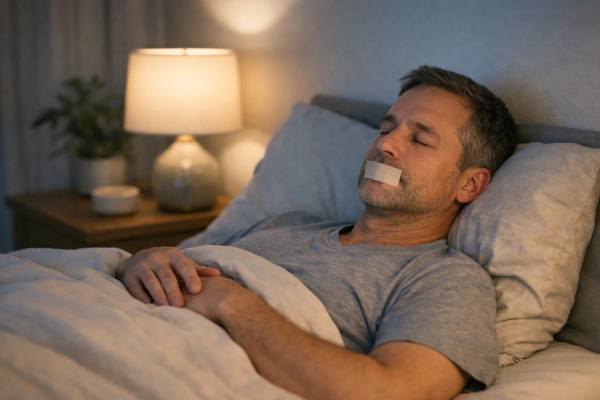
Mouth taping is a simple idea with big promises: place a small strip of tape over closed lips at night to encourage nasal breathing. Fans say it reduces snoring, prevents dry mouth, and improves sleep quality. Skeptics worry it is an internet trend that could mask serious issues like nasal obstruction or sleep apnea. The truth sits in the middle. Nasal breathing has real physiological advantages, and a few early studies suggest mouth-closure strategies can help some people—especially habitual mouth-breathers with mild, carefully selected sleep-disordered breathing. But the evidence is limited, outcomes are not consistent, and safety depends heavily on who is trying it and why. This guide breaks down what mouth taping can realistically do, who should avoid it, and how to address the underlying causes of mouth breathing so you can sleep better without taking unnecessary risks.
Key Insights
- Encouraging nasal breathing may reduce dry mouth and some snoring in certain habitual mouth-breathers.
- Benefits for overall sleep quality are possible but not well-proven, and results vary widely by anatomy and nasal airflow.
- Mouth taping can be risky if you have nasal obstruction, suspected sleep apnea, or breathing problems at night.
- If you try it, start with a brief daytime test and use a gentle, skin-safe approach you can remove instantly.
Table of Contents
- What mouth taping is and why people try it
- What the research says so far
- Potential benefits and realistic expectations
- Risks and who should not try it
- How to try mouth taping more safely
- Fix the root cause of mouth breathing
- Alternatives that often work better
What mouth taping is and why people try it
Mouth taping usually means placing a small piece of porous tape over closed lips before sleep to reduce mouth breathing. It is not meant to “seal” the mouth like packaging tape. The intended effect is gentle: create enough resistance that your default becomes breathing through your nose, while still allowing you to remove the tape easily if you need to speak, cough, or open your mouth.
Why nasal breathing is the goal
Nasal breathing is often preferable because the nose warms, humidifies, and filters air. It can also support a steadier breathing pattern during sleep. Mouth breathing, in contrast, can contribute to dryness, sore throat, and sometimes louder snoring. For some people, mouth breathing is not a habit—it is compensation. If your nose is blocked, your body will choose the mouth to keep airflow moving.
Common reasons people try mouth taping
People usually start mouth taping for one of these reasons:
- Waking with dry mouth, bad breath, or a sore throat
- Snoring that seems worse when sleeping on the back
- A sense of “light sleep” and frequent awakenings
- Difficulty tolerating nasal-only breathing with certain sleep devices
- Curiosity after seeing it promoted as a “sleep hack”
It is also marketed for claims that do not hold up well: higher oxygen levels in everyone, major anxiety reduction, dramatic facial changes, and “detox” effects. Those claims tend to oversimplify physiology. Breathing route can matter, but it does not override fundamentals like sleep duration, sleep-disordered breathing risk, alcohol use, nasal obstruction, and stress.
A helpful way to frame the decision
Mouth taping is best understood as a behavior nudge, not a treatment for unknown breathing problems. If you already breathe well through your nose and you are otherwise a healthy sleeper, it might reduce dryness or minor snoring. If you cannot breathe well through your nose, or you may have sleep apnea, it can backfire—because it interferes with the workaround your body is using to get air.
What the research says so far
The research on mouth taping is growing, but it is still thin compared with other sleep interventions. Most studies are small, use specific patient groups, and focus on snoring or sleep-disordered breathing measures rather than broad outcomes like daytime mood, memory, or long-term health.
What counts as evidence here
When evaluating mouth taping, there are two separate questions:
- Does mouth closure change airflow mechanics during sleep in a measurable way?
- Does that change reliably improve outcomes people care about, without introducing new risk?
Early studies suggest the answer to the first question is often yes: mouth closure can change airflow and airway behavior. The second question is more complicated because the same intervention can help one person and worsen another, depending on nasal patency and where obstruction occurs.
Where the data looks most promising
The most encouraging findings tend to be in carefully selected habitual mouth-breathers, often with mild sleep-disordered breathing. In these groups, mouth taping or mouth-closure methods have sometimes reduced snoring indices or improved apnea metrics. However, these studies typically exclude people with significant nasal blockage and often involve relatively young or healthier participants. That selection is important: it means the results may not apply to the average person trying mouth taping at home.
Why outcomes can be mixed
One reason mouth taping is not universally safe is that mouth breathing can function as a backup route. If the nasal pathway is limited—by congestion, deviated septum, or collapse higher in the airway—forcing mouth closure can reduce total airflow. In other words, mouth closure can be beneficial when it reduces collapsibility and stabilizes breathing, but harmful when it blocks a necessary bypass.
Bottom line on effectiveness
Right now, mouth taping is best described as a potentially useful adjunct for a narrow slice of people, not a broadly proven sleep improvement technique. If your goal is better sleep quality, it is wise to treat mouth taping as an experiment with clear stop rules, not as a substitute for evaluating snoring, insomnia, or daytime sleepiness.
Potential benefits and realistic expectations
If mouth taping helps, the benefit usually comes from changing breathing route and mouth posture, not from a mysterious “oxygen boost.” Keeping expectations realistic helps you decide whether it is worth trying—and prevents you from missing a more important diagnosis.
Benefits people most commonly notice
For appropriate candidates, possible upsides include:
- Less dry mouth: Closing the mouth reduces evaporation and can ease morning thirst and sore throat.
- Less noisy snoring: Some snoring is driven by open-mouth posture, jaw drop, and unstable airflow.
- Better tolerance of nasal breathing: Some people find it trains a calmer breathing pattern over time.
- Fewer awakenings from dryness: If dryness is waking you, reducing it can indirectly improve sleep continuity.
These benefits are most plausible when you already have decent nasal airflow and the main issue is habitual mouth opening during sleep.
What it is unlikely to do
Mouth taping is often oversold. It is unlikely to:
- fix moderate to severe sleep apnea
- replace evidence-based therapies for insomnia
- meaningfully change facial structure in adults
- improve athletic performance in a measurable way for most people
- compensate for short sleep, heavy alcohol use, or late-night bright light
If you snore loudly, gasp, wake with headaches, or feel sleepy during the day, you should think “screen for sleep-disordered breathing” rather than “optimize a hack.”
How to judge success without guessing
Instead of relying on vibe-based feedback, choose two or three signals to track for two weeks:
- morning dry mouth severity (0–10)
- snoring reports from a partner or a simple audio recording
- morning headache frequency
- daytime sleepiness (for example, dozing in meetings or while reading)
If you do not see improvement in those specific measures, it is a sign to move on to a root-cause strategy rather than continuing indefinitely.
A realistic timeline
If mouth taping works for you, you often notice changes quickly—within a few nights—because the mechanism is immediate. If you only notice benefit after weeks, the improvement may be coming from a different change you made at the same time (sleep schedule, alcohol reduction, allergy control). The most useful mindset is: short trial, clear data, and no attachment to the outcome.
Risks and who should not try it
The main safety concern with mouth taping is not the tape itself. It is the possibility of restricting a necessary airflow route during sleep—especially in people with nasal obstruction or sleep-disordered breathing. Even if severe events are rare, the consequence can be serious, so risk screening matters.
Do not try mouth taping if any of these apply
Avoid mouth taping unless a clinician has specifically advised it if you have:
- significant nasal congestion, frequent blocked-nose nights, or you cannot comfortably breathe through your nose while awake
- suspected or diagnosed obstructive sleep apnea that is not being treated
- waking gasping, choking, or with a racing heart
- moderate to severe asthma symptoms at night or other chronic breathing disorders
- frequent acid reflux at night, nausea, or vomiting risk
- heavy alcohol use close to bedtime or sedative medication that increases airway collapse
- panic symptoms, claustrophobia, or a history of trauma reactions related to breathing restriction
Children are a special case: mouth breathing can be linked to airway anatomy, enlarged tonsils, allergies, and dental development. For a child, this should be evaluated clinically rather than managed with a home trend.
Other downsides that are common but less dangerous
Even in low-risk adults, mouth taping can cause:
- skin irritation, rash, or lip inflammation
- anxiety about not being able to open the mouth
- worse sleep due to discomfort or repeated awakenings
- increased mouth pressure that feels unpleasant for some people
- worsening snoring if it changes jaw position in a way that narrows the airway
Red flags that should stop the experiment
Stop immediately if you experience:
- a sense of air hunger or difficulty breathing
- increased nighttime awakenings or new panic symptoms
- worse morning headaches, pronounced dry mouth, or dizziness
- a partner noticing louder snoring, gasping, or pauses
- any new symptom that suggests reduced airflow
The safest approach is to treat mouth taping as optional and replaceable. If your sleep depends on it, or you feel afraid to sleep without it, that is a sign the underlying issue needs a more robust solution.
How to try mouth taping more safely
If you are a reasonable candidate—meaning you breathe well through your nose, you have no signs of sleep-disordered breathing, and you want to experiment for dryness or minor snoring—there is a safer way to do it. Safer does not mean risk-free, but it reduces the most predictable problems.
Start with a quick “nose check”
Before you even consider tape, do this while awake:
- Close your mouth and breathe through your nose for 2 minutes at rest.
- Then try 1 minute of slightly faster breathing, like a gentle walk in place.
If you feel strained, blocked, or panicky, do not tape. Improve nasal airflow first.
Use a graded approach, not an overnight leap
A practical progression:
- Daytime test (30–60 minutes): Place a small strip over the center of closed lips while sitting at home. Confirm you can remove it instantly and you feel calm.
- First night trial: Use the smallest amount of tape that discourages mouth opening rather than fully sealing.
- Short trial window: Evaluate after 3–7 nights. If there is no clear benefit, stop.
This approach protects against the common mistake: turning a discomforting experiment into a nightly struggle.
Choose materials thoughtfully
Use only skin-safe, medical-grade tape designed for sensitive skin, and never use strong household adhesives. Consider a patch test on your skin first. Also think about the removal plan: you should be able to open your mouth quickly without pain.
Reduce the need for tape
Mouth taping works best when the environment supports nasal breathing:
- keep bedroom air comfortably humid if you wake dry
- manage nighttime allergies and congestion
- avoid alcohol close to bedtime
- side-sleep if back-sleeping worsens snoring
Set clear stop rules
Commit in advance: if you feel short of breath, wake with headaches, or notice worsening snoring, you stop and reassess. The goal is improved sleep and safety, not forcing yourself to adapt.
Fix the root cause of mouth breathing
Mouth breathing at night is often a symptom, not the core problem. If you only tape the symptom, you may miss the chance to correct what is driving it. Root-cause work is usually safer and more durable than adhesive-based solutions.
Common drivers of mouth breathing
Start by identifying what pushes you to open your mouth during sleep:
- Nasal congestion: allergies, chronic rhinitis, colds, dry air, or irritants
- Structural issues: deviated septum, narrow nasal passages, nasal valve collapse
- Position and jaw drop: back sleeping, low muscle tone, or alcohol-related relaxation
- Reflux and throat irritation: swelling and discomfort can disrupt nasal breathing
- Sleep-disordered breathing: airway collapsibility can make breathing feel easier through the mouth
A useful clue is variability. If you mouth-breathe only on “stuffy” nights, the driver is likely nasal. If you mouth-breathe regardless of congestion and have loud snoring or daytime sleepiness, screen for sleep-disordered breathing.
Build nasal breathing capacity during the day
If nasal breathing feels weak, train it when you are awake and in control:
- practice gentle nasal breathing during a walk
- use slow, steady breathing when stress rises
- build fitness gradually so nasal breathing becomes easier at higher ventilation
This is not about forcing discomfort. It is about making nasal breathing your default under low to moderate demand so it is available at night.
Address anatomy and medical contributors early
If you have persistent blockage, frequent sinus symptoms, or you cannot comfortably breathe through your nose at rest, a clinical evaluation can be high-yield. The goal is to restore airflow, not to “push through” obstruction.
Do not let mouth taping delay sleep apnea evaluation
If you have loud snoring, witnessed breathing pauses, morning headaches, high blood pressure, or you feel sleepy during the day, treat that as a medical signal. Mouth taping may reduce noise for some people, but it can also mask symptoms and delay diagnosis. The safest path is to evaluate the underlying breathing pattern and treat it with evidence-based options.
Alternatives that often work better
If your goal is better sleep, mouth taping is rarely the most reliable first-line option. Many alternatives are safer, more comfortable, and better supported—especially when snoring or sleep apnea risk is on the table.
For dry mouth and throat irritation
Consider strategies that reduce dryness without restricting airflow:
- adjust bedroom humidity and temperature
- address nasal congestion so you can breathe through the nose comfortably
- review medications that worsen dryness
- evaluate reflux if you wake with throat burning or frequent coughing
Dry mouth can also be a clue to mouth breathing from obstruction, so treating nasal airflow often helps more than taping.
For snoring
Snoring has multiple causes, so match the fix to the pattern:
- Positional therapy: side sleeping often reduces snoring that is worse on the back.
- Nasal support: saline rinses, allergy management, or gentle nasal dilation can help when congestion is the driver.
- Weight and alcohol timing: even modest changes can reduce airway collapsibility for some people.
- Dental and jaw options: oral appliances can help selected snorers, especially when guided by trained clinicians.
If snoring is loud and regular, the best “alternative” may be a proper evaluation to rule out sleep apnea.
For suspected sleep apnea
If you have symptoms suggestive of sleep apnea, prioritize assessment and proven treatments. Sleep apnea is not just noisy breathing; it is a condition linked to fragmented sleep and health risks. Treatments are individualized and can include device-based therapies, positional strategies, and targeted medical management of airway contributors.
For insomnia or poor sleep quality
If your main complaint is difficulty falling asleep, staying asleep, or waking unrefreshed, mouth taping is unlikely to be the core answer. Focus instead on:
- consistent wake time and sleep schedule
- morning light exposure and evening light reduction
- reducing late caffeine and alcohol
- structured behavioral approaches for insomnia when sleep is chronically disrupted
The most effective sleep improvements typically come from aligning breathing, schedule, environment, and stress physiology—not from a single hack.
References
- The Impact of Mouth-Taping in Mouth-Breathers with Mild Obstructive Sleep Apnea: A Preliminary Study – PMC 2022
- Mouth Closure and Airflow in Patients With Obstructive Sleep Apnea: A Nonrandomized Clinical Trial – PMC 2024
- Breaking social media fads and uncovering the safety and efficacy of mouth taping in patients with mouth breathing, sleep disordered breathing, or obstructive sleep apnea: A systematic review – PMC 2025 (Systematic Review)
- Nocturnal mouth-taping and social media: A scoping review of the evidence – PubMed 2025 (Scoping Review)
- Obstructive Sleep Apnea: Assessment and Management in Adults – Province of British Columbia 2023 (Guideline)
Disclaimer
This article is for general educational purposes and does not provide medical advice, diagnosis, or treatment. Mouth taping can affect nighttime breathing and may be unsafe for people with nasal obstruction, asthma or other breathing disorders, reflux with vomiting risk, panic or claustrophobia, or suspected or diagnosed obstructive sleep apnea. If you have loud snoring, witnessed pauses in breathing, waking gasping, morning headaches, high daytime sleepiness, chest pain, new or worsening shortness of breath, or thoughts of self-harm, seek urgent medical care or emergency services right away. Always consult a qualified clinician before trying mouth taping if you have any medical conditions, take sedating medications, or are unsure whether it is safe for you.
If you found this helpful, please consider sharing it on Facebook, X (formerly Twitter), or any platform you prefer.