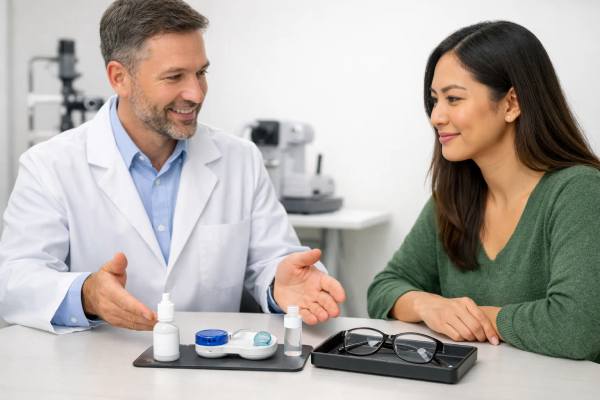
Myopia control is not about “curing” nearsightedness—it is about slowing how quickly myopia increases as a child grows. That matters because higher myopia is strongly linked to a longer eye (axial elongation), and longer eyes carry a higher lifetime risk of retinal detachment, myopic macular changes, and glaucoma. The encouraging news is that several treatments can measurably slow progression when started early and used consistently. The best option is not the same for every child: age, rate of change, lifestyle, dryness, and comfort with eye drops or contact lenses all influence what will work in real life. This guide explains the treatments with the strongest evidence—low-dose atropine, orthokeratology, and specialized contact and spectacle lenses—plus practical ways to combine them with outdoor time and smart near-work habits.
Essential Insights
- Effective myopia control focuses on reducing yearly change in both prescription and axial length, not achieving perfect “20/20” without glasses.
- Low-dose atropine, orthokeratology, and modern defocus-based lenses can slow progression meaningfully, but results vary by age and baseline growth rate.
- The safest plan is the one a child can follow every day—comfort, hygiene, and follow-up visits matter as much as the device or drop.
- A reasonable treatment check-in window is about 6 months, with adjustments if progression remains fast.
- Outdoor time and near-work breaks strengthen results and are worth treating as part of the prescription.
Table of Contents
- What myopia control is and why it matters
- Atropine drops and how they help
- Orthokeratology overnight lenses explained
- Special contact lenses for myopia control
- Special spectacle lenses that slow progression
- Lifestyle moves that make treatments work better
- How to choose and monitor a plan
What myopia control is and why it matters
Myopia control is a long-term strategy to slow progression during the years when a child’s eyes are still growing. The key concept is that myopia is not only a “glasses problem.” In most children, increasing myopia tracks with the eye becoming longer from front to back. That elongation matters because the retina and supporting layers are stretched over a larger surface area, which increases vulnerability later in life.
What outcomes matter most
Clinicians track myopia control using two main measurements:
- Refraction (prescription in diopters): how much minus power is needed for clear distance vision.
- Axial length (millimeters): the physical length of the eye, often the most direct marker of risk.
A child can have a smaller prescription change yet still show concerning axial growth, so the best monitoring looks at both when possible.
Who benefits most from starting early
Myopia tends to progress fastest in younger children, often between early primary school years and early teens. A common high-risk pattern includes:
- onset at a younger age
- faster year-to-year change (for example, around half a diopter or more per year)
- one or both parents with moderate-to-high myopia
- heavy near work with limited outdoor time
Starting earlier matters because slowing growth sooner can reduce the final “peak” myopia a child reaches.
What “success” should look like
Myopia control success is rarely a single number that fits everyone. A practical definition is:
- progression slows compared with the child’s prior trend
- axial length growth is reduced relative to age expectations
- vision stays clear and comfortable with the chosen correction
- the child can follow the plan daily without battles
In real life, a meaningful result might be cutting progression by roughly a third to a half, especially in a child who was changing quickly.
What myopia control does not do
It does not permanently “lock” the eyes at one prescription, and it does not replace regular exams. It also does not remove the need for safe visual habits. Think of myopia control like steering a moving train: you are reducing speed and risk over time, not stopping motion instantly.
Atropine drops and how they help
Low-dose atropine eye drops are one of the most studied pharmacologic approaches to myopia control. Atropine is used in much higher concentrations for other eye purposes, but myopia control typically uses very low concentrations designed to slow progression while keeping side effects manageable.
How atropine works in simple terms
The exact mechanism is still being clarified, but atropine appears to influence signaling pathways involved in eye growth. Importantly, the goal is not to “relax focusing” alone. Modern evidence suggests atropine’s benefits go beyond accommodation and likely involve retina-to-sclera growth signaling.
What dosing looks like in practice
Many programs use nightly drops, often with concentrations commonly discussed around:
- 0.01% (milder effect, fewer side effects for many children)
- 0.025% to 0.05% (often stronger control, with a higher chance of light sensitivity or near blur)
Dose is not a trophy. The best dose is the one that achieves acceptable control with tolerable side effects and good adherence.
Side effects and how families manage them
Low-dose atropine can still cause:
- larger pupils (more light sensitivity)
- mild near focusing difficulty in some children
- occasional headaches or eye irritation
Practical ways to reduce friction include:
- using the drop at bedtime to sleep through early effects
- consistent sunglasses outdoors if light sensitivity appears
- discussing reading support if near blur occurs (sometimes a small reading add or adjusting screen habits helps)
If side effects are significant, the plan often shifts concentration rather than abandoning treatment entirely.
Rebound and stopping strategy
One of the most important counseling points is that stopping atropine can sometimes be followed by a period of faster progression, often called “rebound.” This risk tends to be higher with stronger doses and when stopping abruptly at younger ages. Many clinicians prefer:
- treatment through the years of fastest growth
- a planned taper or step-down approach
- continued monitoring even after stopping
Families should treat atropine as a multi-year tool, not a short “course.”
Who is a good candidate
Atropine is often a strong fit when:
- the child is too young for contact lenses
- hygiene or sports make lenses impractical
- progression is fast and needs a scalable solution
- the family wants a non-lens option to combine with lifestyle changes
Atropine can also be paired with optical treatments when progression remains high, but combination therapy should be guided carefully.
Orthokeratology overnight lenses explained
Orthokeratology (Ortho-K) uses specially designed rigid contact lenses worn overnight to reshape the cornea temporarily. In the morning, the lenses are removed, and the child can often see clearly during the day without glasses. For myopia control, Ortho-K is used not only for daytime freedom, but because its optical effect can reduce eye growth signals linked to progression.
What Ortho-K does and does not do
Ortho-K primarily changes the front surface of the eye (the cornea). It does not permanently alter the eye’s internal length. The vision correction is temporary and depends on consistent overnight wear. For myopia control, the benefit is typically measured by reduced axial length growth over time.
Why it can slow progression
Ortho-K changes how light focuses across the retina, especially in the peripheral retina. Many myopia control approaches aim to reduce patterns of peripheral defocus that may encourage axial elongation. Ortho-K creates an optical profile that is believed to reduce that growth drive in many children.
Safety is mostly about behavior
Ortho-K can be safe and effective, but it demands disciplined hygiene because lenses are worn while sleeping. Key safety rules include:
- wash and dry hands before handling lenses
- follow cleaning and storage instructions exactly
- never top off old solution; use fresh disinfecting solution
- avoid water exposure (no rinsing lenses in tap water; caution with swimming and showering)
- stop wear and seek care quickly if there is pain, light sensitivity, or reduced vision
The highest-risk pattern is continuing lens wear through irritation. Families should have a clear “stop and call” plan.
Who tends to do well with Ortho-K
Ortho-K can be a great fit when:
- the child is motivated and responsible (or parents can supervise reliably)
- daytime glasses are a problem for sports or self-confidence
- there is moderate myopia and manageable astigmatism
- dryness is mild or well controlled
Children with significant dry eye symptoms, frequent allergies with heavy rubbing, or poor tolerance for routines may struggle. In those cases, daytime lenses or atropine may be easier.
Follow-up is part of the treatment
Ortho-K is not “fit once and forget.” Visits are needed to ensure:
- corneal health and lens fit
- stable vision and safe corneal shape changes
- no early signs of inflammation or infection risk
- myopia control is actually happening (ideally using axial length tracking)
Ortho-K works best when safety and monitoring are treated as non-negotiable parts of the deal.
Special contact lenses for myopia control
Not all contact lenses are equal for myopia control. Standard single-vision soft contacts correct vision, but they do not consistently slow progression. Myopia-control contact lenses are designed to create a specific optical pattern—clear central vision with peripheral or simultaneous defocus—to reduce growth signals linked to elongation.
Common designs you may hear about
Two broad categories are often used:
- Dual-focus or concentric ring designs: a central distance zone with surrounding zones that add myopic defocus.
- Multifocal center-distance lenses (higher add): similar to presbyopia designs but prescribed strategically to influence peripheral focus.
While the engineering differs, the practical goal is similar: keep distance vision functional while altering the retinal image profile in a way that slows progression.
What results look like in real life
Across studies and clinical experience, many children see a meaningful slowdown, often in the range of moderate reduction rather than a full stop. Some children respond strongly, while others show only modest change. Reasons include:
- baseline growth rate (fast progressors may still progress, just less)
- lens fit and centration
- wearing time (part-time wear usually underperforms full-time wear)
- unaddressed lifestyle drivers like minimal outdoor time
A useful way to frame it for families: these lenses can change the slope of progression, but they still require good habits and consistent wear.
Comfort and dryness considerations
Soft lenses can be more comfortable than Ortho-K for some children, but dryness and allergies can interfere. Practical tips that reduce dropout include:
- choosing a daily disposable option when available and appropriate
- avoiding eye rubbing and managing allergies proactively
- emphasizing clean technique even with dailies (hands still matter)
- using preservative-free lubricating drops if needed (with guidance)
If a child complains of burning late in the day, the answer is often not “push through.” It may require lens material changes, reduced screen dryness, or a different modality.
Safety basics for kids and teens
Myopia-control soft lenses can be safe when worn responsibly. The biggest safety levers are:
- no sleeping in lenses unless specifically prescribed
- no water exposure (swimming and showering are common risk points)
- replacing lenses exactly on schedule
- stopping wear promptly for redness, pain, or light sensitivity
A child does not need to be “perfect,” but they do need a routine that is repeatable.
When contact lenses may not be the best first step
If a child is very young, has significant anxiety about insertion, or has a history of poor hygiene habits, atropine or spectacle-based myopia control may be a better starting point. You can always step up later when readiness improves.
Special spectacle lenses that slow progression
For families who prefer to avoid contact lenses or drops, specialized spectacle lenses have become a major advancement. These designs aim to slow progression using lenslets or segments that create controlled defocus patterns while preserving clear central vision. They are different from older strategies like undercorrection or standard progressive addition lenses, which generally show limited benefit for most children.
How modern myopia-control spectacles differ
Traditional single-vision glasses correct distance vision but do not consistently slow eye growth. Modern myopia-control spectacles add optical elements—often small lenslets or defocus segments—across the lens surface. The child looks through the clear central zone for sharp vision, while the surrounding elements influence peripheral retinal focus.
The appeal is straightforward: glasses are familiar, non-invasive, and can be easier to implement in younger children.
Expected benefits and who tends to respond
Many children experience a meaningful reduction in progression, but response varies. Strong responders often have:
- consistent full-time wear
- a lens design well matched to pupil size and visual behavior
- good baseline compliance (glasses on in school and at home)
Children who “half wear” (only for distance, only in class) tend to get less benefit. For myopia control spectacle designs, wearing time is part of the medicine.
Adaptation and visual comfort
Most children adapt well, but some notice:
- mild peripheral blur or visual “awareness” of the lenslets initially
- slightly different contrast perception in certain lighting
- sensitivity during sports if lenses fog or shift
Practical solutions include:
- ensuring accurate fitting and frame alignment
- selecting frames that sit stably and comfortably
- giving a real adaptation period (often a few days to a couple of weeks)
- keeping lenses clean, because smudges can magnify visual artifacts
If a child is complaining constantly after the first couple of weeks, the fit and prescription should be rechecked rather than assuming “they will get used to it.”
What to avoid and why
Some older ideas persist online. It is worth being clear:
- Undercorrection is not a reliable myopia control method and can worsen function and increase eye strain.
- Blue light blocking glasses may improve comfort for some screens, but they are not a myopia control strategy.
- Standard progressives may help a small subset, but they are usually not the first-choice tool when stronger options exist.
Special spectacle lenses are particularly valuable when contact lenses are not realistic, when a child has frequent allergies, or when parents want a lower-maintenance plan that can still provide meaningful slowing.
Lifestyle moves that make treatments work better
Lifestyle changes are not “soft advice.” They are a measurable part of myopia prevention and can support treatment effectiveness. Even when a child uses atropine, Ortho-K, or special lenses, daily habits still influence the growth signals that drive progression.
Outdoor time is the highest-yield habit
More time outdoors is consistently linked with lower risk of developing myopia and can help slow progression in some children. The mechanism is likely multifactorial: brighter light levels, different focusing distances, and healthier visual breaks from near work. A practical target many clinicians discuss is around 1.5 to 2 hours outdoors daily when feasible. This does not need to be a single block; it can be split across the day.
What “counts”:
- walking to school, outdoor recess, sports practice
- park time after school
- weekend outdoor family routines
If weather or safety limits outdoor time, even bright daylight near windows can help with rhythm and breaks, though it is not identical to true outdoor exposure.
Near work is not the enemy, but it needs structure
Reading and screens do not automatically cause myopia, but long, uninterrupted near work can amplify progression risk—especially in children already prone to myopia. A workable structure includes:
- Breaks: a short distance-vision break every 20 to 30 minutes
- Distance: keep reading material at a comfortable distance (not pressed close)
- Posture and lighting: good lighting reduces strain and encourages healthier working distance
- Screen dryness awareness: remind children to blink and use breaks to rest eyes
The goal is not to ban learning or devices. It is to reduce continuous near “load.”
Sleep and overall health influence eye growth behaviors
Myopia progression does not exist in isolation. Poor sleep, chronic stress, and minimal physical activity can worsen habits like late-night screen use and indoor-only routines. A simple family plan often works best:
- consistent bedtime for school nights
- devices off before bed
- outdoor time built into weekends as a default
Why lifestyle still matters when using medical treatments
Treatments reduce growth signals, but they do not eliminate them. Lifestyle changes can:
- reduce the baseline drive toward elongation
- improve comfort and reduce dropout from lenses or drops
- support long-term adherence because routines feel healthier overall
If a child is progressing quickly despite treatment, lifestyle is one of the first areas worth strengthening because it improves outcomes without increasing side effects.
How to choose and monitor a plan
Choosing a myopia control plan is a balancing act between efficacy, safety, lifestyle, and what a child can realistically follow. The best plan is individualized and measurable, with clear checkpoints.
A practical way to choose a starting option
Many clinicians begin with three questions:
- How fast is progression? A child changing quickly often needs a stronger or earlier intervention.
- How ready is the child for contact lenses? Maturity and hygiene are as important as prescription.
- What is the family’s capacity for routines and follow-up? The best tool fails if it cannot be maintained.
A reasonable starting framework often looks like:
- younger child or lens-unready: atropine and/or myopia-control spectacles
- sport-focused or glasses-averse: Ortho-K or myopia-control soft lenses
- high progression or strong family history: consider more intensive options and closer monitoring
Monitoring: what happens at follow-up
A myopia control visit typically assesses:
- updated refraction (often with cycloplegia when appropriate)
- visual acuity and comfort
- corneal and ocular surface health (especially with contact lenses)
- axial length trends when available
- adherence and barriers (missed drops, part-time wear, discomfort)
A practical review interval is often every 6 months in active progression years. Faster progressors may need closer follow-up.
When to adjust treatment
Adjustments are considered when:
- progression remains high over two consecutive checks
- axial length growth stays steep compared with expectations
- side effects reduce adherence
- the child’s lifestyle changes (new sports, heavier school load, increased screen time)
“Adjust” may mean:
- changing atropine concentration
- switching from single-vision correction to a myopia-control design
- improving wearing time or fit of a lens
- adding a second modality in select cases
Combination therapy can be useful for some children, but it should be approached thoughtfully to avoid piling complexity onto a family already struggling with adherence.
Setting expectations with a timeline
Myopia control is best framed as a multi-year plan. Families often do well with a simple cadence:
- choose a modality that fits the child
- give it a fair trial with consistent use
- evaluate at 6 months with objective measures
- refine and continue through the high-growth years
- plan a cautious step-down later, with continued monitoring
Safety checklist families can keep at home
- Any eye pain, light sensitivity, or sudden blur: stop contact lens wear and seek prompt care.
- Missed drops happen, but frequent misses lower benefit—attach drops to a nightly routine.
- No water exposure with lenses, and no sleeping in lenses unless specifically prescribed.
- Treat outdoor time and near-work breaks like part of the prescription, not optional extras.
A myopia control plan works when it is both evidence-based and livable. The right choice is the one you can sustain through the years when it matters most.
References
- Optical interventions for myopia control 2023 (Review)
- Safety and Efficacy of Atropine 0.05% Versus 0.01% for Prevention of Myopic Progression in Indian Children: A Randomized Clinical Trial 2025 (RCT)
- Orthokeratology in controlling myopia of children: a meta-analysis of randomized controlled trials 2023 (Meta-analysis)
- Editorial: International Myopia Institute White Paper Series 2023 2023 (Position Series)
- WSPOS 2023 Myopia Consensus Statement 2023 (Consensus Statement)
Disclaimer
This article is for educational purposes only and does not provide medical advice, diagnosis, or treatment. Myopia control decisions depend on a child’s age, rate of progression, eye health, lifestyle, and ability to use drops or contact lenses safely. Contact lenses—especially overnight orthokeratology—require strict hygiene and prompt evaluation for symptoms such as pain, light sensitivity, redness, discharge, or sudden blurred vision. If you are considering myopia control treatments or your child’s myopia is progressing quickly, consult a qualified eye-care professional for an individualized plan and appropriate follow-up.
If you found this article helpful, please consider sharing it on Facebook, X (formerly Twitter), or any platform you prefer.