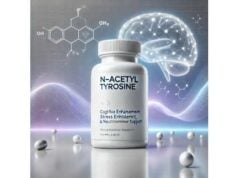
N-acetyltyrosine, often shortened to NALT, is a modified form of the amino acid L-tyrosine that you will see in pre-workout formulas, nootropic blends, and some medical nutrition products. It is promoted for sharper focus under stress, better mood, and more “clean” mental energy, largely because tyrosine is a building block for dopamine, norepinephrine, epinephrine, and thyroid hormones.
In clinical research, however, most of the data involve plain L-tyrosine rather than the N-acetyl form. N-acetyltyrosine is more soluble and easier to keep stable in liquids, and it clearly works as a source of tyrosine when given intravenously, but oral conversion in humans is less well studied and may be less efficient than marketing suggests.
This guide walks through what N-acetyltyrosine actually does, where the evidence is strongest, how people typically use it, reasonable dosage ranges, and the side effects and interactions you need to consider before adding it to your routine.
Key Insights on N-acetyltyrosine
- May support mental performance in stressful conditions by supplying tyrosine for catecholamine production.
- Offers higher solubility than L-tyrosine and is widely used in liquid formulas and medical nutrition.
- Human evidence focuses on L-tyrosine; oral N-acetyltyrosine data are limited and its conversion may be less efficient than commonly assumed.
- Typical supplemental intake is about 150–500 mg N-acetyltyrosine per day, often taken 30–60 minutes before demanding tasks.
- People with thyroid disease, melanoma history, bipolar disorder, serious heart disease, or using MAOIs, levodopa, or high-dose thyroid hormone should avoid unsupervised use.
Table of Contents
- What is N-acetyltyrosine?
- Does N-acetyltyrosine really improve focus and mood?
- How to use N-acetyltyrosine for performance and stress
- Recommended N-acetyltyrosine dosage and timing
- Side effects, interactions, and who should avoid N-acetyltyrosine
- How N-acetyltyrosine compares with L-tyrosine and other forms
What is N-acetyltyrosine?
N-acetyltyrosine (usually N-acetyl-L-tyrosine, or NALT) is L-tyrosine with an acetyl group attached to the amino end of the molecule. This small chemical change makes the powder more water-soluble and more stable in solution, which is why NALT appears both in sports supplements and in medical nutrition for intravenous or tube feeding.
Inside the body, N-acetyltyrosine acts mainly as a prodrug of L-tyrosine. Enzymes can remove the acetyl group, releasing free tyrosine. That tyrosine can then be used to build proteins or converted into key molecules, including:
- Dopamine, norepinephrine, and epinephrine (catecholamine neurotransmitters involved in motivation, focus, and stress response).
- Thyroid hormones (thyroxine and triiodothyronine), which regulate metabolic rate and energy use.
- Melanin, the pigment that influences skin and hair color.
Older animal work showed that when N-acetyltyrosine is infused intravenously during total parenteral nutrition, it is efficiently converted to tyrosine, incorporated into tissue protein, and lost only modestly in the urine, confirming that it can serve as a usable tyrosine source in that setting.
The key uncertainty is oral bioavailability. Tyrosine itself is already well absorbed from the gut, but has limited solubility at high concentrations. N-acetyltyrosine solves some of the solubility problem for liquids and ready-to-drink products, yet research comparing different tyrosine prodrugs has suggested that N-acetyltyrosine is not the most efficient at raising brain or plasma tyrosine levels after oral dosing. A meaningful fraction may be excreted before full conversion, meaning you might need more NALT to get the same functional amount of tyrosine as from plain L-tyrosine.
In practice, this has led to a split: medical nutrition products still use N-acetyltyrosine for its solubility, while many modern sports and nootropic formulas have shifted back toward higher doses of straight L-tyrosine when the goal is acute cognitive or performance support.
Does N-acetyltyrosine really improve focus and mood?
Most of what is known about mental benefits comes from L-tyrosine, not specifically from N-acetyltyrosine. The assumption is that if NALT reliably converts to tyrosine, its effects would be similar, but that link has not been thoroughly tested in humans with oral supplements.
A large body of research shows that tyrosine can support cognitive performance under acute stress or high cognitive load, rather than making healthy people “smarter” in relaxed conditions. Evidence in healthy adults suggests that tyrosine is most helpful when:
- You are exposed to demanding stressors such as cold, sleep deprivation, loud noise, extended wakefulness, or military-style training.
- Tasks require working memory, mental flexibility, or sustained vigilance.
In these situations, tyrosine appears to buffer drops in performance that are thought to arise when catecholamine neurotransmitters are temporarily depleted. Reviews of randomized trials describe consistent improvements in certain cognitive tasks in short-term stressful situations, but limited effects on physical performance and little support for use in clinical psychiatric conditions.
More recent work has tested tyrosine in real-world style stressors. For example, a trial in law-enforcement trainees used L-tyrosine or placebo before a virtual reality active-shooter drill and cognitive challenge. Tyrosine did not reduce physiological stress markers, but it modestly reduced missed responses on a demanding attention task, suggesting selective support for cognition rather than stress hormones themselves.
When it comes to mood, the evidence is mixed. Early small studies explored tyrosine as an antidepressant, with some benefit in individuals with low catecholamine function, but several trials failed to show clear advantages over placebo. Current clinical guidance does not recommend tyrosine or N-acetyltyrosine as stand-alone treatment for depression or anxiety.
For N-acetyltyrosine specifically, high-quality trials using oral NALT in healthy humans for focus or mood are scarce. Most marketed claims are extrapolated from L-tyrosine data plus NALT’s known ability to supply tyrosine in specialized nutrition. Because oral conversion may be less efficient, real-world cognitive effects of NALT might be weaker than those of an equal milligram dose of L-tyrosine, though head-to-head human comparisons are limited.
In practical terms, if people notice benefits from N-acetyltyrosine, they usually describe them as:
- Feeling more mentally “switched on” during demanding work or exams.
- Slightly clearer thinking when tired or stressed.
But these effects are not universal, and they depend heavily on context, dose, and individual brain chemistry.
How to use N-acetyltyrosine for performance and stress
Because N-acetyltyrosine is really a delivery vehicle for tyrosine, the way you use it should mirror how tyrosine has been studied: short-term, targeted dosing around stressful or cognitively demanding events, rather than as an all-day stimulant.
A sensible approach for healthy adults, working with a healthcare professional, is:
- Identify your use case.
- Exam days, intense study, public speaking, high-pressure presentations.
- Shift work, late-night driving, or short-term sleep restriction.
- Occasional athletic events, especially in heat or under heavy cognitive load.
- Choose timing around the stressor.
- Most tyrosine studies give the dose about 30–60 minutes before the task or stress exposure, which allows time for absorption and conversion.
- For long windows (for example, a long exam), some protocols split the dose into two smaller amounts a few hours apart, but this has not been rigorously tested with NALT.
- Consider stacking carefully.
N-acetyltyrosine often appears alongside:
- Caffeine, for alertness.
- L-theanine, to smooth caffeine’s jittery side.
- B vitamins, involved in neurotransmitter metabolism. Some people use a combination such as a moderate caffeine dose plus a modest amount of NALT and L-theanine. However, stacking multiple stimulatory agents can increase heart rate, blood pressure, and anxiety, especially in sensitive individuals. If you already use caffeine habitually, adding tyrosine analogues may have more subtle effects, and starting with a low NALT dose on a low-stakes day is prudent.
- Do not use N-acetyltyrosine as a substitute for sleep.
Trials in sleep-deprived military or shift-work settings show that tyrosine may blunt performance decline for a few hours, but it does not correct the underlying sleep debt. It should not be used to “push through” chronic sleep loss, especially if you operate vehicles, heavy machinery, or work in safety-critical roles. - Align with overall nutrition.
If your diet already provides adequate protein (for most adults, roughly 1.0–1.6 g of protein per kg body weight per day), your baseline tyrosine intake from food is likely sufficient for normal function. Supplements, including NALT, are mainly about temporarily boosting tyrosine availability during unusual stress, not about correcting a dietary deficiency in otherwise well-nourished people.
In athletic contexts, systematic reviews on tyrosine and endurance performance in physically active people generally find that overall effects on performance are small and inconsistent. Some protocols in hot environments show benefits, but there is no robust general improvement in time-to-exhaustion or time-trial performance. For most recreational athletes, N-acetyltyrosine is better viewed as an optional cognitive aid on especially demanding days rather than a reliable performance enhancer.
Recommended N-acetyltyrosine dosage and timing
There are no official dietary reference values or long-term safety limits specifically for N-acetyltyrosine. Dosage advice is therefore based on:
- Doses used in human trials of L-tyrosine.
- Preclinical work and clinical use of N-acetyltyrosine as a parenteral nutrition ingredient.
- Conservative interpretation of safety assessments for high oral tyrosine intakes.
In published tyrosine studies, acute doses for stress and cognition often range from roughly 2 to 10 g of L-tyrosine, sometimes around 100–150 mg per kg of body weight in short-term protocols. These amounts are much higher than what most people would want to use on a routine basis, and they were usually given under controlled research or military supervision.
For everyday supplement use, products containing N-acetyltyrosine typically provide about 150–350 mg per serving, occasionally up to 500 mg, often once per day. A cautious, education-oriented framework for healthy adults might look like:
- Low range (trial use):
- 150–250 mg N-acetyltyrosine once per day, taken 30–60 minutes before a demanding mental task.
- Moderate range (short-term use):
- 250–500 mg per day, potentially split into two smaller doses several hours apart if needed.
- Upper bound for self-directed use:
- Staying at or below about 500–750 mg per day in most healthy adults is a conservative ceiling in the absence of robust long-term data.
Because N-acetyltyrosine is not necessarily converted to tyrosine with complete efficiency, these numbers do not translate directly to the grams of L-tyrosine used in research. They are intentionally lower, reflecting the fact that you are adding to normal dietary intake and that high chronic tyrosine intakes may stress the liver and kidneys in susceptible individuals. Safety assessments have raised concerns that long-term supplemental doses of L-tyrosine in the gram range could pose a risk of adverse effects, especially when scaled to lower body weights.
Additional practical points:
- Timing: take N-acetyltyrosine in the morning or early afternoon to reduce the chance of insomnia. Evening dosing may be more likely to interfere with sleep in some people.
- With or without food: its higher solubility means it can be taken with or without a light snack. Taking it with a small meal may reduce nausea in sensitive users; very large, high-protein meals around the same time may theoretically compete for amino acid transport.
- Body weight and size: smaller individuals should stay toward the lower end of the ranges above. Copying high doses from large athletes or from studies using mg/kg calculations can be unsafe.
- Duration: if used regularly, many people adopt a “use when needed” pattern (for example, only on exam or presentation days) or cycles such as a few weeks on followed by time off, though formal evidence on optimal cycling is lacking.
Anyone with significant medical conditions, especially thyroid, cardiovascular, psychiatric, or liver disease, should not exceed label dosing and should discuss any tyrosine-type supplement with a clinician first.
Side effects, interactions, and who should avoid N-acetyltyrosine
Most short-term studies in healthy adults suggest that tyrosine is generally well tolerated, but that does not mean it is risk-free, particularly when combined with other drugs or used at high doses. N-acetyltyrosine shares the same fundamental risk profile, because its effects depend on conversion to tyrosine.
Commonly reported mild side effects include:
- Nausea, stomach discomfort, or heartburn.
- Headache or lightheadedness.
- Restlessness, jitteriness, or feeling “wired,” especially with caffeine or other stimulants.
- Trouble falling or staying asleep if taken too late in the day.
These effects typically resolve when the dose is lowered or the supplement is discontinued.
Potential interactions and higher-risk situations are more important:
- Thyroid medications: Tyrosine is a precursor for thyroid hormones. Taking tyrosine-type supplements alongside thyroid hormone replacement could, in theory, exaggerate thyroid effects in some individuals, especially at high doses, and should only be considered under medical guidance.
- Monoamine oxidase inhibitor (MAOI) antidepressants: Because tyrosine feeds into catecholamine synthesis, combining high tyrosine intake with MAOIs can increase the risk of excessive catecholamine levels and blood pressure spikes. This combination should be avoided unless a specialist specifically recommends it.
- Levodopa (L-dopa): Tyrosine and related amino acids share transport pathways with levodopa. High doses can interfere with drug absorption or brain uptake, potentially lowering its effectiveness in Parkinson’s disease.
- Other stimulants and pre-workout formulas: Many pre-workouts already contain caffeine, synephrine, yohimbine, or other stimulatory agents. Adding extra NALT or stacking several products can create an unpredictable load on the cardiovascular and nervous systems.
Groups that should avoid N-acetyltyrosine unless closely supervised include:
- People with hyperthyroidism, unstable thyroid disease, or those on high doses of thyroid hormone.
- Anyone with a history of melanoma, because tyrosine is a melanin precursor and some clinicians prefer to avoid additional tyrosine intake in these patients, even though direct evidence is limited.
- Individuals with bipolar disorder, psychotic disorders, or a strong tendency toward mania or agitation, as increasing catecholamine synthesis might worsen symptoms.
- People with uncontrolled high blood pressure, serious arrhythmias, or structural heart disease, especially if other stimulants are used.
- Children and adolescents, except in highly specific metabolic settings under specialist supervision.
- People with inborn errors of metabolism such as phenylketonuria or tyrosinemia, who should only use tyrosine-related supplements as part of a carefully designed medical regimen, not over-the-counter.
- Pregnant or breastfeeding individuals, due to limited safety data, unless a physician specifically recommends and monitors use.
Finally, product quality matters. Supplements are not regulated as strictly as medications. Independent third-party testing from reputable certification programs can reduce the risk of contamination or inaccurate labeling, but it does not replace medical oversight if you have underlying health issues.
If you start N-acetyltyrosine and notice sustained insomnia, heart palpitations, unusual anxiety, mood swings, or any neurological symptoms, you should stop the supplement and seek medical advice.
How N-acetyltyrosine compares with L-tyrosine and other forms
When deciding whether N-acetyltyrosine is worth using, it helps to compare it with the alternatives you actually have:
- Dietary tyrosine from protein-rich foods.
- L-tyrosine capsules or powders.
- Other modified forms such as O-phospho-L-tyrosine, which have mostly been explored in research rather than retail supplements.
Key differences:
- Evidence base
- L-tyrosine is the form directly studied in most human trials of stress, cognition, and endurance performance. Reviews and meta-analyses that find modest benefits under acute stress almost always use L-tyrosine.
- N-acetyltyrosine has a strong track record as a soluble tyrosine source in parenteral and specialized nutrition, but very limited published data as an oral nootropic. Any claimed cognitive benefits are inferred rather than directly demonstrated.
- Solubility and formulation flexibility
- N-acetyltyrosine dissolves more readily in water and tends to stay in solution, making it useful for ready-to-drink formulas, clear beverages, or intravenous nutrition.
- L-tyrosine is less soluble, so high doses in liquids can be gritty or unstable, but capsules and powders can deliver larger amounts easily.
- Conversion and efficiency
- L-tyrosine is already in its active form; once absorbed, it can immediately enter metabolic pathways.
- N-acetyltyrosine requires deacetylation. Experimental data suggest that N-acetyltyrosine contributes to tyrosine pools but may raise plasma tyrosine less effectively than an equivalent oral dose of L-tyrosine, with more lost in the urine. This is one reason many formulators have shifted toward higher-dose L-tyrosine in pre-workouts and focus blends.
- Tolerance and practicality
- Some individuals find high-gram doses of L-tyrosine hard on the stomach. In such cases, smaller doses of a more soluble form like NALT in a drink may feel easier, even if the conversion is less efficient.
- For most healthy users who tolerate capsules or powders, L-tyrosine is usually cheaper per effective gram and better supported by research.
- When N-acetyltyrosine might be reasonable
NALT can make sense when:
- You are using a liquid formula where solubility and clarity are crucial.
- You are working with a clinician on specialized nutrition support (for example, tube feeding or parenteral nutrition) and NALT is part of that prescribed regimen.
- You are experimenting cautiously at low doses and prefer a smaller, soluble serving in a beverage, understanding that the effect size may be modest and that L-tyrosine is the more evidence-backed option.
For purely cognitive or workout-related goals in otherwise healthy adults, many experts now consider plain L-tyrosine the default choice, with N-acetyltyrosine as a niche alternative rather than a clear upgrade. Regardless of form, the fundamentals remain the same: adequate diet, sleep, and stress management will have far larger effects on concentration and performance than any single amino acid supplement.
References
- The effect of tyrosine supplementation on whole-body endurance performance in physically active population: A systematic review and meta-analysis including GRADE qualification 2023 (Systematic Review)
- Impact of L-theanine and L-tyrosine on markers of stress and cognitive performance in response to a virtual reality based active shooter training drill 2024 (RCT)
- Effect of tyrosine supplementation on clinical and healthy populations under stress or cognitive demands–A review 2015 (Review)
- N-Acetyl-L-Tyrosine as a Tyrosine Source during Total Parenteral Nutrition in Adult Rats 1985 (Preclinical Study)
- Should You Try an L-Tyrosine Supplement? A Look at Its Benefits and Side Effects 2023 (Clinical Overview)
Disclaimer
The information in this article is for general educational purposes only and is not a substitute for professional medical advice, diagnosis, or treatment. N-acetyltyrosine and related supplements can interact with medications and underlying health conditions. Always speak with a qualified healthcare professional before starting, stopping, or changing any supplement, especially if you have a medical condition, are pregnant or breastfeeding, or take prescription drugs. Never ignore or delay seeking professional medical advice because of something you have read here.
If you found this guide helpful, you are warmly invited to share it with others on Facebook, X (formerly Twitter), or any platform you prefer, and to follow us on social media. Your thoughtful sharing and support help our team continue to create carefully researched, unbiased health content.