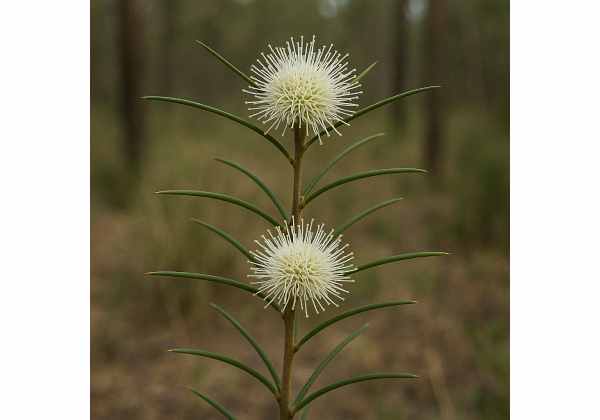
Needle Bush, usually identified as Hakea leucoptera, is an Australian dryland shrub or small tree with rigid needle-like leaves, pale flowers, and a long history of practical value in arid landscapes. It is better known in ethnobotanical and survival contexts than in modern herbal medicine. Traditional records describe it as a source of water from the roots, a nectar-bearing plant, and in some communities a plant whose parts were used in topical remedies for burns, wounds, and other local complaints. That makes it important, but also easy to overstate.
The most useful modern view of Needle Bush is careful and grounded. It has cultural significance, documented traditional applications, and a plausible place in discussions about bush pharmacy, yet there is no strong clinical evidence that supports standardized internal dosing or broad health claims. Its chemistry is also far less studied than that of mainstream medicinal herbs. For readers looking for a trustworthy guide, the key questions are not only what Needle Bush may have been used for, but also what is genuinely known, what remains uncertain, and why safety and plant identification matter so much here.
Essential Insights
- Traditional records describe Needle Bush as a source of root water and as a plant used in some community topical remedies for burns and wounds.
- Its strongest practical value may be ethnobotanical and survival-related rather than clinically proven medicinal use.
- No standardized medicinal oral dose range has been established for Hakea leucoptera.
- Pregnant or breastfeeding people, children, and anyone considering internal use should avoid self-dosing without expert guidance.
Table of Contents
- What Needle Bush is and why it matters
- Key ingredients and what is actually known about the chemistry
- Needle Bush health benefits and what the evidence supports
- Traditional uses food water and topical care
- How Needle Bush is prepared and why modern use is difficult
- Dosage timing and common mistakes
- Safety side effects and who should avoid it
What Needle Bush is and why it matters
Needle Bush is a member of the Proteaceae family, the same broad family that includes banksias, grevilleas, and macadamia. In practical terms, Hakea leucoptera is a hardy shrub or small tree of inland and semi-arid Australia. It is usually described as having narrow cylindrical leaves with a sharp point, pale white to yellowish flowers, and woody seed-bearing fruit. In some regions it grows as a bushy shrub, while in others it can form a small open-crowned tree. This is not just a botanical detail. It helps explain why the plant became useful to people living in dry country. Needle Bush is built for harsh conditions, and its value is closely tied to those conditions.
What makes this species especially interesting is that its reputation is not mainly based on the kind of herbal commerce people may expect from modern supplements. It is not a plant with a widely marketed extract, a standard capsule strength, or an established clinical monograph. Instead, its documented importance comes from traditional knowledge systems, especially those that treated the landscape as a source of medicine, food, materials, and water rather than as separate categories. In that setting, a plant could be valuable because it soothed a wound, produced nectar, or helped a person locate moisture in dry ground.
That broader frame matters because many online herb articles flatten everything into “benefits.” With Needle Bush, that is too simplistic. Some of its most important uses are practical rather than pharmacological. Root water, edible nectar, wood for tools, and occasional topical bush-medicine applications all belong to the story. It is better understood as an ethnobotanical resource than as a proven medicinal herb in the modern clinical sense.
Another reason it matters is that it highlights an important principle: traditional plant use and evidence-based herbal medicine overlap, but they are not identical. A plant can be culturally important and genuinely useful without having been tested in randomized human trials. At the same time, the absence of clinical evidence means claims should stay modest. For Needle Bush, that balance is essential.
The plant is also easy to romanticize because it comes from a striking dryland setting. But the more respectful approach is to see it clearly. It is a hardy Australian species with documented traditional uses, limited direct medicinal research, and an identity that sits somewhere between bush resource, community knowledge, and under-studied herb. Readers who want a more familiar, better-studied Australian topical plant often find it helpful to compare that role with Australian tea tree in topical care, which has a much stronger modern evidence trail.
Key ingredients and what is actually known about the chemistry
The most honest answer to the “key ingredients” question is that Needle Bush does not yet have a well-established medicinal chemistry profile of the kind readers may expect from mainstream herbs. There is no recognized standardized extract for Hakea leucoptera, no accepted marker compound used in commercial practice, and no published clinical framework that ties a given constituent to a defined human dose or outcome. That does not mean the plant has no bioactive chemistry. It means the chemistry has not been mapped in a way that supports confident medicinal claims.
This gap is important. A recent review of the Proteaceae family noted that only a minority of species in the family have been investigated in any meaningful phytochemical detail, and an even smaller fraction have had compounds isolated and fully studied. In other words, scientists know the family is chemically interesting, but they do not yet know enough about many individual members. Needle Bush sits squarely in that under-studied category.
At the family level, Proteaceae plants commonly contain broad classes of compounds such as phenolic compounds, quinones, alkaloids, terpenoid-related molecules, lipids, and other secondary metabolites. Those categories matter because they often show antioxidant, antimicrobial, or anti-inflammatory activity in laboratory research. But a family-level pattern is not the same as a species-specific medicinal fingerprint. It would be misleading to imply that Needle Bush itself has been proven to share all of those activities in a reliable or clinically useful way.
A more grounded way to think about Needle Bush ingredients is by plant part rather than by commercial actives:
- The flowers produce nectar, which helps explain the edible and food-related uses.
- The roots are notable for their practical water-yielding role in traditional knowledge.
- The woody tissues and bark-like material may have contributed to external applications in folk care, especially when processed rather than used raw.
- The seeds and fruit belong more to ethnobotanical and cultural use than to standardized herbal medicine.
This is also a good place to separate likely chemistry from meaningful dosage. Many plants contain phenolics or aromatic compounds, but that alone says very little about whether a plant should be taken internally, applied externally, or avoided altogether. Chemistry only becomes useful to everyday readers when it is linked to validated identity, safe preparation, and known human effects. Needle Bush has not reached that point.
That is why comparison can be helpful. A herb such as marshmallow root has a much clearer reputation for soothing tissues because both its traditional use and its material character are easier to understand. Needle Bush, by contrast, remains a plant with intriguing ethnobotanical importance but a thin evidence base. The right takeaway is not disappointment. It is precision: there may be useful chemistry here, but the published record is still too limited to present it as a defined medicinal ingredient profile.
Needle Bush health benefits and what the evidence supports
When people search for the health benefits of Needle Bush, they usually want a simple list. The problem is that a simple list would be less accurate than a careful one. The evidence for Hakea leucoptera supports a handful of reasonable observations, but not sweeping therapeutic claims.
The first likely benefit is practical hydration support in traditional dryland use, though this is not a supplement-style benefit. Published ethnobotanical and educational sources describe the roots as a source of fresh water in dry environments. That matters for human health in the broadest possible sense: reliable access to water is survival. Still, it should not be reframed as a modern “detox” or hydration herb. This is a land-based use tied to knowledge of place, plant selection, and technique.
The second likely benefit is topical folk support for burns and wounds. Community documentation records that parts of the plant could be mixed with animal fat to make an ointment for burns and wounds. This is one of the clearest medicinal-style uses attached to Needle Bush. Yet it still needs careful wording. It is a documented traditional use, not a validated modern burn treatment. There are no strong human trials showing that a Needle Bush ointment performs safely or effectively in home use.
The third likely benefit is local comfort care in specific traditional contexts. Some sources note additional uses such as treatment for sore eyes or other ailments within community practice. These records matter because they preserve knowledge, but they do not automatically translate into general self-care advice. Eye remedies are a good example. A use can be historically documented and still be unsafe to improvise at home.
The fourth likely benefit is nutritional or supportive use from nectar and edible plant parts. Again, this belongs more to ethnobotany than pharmacology. Nectar can provide energy and fluid, and edible uses point to the plant’s broader place in living with dry-country ecology. But these are not the same as modern medicinal effects.
What the evidence does not support is just as important:
- It does not support standardized internal dosing.
- It does not support disease-treatment claims.
- It does not support assuming antimicrobial, anti-inflammatory, or wound-healing activity simply because other Proteaceae or other Hakea species have shown interesting laboratory results.
- It does not support marketing Needle Bush as a clinically proven herbal supplement.
That last point protects readers from a common mistake. There is a difference between “documented use” and “proven effect.” Needle Bush clearly belongs in the first category. It does not yet belong in the second. For people whose real goal is gentle throat or tissue soothing from a better-known herbal tradition, slippery elm for mucosal support is a clearer example of a herb with a more recognizable modern use pattern.
Traditional uses food water and topical care
The traditional story of Needle Bush is broader and richer than a standard “uses” list. It is a plant associated with multiple forms of utility, and that versatility is part of why it stands out. In published community and ethnobotanical sources, Needle Bush appears not only as a possible medicinal plant but also as a water plant, nectar plant, material plant, and place-based resource.
The root-water use is one of the most striking. In arid and semi-arid environments, knowing which roots can yield drinkable moisture is deeply practical knowledge. This use tells us something important about how the plant was understood: not only as a living organism with medicinal potential, but as part of a survival system. That use is inseparable from local knowledge, seasonal judgment, and landscape observation. It is not something that should be reduced to a novelty fact.
The flowers also matter. Needle Bush nectar is described as edible, which places the plant within the broader Australian tradition of nectar-bearing species valued for direct tasting, sweet drinks, or bee forage. That food role does not make it a medicine by itself, but it does show that the plant supported human wellbeing in more than one way.
The topical uses are where health-focused readers usually concentrate. The most concrete documented example is the use of some plant parts, mixed with animal fat, to make an ointment for burns and wounds. This suggests a local-support role rather than a deep internal medicinal role. It also fits a common theme in traditional plant use: external remedies are often based not on isolated actives but on combinations of plant matter, carrier fats, preparation skill, and observation of results over time.
Some community records also attach Needle Bush to additional uses, including treatment contexts involving sore eyes and other complaints. These uses should be described respectfully and carefully. They show that the plant was part of living knowledge, but they do not give modern readers a license to replicate sensitive treatments on their own.
There are also non-medicinal uses for the timber and other parts of the plant. Wood from Needle Bush has been used for practical objects, and the plant appears in descriptions of shelter-building and tool-related use in some settings. That may seem unrelated to health, but in traditional life these categories overlap. A plant that helps provide water, shelter, materials, and occasional topical care contributes to wellbeing in a very real way.
That broader understanding prevents one of the biggest interpretive errors people make with bush medicine: assuming that every traditional plant use was meant to function like a modern capsule or cream. Needle Bush is more accurately understood as a multipurpose country plant with occasional medicinal applications. Readers interested in a more straightforward topical herb model may find calendula for minor skin support easier to compare, because its modern use is more clearly centered on skin comfort and superficial wound care.
How Needle Bush is prepared and why modern use is difficult
One of the most helpful things an article can do is explain not just what a plant was used for, but why it is hard to translate that use into modern self-care. Needle Bush is a good example. The published record suggests practical preparations rather than standardized herbal products. Root water was used directly. Nectar was taken in simple food-like ways. Topical applications involved parts of the plant being prepared with animal fat. None of those uses fit neatly into today’s tea-tincture-capsule model.
This matters because modern readers often search for a plant and expect familiar instructions such as “steep 2 grams,” “take 20 drops,” or “use a 5 percent extract.” With Needle Bush, that expectation is misplaced. There is no mainstream pharmacopeia entry that tells you how to prepare it safely for internal use. There is also no accepted commercial form that defines what a proper Needle Bush extract should contain.
Why is modern use difficult?
- The traditional preparations were context-specific.
A remedy made in the field or within community practice often depends on knowledge that is not captured by ingredient lists alone. Which part of the plant was chosen, how old it was, when it was gathered, how it was processed, and when it was used all matter. - The plant is not well standardized.
Without a recognized medicinal monograph, one product labeled “Hakea” could differ substantially from another, and wild-harvest material could differ even more. - Preparation can affect safety.
External applications, food-like uses, and root-water uses do not imply that concentrated internal extracts are safe. In fact, they may suggest the opposite: that the historical value of the plant did not depend on concentrated internal dosing. - Misidentification is a real risk.
Arid-zone shrubs with narrow leaves are not a beginner’s field-medicine topic. Using the wrong plant is one of the simplest ways to turn a traditional-use story into a safety problem.
A respectful modern approach is to separate appreciation from imitation. It is entirely reasonable to learn about Needle Bush, value the knowledge associated with it, and understand its place in Australian bush tradition. It is much less reasonable to assume that a topical folk remedy should be recreated at home without guidance, or that a plant with little internal dosing history should be treated like a general wellness herb.
This is where comparison again helps. Some herbs are easy to translate into household use because generations of modern herbalism have already standardized the process. Needle Bush is not one of them. If the practical goal is gentle respiratory support from a more defined herbal tradition, mullein in everyday herbal use is a much clearer example of a plant whose forms and purposes are easier for non-specialists to understand.
Dosage timing and common mistakes
The dosage question is where Needle Bush differs most sharply from common medicinal herbs. The accurate answer is simple: there is no established medicinal oral dose for Hakea leucoptera. No reliable modern source provides a validated range in grams, milligrams, or drops for internal use, and that absence is not a minor gap. It is the central dosing fact readers need to know.
Because of that, “timing” is also mostly undefined. There is no evidence-based advice about whether it should be taken in the morning or evening, with food or without food, for one week or one month. Any article that presents a precise oral schedule for Needle Bush would be filling the evidence gap with guesswork.
That said, people still benefit from dosage guidance in the form of boundaries. For Needle Bush, the safest boundaries are these:
- Do not invent an internal dose from traditional water or food use.
- Do not convert an ethnobotanical record into a capsule schedule.
- Do not assume that because some parts were used topically, the plant is appropriate to swallow as a tea or tincture.
- Do not infer a dose from other Hakea species or from the Proteaceae family as a whole.
The biggest mistakes usually come from category confusion.
Mistake one: confusing survival use with medicinal dosing.
A root that yields water is valuable, but that does not tell you anything about safe extract strength or repeated ingestion.
Mistake two: assuming “traditional use” means “safe for everyone.”
Traditional knowledge is often highly specific. It may depend on place, preparation, and user experience. Removing those details can make the practice less safe, not more.
Mistake three: copying external uses internally.
A plant part used in an ointment should not be automatically treated as suitable for tea, decoction, or tincture.
Mistake four: using Needle Bush instead of a more appropriate herb.
Many people searching for this plant are really looking for help with a topical issue or mild throat irritation. In those cases, a better-studied herb may be more practical. For example, someone seeking a classic soothing herb for irritated tissues may learn more from marshmallow root use and dosing than from trying to force Needle Bush into a role it has not been shown to fill.
Mistake five: treating uncertainty as permission.
Some readers assume that because a plant is under-studied, experimentation is harmless. The opposite is often true. Uncertainty should lead to caution, not enthusiasm.
If a clinician trained in Australian ethnobotany, bush medicine, or phytotherapy ever recommends a specific preparation, that is a different situation. But for general readers, the correct dosage message is not a number. It is restraint.
Safety side effects and who should avoid it
Needle Bush should be approached as a plant with limited medicinal evidence, uncertain internal safety, and meaningful identification issues. That combination argues for caution even before specific side effects are considered.
The first safety issue is lack of internal-use data. There are no solid human studies establishing a safe oral dosage range, long-term tolerability, or predictable interaction profile. Without that information, internal self-use is difficult to justify. This is especially true for concentrated preparations, powders, tinctures, or homemade extracts.
The second safety issue is species confusion and wild harvesting. A person who is not trained in plant identification should not gather sharp-leaved shrubs in dry-country environments for self-medication. Misidentification is a practical hazard, and even correct identification does not guarantee suitable preparation.
The third safety issue is sensitive body sites. Traditional references to eye-related use or burn remedies should not be taken as a signal to experiment on the eyes, deep wounds, infected skin, or significant burns. These are areas where a poorly chosen plant preparation can worsen harm. Modern wound care and eye care are safer than improvisation.
The fourth safety issue is possible allergy or irritation. Proteaceae plants are chemically active, and family members are not free from sensitizing potential. Even when no specific adverse-effect profile has been mapped for Needle Bush, it is sensible to assume that skin irritation or individual reactions are possible, especially with crude plant material.
The people who should be most cautious include:
- pregnant or breastfeeding people
- infants and children
- anyone with severe burns, infected wounds, or eye symptoms
- anyone taking prescription medicines and considering internal use
- people with a history of plant allergy or highly reactive skin
- anyone tempted to replace medical care with bush remedies
It is also worth saying that cultural respect is part of safety. Traditional plant knowledge is not merely a collection of raw instructions waiting to be copied. In many cases, the safest and most respectful way to engage with that knowledge is to learn from it without reproducing it casually.
A balanced final view is this: Needle Bush has genuine ethnobotanical interest and documented traditional practical uses, but it is not a modern self-prescribing herb. If your goal is evidence-based treatment for burns, wounds, infection, eye problems, or ongoing illness, medical care comes first. If your goal is to explore gentle plant-based skin support, better-known topical herbs such as aloe vera for minor skin comfort usually offer clearer guidance and better-defined safety expectations.
References
- A Review of Phytochemicals and Bioactive Properties in the Proteaceae Family: A Promising Source of Functional Food 2023 (Review)
- The Curious Ethnobotany of Alice Duncan-Kemp 2024
- Budjiti Use of Traditional Plants on Naree Station 2026
- Hakea leucoptera subsp. leucoptera 1996
Disclaimer
This article is for educational purposes only and is not a substitute for medical advice, diagnosis, or treatment. Needle Bush is an under-studied plant in modern herbal medicine, and most claims connected to it come from ethnobotanical or community-use records rather than clinical trials. Do not use wild-harvested Needle Bush internally, on the eyes, on major burns, or in place of professional care. Speak with a qualified healthcare professional before using any plant remedy if you are pregnant, breastfeeding, managing a chronic condition, taking medication, or treating a child.
If you found this article useful, please consider sharing it on Facebook, X, or your preferred platform.