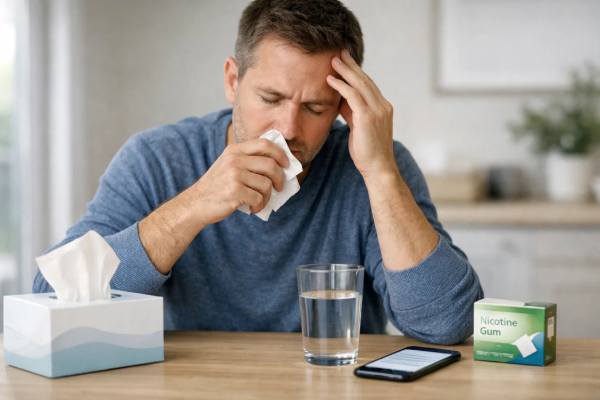
Quitting nicotine is a major change for your nervous system and your airways, so it is common to feel “sick” right as you are trying to get healthier. A cold can cause cough, headache, and fatigue—but nicotine withdrawal can also trigger anxiety, restlessness, sleep disruption, and headaches that feel surprisingly physical. On top of that, many people notice more coughing after they stop smoking or vaping, not because they caught something, but because airway clearance begins to recover and mucus starts moving again. The overlap creates a stressful question: Is this a virus, or is this withdrawal? The answer matters because it shapes what to do next—rest and monitoring for an infection, or a structured plan to ease withdrawal so you do not relapse. This guide gives clear timing clues, symptom patterns, and practical self-checks to separate the two.
Essential Insights to Separate the Two
- Withdrawal symptoms often start within the first day after stopping nicotine and peak around days 2–3, while colds usually follow an exposure and build over 1–3 days.
- New nasal congestion, sneezing, and sore throat point more toward a cold than withdrawal.
- Anxiety, irritability, intense cravings, and trouble concentrating point more toward withdrawal than a virus.
- A cough after quitting can be a normal “airway reset,” but shortness of breath, chest pain, or coughing blood needs prompt medical evaluation.
- If you are unsure, use a 24-hour plan: check temperature, track trend, and avoid changing multiple variables at once.
Table of Contents
- Why quitting can mimic a cold
- Timing patterns that reveal the cause
- Cough, anxiety, and headache side by side
- Self checks you can do today
- If it is withdrawal, make a plan
- If it is a cold, protect recovery
Why quitting can mimic a cold
Nicotine affects the body in two big domains that overlap with “cold-like” complaints: the brain’s alertness and stress circuits, and the airways’ mucus and cough reflex. When you stop nicotine, both systems shift at the same time—often within hours—and your symptoms can feel like a viral illness even when you are not infected.
What withdrawal does to your nervous system
Nicotine rapidly stimulates receptors that influence dopamine and other signaling chemicals tied to focus, reward, and calm. When nicotine is removed, the brain has to recalibrate. That recalibration commonly produces:
- Anxiety or a “wired” feeling
- Irritability and low frustration tolerance
- Headache, fogginess, and trouble concentrating
- Sleep disruption (trouble falling asleep, vivid dreams, early waking)
These are not signs of weakness. They are a predictable adjustment period. The key is that withdrawal symptoms often come in waves and can be strongly linked to triggers: morning routines, driving, breaks at work, after meals, or stress.
What quitting does to your airways
If you have smoked or vaped, your airways have been exposed to irritants that change mucus and the tiny hair-like structures that move mucus upward. After quitting, those clearance mechanisms can begin to recover. A common result is a cough that feels more noticeable than before—sometimes with increased phlegm or throat clearing—because mucus starts moving again instead of sitting quietly.
This cough can be unsettling, especially if it appears alongside fatigue and headache. But it has a different “logic” than a cold cough. A withdrawal-related cough often has these features:
- More throat clearing or mucus movement than fever or chills
- A pattern that is worse in the morning
- Gradual improvement over weeks rather than a sharp peak-and-resolve over several days
Why the overlap is so common
Two additional factors create confusion:
- Attention effect: when you stop nicotine, you may notice sensations you previously ignored or masked.
- Stress effect: stress and poor sleep can amplify body aches, headache, and cough sensitivity, making mild symptoms feel severe.
Understanding these mechanisms does not replace medical evaluation when needed. It simply helps you interpret symptoms with less fear and more accuracy.
Timing patterns that reveal the cause
When symptoms overlap, timing is your best diagnostic tool. A cold follows an exposure and a short incubation period. Withdrawal follows nicotine reduction and often starts quickly.
The nicotine withdrawal timeline in plain terms
Most people notice withdrawal symptoms in the first day after stopping or sharply cutting down nicotine. Symptoms commonly intensify over the next two to three days, then begin easing over the following weeks. That does not mean you feel “fine” after a week; it means the sharpest edge usually fades, while cravings and trigger-driven anxiety can linger.
A useful pattern is:
- First 24 hours: cravings, irritability, restless energy, headache, sleep disruption
- Days 2–3: peak intensity for many people; anxiety and concentration problems can be strongest
- Weeks 1–4: physical symptoms usually settle; trigger-based urges remain the main challenge
If you are using nicotine replacement (patch, gum, lozenge), the timeline can change. You may feel fewer withdrawal spikes, but you can still have symptoms if the dose is too low or if you remove nicotine from your strongest trigger moments (for example, morning coffee).
The common cold timeline in plain terms
A cold typically begins after exposure to a respiratory virus, then builds over one to three days. Many people notice an early scratchy throat or fatigue, followed by nasal symptoms (runny nose, sneezing, congestion). Symptoms often peak around the second or third day of illness, then gradually improve. Cough can be the symptom that lingers the longest.
A classic pattern is:
- Day 1: sore throat, sneezing, mild fatigue, watery runny nose
- Days 2–3: congestion intensifies; cough begins or increases; headache may appear
- Days 4–7: symptoms start easing; energy slowly returns
- Days 7–14: cough and postnasal drip may linger even as other symptoms resolve
Timing clues that strongly point one way
Withdrawal is more likely when symptoms start the same day you stopped nicotine, especially if anxiety and cravings are prominent. A cold is more likely when symptoms start after a known exposure and are driven by nasal and throat symptoms.
A practical question to ask is: Did the symptoms start because my nicotine changed, or because my environment changed? If you can link symptom onset to “last cigarette,” “last vape,” or “dropped my nicotine strength,” withdrawal moves up the list.
Cough, anxiety, and headache side by side
The fastest way to tell withdrawal from a cold is to compare symptom “clusters.” Individual symptoms can overlap, but clusters often do not. Use the comparisons below as pattern recognition, not as a definitive diagnosis.
Cough: what the cough is trying to do
A cold cough is often part of an upper-airway package: runny nose, postnasal drip, scratchy throat, and cough that worsens when you lie down. A withdrawal-related cough more often reflects airway clearance changes after quitting, especially in people who smoked. It may feel “productive” or mucusy even if you are not otherwise sick.
Helpful distinguishing questions:
- Is the cough paired with a new runny nose and sore throat?
- Is the cough worse in the morning with mucus movement but little nasal illness?
- Is the cough improving steadily each week, or worsening rapidly each day?
Anxiety: emotional vs inflammatory context
Withdrawal anxiety often feels internally driven: restlessness, irritability, a sense that something is “off,” and cravings that surge with triggers. Cold-related anxiety tends to be situational: worry about missing work, discomfort, or poor sleep, rather than repeated cravings and agitation.
Clues that favor withdrawal:
- Strong urge to smoke or vape to “fix” the feeling
- Irritability that feels out of proportion to the situation
- Relief after nicotine replacement or a coping strategy, even if temporary
Clues that favor a cold:
- Anxiety mostly tied to symptoms like fever, aches, or breathing discomfort
- Anxiety that improves when congestion and cough improve
Headache: mechanism matters
Headaches can occur with both. With colds, headache is often from sinus pressure, dehydration, or generalized inflammation. With withdrawal, headache is often linked to nervous system adjustment, caffeine changes, and sleep disruption. If you quit nicotine, you may also unintentionally change your caffeine intake (for example, less coffee during smoke breaks), which can trigger headaches on its own.
Quick cluster comparison
| Pattern | More consistent with withdrawal | More consistent with a cold |
|---|---|---|
| Onset | Same day as stopping or cutting nicotine | After exposure, builds over 1–3 days |
| Nasal symptoms | Often mild or absent | Common: runny nose, sneezing, sore throat |
| Mood and focus | Prominent: irritability, anxiety, fogginess | Variable, usually less prominent |
| Fever and chills | Uncommon | Possible, usually low-grade in adults |
| Cough quality | Clearing, morning-heavy, can last weeks | Often linked to drip, peaks then eases |
If you do not fit cleanly into one column, you may be dealing with both: early withdrawal plus a viral illness. In that case, the safest path is to treat symptoms, protect sleep and hydration, and watch the trend carefully.
Self checks you can do today
When you feel uncertain, the goal is not to become your own diagnostician. The goal is to collect a few objective signals that reduce guesswork and help you decide whether to monitor, adjust withdrawal support, or seek care.
Check 1: temperature and trend
Take your temperature at the same time twice a day for 24–48 hours (for example, morning and evening). A consistently normal temperature makes a classic infection less likely, though not impossible. A rising temperature trend supports a viral process more than withdrawal.
Also pay attention to chills, sweats, and body aches. These can occur with sleep deprivation, but they are more typical in viral illness when they are persistent and paired with nasal symptoms.
Check 2: nasal and throat “inflammation signs”
Ask: Do I have a new sore throat, sneezing, and watery runny nose? Those early upper-respiratory signs push the needle toward a cold. Withdrawal can cause throat clearing and irritation, but it usually does not cause a classic “coming down with something” sore throat.
A helpful detail is timing. Cold sore throat often shows up early, before the cough. Withdrawal-related throat symptoms are often more variable and tied to dryness, reflux, or airway clearance.
Check 3: cravings and trigger mapping
Withdrawal tends to flare in predictable moments. Write down when symptoms spike:
- Within 10–20 minutes after coffee
- While driving
- During a work break
- After meals
- During stress or conflict
If anxiety and headache reliably spike in those windows, withdrawal becomes more likely.
Check 4: response to a controlled intervention
Use one controlled change, not five. Examples:
- If you use nicotine replacement, take a planned dose (per label or clinician plan) and observe whether anxiety and restlessness soften within an hour.
- If you suspect a cold, use a basic cold-support step (hydration plus rest plus saline nasal care) and see if congestion and throat discomfort improve.
The point is not that a single response proves the diagnosis. The point is that withdrawal symptoms often respond to withdrawal-targeted tools, while cold symptoms respond more to time, hydration, and decongestion measures.
Check 5: red-flag screening
Regardless of cause, seek prompt medical care if you have:
- Shortness of breath at rest, chest pain, or bluish lips
- Confusion, fainting, or severe weakness
- Coughing blood
- Severe headache with neck stiffness, new neurologic symptoms, or unusual rash
If any of these are present, do not try to “sort it out” at home.
If it is withdrawal, make a plan
If the pattern fits withdrawal, the priority is to reduce suffering without undermining your quit attempt. A good plan makes symptoms feel predictable and manageable rather than random and alarming.
Use the simplest evidence-based supports
Withdrawal is one of the main reasons people relapse, so symptom relief is not “cheating.” It is harm reduction. Depending on your situation and medical history, options can include nicotine replacement therapy (NRT) and non-nicotine prescription medications. Many people do best with steady baseline support plus a tool for breakthrough cravings.
A practical structure many people find workable is:
- A steady option to prevent constant withdrawal (often a patch or consistent dosing schedule)
- A fast option for trigger moments (often gum or lozenges)
- A plan for the highest-risk times of day (morning, after meals, stress windows)
If you are already using NRT and still feel intense symptoms, under-dosing is common. Over-dosing can happen too, so treat this as a reason to reassess rather than to guess. A clinician or pharmacist can help you match dose to your previous nicotine intake.
Address the “three drivers” that amplify withdrawal
- Sleep debt: poor sleep makes cravings louder and headaches more likely. Protect sleep with a fixed wake time, a dark room, and a wind-down routine.
- Dehydration and skipped meals: quitting changes appetite patterns. Stable fluids and regular protein-rich meals can blunt headache and irritability.
- Caffeine mismatch: nicotine and caffeine interact. After quitting, the same coffee intake can feel stronger, or your coffee routine can drop suddenly. Either shift can worsen anxiety or headache. Aim for consistency for two weeks before making major caffeine cuts.
What to do about the cough
A post-quitting cough is often managed like any non-dangerous cough:
- Drink warm fluids and keep hydration steady
- Use honey if appropriate for your age and health status
- Avoid smoke exposure and harsh aerosols
- Consider that reflux can worsen cough during stressful periods and late meals
If the cough is worsening, associated with fever, or lasts beyond a month without improvement, get evaluated. “Normal quitting cough” should trend better over time, even if slowly.
When withdrawal needs professional support
Get help promptly if you have:
- Severe anxiety or panic that feels unmanageable
- Depressed mood with hopelessness
- Thoughts of self-harm
- Inability to sleep for several nights in a row despite good sleep habits
Withdrawal is temporary, but safety comes first, and you deserve support.
If it is a cold, protect recovery
If your symptoms fit a cold, you can still protect your quit attempt while you recover. Illness is a common relapse trigger because the brain reaches for familiar comfort. The goal is to treat symptoms, reduce stress, and avoid “one cigarette to calm down” thinking.
Focus on symptom relief that does not complicate withdrawal
Supportive care usually includes:
- Hydration and regular meals, even if appetite is low
- Rest, with brief movement to prevent stiffness
- Saline nasal spray or rinse for congestion and drip
- Warm fluids and throat comfort strategies for cough
Be cautious with multi-symptom cold products that contain stimulants or sedating antihistamines, especially if you are already experiencing withdrawal anxiety or sleep disruption. If you use any medicine, use the smallest set of targeted ingredients that match your symptoms.
Understand the cough timeline
A cold cough can linger, especially if postnasal drip continues. It is common for cough to last longer than the runny nose. What matters is direction: cough should slowly become less intense and less frequent. If cough is worsening after a week, or if you develop new fever after initial improvement, reassessment is wise.
If you recently quit smoking, you may have two cough drivers at once: viral irritation and airway clearance recovery. That combination can feel intense, but it can still be self-limited if your breathing is otherwise comfortable.
Protect your quit attempt during the “tired and irritable” phase
Make your plan easier than relapse:
- Keep nicotine replacement available if you use it
- Remove smoking or vaping cues from your immediate environment
- Use a short list of substitutes: water, gum, a brief walk, or a 3-minute breathing reset
- Remind yourself that “feeling awful” is not evidence you need nicotine; it is evidence you need rest and time
When to seek medical evaluation
Get prompt care if you have:
- Trouble breathing, wheezing, or chest pain
- Fever that persists several days or returns after improving
- Severe sore throat with difficulty swallowing, drooling, or dehydration
- Symptoms that last more than 10 days without improvement, or that worsen instead of slowly improving
If you have chronic lung disease, asthma, immune suppression, or you are pregnant, it is reasonable to seek guidance earlier.
References
- WHO clinical treatment guideline for tobacco cessation in adults 2024 (Guideline)
- Tobacco Smoking in Adults (2025) – Canadian Task Force on Preventive Health Care 2025 (Guideline)
- Withdrawal Syndromes – StatPearls – NCBI Bookshelf 2024 (Clinical Review)
- Interventions for smoking cessation: An overview of Cochrane reviews – PMC 2024 (Overview of Reviews)
- About Common Cold | Common Cold | CDC 2024 (Public Health Guidance)
Disclaimer
This article is for general educational purposes and does not provide medical advice, diagnosis, or treatment. Cough, headache, and anxiety can have many causes, and nicotine withdrawal and viral infections can overlap. If you have severe or worsening symptoms, trouble breathing, chest pain, coughing blood, persistent high fever, confusion, or significant mental health distress, seek medical care promptly. If you are pregnant, have chronic lung disease, take prescription medications, or are using nicotine replacement or other quit-smoking medicines, consult a qualified clinician or pharmacist for individualized guidance.
If you found this article helpful, please consider sharing it on Facebook, X, or any platform you prefer.