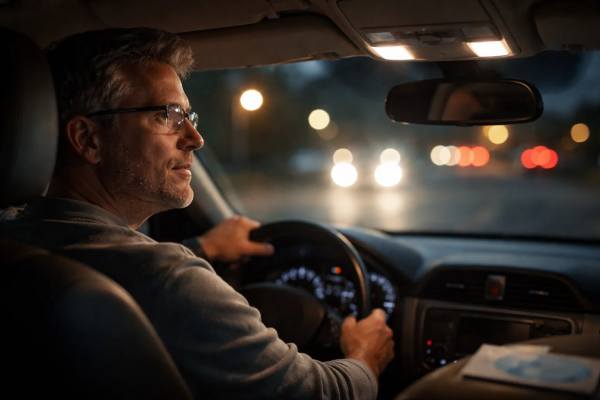
Glare and halos at night can make driving, walking, or even reading street signs feel far more difficult than your daytime vision would suggest. The reason is simple but important: low light changes how your eyes work. Your pupils widen, your focusing system shifts, and tiny imperfections in the tear film, cornea, lens, or retina become more noticeable—especially around bright point sources like headlights and LEDs. When you understand what these symptoms mean, you can separate common, fixable issues (like dry eye or an outdated prescription) from problems that deserve a prompt eye exam (like cataracts or certain forms of glaucoma). This guide explains what glare and halos typically signal, how to do a practical self-check, what clinicians look for during an evaluation, and which solutions tend to help most in real life—so you can make safer choices and get to the right next step sooner.
Essential Insights
- Many night-vision complaints improve after correcting refractive error, treating dry eye, or updating lens coatings and fit.
- Persistent halos and glare can be an early functional sign of cataract changes, even when daylight vision seems “fine.”
- Sudden halos with eye pain, redness, nausea, or rapidly reduced vision require urgent evaluation.
- Use a two-week symptom log (when, where, and triggers) to make an eye exam more targeted and productive.
Table of Contents
- What glare and halos really mean
- Common causes from tears to lens and retina
- A practical self-check before your appointment
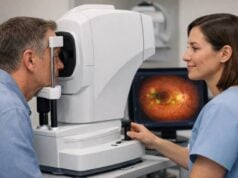
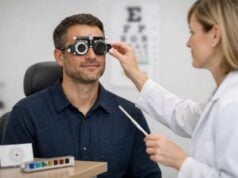
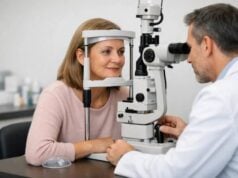
- What an eye exam tests for night vision complaints
- Solutions that actually reduce glare and halos
- When to seek urgent care and when to recheck
What glare and halos really mean
“Night vision problems” is a broad phrase, but most people are describing one of three experiences: glare, halos, or starbursts. They often overlap, yet each points to a slightly different optical issue.
Glare is the loss of visual clarity or comfort caused by bright light. You may feel temporarily blinded by oncoming headlights, struggle to see pedestrians near bright signs, or notice that wet roads look like mirrors. Halos are rings or glow-like circles around lights. Starbursts look like spikes or rays radiating from a light source.
Why do these symptoms show up at night? Low light forces your pupils to widen. A larger pupil lets in more light, but it also exposes more of the eye’s optical system. That means you are using a wider “window” of the cornea and lens, including peripheral areas where aberrations and scatter are often higher. At the same time, night driving and nighttime environments are dominated by high-contrast point sources (headlights, LEDs, reflective signs). High contrast makes small amounts of blur, scatter, or tear-film instability much more noticeable.
Two mechanisms explain most glare and halo complaints:
- Light scatter (straylight): Light bounces or diffuses instead of forming a clean image. This commonly happens with tear-film problems, early lens changes, or surface irregularities.
- Optical aberrations and defocus: The eye’s focusing system or corneal shape creates distortions, especially when the pupil is large. This is common with uncorrected astigmatism, higher-order aberrations after certain surgeries, or poorly centered optics.
A useful mental model: halos are often a “bright edge artifact,” while glare is often “contrast collapse.” People can still read an eye chart in a bright exam room yet struggle at night because the chart is not replicating low-light, high-glare conditions. That is why a focused night-vision evaluation looks beyond standard acuity testing and asks about real tasks, lighting, and specific triggers.
Common causes from tears to lens and retina
Night glare and halos are symptoms, not diagnoses. The goal is to identify where the “signal” is being degraded: the tear film, the cornea, the lens, the pupil and iris, or the retina and optic nerve. Many people have more than one contributor.
Tear film and eyelids (very common):
A smooth tear film is the first optical surface of the eye. If it breaks up quickly, the surface becomes uneven and scatter increases. Night symptoms can be worse because you blink less when staring (especially while driving or using a screen before driving). Clues include burning, fluctuating blur, stringy mucus, contact lens intolerance, or symptoms that improve right after blinking.
Refractive error and astigmatism (common and fixable):
Small uncorrected astigmatism can create streaks, flare, or starbursts around lights. A slightly outdated glasses prescription can also reduce contrast and make halos more prominent. If closing one eye reduces symptoms noticeably, refractive or alignment factors may be involved.
Corneal shape and surface irregularity:
Conditions like keratoconus, corneal scarring, or irregular astigmatism can amplify night distortions. Even subtle surface changes—such as dry spots, contact lens deposits, or poorly fitting lenses—can create disproportionate nighttime complaints.
Lens changes and cataracts (especially after midlife):
Cataracts are not only “blur.” Early lens changes can scatter light and reduce contrast before you notice significant daytime blur. Many people first recognize the problem as “headlights are unbearable” or “everything has a haze at night.”
After eye surgery or procedures:
Some people experience night halos after refractive surgery (such as LASIK/PRK) or after lens surgery with certain intraocular lens designs. The optical system may be sharper on-axis but more aberrated in low light with a large pupil, creating rings or glare around point lights.
Pupil size and medications:
A larger pupil can worsen symptoms by exposing peripheral aberrations. Some medications can dilate pupils, dry the ocular surface, or change focus, which can indirectly worsen night vision. If symptoms started soon after a new medication, it is worth mentioning during an exam.
Retinal and neurologic contributors (less common, important):
Problems with dark adaptation, contrast sensitivity, or peripheral vision can make nighttime environments harder even without classic halos. Diabetes, certain retinal conditions, and some neurologic issues can reduce night performance. These typically come with other signs: trouble adjusting from bright to dark, reduced peripheral awareness, or a sense that “everything is dim” rather than “lights have rings.”
Because multiple factors often stack, the most accurate approach is to identify the dominant contributor first—then address secondary issues for the best overall improvement.
A practical self-check before your appointment
A careful self-check can help you describe symptoms precisely and may reveal simple fixes. It is not a substitute for an exam, but it can make the visit faster and more effective.
1) Identify the exact pattern
Use these prompts for a short log over 7 to 14 days:
- Are symptoms glare, halos, starbursts, or a general dimness?
- Do they happen only while driving, only in LED-heavy areas, or in any dark setting?
- Do they worsen when you are tired, after screens, or in dry/air-conditioned environments?
- Are they worse in rain, on dirty windshields, or when lights reflect off wet roads?
2) Check one eye versus both
In a safe, stationary setting (not while driving), look at a small light source at night and compare:
- Both eyes open
- Right eye only
- Left eye only
If one eye is clearly worse, the issue may be more localized (tear film, cornea, early lens change) in that eye. If both eyes are similar, systemic factors (dry eye, refractive error, lighting environment) become more likely.
3) Blink test for tear-film instability
If your vision looks hazy or lights have more flare, blink fully a few times. If the symptom improves briefly and then returns within seconds, the tear film may be breaking up quickly. This is a strong clue for dry eye or lid-gland issues.
4) Quick environment checks that matter
These do not “cure” an eye problem, but they can reduce avoidable glare:
- Clean the windshield inside and out, plus headlights and mirrors.
- Reduce dashboard brightness at night.
- Remove smeary interior glass films (common with cleaners that leave residue).
- If you wear glasses, clean lenses carefully; microfiber smears can mimic haze.
5) Glasses and contact lens clues
- If glasses help significantly compared with contacts, contact lens dryness, deposits, or fit may be contributing.
- If symptoms are worse with glasses at night, check whether lenses have heavy scratches, poor coating performance, or significant smearing that amplifies scatter.
Bring your symptom log, your current glasses, and any older pair to your appointment. The difference between them can be diagnostically useful.
What an eye exam tests for night vision complaints
A standard eye exam often focuses on visual acuity in bright conditions, but a night-vision complaint requires a slightly different lens. Clinicians want to understand whether the main issue is scatter, aberration, focus, ocular surface quality, or retinal function.
History that guides the exam
Expect questions like:
- When did symptoms start, and were they sudden or gradual?
- Are you noticing more trouble with oncoming headlights, streetlights, or LED signs?
- Do you have dryness, burning, or fluctuating blur?
- Have you had refractive surgery, cataract surgery, or other eye procedures?
- Any new medications, recent illness, or major changes in screen time?
Precise answers matter because different causes have different “signatures.” For example, tear-film issues often produce fluctuating symptoms that change with blinking; early cataract scatter tends to be more consistent and progressive.
Refraction and lens alignment
A careful refraction looks for small changes in spherical power and astigmatism that can have outsized nighttime impact. Clinicians may also check binocular vision alignment because subtle eye teaming issues can worsen fatigue and reduce contrast, especially in low light.
Ocular surface and tear-film evaluation
This can include inspection of the eyelid margins, tear breakup time, staining patterns, and meibomian gland function. These findings help distinguish “dryness sensation” from true optical degradation caused by an unstable tear layer.
Corneal shape and optical quality
If irregular astigmatism or post-surgical aberrations are suspected, corneal topography or tomography can map corneal curvature and detect subtle irregularities. Some clinics also assess higher-order aberrations to understand night-related distortions.
Lens and cataract assessment
A slit-lamp exam evaluates lens clarity and the location of any opacities. Certain patterns can be particularly associated with glare and halos even when the lens is not severely cloudy overall.
Retina, optic nerve, and functional testing
A dilated exam checks the retina and optic nerve for conditions that can reduce contrast or dark adaptation. In selected cases, clinicians may evaluate contrast sensitivity or glare disability more directly, especially when symptoms do not match the daytime acuity result.
A strong takeaway: when night driving is the main complaint, the most helpful exam is one that prioritizes real-world function—contrast, scatter, and stability—not only the smallest letters you can read in a bright room.
Solutions that actually reduce glare and halos
The best solution depends on the dominant cause. Many people improve with a layered approach: correct focus first, stabilize the tear film next, then address lens or surgical factors if needed.
Optimize the basics: focus and clarity
- Update your prescription: Even a modest change in astigmatism correction can reduce starbursts and flare.
- Consider lens features that reduce reflections: Quality anti-reflective coatings can improve comfort and contrast in challenging lighting.
- Check frame fit and optical centering: Poorly positioned lenses can create unwanted prismatic effects or reduce usable optical quality, especially in higher prescriptions.
Stabilize the tear film
If the blink test suggests tear instability, addressing it can meaningfully reduce scatter:
- Use preservative-free lubricating drops if you need frequent dosing, and favor consistency over occasional use.
- Support eyelid oil glands with warm compresses and gentle lid hygiene if recommended by your clinician.
- Adjust habits that dry the surface: aim car vents away from the face, take screen breaks, and blink fully during prolonged visual tasks.
A key point: dry eye is not only discomfort. It can be an optical problem that directly worsens glare and halos at night.
Manage contact lens factors
If contacts worsen night symptoms, common fixes include:
- Reassessing lens material, fit, and replacement schedule
- Addressing deposits and cleaning method
- Using rewetting strategies or switching to daily disposable lenses if dryness and deposits are recurring issues
Address lens changes and cataract-related scatter
When cataract changes are driving symptoms, the definitive treatment is cataract surgery, but timing is individualized. Many people decide based on function: whether night driving feels unsafe, whether glare limits work, or whether contrast loss is interfering with daily life. If you have already had cataract surgery and later develop renewed haze and glare, your clinician may evaluate for posterior capsule changes that can sometimes be treated in-office.
Post-surgical halos and optical design issues
After refractive surgery or certain lens implants, halos may improve over time as the visual system adapts and the ocular surface stabilizes. For persistent symptoms, options may include:
- Treating dry eye aggressively (often overlooked after procedures)
- Evaluating pupil size and low-light aberrations
- Adjusting correction strategy for residual refractive error
- Discussing procedure-specific solutions if symptoms are severe and persistent
Night driving strategies that reduce risk
Even while you pursue medical fixes, these steps can improve safety:
- Avoid driving when you are exhausted; fatigue reduces contrast sensitivity and slows processing.
- Increase following distance to reduce headlight glare impact.
- Keep your gaze slightly to the right edge line when an oncoming car approaches to reduce direct glare exposure.
- If symptoms are severe or rapidly worsening, limit night driving until evaluated.
Effective care is usually not a single “magic” product. It is matching the solution to the source of scatter or distortion—and then confirming improvement with your real-world tasks.
When to seek urgent care and when to recheck
Most night-vision complaints are not emergencies, but some combinations of symptoms require immediate evaluation because they can signal conditions that threaten vision.
Seek urgent care if halos come with pain or sudden change
Get prompt, same-day evaluation if you have halos or glare plus any of the following:
- Moderate to severe eye pain
- Marked redness in one eye
- Nausea or vomiting along with eye symptoms
- Sudden, significant drop in vision
- A new headache with visual symptoms that is intense or unusual for you
One reason this matters: acute rises in eye pressure can cause halos around lights along with pain and systemic symptoms. Quick treatment can protect vision.
Urgent evaluation is also appropriate for “retinal warning signs”
These symptoms are not typical “glare problems,” but people sometimes notice them first at night:
- Flashes of light, a sudden shower of new floaters, or a curtain-like shadow
- New distortion of straight lines
- A dark spot or missing area in your vision
If you notice these, do not wait to see whether they resolve on their own.
Recheck soon if symptoms persist despite basic fixes
Schedule a recheck (often within weeks, sooner if driving safety is affected) if:
- Night glare is progressively worsening over months
- You have persistent halos in one eye that are not improving
- Your symptom log suggests a consistent trigger pattern that has not responded to cleaning lenses, updating glasses, or dry eye measures
- You are avoiding night driving because you do not feel safe
Bring the right details to make the visit count
A short, structured description helps clinicians narrow causes quickly:
- “Halos only around LED headlights, worse after 20 minutes of driving.”
- “Glare improves for a few seconds after blinking.”
- “Left eye is consistently worse than right at night.”
- “Symptoms started after a new medication” or “after a procedure.”
Night vision problems are disruptive, but they are also information. When you connect the symptom pattern to likely sources—tear film, cornea, lens, or retina—you move faster toward a solution and safer nighttime choices.
References
- Dry Eye Syndrome Preferred Practice Pattern® – PubMed 2024 (Guideline)
- Light discomfort thresholds under different lighting conditions in healthy subjects and dry eye patients – PMC 2025
- Effect of the chromaticity of stimuli on night vision disturbances – PMC 2024
- Patient-Reported Outcomes of Visual Disturbances with a Trifocal Intraocular Lens: A Meta-Analysis – PMC 2024
- May 2025 surveillance of cataracts in adults: management (NICE guideline NG77) 2025 (Guideline Update)
Disclaimer
This article is for general educational purposes and does not replace an eye examination or individualized medical advice from an optometrist or ophthalmologist. Night glare and halos can have many causes, ranging from dry eye and refractive error to cataracts and conditions that require urgent care. Seek prompt evaluation if you have sudden vision changes, severe eye pain, marked redness, nausea or vomiting with eye symptoms, new double vision, or flashes and a curtain-like shadow in your vision.
If you found this article useful, please consider sharing it on Facebook, X (formerly Twitter), or any platform you prefer.