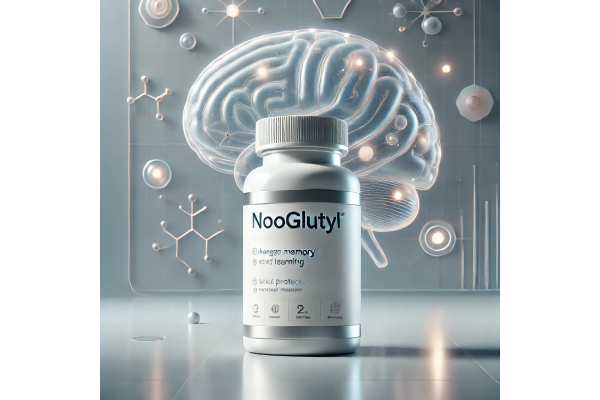
Nooglutyl (often written “nooglutil”) is a synthetic nootropic compound developed in Russia and studied mainly in animals. It belongs to a group of substances that modulate AMPA-type glutamate receptors, which are central to learning, memory, and synaptic plasticity. In laboratory models, Nooglutyl has shown promise for improving memory, protecting the brain after injury, and easing anxiety-like behaviors under stress.
At the same time, almost everything we know about Nooglutyl comes from experiments in rats and mice, not from clinical trials in people. It is not an approved medication in major regions and is usually sold online as a “research chemical,” often without strict quality control or clear dosing guidelines. That makes understanding both its potential and its uncertainties essential.
This guide explains how Nooglutyl appears to work, where it seems helpful in preclinical research, what is known about dosing in animal studies, what the main safety concerns are, and why any human use remains experimental.
Key Insights about Nooglutyl
- Nooglutyl is an experimental AMPA receptor modulator that improves learning, memory, and neurological outcomes in several animal models.
- Evidence in humans is essentially absent, so benefits and risks for people remain uncertain.
- Research doses in animals often range from about 10–70 mg/kg by injection, and there is no established safe or effective human dose.
- Potential risks include excessive glutamatergic stimulation with concerns about seizures, mood changes, and unknown long-term effects.
- People who are pregnant, have epilepsy, serious psychiatric illness, or major cardiovascular or liver disease should avoid experimental use of Nooglutyl.
Table of Contents
- What is Nooglutyl and how does it work?
- Potential cognitive and neurological benefits of Nooglutyl
- How is Nooglutyl used and who is it for?
- Nooglutyl dosage in studies and in practice
- Nooglutyl side effects and safety concerns
- Who should avoid Nooglutyl and why
- What the research says about Nooglutyl
What is Nooglutyl and how does it work?
Nooglutyl is a laboratory-designed nootropic whose chemical name is N-(5-hydroxynicotinoyl)-L-glutamic acid. In the scientific literature it is often referred to as “nooglutil” or by a development code such as ONK-10. It was originally synthesized at a Russian pharmacology institute as a potential treatment for amnesia and other cognitive impairments.
The compound acts primarily as a positive modulator of AMPA-type glutamate receptors. These receptors handle fast excitatory communication between neurons and are fundamental to synaptic plasticity, the process by which the brain strengthens or weakens connections in response to experience. A positive modulator does not directly activate a receptor; instead, it makes the receptor respond more strongly or more persistently to its usual signal—in this case, glutamate.
By enhancing AMPA receptor function, Nooglutyl appears to influence several neural processes:
- Efficiency of synaptic transmission in circuits related to learning and memory
- The brain’s response to injury, including hemorrhagic stroke models
- Behavioral responses to drug withdrawal and other stressors
This mechanism places Nooglutyl in the same broad family as so-called “ampakines,” another group of AMPA receptor modulators explored for cognitive enhancement and neuropsychiatric indications. The potential advantage of this class is targeted support of plasticity-related signaling. The main concern is that excessive glutamatergic activity can damage neurons or provoke seizures if pushed too far.
From a regulatory standpoint, Nooglutyl has not progressed to widely recognized phase II or phase III trials. It does not appear on lists of approved cognitive drugs in major jurisdictions, and most references describe it as a preclinical or early-stage experimental agent.
In practical terms, that means Nooglutyl should still be viewed as a research tool rather than as a finished therapeutic product.
Potential cognitive and neurological benefits of Nooglutyl
Claims about Nooglutyl’s benefits mostly trace back to animal studies that look at cognition, behavior, and brain resilience under different kinds of stress. While these findings cannot be assumed to apply directly to humans, they do outline where the compound seems most promising.
In models of hemorrhagic stroke, rats receive a controlled intracerebral bleed to imitate post-traumatic hematoma. When Nooglutyl is given as an injection a few hours after this injury, treated animals show fewer neurological deficits, better movement coordination, and improved performance on memory-related tasks compared to untreated controls. Mortality rates in those experiments are also lower in the Nooglutyl groups, suggesting a degree of neuroprotection in the acute phase of brain injury.
A different line of research uses senescence-accelerated mice that develop early aging features, including cognitive decline. In these models, Nooglutyl has been reported to improve locomotor activity, reduce anxiety-like behaviors, and enhance the retrieval of learned avoidance responses. The implication is that the compound may counter some aspects of age-related behavioral and memory deficits, at least within that specific strain and experimental setup.
Nooglutyl has also been examined in the context of benzodiazepine withdrawal. Long-term diazepam treatment is used to induce dependence in rats, which are then subjected to withdrawal. A single dose of Nooglutyl in this setting reduces anxiety-like behavior in conflict tests, without showing clear evidence of direct stimulation of dopamine D₂ receptors in normal animals. That pattern suggests a more nuanced modulation of stress and anxiety pathways.
When you put these findings together, several potential benefit domains emerge:
- Support for learning and memory under challenging conditions
- Protection of brain tissue and function after hemorrhagic or traumatic injury
- Reduction in anxiety-like symptoms associated with sedative withdrawal or aging
However, there are important limitations. The studies usually involve relatively small groups of animals, are often run in single laboratories, and may use different dosing schedules, making direct comparisons difficult. There is no large, independent body of replication, and virtually no high-quality human data.
For now, it is most accurate to say that Nooglutyl shows pro-cognitive and neuroprotective signals in animal models, and these signals justify continued research. They do not yet justify viewing the compound as a proven cognitive enhancer in everyday life.
How is Nooglutyl used and who is it for?
In formal research settings, Nooglutyl is used as a pharmacological probe. Neuroscientists, pharmacologists, and translational researchers administer it to animals to explore how boosting AMPA receptor activity affects learning, memory, neural recovery, and behavior under stress.
Typical experimental goals include:
- Testing whether AMPA modulation improves outcomes after brain injury
- Comparing Nooglutyl’s actions to those of other nootropics or neuroprotective drugs
- Mapping behavioral changes in models of aging, anxiety, or drug withdrawal
In these studies, animals are monitored closely, dosing is defined by experimental protocols, and results are analyzed statistically. Even in this controlled framework, Nooglutyl remains a tool for understanding mechanisms rather than a finished treatment.
Outside of laboratories, Nooglutyl appears in the online “nootropics” market. Vendors often describe it as a research chemical and explicitly state that it is not sold for human consumption, even though some customers are self-experimenters. People drawn to it tend to fall into a few broad groups:
- Hobbyist biohackers who seek novel cognitive enhancers
- Individuals who have tried more common nootropics and want something mechanistically different
- Users building complex “stacks” that combine multiple synthetic and natural compounds
These practices raise several concerns:
- Product quality and purity can be uncertain. Without transparent manufacturing and third-party testing, what is in the capsule or powder may not match the label.
- Dosing is speculative, since no human standard exists. People often rely on anecdotes, online forums, or rough conversions from animal data, which may not be safe.
- Use is usually unsupervised. Underlying conditions, drug interactions, and early warning signs of harm may go unnoticed.
In contrast, people with medically recognized cognitive problems—such as post-stroke deficits or dementia—are typically better served by evidence-based options: rehabilitative therapies, approved medications when indicated, and careful management of vascular risk factors. For them, experimental compounds like Nooglutyl are best handled within clinical trials where safety and benefit can be rigorously evaluated.
In short, while Nooglutyl is an interesting research compound, its role in everyday life for most people should be educational rather than practical: understanding what it is and what the current evidence shows, not ingesting it.
Nooglutyl dosage in studies and in practice
One of the most important points about Nooglutyl is that there is no clinically validated human dosage. All clear numerical guidance comes from animal work, and most of that uses injections rather than oral administration.
Some examples from the preclinical literature include:
- In hemorrhagic stroke models in rats, single intraperitoneal injections of 10 mg/kg and 20 mg/kg given a few hours after injury improved neurologic scores, motor coordination, and memory-related performance, while also reducing mortality compared with untreated animals.
- In benzodiazepine withdrawal experiments, rats withdrawn from long-term diazepam treatment received a single 70 mg/kg intraperitoneal dose of Nooglutyl, which reduced anxiety-like behaviors in conflict tests.
Other studies use similar intraperitoneal dose ranges and look at different models of cognitive impairment or brain damage. The details vary across experiments, and many are available only in summary form.
Converting these numbers directly into a “human dose” is not reliable for several reasons:
- Rodents and humans differ in metabolism, receptor distribution, and brain structure. Scaling formulas are rough at best when data are sparse.
- Most animal work uses injection. Oral absorption, breakdown, and active metabolite profiles in humans are unknown, which means the effective oral dose could be higher or lower than the injected dose.
- Toxicology, organ safety, and pharmacokinetics have not been systematically mapped in humans, so there is no defined safety margin.
Despite this, some commercial products present oral capsules in small unit doses, for example 5–10 mg each. These values do not come from published clinical trials. They are essentially guesses, possibly influenced by community experimentation rather than by formal dose-finding studies.
Because of this, it is not appropriate to give a “recommended daily dose” for Nooglutyl. From a safety and ethics standpoint:
- Any self-administered regimen is experimental.
- Combining Nooglutyl with other nootropics, stimulants, or psychiatric drugs increases uncertainty and risk.
- Responsible dose exploration, if it were ever done, would belong in a structured clinical trial with stepwise escalation, lab monitoring, and clear stopping rules.
Until such human data exist and are publicly available, the safest guideline is to treat Nooglutyl as a compound without an established dosage for human use, regardless of what labels or online sources may suggest.
Nooglutyl side effects and safety concerns
Because Nooglutyl has not been through modern clinical trials, its side effects in humans are largely unknown. Safety discussions therefore rely on animal observations, experience with similar AMPA modulators, and broader knowledge of nootropics as a category.
In many animal studies, the focus is on whether Nooglutyl improves behavioral or neurological outcomes, not on systematically cataloging adverse effects. The fact that treated animals often perform better in tasks and survive injury models suggests that acute toxicity at those doses is not overwhelming. However, these experiments usually do not include long-term organ assessments or large enough sample sizes to detect rare problems.
AMPA receptor modulators as a class are known to sit on a narrow balance: modest enhancement of glutamatergic signaling can support plasticity, but excessive activation can cause excitotoxicity, in which neurons are damaged by too much calcium influx and metabolic stress. Overly strong AMPA modulation has been associated in other contexts with seizures and worsening of brain injury.
On that basis, several categories of potential side effects are plausible if Nooglutyl were used by people:
- Neurological and psychiatric
- Headaches, restlessness, or agitation
- Insomnia, vivid dreams, or disrupted sleep cycles
- Heightened anxiety or irritability, especially in stress-sensitive individuals
- Lowered seizure threshold in people with existing risk factors
- Cardiovascular and autonomic
- Increases or fluctuations in heart rate and blood pressure
- Palpitations or a sensation of “overstimulation,” particularly when combined with caffeine or other stimulants
- Gastrointestinal and general
- Nausea, stomach discomfort, or reduced appetite
- Fatigue or mood dip after the drug wears off, especially if used repeatedly
There may also be indirect harms. Reviews of smart drug use in healthy people note that relying on pharmacological enhancement can lead to neglect of foundational habits (sleep, exercise, stress management), escalation to higher doses over time, and risky combinations with prescription medications.
The greatest concern with Nooglutyl is uncertainty. Without systematic human data, we do not know:
- How often serious adverse events would occur
- Whether certain organ systems (liver, kidneys, heart) are particularly vulnerable
- What happens with months or years of intermittent use
- How it interacts with common medications such as antidepressants, antiepileptics, or blood pressure drugs
Given that background, the default assumption should be that Nooglutyl has uncharacterized but potentially significant risks in humans, and that casual or unsupervised use is not advisable.
Who should avoid Nooglutyl and why
Because Nooglutyl’s safety profile in humans is poorly defined and its mechanism can increase neuronal excitability, several groups should avoid it entirely unless they are part of a formal clinical trial.
People with seizure risk or unstable neurological conditions
AMPA receptor modulation can, in principle, lower the threshold for seizures. Individuals with:
- Epilepsy or a history of unprovoked seizures
- Structural brain lesions, such as tumors or large scars from previous strokes
- Recent severe head injury or neurosurgery
face a higher theoretical risk that an excitatory compound could provoke or worsen seizure activity.
Individuals with serious psychiatric disorders
Any drug that alters excitatory neurotransmission can potentially destabilize mood or exacerbate psychotic or anxiety symptoms. People with:
- Bipolar disorder
- Schizophrenia or related psychotic conditions
- Severe generalized anxiety, panic disorder, or post-traumatic stress
are more vulnerable to unwanted mood and perceptual changes, and should not experiment with unapproved nootropics without specialist oversight. In practice, safer and better-studied treatments exist for these conditions.
Pregnant, breastfeeding, or underage individuals
Developing brains are particularly sensitive to perturbations in glutamatergic signaling. Since Nooglutyl has no reproductive or developmental safety data in humans and limited preclinical coverage, it should be avoided by:
- People who are pregnant or may become pregnant
- Those who are breastfeeding
- Children and adolescents whose nervous systems are still maturing
People with major cardiovascular, liver, or kidney disease
Metabolism and clearance of experimental compounds are often altered in organ impairment. Without pharmacokinetic and safety data in such populations, adding Nooglutyl can introduce unnecessary risk, particularly if blood pressure, heart rhythm, or drug clearance are already fragile.
Individuals on complex medication regimens
If you are taking:
- Multiple psychiatric or neurological medications
- Antiepileptic drugs
- Strong stimulants, sedatives, or other nootropics
the chance of unpredictable interactions is high. Nooglutyl could either amplify or blunt the effects of these medicines in ways that have not been systematically studied.
For all of these groups, avoiding Nooglutyl is the safest course. For individuals who are otherwise healthy but curious, the lack of evidence and undefined risk profile still argue for caution and for focusing on proven strategies—such as sleep, exercise, cognitive training, and appropriate medical care—before considering experimental substances.
What the research says about Nooglutyl
When you look across the available literature, Nooglutyl emerges as a compound with intriguing preclinical results but a large evidence gap in humans.
On the positive side, studies in rats and mice show:
- Improved neurological outcomes and survival after induced hemorrhagic stroke when Nooglutyl is given shortly after injury
- Better behavioral and memory performance in models of accelerated aging
- Reduced anxiety-like behavior during benzodiazepine withdrawal
These findings are consistent with its role as a modulator of glutamate signaling in circuits that support memory and stress resilience. They suggest that, in controlled experimental settings, Nooglutyl can help the injured or stressed brain perform better.
However, there are several caveats:
- Most studies involve small samples and are conducted in a narrow set of laboratories, which makes external validation difficult.
- Doses, timing, and outcome measures vary, so the full dose–response relationship is not clear even in animals.
- Long-term safety, including organ health and behavior beyond the study window, is seldom examined.
Broader reviews of nootropics and positive modulators of AMPA receptors reinforce a common pattern. Many agents in this class show promising animal results but then deliver modest, inconsistent, or no clear cognitive benefits in rigorous human trials. At the same time, they can introduce side effects or interactions that matter at a population level.
Drug-development databases and pharmacology overviews still list Nooglutyl as a preclinical or early-stage compound. There is no record of it completing the sequence of large phase II and phase III human trials that would be needed for approval as a medication for cognitive impairment, stroke recovery, or any other indication.
From a practical perspective, the key points are:
- Nooglutyl is scientifically interesting and may help researchers understand how AMPA modulation influences cognition and neuroprotection.
- Its benefits for everyday memory, focus, or performance in healthy people are unproven.
- Its risks, both short- and long-term, have not been mapped in humans.
- Safer, evidence-backed avenues exist for people seeking cognitive support, including lifestyle changes, management of cardiovascular and metabolic risk factors, and appropriate use of regulated medications under medical supervision.
Until well-designed human studies are carried out and published, Nooglutyl is best regarded as a research compound rather than as a ready-to-use brain supplement.
References
- Nootropics as Cognitive Enhancers: Types, Dosage and Side Effects of Smart Drugs 2022 (Systematic Review)
- Cognitive Impairment and Nootropic Drugs: Mechanism of Action and Spectrum of Effects 2023 (Review)
- Positive AMPA and Kainate Receptor Modulators and Their Therapeutic Potential in CNS Diseases: A Comprehensive Review 2025 (Systematic Review)
- Effect of nooglutil on benzodiazepine withdrawal syndrome and binding of 3H-spiperone with D2 receptors in rat striatum 2002 (Preclinical Study)
- [Effect of nooglutil on rats with intracerebral posttraumatic hematoma (hemorrhagic stroke)] 2003 (Preclinical Study)
Disclaimer
The information in this article is for educational purposes only and does not constitute medical advice, diagnosis, or treatment. Nooglutyl is an experimental compound without established safety, efficacy, or dosing guidelines in humans, and it is not approved as a medication by major regulatory agencies. Do not start, stop, or change any medication or supplement based on this article. Always consult a qualified healthcare professional about your specific health situation, especially before considering any nootropic, research chemical, or off-label therapy.
If you found this guide helpful, you are welcome to share it on Facebook, X (formerly Twitter), or any other platform you prefer, and to follow us on social media. Your support through thoughtful sharing helps our team continue to research and publish clear, evidence-informed content.