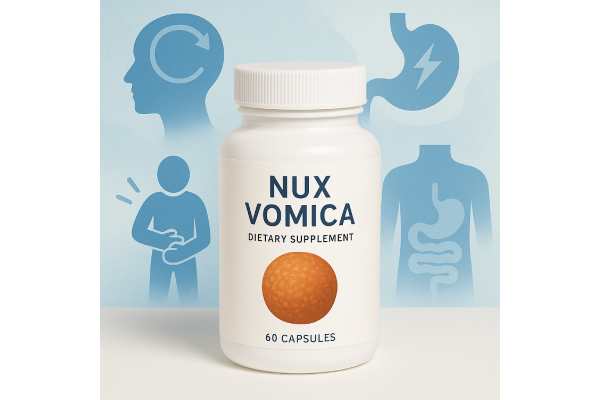
Nux vomica comes from the seeds of the Strychnos nux-vomica tree, a traditional remedy with a very narrow line between “medicine” and “poison.” The seeds are rich in powerful alkaloids, mainly strychnine and brucine, which can affect the nervous system, digestion, pain perception, and inflammation. Historically, detoxified seed preparations have been used in Ayurveda, traditional Chinese medicine, and Unani medicine for conditions such as digestive sluggishness, certain types of pain, and fatigue.
Today, nux vomica appears in two very different forms: highly diluted homeopathic products and tightly controlled herbal or pharmaceutical preparations used in research and specialized clinics. Understanding the difference between these forms is essential for safety. Crude or improperly processed seeds are extremely toxic and are not suitable for self-experimentation. This guide walks you through how nux vomica is thought to work, where potential benefits come from, how modern products differ, why safe dosage is so complex, and which risks and side effects matter most if you are considering any product containing nux vomica.
Key Insights for Nux vomica
- Detoxified and standardized nux vomica preparations show anti-inflammatory, analgesic, and neuroactive effects in laboratory and animal studies.
- Crude nux vomica seeds are highly poisonous because of strychnine and brucine and must never be used as homemade remedies.
- Modern therapeutic products use microgram-per-kilogram–level alkaloid doses under expert supervision; over-the-counter homeopathic nux vomica contains only ultra-diluted material.
- People who are pregnant, breastfeeding, have seizures, serious liver or kidney disease, or are on multiple nervous-system medicines should avoid nux vomica.
Table of Contents
- What is nux vomica and how does it work?
- Potential benefits of nux vomica in modern use
- How to take nux vomica safely
- Nux vomica dosage ranges and product types
- Risks, interactions, and who should avoid nux vomica
- What the research really says about nux vomica
What is nux vomica and how does it work?
Nux vomica refers to the dried seeds of the Strychnos nux-vomica tree, native to South and Southeast Asia. The seeds are very hard, disc-like, and naturally contain a mixture of indole alkaloids. Two stand out: strychnine and brucine. Both influence the central nervous system and are responsible for most therapeutic claims and most of the toxicity.
In traditional systems, detoxified seeds were considered warming, stimulating, and “nerve strengthening.” Different cultures applied elaborate detoxification processes before using the seeds medicinally. These steps might include prolonged soaking, boiling, roasting, or processing in specific liquids to reduce strychnine and brucine content. The resulting material was then used in very small amounts inside multi-herb formulas, not as a casual, standalone remedy.
From a modern pharmacology perspective, nux vomica acts mainly through:
- Blocking inhibitory glycine receptors in the spinal cord and brainstem, which makes motor neurons more excitable.
- Modulating pain-signaling pathways, partly via brucine and its derivatives.
- Interacting with inflammatory cascades and oxidative stress pathways in tissues.
These mechanisms explain why processed nux vomica extracts can appear to increase alertness, enhance certain reflexes, and show anti-inflammatory or analgesic effects in experimental models. However, they also explain the danger: the same pathways, overstimulated, produce severe muscle spasms, convulsions, and respiratory failure.
An important distinction is that homeopathic nux vomica products are chemically very different. They start from the same plant but are diluted repeatedly, often far beyond Avogadro’s limit, leaving little to no measurable alkaloid. Whatever one thinks about homeopathy, the toxicological risk profile of these products is not the same as that of herbal seed extracts.
In short, nux vomica is not an everyday “tonic herb.” It is a physiologically aggressive plant material with a razor-thin safety margin when used in its non-homeopathic forms.
Potential benefits of nux vomica in modern use
Most modern interest in nux vomica centers on processed seed preparations and isolated compounds such as brucine. The research focuses on potential benefits for pain, inflammation, neurological recovery, and tumor biology. It is crucial to remember that much of this work is preclinical (cell and animal studies), and does not justify unsupervised human use.
Commonly discussed potential benefits include:
- Digestive function
Traditional texts describe detoxified nux vomica as stimulating appetite, gastric secretions, and intestinal motility in “sluggish” digestion. Some animal studies support effects on gut motility and secretions. However, the same stimulatory action is part of its toxic profile, so this is not a benign “digestive bitter.” - Pain and inflammation
Processed seed extracts and brucine-rich fractions display analgesic and anti-inflammatory effects in animal models. They appear to inhibit specific inflammatory mediators and modulate pain perception pathways. This underlies their use in traditional formulas for joint pain, neuralgia, and certain chronic pain patterns. - Neurological recovery
In controlled laboratory settings, carefully standardized nux vomica seed preparations have shown improvements in functional recovery after nerve injury in rodents, along with reductions in oxidative stress markers. This suggests possible neuroprotective or neurorestorative effects, but only under strictly controlled dosing and processing. - Anti-tumor activity
Brucine and related compounds from nux vomica have demonstrated anti-proliferative effects in various cancer cell lines and experimental models. They may interfere with cell-cycle regulation, angiogenesis, and apoptosis pathways. These findings are scientifically interesting but remain far removed from safe, evidence-based cancer therapies in humans. - Immune and metabolic effects
Some data suggest effects on immune modulation and blood sugar regulation when processed nux vomica is combined with other herbs. It is rarely used alone for these purposes.
There is an important theme: promising biological activity in the lab does not automatically translate into a practical, safe supplement for general use. In fact, because the active compounds are so toxic, nux vomica may be one of the least suitable plants for self-directed experimentation, even if its pharmacology is intriguing.
How to take nux vomica safely
When people ask how to take nux vomica, they are usually mixing together very different products. Safety depends almost entirely on which form you mean:
- Crude or minimally processed seeds
- These are the raw seeds or simple powders from the whole seed.
- They remain highly poisonous and are not safe for self-administration in any quantity.
- Even small errors in weighing, grinding, or preparing them can lead to life-threatening strychnine poisoning.
- They should not be used at home for any reason.
- Detoxified herbal preparations
- These are products in which the seeds have undergone controlled detoxification processes to reduce strychnine and brucine content while retaining some pharmacological activity.
- They are used within regulated traditional medicine systems, often in combination formulas, and typically in specialized clinics.
- Dosing is based on standardized alkaloid content, not just milligrams of crude seed, and is adjusted by practitioners trained in both traditional and modern toxicology.
- For an individual consumer, these are not appropriate “do-it-yourself” supplements.
- Standardized extracts, fractions, or brucine-based preparations
- In modern research, purified or enriched fractions are used to probe analgesic, anti-inflammatory, neuroprotective, or anti-cancer mechanisms.
- These are investigational materials, not over-the-counter health supplements.
- If they appear in clinical studies, they are prescribed and monitored within the trial protocol, often with careful lab monitoring.
- Homeopathic nux vomica
- These preparations are typically labeled with potencies such as 6C, 9C, 30C, or similar.
- Repeated dilution and succussion means they contain extremely low, often non-detectable amounts of strychnine or brucine.
- Toxicological risk from alkaloids is therefore negligible when products are manufactured correctly.
- Whether or not one finds them clinically helpful, they should not be confused with herbal extracts.
Practical safety principles:
- Never attempt to process or detoxify nux vomica seeds yourself, even if you have access to traditional instructions. Small technical mistakes can drastically change alkaloid content.
- Avoid buying loose seeds or non-standardized powders for oral use. Laboratory data show wide variation in strychnine and brucine levels between batches.
- If a product does not clearly distinguish whether it is homeopathic or an herbal extract, do not use it until you have independent confirmation.
- If a licensed practitioner recommends a nux vomica–containing herbal formula, ask explicitly how the preparation is standardized, what monitoring is required, and what early toxicity signs to watch for.
For most people, the only form that can reasonably be considered at home without medical supervision is properly manufactured homeopathic nux vomica, and even then, it should be treated like any other medicinal product and discussed with a healthcare professional.
Nux vomica dosage ranges and product types
Unlike many herbs, there is no simple “take X mg per day” guideline for nux vomica. The safe use of non-homeopathic nux vomica depends on the precise content of strychnine and brucine, the method of detoxification, the patient’s body weight and comorbidities, and co-administered medicines. Because the therapeutic window is extremely narrow, major herbal regulatory bodies in several countries have concluded that crude nux vomica is not suitable for self-medication.
Key points about dosage:
- Variability of alkaloid content
Crude seeds can contain around one percent or more total toxic alkaloids by weight, but this varies by origin, harvest, and storage. Detoxification can reduce strychnine and brucine levels by roughly half or more, but the exact reduction depends on the chosen method and its execution. Using “milligrams of seed” as a dosage unit is therefore misleading. - Therapeutic versus toxic range
Experimental and historical clinical data suggest that any physiologically active dose of strychnine sits uncomfortably close to doses that can cause severe toxicity. Modern toxicology reports underscore that relatively small increases above intended therapeutic exposure can produce life-threatening effects. This makes a fixed self-care “dose range” for crude nux vomica inherently unsafe. - Research-grade standardized preparations
In modern studies, detoxified seed preparations or extracts are sometimes dosed in a way that corresponds to microgram-level amounts of total alkaloids per kilogram of body weight in animal models. Translating such protocols to humans safely requires rigorous pharmacokinetic work and regulatory oversight. These are not dosing schemes for home use. - Homeopathic dosing
For homeopathic pellets or drops, the usual instructions specify the number of pellets, drops, and frequency rather than milligrams of plant material. Because these products are ultra-diluted, the focus is not on strychnine intake but on the specific homeopathic approach. From a safety standpoint, following the manufacturer’s guidance and not exceeding label recommendations is normally adequate for healthy adults, but it is still wise to discuss use with a knowledgeable clinician, especially in pregnancy or serious chronic illness.
Putting this together:
- There is no universally accepted, safe, oral dosage of crude nux vomica seeds for self-care.
- Detoxified and standardized preparations are dosed according to alkaloid content under expert supervision.
- Homeopathic nux vomica is dosed as per product labeling, and is not used as a source of alkaloids.
If you see an online source suggesting you take a certain number of raw seeds or a certain gram amount of unstandardized powder, that advice conflicts with contemporary toxicology and should be considered unsafe.
Risks, interactions, and who should avoid nux vomica
The primary risk of nux vomica is straightforward: strychnine and brucine are powerful neurotoxins. While detoxification and standardization can reduce this risk under professional supervision, the margin between a stimulating dose and a poisonous one is very narrow.
Major risks of non-homeopathic nux vomica include:
- Acute poisoning
Symptoms can include intense muscle stiffness, painful convulsions triggered by minimal stimuli (light, sound, touch), locked jaw, breathing difficulty, hyperthermia, and rapid progression to respiratory failure. Consciousness may remain intact during seizures, which can be extremely distressing. This is a medical emergency requiring intensive care. - Neurological and muscular complications
Even with survival, prolonged convulsions can lead to muscle breakdown (rhabdomyolysis), kidney injury, and long-term neurological effects. - Cardiovascular strain
Severe muscle activity, extreme stress, and hyperthermia can stress the heart and circulation, especially in people with existing cardiovascular disease. - Narrow therapeutic index
The difference between the lowest dose that causes noticeable neurological effects and the dose that causes severe toxicity is small. That is why modern mainstream practice generally avoids strychnine-containing remedies outside strictly controlled settings. - Product quality issues
Mislabeling, contamination, incorrect detoxification, or inaccurate measurement of alkaloid content can all turn a theoretically “safe” product into a dangerous one.
Potential interactions:
- Central nervous system medicines
Drugs that affect seizure threshold (such as some antidepressants, antipsychotics, or stimulants) may interact unpredictably with any residual strychnine-like activity. - Other herbs or supplements with stimulating or convulsant potential
Combining multiple stimulating agents can increase nervous system instability. - Liver or kidney–metabolized medicines
Severe toxicity can impair organ function, complicating other medications that depend on these organs for clearance.
Who should avoid nux vomica entirely (including non-homeopathic herbal forms):
- People with any history of seizures, epilepsy, or unexplained convulsions.
- Those with serious liver or kidney disease.
- Pregnant or breastfeeding individuals, due to potential fetal and neonatal toxicity.
- Children and adolescents, for whom the risk–benefit ratio is particularly unfavorable.
- Anyone with active severe anxiety, agitation, or conditions worsened by nervous system stimulation.
- Individuals taking multiple medicines that affect the central nervous system, unless under direct specialist supervision.
Even with homeopathic nux vomica, caution is advisable in pregnancy, the very elderly, and those with complex medical regimens. While alkaloid toxicity is not a concern with ultra-diluted products, overall medication burden and individual sensitivity still matter.
If there is any suspicion of nux vomica or strychnine exposure above therapeutic levels, emergency medical care should be sought immediately, rather than waiting for symptoms to progress.
What the research really says about nux vomica
Modern research on nux vomica paints a nuanced picture: this plant has potent bioactive compounds with genuine pharmacological effects, but it is also inherently dangerous, and the distance between “interesting” and “clinically useful and safe” is large.
Highlights from preclinical and clinical research:
- Comprehensive reviews
Large reviews of Strychnos nux-vomica summarize its botany, phytochemistry, pharmacology, and toxicity. They confirm a broad range of activities: antioxidant, anti-inflammatory, analgesic, neuroactive, and anti-tumor, among others. However, they also emphasize that many studies are preliminary and often rely on processed seeds or isolated compounds in animal or cell models rather than well-designed, modern human trials. - Detoxification studies
Analytical work on traditional detoxification methods shows that boiling, soaking, and other processes can significantly reduce strychnine and brucine content, sometimes by about half or more, while preserving some phenolic and other constituents. This supports the idea that detoxification is not simply “ritual” but chemically meaningful. Still, these methods were validated in laboratories with precise measurements, not in home kitchens. - Processed seed preparations
In specific animal models, detoxified nux vomica seed preparations have improved recovery after nerve injury and modulated oxidative stress and inflammatory markers. These findings hint at neuroprotective and functional benefits but do not establish safety or efficacy in humans for any particular indication. - Isolated alkaloids like brucine
Brucine has been studied for anti-inflammatory, analgesic, and anti-cancer properties in various experimental systems. Network pharmacology and molecular docking studies have explored how brucine and related compounds might interact with multiple targets involved in inflammation, apoptosis, and tumor progression. These are sophisticated scientific explorations, but they also underscore how strong these compounds are—and why they must be handled cautiously. - Toxicology and case reports
Case reports and toxicology reviews document severe strychnine poisonings, sometimes from rodenticides and sometimes from medicinal or accidental exposures. They highlight the characteristic convulsions, the need for intensive care, and the potential for death even with prompt treatment. These real-world experiences reinforce why regulators often classify nux vomica as an unsafe herb for over-the-counter therapeutic use.
Crucially, there is a lack of high-quality, modern, randomized controlled trials showing that any non-homeopathic nux vomica preparation provides a clear, clinically meaningful benefit that outweighs its risks for common conditions in the general population. Most evidence is small-scale, preliminary, or conducted in specialized contexts.
Putting it in perspective:
- Nux vomica is best viewed as a toxic plant with interesting pharmacology rather than a routine wellness supplement.
- Research supports its potential in tightly controlled, narrow niches, but not as a general-purpose tonic or home remedy.
- For most individuals seeking digestive support, pain relief, or mood balance, safer and better-studied options are available.
References
- Botany, phytochemistry, pharmacology and toxicity of Strychnos nux-vomica L.: a review 2018 (Systematic Review)
- Strychnos nux-vomica L. seed preparation promotes functional recovery and attenuates oxidative stress in a mouse model of sciatic nerve crush injury 2020 (Preclinical Study)
- Different Traditional Methods of Nux-Vomica Detoxification Have Therapeutic Rationales 2016 (Analytical and Pharmacognostic Study)
- Brucine: A Review of Phytochemistry, Pharmacology, and Toxicology 2020 (Systematic Review)
- Strychnos nux-vomica: A Poisonous Plant with Various Aspects of Therapeutic Significance 2017 (Narrative Review)
Disclaimer
The information in this article is for educational purposes only and is not intended as medical advice, diagnosis, or treatment. Nux vomica is a highly toxic plant, and non-homeopathic preparations should never be used without direct guidance from a qualified healthcare professional experienced in its pharmacology and toxicology. Never attempt to process or dose nux vomica seeds on your own. If you are considering any product that contains nux vomica, discuss it with your physician, pharmacist, or licensed traditional medicine practitioner, especially if you are pregnant, breastfeeding, have chronic health conditions, or take prescription medications. In any suspected poisoning or overdose, seek emergency medical care immediately.
If you found this guide helpful, you are welcome to share it with others on Facebook, X (formerly Twitter), or any platform you prefer, and to follow our work on social media. Your thoughtful support by sharing our articles helps our team continue to research and produce balanced, evidence-informed content.