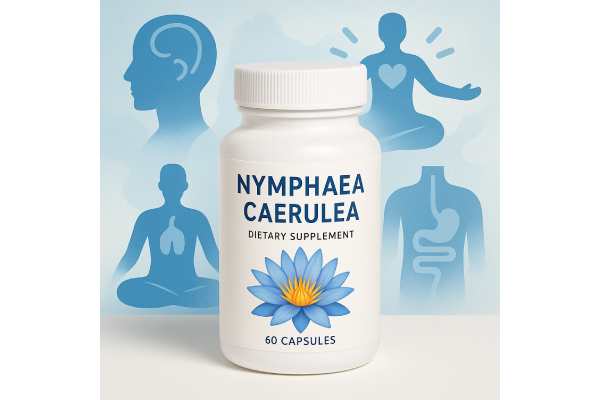
Nymphaea caerulea, often called blue lotus or Egyptian blue water lily, is a visually striking aquatic plant with a long history of ceremonial and sensual use. Ancient artwork from the Nile region suggests that its flowers were valued for their fragrance, beauty, and possible mood-altering effects. Today, blue lotus is widely sold online as dried flowers, resins, extracts, and vape products promoted for relaxation, sleep, enhanced dreaming, and intimacy.
The modern appeal of Nymphaea caerulea rests on a handful of key ideas: that it may gently calm the nervous system, shift mood, encourage a dreamy or meditative state, and offer a “natural” alternative to synthetic relaxants. At the same time, there are important cautions. Chemical analyses show that blue lotus contains psychoactive alkaloids that act on dopamine and serotonin receptors. Commercial products can differ enormously in strength, purity, and composition, and formal safety studies in humans are limited.
This guide explains what Nymphaea caerulea is, how it appears to work, what benefits people seek from it, how it is used, what is known about sensible dosage ranges, and which side effects and risks deserve close attention.
Key Insights for Nymphaea caerulea
- Nymphaea caerulea (blue lotus) contains alkaloids such as nuciferine and related molecules that interact with dopamine and serotonin receptors and may produce mild relaxation and mood changes.
- Evidence for benefits like reduced anxiety, improved sleep, or better sexual function is mainly anecdotal, with only limited preclinical and case-based scientific support.
- Common product directions cluster around about 1–3 g of dried petals as tea or around 200–300 mg of concentrated extract per serving, but no official safe or therapeutic human dose has been defined.
- Side effects can include dizziness, drowsiness, confusion, nausea, and distressing changes in perception, especially with high doses or inhaled/vaped products.
- People who are pregnant or breastfeeding, under legal drinking age, or living with heart disease, serious mental health conditions, or complex medication regimens should avoid blue lotus unless a specialist clearly advises otherwise.
Table of Contents
- What is Nymphaea caerulea and how does it work?
- Main benefits and traditional uses of Nymphaea caerulea
- Practical ways to use Nymphaea caerulea today
- Nymphaea caerulea dosage: how much and how often?
- Side effects, risks, and who should avoid Nymphaea caerulea
- Research summary, legal status, and safety gaps
What is Nymphaea caerulea and how does it work?
Nymphaea caerulea is a water lily species native to parts of East Africa and the Nile basin. It has rounded floating leaves and showy blue to violet flowers that open in the morning and close at dusk. Historically, it is often depicted in ancient Egyptian art and funerary scenes, where the blossoms appear near the nose, in wreaths, or scattered around important figures. This suggests cultural roles that combine symbolism, fragrance, and possible psychotropic effects.
Blue lotus is botanically distinct from the sacred lotus (Nelumbo nucifera), though they are often confused in popular writing. Both plants, however, share certain types of alkaloids. Analyses of authenticated Nymphaea caerulea extracts show a mix of fatty acids, aromatic compounds, diterpenoids, phytosterols, and, most importantly, aporphine-type alkaloids such as nuciferine. Some plant materials and products may also contain detectable levels of apomorphine or closely related molecules.
These alkaloids interact with receptors for dopamine and serotonin, two key neurotransmitters involved in mood, reward, wakefulness, and perception. Nuciferine, for example, has shown complex actions at several dopamine and serotonin receptor subtypes in laboratory work. In living systems, this kind of “multi-receptor” pattern can translate into subtle changes in alertness, emotional tone, and sensory filtering. Apomorphine, when present, is a stronger dopamine agonist and is used clinically in strictly controlled injectable form for certain conditions.
From the point of view of someone drinking a blue lotus tea or using a resin, the practical takeaway is that Nymphaea caerulea is not simply a fragrant flower. Properly prepared extracts can act as mild psychoactives, often described as generating relaxed clarity, pleasant heaviness in the body, or a dreamy state somewhere between waking and sleep. At higher exposures or with rapid delivery methods like vaping, the same pharmacology can tip into confusion or agitation.
Another layer of complexity is product variability. Comparative research between authenticated plant extracts and commercially available “blue lotus” products has found wide differences in chemical composition. Some retail products resemble genuine extracts, while others contain very low amounts of characteristic alkaloids or appear to be adulterated. This variability makes it hard to predict effects or to define a reliable dose.
Overall, Nymphaea caerulea is best understood as a visually beautiful aquatic plant with genuine neuroactive potential, mediated mainly through dopamine and serotonin systems, but with considerable uncertainty around potency in real-world products.
Main benefits and traditional uses of Nymphaea caerulea
For many people, blue lotus carries a sense of mystique: ancient art, ritual scenes, and claims about trance-like states or enhanced intimacy. It is important to separate the symbolic layers from what people actually use it for today and what the science can plausibly support.
Historically, the flowers appear linked to:
- Fragrance and decoration in feasts, rituals, and burials.
- Association with rebirth, the sun, and altered states in mythological cycles.
- Occasional references to steeping blossoms in alcoholic drinks for celebratory or ceremonial purposes.
These uses suggest that blue lotus was valued for both its sensory qualities and its mood-shifting effects, but they do not amount to a detailed medical tradition in the way some other herbs are documented.
In contemporary practice, Nymphaea caerulea is most often promoted for:
- Relaxation and stress relief
Many users describe a gentle winding down of mental chatter, reduced muscle tension, and a sense of calm sociability when they drink a moderate-strength tea or use a small amount of extract. The dopamine- and serotonin-related actions of its alkaloids offer a plausible mechanism for these experiences. - Sleep and dream support
Some people report easier sleep onset, more vivid dreams, or a light hypnagogic state between waking and sleep when using blue lotus in the evening. These reports are highly individual. There is not yet strong research showing that blue lotus improves insomnia in a sustained, clinically meaningful way, so it should not be considered a primary treatment for chronic sleep disorders. - Mood and emotional tone
At modest doses, users sometimes describe slight euphoria, emotional softening, or increased appreciation for music and touch. At higher doses, however, the same mechanisms can overshoot, leading to emotional blunting, anxiety, or a sense of detachment. - Sensuality and intimacy
Blue lotus is occasionally marketed as an aphrodisiac. Some partners find that it helps them feel more relaxed and connected, possibly by reducing performance anxiety or increasing bodily awareness. There is no robust clinical evidence that Nymphaea caerulea directly enhances sexual function, so any benefits here are best understood as indirect and mood-related.
Beyond these psychoactive themes, laboratory studies indicate that blue lotus constituents have antioxidant and anti-inflammatory properties and can influence certain enzymes and microbial strains. These findings are interesting but still early and are not a reason on their own to start using the plant.
In summary, the most realistic and evidence-aligned expectation is that Nymphaea caerulea may provide a mild, somewhat unpredictable shift toward relaxation and dream-like awareness for some people, with significant variation by individual and product. It is not a proven cure for anxiety, depression, or insomnia, and it should not replace established therapies for those conditions.
Practical ways to use Nymphaea caerulea today
Modern blue lotus products span a wide range of formats. The form you choose dramatically affects onset, intensity, and risk profile.
Commonly available forms include:
- Dried flowers or petals
Sold loose or in tea bags. These can be steeped in hot water or soaked in wine or other beverages. Effects tend to be slower in onset and milder. - Concentrated extracts and resins
These may be labeled with ratios such as “10:1” or “20:1,” indicating an attempt to concentrate active compounds. They can be added to liquids, taken under the tongue, or incorporated into other plant blends. - Tinctures and fluid extracts
Usually alcohol- or glycerin-based, dosed in drops or milliliters. The concentration of alkaloids varies, often without detailed testing data on the label. - Smokeable herbs and vape liquids
Some products mix blue lotus with other botanicals to be smoked or vaporized. Others are marketed as pure blue lotus e-liquids. These routes deliver constituents to the bloodstream more rapidly, leading to quicker and often stronger effects.
If someone chooses to use blue lotus despite the uncertainties, gentler methods are generally preferable:
- Tea or infusion with dried petals
- Steep 1–2 g of dried petals (roughly a teaspoon, depending on density) in just-boiled water for 10–15 minutes.
- Start with half a cup, then wait 60–90 minutes before deciding whether to drink more.
- Use this ritual no more than occasionally to reduce the risk of building tolerance or psychological dependence.
- Diluted tinctures or extracts
- Follow the lowest end of the product’s suggested serving range.
- Mix the extract into a cup of water or non-alcoholic beverage rather than taking it all at once.
- Avoid taking it on an empty stomach until you understand how your body responds.
- Avoiding risky combinations
- Do not mix blue lotus with alcohol, benzodiazepines, opioids, or strong sleep medications.
- Avoid using it in combination with other psychoactive herbs or recreational substances.
Routes such as vaping and smoking deserve special caution. Case reports of blue lotus–related toxicity have commonly involved inhaled preparations, with users arriving at emergency departments in states of severe confusion or agitation. The rapid spike in blood levels and the possibility of additional undisclosed substances make inhalation a high-risk practice compared with tea.
Additional practical harm-reduction advice:
- Use blue lotus only in safe, familiar environments where you do not need to drive or operate machinery.
- Avoid using it when you are alone if you are unsure how it affects you.
- Keep it out of reach of children and pets; psychoactive plants should be treated like medications, not casual teas.
For many people, the safest decision is to treat the plant as ethnobotanical information rather than something to ingest. If you do decide to experiment, doing so rarely, at low doses, and with oral tea-based preparations offers the most conservative path.
Nymphaea caerulea dosage: how much and how often?
A central challenge with blue lotus is that there is no official, standardized dosage framework. Authorities in many regions do not recognize Nymphaea caerulea as a food or medicinal ingredient, so formal guidelines for safe intake simply do not exist. Any numbers you see on packaging come from manufacturers, not from regulatory assessments.
Even so, certain patterns appear across products and user reports, which can be discussed as reference points rather than firm recommendations.
For dried petals or flowers used as tea:
- Many packages suggest about 1–3 g of dried material per serving.
- Some “strong brew” directions recommend up to around 5 g per session, typically split into more than one cup.
- These amounts might be spread over an evening rather than taken all at once.
For solid or powdered extracts:
- Extracts labeled with high ratios (for example, “10:1”) often list 200–300 mg as a typical serving, sometimes up to twice that for advanced users.
- Resins may describe a pea-sized amount, which usually corresponds to several hundred milligrams.
For tinctures:
- Serving sizes tend to range around 0.5–1 mL, taken up to a few times per day according to labels, though using it every day is harder to justify given the lack of long-term safety data.
Because real-world products vary so much in their content of nuciferine, apomorphine, and other constituents, these ranges should not be treated as universally safe. Some products may be comparatively weak; others, especially those with enriched alkaloid content, may be much stronger per unit than expected.
Conservative patterns of use, if someone proceeds, would include:
- Staying at the lower end of label suggestions or below, at least for the first few attempts.
- Limiting use to occasional sessions (for example, once every one to two weeks rather than nightly).
- Avoiding repeated doses in a single evening when the initial effects feel subtle; some people only realize how altered they are when they try to stand, read, or interact.
There is also the question of cumulative effects. It is not currently known whether frequent, ongoing exposure to blue lotus alkaloids increases the risk of mood instability, dependence, or tolerance. In the absence of strong data, it is prudent to assume that regular daily use could carry additional risk.
Certain groups should treat these dosage ranges as upper bounds or avoid blue lotus altogether, including people with smaller body size, those over 65, and those taking medications that influence the brain, blood pressure, or heart rhythm. For them, even common label doses may be too high.
The safest summary is that there is no universally safe or therapeutic dose of Nymphaea caerulea that can be recommended for general health. Any exposure should be as low, infrequent, and carefully monitored as possible, if it is used at all.
Side effects, risks, and who should avoid Nymphaea caerulea
Because blue lotus affects central neurotransmitter systems, side effects and risks need to be taken seriously, even if many users experience only mild effects. The plant’s psychoactive profile puts it closer to a novel psychoactive substance than to a routine culinary herb.
At mild to moderate doses, commonly reported effects include:
- Drowsiness or a heavy, “floaty” body feeling.
- Dizziness, unsteady walking, or difficulty focusing.
- Mild nausea or stomach discomfort.
- Changes in blood pressure or heart rate that may feel like palpitations or lightheadedness.
- Emotional blunting or, sometimes, paradoxical anxiety.
At higher exposures or with concentrated inhaled products, more severe reactions have been documented, such as:
- Noticeable confusion or disorientation.
- Agitation, restlessness, or panicked states.
- Slurred speech or difficulty forming coherent thoughts.
- Significant impairment in coordination and reaction time.
In a series of documented clinical encounters, adults who had used blue lotus—often by vaping—presented to emergency departments with acute altered mental states. Standard toxicology screens sometimes failed to detect the plant’s constituents, complicating diagnosis. This highlights how misleading it can be to assume that a “natural” plant-based product is automatically safe or softly acting.
Potential interactions are another concern:
- Central nervous system depressants
Combining blue lotus with alcohol, sedative medications, or opioid painkillers may increase sedation, confusion, and risk of accidents or respiratory depression. - Medications affecting dopamine or serotonin
People taking antidepressants, antipsychotics, Parkinson’s disease medications, or other drugs that act on these systems could experience unpredictable effects. - Other psychoactive herbs or substances
Stacking multiple substances that alter perception or mood makes it harder to judge dose, increases risk, and complicates medical care if something goes wrong.
Groups that should avoid Nymphaea caerulea entirely include:
- Pregnant and breastfeeding individuals, since the impact on fetal and infant development is unknown, and psychoactive substances are generally discouraged in these periods.
- Children and adolescents, whose brains are still developing and who may be more vulnerable to mood and perception changes.
- People with a history of psychosis, bipolar disorder, severe depression, or panic disorder, because modulation of dopamine and serotonin can destabilize symptoms.
- Individuals with cardiovascular disease or arrhythmias, due to possible heart rate and blood pressure effects.
- Those with chronic liver or kidney disease, who may not process or eliminate alkaloids efficiently.
- Anyone in a safety-sensitive role, such as professional drivers, pilots, or operators of heavy machinery.
Warning signs that warrant urgent medical attention include chest pain, extreme agitation, hallucinations, inability to stay awake or to be roused, uncontrolled vomiting, or any sudden change in speech or movement. In such situations, emergency services should be contacted and all recent substance use—including blue lotus products—should be disclosed to healthcare providers.
In short, while many people view blue lotus as a gentle herbal relaxant, its psychoactive nature and the variability of commercial products mean that risks are real. Caution, self-awareness, and prompt medical help in the face of severe symptoms are essential.
Research summary, legal status, and safety gaps
Scientific interest in Nymphaea caerulea and related plants has increased in recent years, but the research base is still modest compared with more established herbs. Existing work focuses on three main areas: chemical composition, pharmacology of its alkaloids, and safety signals from real-world use.
On the chemistry side, detailed analyses of authenticated blue lotus extracts show a complex mixture of molecules, including fatty acids, aromatic alcohols, phenyl derivatives, diterpenoids, and plant sterols. The aporphine alkaloids nuciferine and related compounds appear at relatively low but significant levels. When researchers compared authentic extracts with commercial blue lotus products, they found substantial differences, with some retail items showing very different profiles or much lower amounts of key constituents. This raises questions about labeling accuracy and consistency.
Pharmacological studies of nuciferine and other aporphine alkaloids reveal that they can act at several dopamine and serotonin receptor subtypes, sometimes in ways that resemble atypical antipsychotic templates. In animal models, nuciferine has shown antipsychotic-like actions without some of the side effects of older drugs, as well as effects on locomotion and sensory processing. This helps explain why blue lotus might alter mood and perception but also underscores that these are powerful scaffolds better suited to controlled drug development than casual self-experimentation.
Analytical work on blue lotus resins and vaping materials has confirmed that certain products contain apomorphine and nuciferine, both clearly psychoactive. Clinical case reports document that people using these products, especially via vaping, can develop enough confusion and behavioral change to require hospital care. This line of evidence confirms that blue lotus can be acutely toxic or destabilizing at real-world doses.
Legal status varies:
- In many countries, blue lotus is not officially scheduled as a controlled substance but is not recognized as a food or approved herbal medicine either. Products are often sold as “incense,” “collector’s items,” or “not for human consumption” to avoid regulatory issues.
- Some jurisdictions have explicitly banned blue lotus products, particularly where they have become popular as legal highs.
- Certain organizations, such as military and safety-sensitive employers, may prohibit its use regardless of civilian law because of its psychoactive nature and potential to impair performance.
Significant gaps remain in our understanding:
- There are no large, high-quality human trials evaluating blue lotus for anxiety, sleep, or other common wellness outcomes.
- Long-term safety with repeated use has not been systematically studied.
- The impact of chronic blue lotus exposure on mental health, cognition, and cardiovascular function is unknown.
- Interactions with prescription medications have not been mapped beyond theoretical considerations.
Given these gaps, the most cautious interpretation is that Nymphaea caerulea is scientifically interesting, culturally important, and genuinely psychoactive—but not yet supported by robust evidence for safe, routine, self-directed use. People seeking help for anxiety, insomnia, or mood issues are more likely to benefit from well-studied, regulated approaches, whether herbal, psychological, or pharmacological, guided by qualified professionals.
References
- Chemical Composition, Market Survey, and Safety Assessment of Blue Lotus (Nymphaea caerulea Savigny) Extracts 2023 (Experimental and Safety Study)
- The Blue Lotus Flower (Nymphea caerulea) Resin Used in a New Type of Electronic Cigarette, the Re-Buildable Dripping Atomizer 2017 (Analytical Case Study)
- In Vitro and In Vivo Characterization of the Alkaloid Nuciferine 2016 (Pharmacological Study)
- Toxicity From Blue Lotus (Nymphaea caerulea) After Ingestion or Inhalation: A Case Series 2021 (Clinical Case Series)
- A Systematic Review of Proaporphine Alkaloids and a Pharmacological Update 2025 (Systematic Review)
Disclaimer
The information in this article is provided for general educational purposes only and is not intended as medical advice, diagnosis, or treatment. Nymphaea caerulea (blue lotus) products are not approved medicines, their composition can vary widely, and their effects and long-term risks are not fully understood. Do not use blue lotus or any other psychoactive plant as a substitute for professional care for anxiety, sleep problems, pain, or any medical or psychological condition. Always consult a qualified healthcare professional before trying new herbs or supplements, especially if you are pregnant, breastfeeding, under legal adult age, have chronic health conditions, or take prescription medications. If you experience severe or concerning symptoms after using blue lotus, seek urgent medical attention and inform clinicians about everything you have taken.
If you found this guide useful, you are welcome to share it on Facebook, X (formerly Twitter), or any social platform you prefer, and to follow our future work. Thoughtful sharing helps support our ability to continue producing careful, evidence-informed content on botanical and integrative health topics.