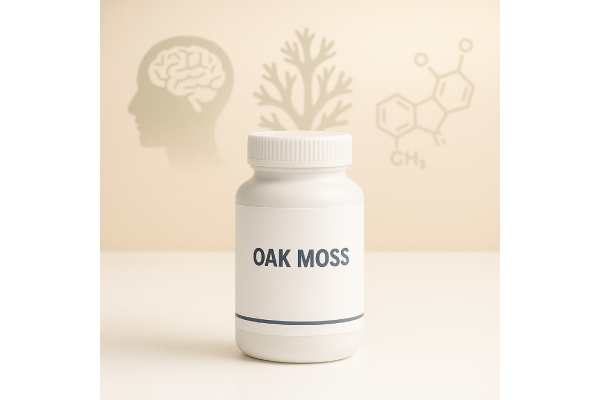
Oak moss, usually referring to the lichen Evernia prunastri, is far better known in perfumery than in herbal medicine. It grows on oak and other trees, forming soft, branching clumps with a deep, forest-like aroma that has shaped classic chypre and fougère fragrances for decades. In recent years, you may see oak moss mentioned in teas, tinctures, skin care, and even metabolic or anticancer research. Laboratory studies show that its polyphenols and polysaccharides can act as antioxidants, influence inflammatory pathways, and inhibit certain microbes under controlled conditions.
At the same time, oak moss is a recognised fragrance allergen and a complex, chemically variable lichen that can accumulate environmental pollutants. Internal use is poorly studied and may carry kidney and nervous system risks, especially at higher doses or with long-term intake. This guide walks you through what oak moss actually is, how it is used, what science suggests, and where caution clearly outweighs curiosity.
Key Insights on Oak Moss
- Oak moss is a fragrant lichen with antioxidant, anti-inflammatory, and antimicrobial activity in laboratory models.
- Real-world health benefits for digestion, immunity, or chronic disease are unproven and largely based on tradition.
- Cosmetic and perfume products usually limit oak moss to very low concentrations, often around or below 0.1% of the finished formula.
- Internal use (tea, tincture, capsules) is not supported by robust safety or dosing data and may be unsafe in higher or prolonged doses.
- People who are pregnant, breastfeeding, have kidney disease, porphyria, or known fragrance allergies should avoid oak moss unless a clinician specifically advises otherwise.
Table of Contents
- What is oak moss and how does it work?
- Oak moss benefits: what it may help with
- How to use oak moss in real life
- Oak moss dosage and typical concentrations
- Oak moss side effects, risks, and who should avoid it
- Research summary: what science says about oak moss
What is oak moss and how does it work?
Oak moss is not a true moss but a lichen: a partnership between a fungus and a photosynthetic partner, usually an alga. The species most often used in products is Evernia prunastri, a fruticose (shrubby) lichen that forms short, branching, flattened lobes. It prefers the bark of oaks but also colonises fir, pine, and other trees in cool, temperate forests. Dried oak moss turns darker and brittle but keeps its characteristic earthy, woody, slightly leather-like aroma that perfumers value as a base note and fixative.
Chemically, oak moss contains several groups of compounds. Its phenolic components include depsides such as evernic acid and atranorin, which contribute to both fragrance and biological activity. It may also contain small amounts of usnic acid in some samples. Beyond phenolics, oak moss provides complex polysaccharides (including glucans and galactomannans) and a range of volatile molecules that together create its recognisable scent profile. The exact composition depends on growing location, host tree, environmental pollution, and extraction method.
From a mechanistic standpoint, many potential health effects of oak moss are inferred from how these compounds behave in cell and animal models. Phenolics can neutralise free radicals, modulate inflammatory enzymes, and influence cell signalling pathways. Polysaccharides can interact with skin and mucous membranes to form films and may stimulate or calm immune activity, depending on structure and context. Antimicrobial activity appears when certain extracts inhibit bacteria or fungi in vitro, although the strength and spectrum depend heavily on the solvent used.
It is important to remember that lichens like oak moss are slow-growing and can accumulate heavy metals and airborne contaminants over time. That bioaccumulation, combined with the presence of potentially neurotoxic molecules such as thujone in some extracts, is a major reason why internal use is considered high risk and why regulators focus on very low cosmetic concentrations rather than supplement-style dosing.
Oak moss benefits: what it may help with
When people ask about “benefits” of oak moss, they are usually hoping for clear answers on digestion, immunity, skin health, or even cancer support. The reality is more nuanced and leans heavily toward laboratory findings, cosmetic applications, and careful risk management.
One of the most consistent findings in research is that oak moss extracts show strong antioxidant activity. In test tubes, they can scavenge several types of free radicals and protect cells from oxidative damage under experimental conditions. This antioxidant effect underpins claims that oak moss might support healthy aging, cardiovascular balance, or neuroprotection. However, these claims remain speculative without controlled human trials showing actual outcomes such as improved cognitive performance or reduced disease risk.
A second cluster of potential benefits comes from anti-inflammatory effects in models. Certain oak moss fractions can reduce the activity of enzymes involved in producing inflammatory mediators, and they may downregulate pro-inflammatory signals in cultured cells. This has led to interest in using oak moss-derived ingredients in topical formulations aimed at calming redness, soothing irritation, or gently supporting barrier function. Polysaccharide-rich extracts, in particular, have shown promise as film-forming, hydrating agents in early cosmetic research.
Oak moss also exhibits measurable antimicrobial activity against some bacteria and fungi in laboratory tests. This property is sometimes cited to justify its inclusion in deodorants, soaps, or balms, with the idea that it may help control odour-causing microbes or support general skin hygiene. In practice, the antimicrobial effect in a finished product is the combined result of the full formula, not oak moss alone, and must be balanced against the lichen’s known allergenic potential.
Traditional herbal medicine attributes additional benefits to oak moss, especially for digestion and respiratory health. Folk uses include decoctions for sluggish digestion, chronic catarrh, and fatigue. Modern evidence-based sources, though, consistently classify these uses as “insufficiently proven,” highlighting that there are many other herbs with stronger safety data and more robust clinical research for these same complaints.
In summary, the most realistic view is that oak moss may offer:
- Sensory and cosmetic benefits as a carefully controlled fragrance and skin-feel ingredient.
- Interesting antioxidant and anti-inflammatory properties that are promising for research but not yet translated into everyday health recommendations.
Until properly controlled trials in humans appear, any broader health claims—especially for serious or chronic diseases—should be considered unconfirmed, and internal use should be approached with extreme caution.
How to use oak moss in real life
For most people, oak moss is relevant in daily life for how it smells rather than how it tastes. Understanding typical use patterns helps you decide where you are comfortable keeping it and where you might want to step back.
The most common exposure is through perfumery and fragranced cosmetics. Oak moss absolute, a concentrated extract obtained by solvent extraction and refining, is a classic base note in many fine fragrances, soaps, and aftershaves. It provides depth, complexity, and longevity to a scent, anchoring brighter top and heart notes. You may see it listed as “Evernia prunastri extract” or “oakmoss” on ingredient lists, sometimes alongside tree moss or other lichen-derived ingredients.
If you enjoy traditional chypre or fougère perfumes, you are already interacting with oak moss, albeit at very low levels. Modern regulations require that sensitising constituents be reduced and that total concentrations stay under strict limits. For most users without fragrance allergy, this means occasional use is acceptable. However, if you develop itching, redness, or eczema where perfume is applied—especially around the neck, wrists, or behind the ears—oak moss is one of several possible triggers that your dermatologist might investigate in patch testing.
Beyond perfumery, oak moss sometimes appears in niche herbal products. Herbalists or DIY enthusiasts may add it to salves, bath blends, or “forest” themed body care for its aroma and perceived grounding quality. Some experimental skin care formulas now explore glucan-rich oak moss extracts as texture enhancers or soothing agents, pairing them with other well-established ingredients like aloe or panthenol. In this context, oak moss is not meant to act as a medicine but as one part of a sensorial and supportive formula.
Internal use—teas, tinctures, capsules—is where caution is greatest. Although older herbal traditions describe oak moss decoctions for digestion or fatigue, modern safety-focused sources emphasise that there is no reliable dosing guidance, limited toxicity data, and meaningful concerns about thujone, kidney effects, and pollutant accumulation. In many cases, safer alternatives exist for the same goals: for example, peppermint or ginger for mild digestive discomfort, or fully evaluated adaptogens for fatigue under professional guidance.
Practically speaking, a balanced approach to oak moss might be:
- Enjoy it in well-formulated, regulated perfumes and fragranced products if you do not have fragrance allergies.
- Avoid home-made internal preparations or high-dose tinctures, especially if you have any chronic health conditions.
- If you are drawn to its forest scent and want topical benefits, favour products that use purified, low-allergen extracts and are transparent about safety testing rather than raw, unstandardised materials.
Using oak moss mindfully this way allows you to appreciate its unique aromatic character while minimising health risks.
Oak moss dosage and typical concentrations
Unlike many herbs, oak moss does not have a well-defined “therapeutic dose” for internal use. Instead, modern guidance focuses on strict concentration limits in cosmetic and fragrance products and on discouraging unsupervised internal consumption.
In regulated perfumery and skin care, dosage is usually expressed as a percentage of oak moss extract in the final product. International guidelines and industry standards typically cap this at very low levels, often around or below 0.1% of the finished formula for leave-on products applied to the skin. Within this narrow range, manufacturers may use even smaller amounts to achieve the desired scent and fixative effect while keeping allergen exposure as low as reasonably achievable.
These limits are set with the assumption that many people use multiple fragranced products in a day: perfume, deodorant, lotion, shampoo, and more. Even if each product contains only trace amounts of oak moss, the total exposure can add up, especially over months or years. For someone with fragrance allergy or highly reactive skin, even these small quantities may be enough to trigger symptoms, which is why full ingredient lists and, in some regions, allergen labelling are so important.
When it comes to herbal teas, tinctures, or capsules, the picture changes sharply. Evidence-based monographs and clinical reference texts generally state that there is insufficient reliable data to define a safe or effective oral dosage of oak moss for any condition. Reports of adverse events with excessive intake—including neurological symptoms such as tremors or convulsions, gastrointestinal distress, and kidney damage—suggest that internal oak moss is capable of causing harm at doses that are not clearly predictable for all individuals.
You may encounter informal guidance in folk herbalism or online communities suggesting specific amounts of dried oak moss per cup of water, or a certain number of tincture drops. These figures are not grounded in modern clinical trials, and they do not account for batch-to-batch variation in chemistry, environmental pollutants, or individual susceptibility. In other words, they are best understood as tradition, not as evidence-based dosing.
Because of this, the most prudent stance for self-care is:
- Treat internal oak moss as having no established safe dose for general use.
- If a practitioner proposes oak moss internally, ensure they understand its toxicology, your full medical history, and interactions with your current medications, and that they can explain why no safer alternative will do.
- For topical use, respect product labels, avoid combining multiple oak moss-heavy products, and never “boost” a cosmetic by adding extra raw oak moss or concentrate at home.
In summary, dosage for oak moss is mostly about tightly limited concentrations in cosmetics and perfumes and about avoiding unsupervised internal dosing, rather than fine-tuning milligrams per day as you might with a vitamin or a well-studied herbal extract.
Oak moss side effects, risks, and who should avoid it
Side effects are where oak moss demands the most respect. While many people use oak moss-containing perfumes without obvious problems, others experience significant reactions, and internal use raises additional concerns.
The most well-documented issue is allergic contact dermatitis. Certain constituents in oak moss, especially molecules like atranol and chloroatranol, are strong sensitizers. Repeated exposure, even at low levels, can lead the immune system to treat oak moss as a threat. Once sensitised, a person may react with redness, itching, or eczema-like rashes whenever they encounter it again. The reaction often appears at fragrance application sites: neck, wrists, chest, behind the ears, or sometimes on the hands from handling scented products.
In some people, dermatitis can become chronic or extend beyond the original contact areas. Because oak moss is just one of many potential fragrance allergens, identifying it as the specific trigger usually requires patch testing under the supervision of a dermatologist or allergist. Regulatory agencies have responded by limiting oak moss concentrations and requiring reduction of the most problematic molecules in commercial extracts.
Internal side effects are less common in everyday life but potentially more serious. When taken orally in excessive amounts or for too long, oak moss has been associated with:
- Neurological symptoms such as restlessness, confusion, dizziness, tremors, or even convulsions.
- Nausea, vomiting, and abdominal discomfort.
- Worsening of kidney function or direct kidney damage, especially in susceptible individuals.
These problems likely reflect a combination of intrinsic toxic compounds (including thujone in some extracts) and the lichen’s tendency to store environmental pollutants, including heavy metals. Because internal use is both poorly studied and harder to control, it is generally considered higher risk than regulated topical or fragrance use.
Certain groups should avoid oak moss altogether unless a specialist explicitly advises otherwise:
- People with known fragrance allergies or a history of positive patch tests to oak moss or related lichens.
- Anyone with chronic eczema, especially if perfumed products tend to cause flares.
- Pregnant or breastfeeding individuals, because of limited safety data and theoretical risks from thujone-containing plants.
- People with kidney disease, given the potential for nephrotoxicity.
- Individuals with porphyria, a rare metabolic disorder that some reports suggest can be aggravated by oak moss.
- Children, whose skin and nervous systems are generally more vulnerable and for whom there is no safety research.
Interactions may occur if oak moss is combined with other nephrotoxic drugs, strong central nervous system stimulants, or multiple fragranced products at once. While there is limited formal interaction research, the safest course is to keep total exposure low, avoid internal use, and work with a clinician if you have complex medication regimens or chronic illness.
If you suspect a reaction to oak moss—whether skin-related or systemic—the immediate step is to stop all products containing it and consult a healthcare professional. Bringing photos of ingredient labels can be very helpful for your clinician in narrowing down the likely culprits.
Research summary: what science says about oak moss
Scientific interest in oak moss has grown in recent years, driven by its complex chemistry and multifaceted biological actions. When you step back and look at the research landscape, several themes emerge.
First, the phytochemistry of Evernia prunastri is now relatively well mapped. Researchers have identified a wide range of phenolic compounds, including evernic acid, atranorin, and related depsides, alongside polysaccharides with distinctive branching patterns. This detailed chemical profiling helps explain why different extracts behave differently and provides a basis for standardising future experimental preparations.
Second, numerous in vitro and animal studies report meaningful antioxidant and anti-inflammatory activity. Oak moss extracts can quench reactive oxygen species, protect biomolecules from oxidative stress, and dampen the production of inflammatory mediators in cell cultures. In some models, they also influence enzymes related to melanin production, hinting at potential cosmetic uses in managing uneven skin tone or dullness when carefully formulated.
Third, oak moss shows antimicrobial and anticancer potential in early research. Extracts have inhibited the growth of certain bacteria and fungi under laboratory conditions, and when used alongside chemotherapy agents in cell cultures, some oak moss constituents appear to enhance cancer cell sensitivity or influence survival pathways. These kinds of findings raise the possibility that oak moss-derived compounds could one day contribute to new drugs or supportive therapies.
However, the limitations are just as important. Most studies use isolated compounds or carefully prepared extracts under controlled conditions, not the teabags, tinctures, or cosmetic ingredients that consumers might encounter. There are very few well-designed human trials, and virtually none that look at oral oak moss as a treatment for specific health conditions. Safety data for long-term internal use are sparse, and the known risks of allergy and potential nephrotoxicity loom large.
Regulatory documents and expert reviews therefore tend to treat oak moss as:
- A source of promising molecules for further research, especially in dermatology, oncology, and antioxidant science.
- A high-risk fragrance allergen that must be tightly controlled in consumer products.
- A poor candidate for self-directed supplementation, given the lack of dosing evidence and the presence of safer, better-studied herbs for most of the same indications.
In practical terms, science currently supports using oak moss primarily in carefully formulated cosmetic and fragrance products, while leaving internal therapeutic applications for future research rather than present-day self-care. If that evidence eventually changes, it will likely be because specific, purified constituents—rather than crude oak moss as a whole—have proven both effective and safe in rigorous clinical trials.
References
- Antimicrobial and antioxidant activity of Evernia prunastri extracts and their isolates – PubMed 2021 (Experimental study)
- Eco-Friendly Species Evernia prunastri (L.) Ach.: Phenolic Profile, Antioxidant, Anti-inflammatory, and Anticancer Properties – PubMed 2024 (Experimental study)
- Evernia prunastri lichen as a source of bioactive glucans with potential for topical applications – ScienceDirect 2024 (Experimental study)
- Opinion concerning Oakmoss/Treemoss Extracts And Appropriate Consumer Information adopted by the SCCNFP during the 14th plenary meeting of 24 October 2000 | Scientific Committees 2000 (Guideline)
- Oak Moss: Health Benefits, Side Effects, Uses, Dose & Precautions 2025 (Clinical monograph)
Disclaimer
The information in this article is intended for general educational purposes only and is not a substitute for personalised medical advice, diagnosis, or treatment. Oak moss is a biologically active lichen with notable risks, including skin allergy and possible toxicity when used internally. Never start, stop, or change any medication, supplement, or herbal remedy based solely on what you read here. Always consult a qualified healthcare professional who can evaluate your individual circumstances, medical history, and treatment goals. Seek urgent medical attention for severe rashes, breathing difficulty, neurological symptoms, or signs of kidney problems such as reduced urine output or swelling.
If you found this overview helpful, you are kindly invited to share it on Facebook, X (formerly Twitter), or any platform you prefer, and to follow our work on social media. Your thoughtful support by sharing our articles helps us continue to research, write, and refine high-quality, evidence-informed content for readers like you.