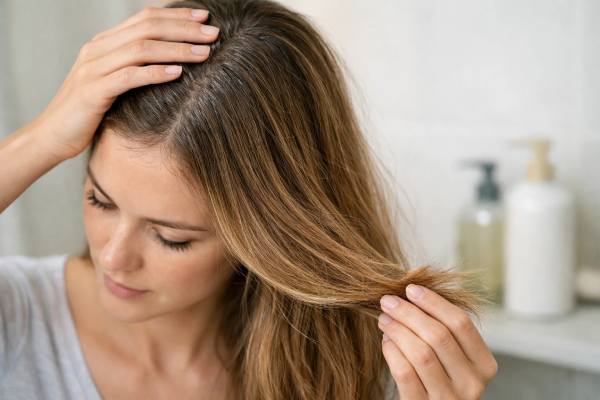
Few hair concerns feel as contradictory as roots that look slick by midday and ends that still feel rough, frayed, or thirsty. It can make every wash day feel like a compromise. If you choose a stronger shampoo, your scalp may look fresher but your lengths become dull. If you reach for richer masks and oils, the ends soften while the crown falls flat.
That tension exists because your scalp and your hair shaft do not have the same needs. The scalp produces sebum. The ends do not. Over time, heat, brushing, color, sun exposure, and simple weathering wear down the outer surface of the hair, especially the oldest parts near the bottom. Meanwhile, the scalp may keep making enough oil to leave the roots shiny long before that oil meaningfully protects the lengths.
A balanced routine does not try to force the whole head into one category. It treats the scalp like scalp and the ends like aging fiber, with different cleansing, conditioning, and styling choices for each zone.
Fast Facts
- Frequent gentle cleansing can improve oily roots without automatically damaging the hair when the formula and routine fit your scalp.
- Conditioner placed mainly on mid-lengths and ends can improve softness, slip, and frizz without flattening the roots.
- Silicone-based or bond-supporting products can help protect dry ends, but buildup can make fine or oily hair look heavier over time.
- Split ends cannot be permanently repaired by products alone, so trimming and friction control still matter.
- Shampoo the scalp as often as oil production truly requires, then keep richer products from the root area and concentrate them on the oldest, driest sections.
Table of Contents
- Why Roots and Ends Behave So Differently
- What Usually Causes Oily Roots and Dry Ends
- How to Build a Balanced Wash Routine
- Conditioning and Styling Without Weighing Hair Down
- Weekly Fixes for Buildup, Damage, and Frizz
- When This Pattern Points to a Scalp Problem
Why Roots and Ends Behave So Differently
Oily roots and dry ends are not a paradox once you look at where each problem begins. Oil starts at the scalp. Dryness and roughness usually build along the hair shaft. Those are two different structures with two different jobs, so they rarely age at the same pace.
The scalp contains sebaceous glands that release sebum around each follicle. That oil helps lubricate the scalp surface and newly emerging hair. Some people naturally produce more of it because of genetics, hormones, sweat, climate, or simple scalp physiology. If the scalp is oil-rich, the hair near the root will look shinier, separate faster, and lose volume sooner.
The ends live a very different life. They are the oldest part of the hair fiber, often months or years older than the roots. By the time hair reaches shoulder length or longer, those bottom sections have already gone through repeated washing, combing, sun exposure, friction from collars and pillowcases, heat styling, and sometimes coloring or bleaching. That wear slowly lifts or chips away at the outer cuticle, which makes the fiber rougher, more porous, and less able to hold moisture well.
Another reason the imbalance is so common is that sebum does not always travel efficiently from scalp to ends. Straight, shorter hair may let oil move downward more easily. Long, wavy, curly, or coily hair often does not distribute scalp oil as evenly, so the roots can look greasy while the lower half still feels dry. This is one reason people with textured hair may feel both oily and dry at once.
A useful way to think about it is this:
- The scalp needs cleansing based on oil production.
- The mid-lengths need low-friction care and selective conditioning.
- The ends need the most protection because they are the oldest and most weathered part of the fiber.
This is why one all-over product rarely solves everything. A stronger shampoo may improve the root area but leave the cuticle drier. A rich mask may soften the ends but collapse the volume at the scalp. Good routines separate these needs instead of treating the whole head as one surface.
It also helps to remember that “dry” does not always mean the same thing. Ends may be dry because they are damaged, because they are highly porous, because buildup is making them feel rough, or because the routine strips them faster than it replenishes slip. That is why balancing hair care is less about chasing a perfect ingredient and more about matching the right product to the right zone. Once that idea clicks, the routine becomes much easier to adjust.
What Usually Causes Oily Roots and Dry Ends
This pattern rarely comes from a single mistake. More often, it develops from several small habits and conditions that pull in opposite directions. The scalp gets cleaned and stimulated one way, while the lengths are stressed in another.
One common cause is overwashing with the wrong formula or underwashing out of fear. If the scalp is truly oily and washing is delayed too long, roots can accumulate sebum, sweat, flakes, and styling residue. But if a harsh cleanser is used too often across the entire length, the ends may become progressively rougher. The issue is not simply how often you wash. It is whether the scalp is being cleansed appropriately while the lengths are being protected.
Product placement is another frequent problem. Many people apply shampoo like body wash, dragging lather from roots to ends and scrubbing the full length every time. Others apply conditioner too high up, coating the root area and making the crown flat by the next day. A balanced routine usually works best when shampoo focuses on the scalp and conditioner focuses on the older part of the fiber.
Heat and chemical processing are major contributors too. Blow-drying, flat ironing, curling, bleaching, straightening, and permanent color all increase weathering of the cuticle. The result is hair that feels drier toward the bottom even if the scalp remains oily. If that sounds familiar, support for damaged hair and bond-focused care may fit the ends better than heavier scalp products.
A few other patterns show up often:
- fine hair that gets greasy quickly but tangles at the ends,
- long hair where scalp oil never reaches the bottom third,
- curly or wavy hair with uneven sebum distribution,
- frequent dry shampoo use that improves the look of the roots while leaving buildup behind,
- hard water or product residue that makes the ends feel coated yet still dry.
There is also a routine mismatch many people miss. They buy products for “oily hair,” then use them on chemically treated or heat-damaged lengths. Or they buy “repair” products for the ends and apply them close to the scalp. The routine is not wrong in principle. It is just being used too broadly.
Environment matters as well. Humidity can make roots look oilier and ends frizzier. Winter air and indoor heating can worsen dryness in the lower lengths even when the scalp still produces enough oil. Sun exposure can add another layer of weathering, especially in colored or fine hair.
One of the most helpful shifts is to stop asking, “What is my hair type?” as if there is one answer. A more useful question is, “What is my scalp doing, and what are my ends doing?” When those are treated as separate problems, it becomes much easier to choose wash frequency, product weight, and styling habits that work together instead of fighting each other.
How to Build a Balanced Wash Routine
The best wash routine for oily roots and dry ends starts with one rule: cleanse according to the scalp, not according to outdated guilt about washing too often. If your roots look greasy quickly, a more frequent wash schedule may be healthier and more comfortable than stretching washes too long. For some people that means every other day. For others it means most days. The real test is how your scalp looks and feels, not a rigid online rule.
Start with shampoo placement. Focus it on the scalp, hairline, crown, and nape, where oil and sweat accumulate most. Massage gently with fingertips rather than nails. As you rinse, the lather that travels downward is often enough for the lengths unless you have heavy product residue, chlorine exposure, or significant buildup.
That single change often helps more than switching brands.
Choosing the cleanser matters too. If roots get slick fast, a lightweight or balancing shampoo may work better than a creamy, highly conditioning one. But “stronger” is not always smarter. Overly aggressive cleansing can make the lengths rough and encourage you to overcorrect with heavier products later. The better target is a shampoo that removes oil efficiently without leaving the hair stiff.
A useful routine often looks like this:
- Shampoo the scalp thoroughly.
- Let the rinse water carry a light cleanse through the lengths.
- Apply conditioner only from mid-lengths downward.
- Use a second small pass of conditioner on the driest bottom few inches if needed.
- Rinse well so roots stay light.
Frequency should stay flexible. Research and clinical guidance do not support the old idea that well-formulated shampoo automatically damages hair simply because it is used often. For oily scalps, washing more regularly can improve comfort and appearance when the products are suitable. If you want a broader framework for that decision, this guide on how often to wash hair by scalp type can help you match frequency to oil level rather than guesswork.
Water temperature also matters more than many people think. Very hot water can leave the scalp feeling stripped and the ends rougher. Lukewarm water is usually the most balanced option. It cleans effectively without making the entire process harsher than it needs to be.
Double shampooing can help, but only when it solves a real problem. If the scalp carries a lot of dry shampoo, sweat, or styling residue, a quick first cleanse followed by a second focused scalp cleanse may work well. But if your hair is already fragile, there is no benefit in turning every wash into a deep-clean session.
The goal is not squeaky hair. It is a scalp that feels clean and ends that still feel workable afterward. When that balance is right, you should notice fresher roots, less need for emergency dry shampoo, and ends that no longer feel punished every time you wash.
Conditioning and Styling Without Weighing Hair Down
Conditioning is where many oily-root routines go off course. People either avoid conditioner because they fear greasiness, or they apply rich products too close to the scalp and flatten the entire style. The solution is rarely to skip conditioning altogether. It is to place it more strategically.
Conditioner belongs mainly on the mid-lengths and ends because those sections are older, rougher, and more friction-prone. This is especially true after coloring, heat styling, sun exposure, or long periods between trims. A good rinse-out conditioner adds slip, lowers friction between strands, improves detangling, and helps the cuticle lie flatter. That means less snagging, less frizz, and fewer split-looking ends.
For fine or easily weighed-down hair, lighter conditioners or milky leave-ins tend to work better than thick masks at every wash. For coarser or curlier hair, richer formulas may still work well as long as they stay off the scalp. Silicone-containing products can be especially useful on damaged ends because they reduce friction and help hold smoothness, though repeated heavy use may require occasional buildup management.
The practical question is not “Are silicones good or bad?” but “Do they help this section of my hair behave better without making the rest collapse?” On dry ends, they often do.
Styling choices matter just as much as the conditioner itself. A balanced routine often improves when you:
- apply leave-in only to the driest zones,
- keep oils and serums off the first few inches near the scalp,
- avoid stacking several heavy products at once,
- detangle gently, starting from the ends,
- reduce heat exposure on the oldest sections of hair.
Detangling deserves more attention than it usually gets. Rough brushing can make dry ends look even drier because it increases mechanical wear. If you are sorting out breakage and snagging, the difference between wet and dry detangling is worth understanding, especially for textured or fragile hair.
One of the most common myths is that conditioner “repairs” split ends in a permanent way. It does not. What it can do is temporarily smooth, coat, and align damaged areas so the hair feels softer and looks more polished. That is valuable, but it is not the same as reversing structural damage. Once an end has split significantly, trimming is still the cleanest fix.
Styling order also matters. If you use mousse, texture spray, dry shampoo, cream, oil, and hairspray in one routine, the roots and ends may both become harder to read. The roots look oily sooner because of product load, while the ends feel dry because residue is sitting on top of damaged fiber rather than truly improving slip. Simpler routines are often more balanced.
The best sign that your conditioning strategy is working is not just shine. It is this: your ends feel softer and detangle more easily, but your roots still keep movement and lift. That is usually the sweet spot.
Weekly Fixes for Buildup, Damage, and Frizz
Daily or regular care does most of the work, but weekly adjustments are what keep oily roots and dry ends from drifting back into the same frustrating cycle. These are the resets that help when shampoo alone is no longer enough and conditioner alone feels too heavy.
The first reset is clarifying. If your roots seem greasy unusually fast, your hair feels coated, or styling products stop performing well, buildup may be part of the problem. Dry shampoo, leave-ins, silicones, hard water minerals, and hairsprays can all accumulate over time. That buildup can make roots heavier while leaving the ends strangely dull and rough. A clarifying wash used occasionally can help restore movement, but it should be used with intention rather than as an every-wash fix. This is where a guide to when and how often to use clarifying shampoo can help you choose the right interval.
The second reset is targeted masking. A rich mask does not need to touch the scalp to be useful. In fact, it usually works better when applied from the ears downward or just on the bottom third of the hair. Leaving it on for a few minutes after shampooing can improve softness and help reduce friction in weathered areas without overwhelming the roots.
The third reset is trimming and surface protection. No product can keep progressively frayed ends looking healthy forever. If the bottom inch keeps tangling, splitting, or looking thin, a trim may do more than any serum. That is not a failure of the routine. It is maintenance.
You may also benefit from small weekly checks:
- Are you using too much dry shampoo instead of washing when the scalp truly needs it?
- Are your hot tools focused on the same already-dry sections?
- Are heavy oils sitting on the hair without actually improving softness?
- Are you sleeping on rough fabric or tying hair too tightly?
Heat deserves special caution. When the roots are oily, many people wash more, then heat style more, then wonder why the ends worsen. Repeated blow-drying and ironing can make the lower half progressively drier. If heat is part of your routine, understanding how heat protectant works is one of the simplest ways to reduce avoidable damage.
There is also a point where “repair” products become more cosmetic than corrective. They can absolutely improve feel and appearance, but they work best when paired with less friction, smarter cleansing, and realistic trims. Weekly care should support the routine, not compensate for constant damage.
A strong weekly routine is not elaborate. It is selective. Clarify when buildup is obvious, deeply condition only where dryness is real, and protect the ends before they become the casualty of every attempt to control the roots.
When This Pattern Points to a Scalp Problem
Oily roots and dry ends are common, but they are not always just a routine issue. Sometimes the scalp is sending a clearer signal: the problem is not only sebum balance, but irritation, inflammation, or a scalp disorder that changes how hair looks and feels from the root outward.
A few clues suggest the issue is moving beyond ordinary oiliness:
- persistent itch rather than simple greasiness,
- visible flakes that return quickly after washing,
- redness along the hairline or part,
- burning, soreness, or tenderness,
- greasy scalp with unusually increased shedding,
- bumps, crusting, or areas that feel raw.
These features can point toward seborrheic dermatitis, psoriasis, contact irritation, or another scalp condition. In those cases, adding more oil to the ends or using harsher cleansers on the scalp may not solve the real problem. A medicated or more specific scalp routine may be needed first.
Dry ends can also be misleading here. People often assume the entire head is dry when flakes appear, but flakes on an oily scalp frequently reflect inflammation rather than lack of moisture. That is why using richer and richer scalp oils can sometimes make the root area feel worse instead of better. If your symptoms include scaling and itch, it may help to compare them with the pattern described in dandruff versus dry scalp differences.
There is another warning sign worth noting: more breakage or hair loss than expected. If the roots are greasy but the hair also seems to be thinning, shedding excessively, or snapping around the crown, there may be a separate factor involved. Routine changes help only so much when the scalp is inflamed or the hair fiber is already compromised.
Seek professional advice sooner if:
- the scalp stays itchy or red despite a simplified routine,
- flakes are thick, yellowish, or stubborn,
- there is pain, oozing, or patchy loss,
- the hair is shedding far more than usual,
- every product seems to sting or worsen the scalp.
The good news is that many people do not need a dramatic overhaul. They need a more accurate read of what the scalp is doing. If the scalp is healthy, balancing oil control and end protection usually works well. If the scalp is unhealthy, it has to be treated as a scalp issue first.
That distinction matters because the best hair routine in the world cannot fully compensate for an inflamed scalp. Once the scalp barrier and oil control improve, the rest of the routine becomes much easier to fine-tune. Until then, roots may keep looking oily for the wrong reason, and ends may keep feeling dry because the whole routine is compensating for a problem that starts higher up.
References
- On Hair Care Physicochemistry: From Structure and Degradation to Novel Biobased Conditioning Agents 2023 (Review)
- The Impact of Shampoo Wash Frequency on Scalp and Hair Conditions 2021 (Clinical Study)
- With or without Silicones? A Comprehensive Review of Their Role in Hair Care 2025 (Review)
- Hair Cosmetics for the Hair Loss Patient 2021 (Review)
- Shampoo and Conditioners: What a Dermatologist Should Know? 2015 (Practical Review)
Disclaimer
This article is for educational purposes only and is not a substitute for medical advice, diagnosis, or treatment. Hair that has oily roots and dry ends is often a routine and hair-shaft care issue, but scalp itching, persistent flaking, redness, pain, or unusual shedding may signal a condition that needs medical evaluation. If symptoms persist or worsen, seek advice from a qualified clinician or dermatologist.
If this article helped you fine-tune your routine, please share it on Facebook, X, or another platform where it might help someone else manage oily roots and dry ends more effectively.