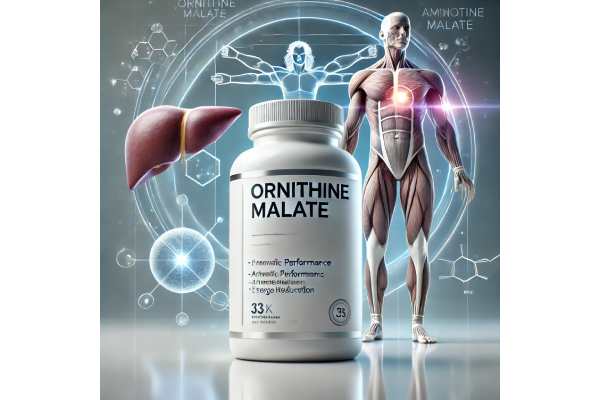
Ornithine malate combines two biochemically active compounds in one supplement: the amino acid L-ornithine and the Krebs cycle intermediate L-malate. Together they are marketed for reducing fatigue, supporting exercise performance, and aiding recovery, especially in multi-ingredient pre-workout formulas. Ornithine participates in the urea cycle, the pathway that converts ammonia into urea for safe excretion. Malate feeds directly into cellular energy production and can influence nitric oxide pathways.
Human trials with L-ornithine alone suggest it can reduce perceived fatigue, support stress resilience, and improve some aspects of sleep quality at moderate doses. Separate research on malate shows it can modulate nitric oxide and energy metabolism. Ornithine malate sits at the intersection of those mechanisms, although direct clinical data on the exact salt are still limited. This guide walks through how it works, realistic benefits, practical dosage ranges, stacking strategies, and safety points so you can decide whether ornithine malate fits your goals.
Quick overview for ornithine malate
- May help reduce subjective fatigue and support recovery during repeated or prolonged exercise.
- Could support stress resilience and sleep quality indirectly through the urea cycle and neurotransmitter pathways.
- Typical supplemental range is about 1–6 g ornithine malate per day in divided doses.
- Start low if you have a sensitive stomach; higher doses can occasionally cause mild gastrointestinal discomfort.
- People with kidney or liver disease, urea cycle disorders, pregnancy, or under 18 should avoid use unless a clinician specifically advises it.
Table of Contents
- What is ornithine malate?
- How ornithine malate works in the body
- Key benefits of ornithine malate
- How to take ornithine malate effectively
- Ornithine malate dosage and timing
- Side effects, safety, and precautions
- What science says about ornithine malate
What is ornithine malate?
Ornithine malate is a salt combining the non-protein amino acid L-ornithine with L-malic acid, a natural intermediate of the Krebs (citric acid) cycle. Manufacturers typically pair one or two ornithine molecules with one malate molecule to improve taste, solubility, and stability compared with straight ornithine powders.
L-ornithine
Ornithine is best known for its role in the urea cycle, the liver pathway that detoxifies ammonia by converting it into urea. Ammonia builds up when you break down protein or when exercise intensity and duration are high. Excess ammonia is associated with fatigue, impaired performance, and, in severe medical cases, neurological symptoms.
Ornithine itself is not built into proteins, but it acts as a carrier that accepts carbamoyl groups and helps move nitrogen through the urea cycle. Supplemental L-ornithine has been studied for:
- Reducing perceived physical fatigue in healthy adults during long or repetitive exercise.
- Supporting stress management and subjective sleep quality.
- Assisting ammonia detoxification in liver support protocols (usually as ornithine aspartate, a different salt).
L-malate
Malate is a dicarboxylic acid that appears in fruits and inside your cells as a normal part of the Krebs cycle. In metabolism, it helps:
- Regenerate NAD⁺ and support mitochondrial ATP production.
- Participate in the malate–aspartate shuttle that moves reducing equivalents into mitochondria.
- Provide precursors for aspartate and, indirectly, for L-arginine and nitric oxide production in some tissues.
By pairing ornithine with malate, supplement designers aim to support both ammonia clearance and cellular energy production. You can think of ornithine malate as an “ammonia plus energy” amino acid complex rather than a single-purpose ingredient.
You will most often see ornithine malate in:
- Pre-workout powders marketed for energy, pump, and performance.
- Recovery blends with arginine, citrulline, or branched-chain amino acids.
- Occasional stand-alone capsules or powders for fatigue or recovery support.
How ornithine malate works in the body
To understand what ornithine malate can do, it helps to separate the actions of ornithine and malate and then consider where they might overlap.
Ornithine and the urea cycle
When you consume protein or break down your own muscle, amino groups are released and converted into ammonia, which is toxic in excess. The urea cycle turns ammonia into urea so it can be excreted in urine. Ornithine is a central carrier in this cycle:
- Ornithine accepts carbamoyl phosphate to form citrulline.
- Citrulline combines with aspartate to eventually generate arginine.
- Arginine is cleaved to yield urea and regenerate ornithine.
By increasing the availability of ornithine, supplementation may:
- Support faster conversion of ammonia to urea.
- Reduce the rise in blood ammonia during long or intense exercise.
- Shift metabolism toward greater use of fats and preservation of glycogen, as seen in human fatigue studies with L-ornithine.
This is the main reason ornithine salts are also used clinically in certain liver conditions to help manage ammonia.
Malate and cellular energy
Malate feeds into the Krebs cycle, where carbohydrates, fats, and amino acids are oxidized for ATP production. Within this cycle and the malate–aspartate shuttle, malate helps:
- Maintain the NAD⁺/NADH balance required for continuous ATP generation.
- Support mitochondrial function, especially when energy demand rises.
- Provide precursors for aspartate and, through extended pathways, for arginine and nitric oxide.
Animal research indicates that providing extra malate can increase tissue levels of L-arginine and nitric oxide and improve blood pressure control in certain models. This suggests malate has broader vascular and metabolic roles, particularly when nitric oxide pathways are stressed.
The combined effect: why the salt matters
In practice, ornithine malate may influence fatigue and performance through a few converging mechanisms:
- Ammonia handling: Ornithine strengthens the urea cycle’s ability to remove ammonia produced during intense exertion. Lower ammonia can mean less central fatigue and clearer cognition later in a session.
- Energy and redox balance: Malate supports mitochondrial ATP production and the recycling of NADH to NAD⁺, which can be critical when energy demand is high.
- Nitric oxide and blood flow (indirect): By feeding into pathways that affect arginine and nitric oxide, malate may complement arginine or citrulline in NO-boosting stacks, though this effect has been better documented in animals than in human trials.
- Stress and sleep: Trials using L-ornithine alone suggest it can modulate cortisol responses, mood, and sleep quality under stress. Ornithine malate provides the same amino acid, so similar central effects are plausible.
The key point: most high-quality human data are on L-ornithine (often as the hydrochloride salt) plus mechanistic work on malate. Ornithine malate brings those pathways together, but direct clinical trials on the exact salt remain limited, so benefits are partly extrapolated.
Key benefits of ornithine malate
Because clinical research has largely focused on L-ornithine and, separately, on malate, it is important to view claims for ornithine malate through that lens. The most realistic, evidence-aligned benefits fall into several categories.
1. Reduced subjective fatigue and better exercise tolerance
Human trials in healthy adults have found that oral L-ornithine in the 2,000–6,000 mg per day range can:
- Reduce perceived fatigue during and after long cycling or endurance tasks.
- Shift metabolism toward greater fat use and more efficient handling of ammonia and lactate.
- Help participants feel less drained in the hours after prolonged exertion.
Ornithine malate supplies the same amino acid, and exercise-focused products usually position it as an “anti-fatigue” ingredient. The malate component may add support for mitochondrial energy production, particularly during repeated high-intensity bouts, although direct confirmation in humans is still limited compared with citrulline malate.
In practice, users most often notice:
- Slightly better stamina in the later sets or intervals.
- Less “brain fog” or motivational drop-off as a session wears on.
- A smoother recovery of energy over the next several hours.
2. Support for stress resilience and sleep quality
Randomized controlled trials of L-ornithine alone have shown improvements in:
- Cortisol balance and cortisol-to-DHEA ratios in stressed workers.
- Profile of mood scores for anger, hostility, and fatigue.
- Subjective measures of sleep initiation, continuity, and feeling refreshed on waking.
A newer trial using 1,600 mg of L-ornithine daily around a standardized social stress protocol reported better scores for fatigue and anger the morning after the stress challenge.
Ornithine malate includes the same active amino acid, so similar mental and sleep-related benefits are plausible, especially when taken in the evening at lower doses. The malate portion is not known to directly aid sleep but is unlikely to interfere at usual intakes.
3. Possible synergy in performance stacks
Ornithine malate is often formulated with:
- Citrulline or arginine for nitric-oxide-related “pump” and blood flow.
- Beta-alanine and creatine for buffering and strength.
- Caffeine for alertness.
Within such blends, ornithine malate may contribute by:
- Supporting ammonia clearance when high repetitions or long sessions elevate nitrogen waste.
- Enhancing mitochondrial throughput via malate, helping the rest of the stack work more efficiently.
- Moderately improving how “drained” you feel after tough sessions, especially when training volume is high.
It is important to recognize that in multi-ingredient products, it can be difficult to attribute effects to ornithine malate alone. However, its mechanistic role complements other common performance ingredients rather than overlapping exactly with them.
4. Liver and metabolic support (adjacent evidence)
Clinically, ornithine salts are used to help manage ammonia in people with liver dysfunction, though most data involve ornithine aspartate, not malate. For otherwise healthy people, this translates into a more modest “detox support” role: helping the liver keep up with nitrogen handling when protein intake, training load, or stress are high.
This should not be viewed as a treatment for liver disease, but it does align with the broader metabolic profile of ornithine: supporting urea cycle function, nitrogen excretion, and, indirectly, overall metabolic flexibility.
How to take ornithine malate effectively
Because direct clinical guidelines for ornithine malate are sparse, practical usage is usually based on:
- Doses of L-ornithine used in human trials.
- Known safe intake levels from structured safety studies.
- Typical amounts found in sports supplements.
Stand-alone use vs combination formulas
As a stand-alone supplement
If you are using ornithine malate by itself (capsules or powder):
- For fatigue and performance support, many people start around 1–3 g of ornithine malate taken 30–60 minutes before training.
- For stress or sleep support, lower doses (for example, 500–1,500 mg of the salt) in the evening may be sufficient, often 1–2 hours before bed.
Remember that the salt contains both ornithine and malate. A 3 g dose of ornithine malate typically provides around 1.5–2 g of elemental ornithine, depending on the exact ratio used by the manufacturer.
In multi-ingredient pre-workouts
In complex formulas, ornithine malate often appears at:
- 1–2 g per serving in basic blends.
- 3–6 g per serving in more aggressive performance products.
When reading labels, check:
- The exact form (ornithine malate vs plain ornithine).
- Whether the amount listed is for the full salt or just “L-ornithine as malate.”
- The presence of other stimulants like caffeine that may dominate how the product feels.
Timing strategies
Common approaches include:
- Pre-workout only: A single dose 30–60 minutes before training to target exercise performance and acute fatigue.
- Split dosing: Half the daily intake before training and half later in the day (or evening) when the goal includes recovery or stress support.
- Evening-focused: Smaller doses taken after dinner or before bed when the primary goal is mood and sleep quality rather than performance.
For most healthy adults, consistent daily use over several weeks is more likely to show stress and sleep benefits, whereas performance effects may be noticeable on the first few training days if the dose is adequate.
Practical tips for best results
- Start at the lower end of the range, especially if you tend to get gastrointestinal upset from amino acid supplements.
- Take it with a small snack or mixed into a carbohydrate drink if straight powder on an empty stomach bothers you.
- Track how you feel not only during your workout but also 3–6 hours later and the next morning; much of the benefit is in recovery and reduced lingering fatigue.
- Avoid combining high doses with heavy late-night caffeine; this makes it harder to judge whether ornithine is improving or worsening your sleep quality.
Ornithine malate dosage and timing
While no official dietary allowance exists for ornithine, safety and efficacy data from human trials give useful guideposts for ornithine-containing supplements, including ornithine malate.
Evidence-aligned dosage ranges
Research in healthy adults has used:
- 400 mg per day of L-ornithine (as a different salt) for stress and sleep support over several weeks.
- 2,000–6,000 mg per day of L-ornithine for short-term reductions in exercise-induced fatigue.
- Up to 12,000 mg per day of L-ornithine (as the hydrochloride salt) for four weeks in structured safety studies without clinically relevant toxicity in screened adults.
Translating this to ornithine malate:
- A conservative daily range for most healthy users is about 1–6 g of ornithine malate, which typically corresponds to roughly 500–3,000 mg of elemental L-ornithine.
- Higher intakes are possible under professional supervision, but pushing intake close to the safety upper limit (in terms of elemental ornithine) is not necessary for typical performance and wellness goals.
Suggested dosing by goal
For general fatigue and recovery
- 1.5–3 g ornithine malate per day.
- Take 1–2 g about 30–60 minutes before exercise, with the remainder (if any) later in the day or early evening.
For performance in long or intense sessions
- 3–6 g ornithine malate around training, often as a single pre-workout dose or split pre- and intra-workout.
- Consider pairing with carbohydrates and adequate hydration.
For stress and sleep-related goals
- 500–1,500 mg ornithine malate in the evening, about 1–2 hours before bed.
- Avoid taking it very late with heavy meals or alcohol, as these can independently disrupt sleep.
Duration of use
- For acute performance: benefits, if they occur, are typically felt on the days you take it.
- For stress and sleep: trials suggest that several weeks of daily intake are more informative than a single dose.
- For ongoing support: cycling (for example, 8–12 weeks on, a few weeks off) is a reasonable approach, especially at the higher end of the range.
If you are already using multiple amino acid supplements (such as arginine, citrulline, or branched-chain amino acids), it is sensible to stay in the lower part of the ornithine malate range to avoid unnecessary total nitrogen load.
Side effects, safety, and precautions
At typical supplemental doses, ornithine malate appears well tolerated in healthy adults. Safety studies using high doses of L-ornithine over several weeks did not find clinically relevant adverse changes in standard blood tests or vital signs. Still, some points deserve attention.
Common, usually mild side effects
Reported side effects with higher doses of L-ornithine (and, by extension, ornithine salts) include:
- Mild gastrointestinal discomfort (nausea, bloating, or loose stools).
- Occasional headache or a “wired” feeling when taken late with stimulants or very large pre-workout stacks.
- Rare transient changes in energy or mood during the first few days, usually resolving as the body adapts.
These effects are more likely when:
- Doses exceed about 6 g of the salt per day.
- The supplement is taken on an empty stomach.
- Multiple amino acid products are combined without adjusting individual doses.
Who should avoid ornithine malate or use medical guidance
Because ornithine directly affects nitrogen handling and the urea cycle, caution is important in some groups:
- People with known urea cycle disorders or unexplained episodes of high ammonia: supplemental ornithine may complicate management and should only be used under specialist supervision.
- Anyone with significant liver disease (such as cirrhosis or active hepatitis): although ornithine salts are used clinically in some liver settings, dosing and monitoring must be individualized by a physician. Self-prescribing is not safe.
- People with moderate to severe kidney impairment: altered urea handling and nitrogen excretion can make extra amino acid loads risky.
- Pregnant or breastfeeding individuals: safety data at supplemental doses are insufficient; avoid unless specifically recommended by a clinician.
- Children and adolescents: there is very limited evidence in these age groups; use only in research or medical contexts.
Potential interactions
Ornithine malate is not known for many direct drug interactions, but some theoretical or practical considerations include:
- Protein-restricted diets (for kidney disease or certain metabolic conditions): extra nitrogen from amino acid supplements may conflict with medical nutrition plans.
- Neurological conditions involving ammonia (for example, some inborn metabolic disorders): modifying ammonia pathways without medical oversight can be dangerous.
- Heavy stimulant use: large pre-workout stacks that combine ornithine malate with high-dose caffeine and other stimulants may increase the risk of palpitations, anxiety, or sleep disruption, not because of ornithine itself but because the overall formula is too aggressive.
As with most supplements, stop use and seek medical advice if you develop persistent gastrointestinal symptoms, new headaches, significant changes in mood or sleep, or any neurological symptoms such as confusion or difficulty concentrating.
Practical safety steps
- Start at the low end of the dosage range and increase slowly if needed.
- Do not exceed a total intake that would provide more than about 6 g of elemental L-ornithine per day unless under professional supervision.
- Reassess use if you develop new health conditions, start new prescription medications, or are advised to change your protein intake.
What science says about ornithine malate
The scientific picture around ornithine malate is built from three main bodies of evidence:
- Clinical trials using L-ornithine alone in healthy adults.
- Safety studies of higher-dose ornithine supplementation.
- Mechanistic and animal research on malate and related metabolic pathways.
Human trials on L-ornithine
Several controlled studies in healthy adults have reported that:
- Daily L-ornithine can reduce perceived fatigue during extended exercise and modulate markers of lipid use and ammonia handling.
- Eight weeks of moderate-dose L-ornithine improves certain mood scores, lowers cortisol-related stress markers, and enhances subjective sleep quality in workers with mild fatigue.
- Short-term L-ornithine intake around a standardized social stress test improves fatigue- and anger-related mood scales the following day, even when cortisol itself does not change.
These trials typically used doses between 400 mg and 6,000 mg per day, with good tolerability and minimal side effects in screened adults.
Safety trials at higher doses
A structured, dose-escalation study in healthy men evaluated graded doses of oral L-ornithine over several four-week periods, up to 12 g per day. Across this range:
- Routine blood chemistry, liver enzymes, kidney markers, and hematology stayed within reference ranges.
- Reported adverse events were mild and not clearly linked to the amino acid.
- Investigators concluded that 12 g per day of L-ornithine for four weeks could be considered a no-observed-adverse-effect level in that population.
This gives a useful safety ceiling when considering the combined ornithine content of different supplements, including ornithine malate.
Mechanistic evidence on malate
Animal and cellular work indicates that:
- Supplemental malate can raise tissue levels of L-arginine and nitric oxide and improve blood pressure control in certain hypertensive models.
- Malate participates in shuttles that maintain mitochondrial redox balance and support sustained ATP production under high energy demand.
- In combination with aspartate or other amino acids, malate can influence metabolic signaling beyond simple energy provision.
These findings support the idea that malate is more than just a passive acid partner in the salt; it likely contributes to vascular and energetic effects seen in some performance and health contexts.
What is still uncertain
Despite the promising picture, direct randomized trials using ornithine malate itself as a single, isolated variable are scarce. Open questions include:
- Whether ornithine malate performs meaningfully better than an equivalent dose of L-ornithine alone for exercise performance.
- The degree to which malate in this context adds to nitric oxide-related outcomes compared with better-studied options like citrulline malate.
- Optimal dosing of the specific salt for different goals (performance, stress, sleep) beyond extrapolations from ornithine-only trials.
For now, it is reasonable to say that ornithine malate is a mechanistically sound way to deliver L-ornithine with added metabolic support from malate, but the strongest evidence base still sits with L-ornithine supplementation in general rather than the malate form specifically.
References
- L-ornithine supplementation attenuates physical fatigue in healthy volunteers by modulating lipid and amino acid metabolism 2008 (Randomized Controlled Trial)
- Randomised controlled trial of the effects of L-ornithine on stress markers and sleep quality in healthy workers 2014 (Randomized Controlled Trial)
- Subchronic tolerance trials of graded oral supplementation with ornithine hydrochloride or citrulline in healthy adults 2023 (Original Clinical Safety Study)
- Effects of Oral Ingestion of L-Ornithine on Mental Stress and Fatigue Based on the Trier Social Stress Test in Healthy Humans: A Randomized, Double-Blind, Placebo-Controlled, Parallel-Group Trial 2024 (Randomized Controlled Trial)
- Malate and Aspartate Increase L-Arginine and Nitric Oxide and Attenuate Hypertension 2017 (Mechanistic Animal and Cellular Study)
Disclaimer
The information in this article is for general educational purposes only and is not intended to provide medical advice, diagnose any condition, or replace a consultation with a qualified health professional. Ornithine malate and other supplements can affect metabolism, interact with health conditions, and influence the way medications work. Always discuss new supplements with your physician, pharmacist, or another qualified clinician, especially if you have liver or kidney disease, metabolic or neurological disorders, are pregnant or breastfeeding, or take prescription medications. Never delay or disregard professional medical advice because of something you have read online.
If you found this guide useful, you are warmly invited to share it on Facebook, X (formerly Twitter), or any social platform you prefer, and to follow our work on social media. Your support through thoughtful sharing helps our team continue to research, write, and update clear evidence-based content on nutrition and health.