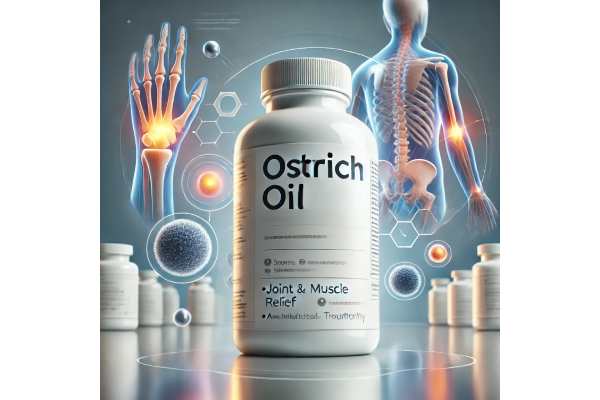
Ostrich oil is a rendered fat obtained from the subcutaneous and abdominal tissues of the ostrich (Struthio camelus). Long used in parts of Africa and the Middle East, it has recently attracted interest in skincare and wellness circles for its rich content of unsaturated fatty acids and its traditional use on sore joints, dry skin, and minor wounds.
Modern cosmetic formulators value ostrich oil for its light texture, high oleic and linoleic acid content, and its ability to blend into oil-in-water creams and serums. At the same time, scientific research on its clinical benefits in humans is still limited. Most evidence comes from laboratory analyses, animal experiments, and ethnomedical surveys, not large, controlled human trials.
If you are curious about ostrich oil as a supplement or topical product, it is important to understand what we do and do not know: how it is produced, its possible benefits, how to use it sensibly, and which safety concerns matter before putting it on your skin or considering ingestion.
Key Insights for Using Ostrich Oil
- Ostrich oil is a concentrated animal fat rich in oleic, linoleic, and palmitic acids that may support skin hydration and barrier function.
- Traditional use includes massage for muscle aches, joint discomfort, and dry or irritated skin, though robust clinical trials are lacking.
- Many cosmetic products use 5–20% ostrich oil in creams or balms, applied 1–2 times daily on intact skin according to label directions.
- People with bird, poultry, or animal-fat allergies, very acne-prone skin, or complex medical conditions should be cautious or avoid use.
- Oral use of ostrich oil is poorly studied and should not be started without guidance from a qualified healthcare professional.
Table of Contents
- What is ostrich oil and how is it made?
- Potential benefits and traditional uses
- How to use ostrich oil safely day to day
- Dosage guidance and product types
- Side effects, risks and who should avoid it
- What the research actually says so far
What is ostrich oil and how is it made?
Ostrich oil is an animal-derived oil obtained by rendering the fatty tissues of the ostrich, particularly from the subcutaneous and abdominal fat pads. Like other animal fats, it is composed mainly of triglycerides, but its fatty acid profile is somewhat unusual for a land animal: it contains a high proportion of monounsaturated oleic acid, meaningful amounts of linoleic acid (an essential omega-6 fatty acid), and smaller fractions of palmitic, stearic, and other fatty acids.
Analyses of ostrich fat suggest that, compared with some common livestock fats, it is relatively rich in polyunsaturated and monounsaturated fatty acids and lower in saturated fats. This composition partly explains why the meat and oil are often marketed as “lighter” or more similar to certain plant oils than to typical tallow or lard. It also underpins interest in its use on the skin, because oleic and linoleic acids can influence skin barrier function and absorption when used topically.
To produce ostrich oil, the fat is gently heated (rendered) to separate liquid oil from connective tissue and water. The crude oil is then filtered and may be further refined, deodorized, or fractionated to remove impurities, odor, and pigments. Cosmetic-grade oils are usually more highly processed and may be blended with antioxidants such as vitamin E to delay oxidation and rancidity.
Commercially, ostrich oil appears in several forms:
- Pure liquid oil in dropper bottles for direct skin application or blending into DIY formulations.
- Balms and salves that combine ostrich oil with waxes and other oils.
- Creams and lotions where ostrich oil is one of several lipid components in an oil-in-water emulsion.
- Less commonly, softgel capsules marketed as dietary supplements, often with minimal data on dose or efficacy.
Because it is an animal product, ethical sourcing and hygiene standards matter. Reputable producers use farmed ostriches, follow veterinary and food-safety regulations, and test for contaminants. Poorly rendered or stored oil can oxidize, develop off-odors, and potentially irritate skin, so freshness and quality control are important considerations.
Potential benefits and traditional uses
In many communities where ostriches are common, their oil has long been part of traditional medicine. Ethnobiological fieldwork in East Africa, for example, reports ostrich oil used sparingly to massage painful muscles, treat earaches, and support respiratory complaints. Traditional uses do not prove clinical benefit, but they highlight the ways people have experimented with the oil over generations.
From a biochemical perspective, the main interest in ostrich oil comes from its fatty acid profile. Oleic acid is known to enhance penetration of some substances through the skin and to soften dry, rough areas. Linoleic acid is an essential fatty acid that plays a role in maintaining the skin barrier and may help reduce transepidermal water loss when applied topically as part of an appropriate formulation. Together with other lipids in the oil, these components may support:
- Skin hydration and protection from dryness and environmental stressors.
- Softening of rough areas such as elbows, heels, and callused hands.
- Gentle massage for stiff muscles and joints.
Some users and practitioners also apply ostrich oil preparations to:
- Mild irritations or chapped skin (for example, from wind or frequent handwashing).
- The edges of minor, superficial wounds or abrasions, once clean and beginning to close.
- Areas of cosmetic concern such as old scars or stretch marks, usually as part of a broader skincare routine.
However, it is critical to keep expectations realistic. There are very few controlled trials in humans specifically testing ostrich oil for conditions such as eczema, psoriasis, arthritis, or scars. Most claims are extrapolated from the known properties of its fatty acids, from in vitro or animal work, or from anecdotal reports.
When used within a well-designed cosmetic product, ostrich oil can be considered a functional emollient: it helps smooth the surface of the skin and may support barrier function, especially in dry or mature skin. It should not be seen as a stand-alone cure for chronic inflammatory or autoimmune skin diseases, nor as a replacement for prescribed medications for joint or respiratory conditions.
How to use ostrich oil safely day to day
Most people encounter ostrich oil as a topical product for skin or hair. The basic principle is to use the smallest amount that gives the desired effect, on intact skin, and to avoid sensitive areas until you are sure you tolerate it.
For pure oil on the skin, a typical pattern might look like this:
- Cleanse the area gently and pat dry.
- Place 1–3 drops (roughly 0.05–0.15 mL) of ostrich oil into clean hands.
- Warm it between your fingertips and press or massage lightly into the target area (for example, a dry patch on the forearm or a rough heel).
- Allow several minutes for absorption before dressing or applying other products.
For larger body areas, many people use about 0.5–1 mL per application (a pea- to grape-sized amount) and apply once or twice daily. Oils generally work best when applied to slightly damp skin, such as after bathing, to help lock in moisture.
When using creams, balms, or lotions that contain ostrich oil as one ingredient among many, it is usually safest to follow the manufacturer’s instructions. Many leave-on products are designed for once- or twice-daily use on dry or normal skin. Spot-treating a small area first for several days can help reveal any tendency toward irritation or breakouts.
Practical tips for everyday use include:
- Patch testing: Apply a small amount on the inner forearm once daily for 3–5 days. Avoid using on the face until no redness, itching, or bumps appear.
- Layering with other skincare: If you use actives such as retinoids or acids, apply those first (if tolerated), then follow with an ostrich oil product as an emollient step.
- Hair and scalp: Some users massage a few drops into dry ends, or onto a dry, flaky scalp before shampooing. Because animal oils can be heavy, start with very small amounts.
- Massage: For joint or muscle massage, ostrich oil is often blended with lighter oils to improve glide. Again, this is for comfort, not a proven treatment for arthritis.
Oral use should be approached very cautiously. While some traditional practices describe ingestion of small amounts (for example, 1–5 mL mixed with food), there is little formal safety data, and long-term effects are poorly characterized. Without guidance from a clinician who understands your health history, it is safer to limit ostrich oil to external use.
Dosage guidance and product types
There is no officially established “dosage” for ostrich oil in the way there might be for a licensed medicine or a well-studied dietary supplement. Guidance is therefore based on typical cosmetic formulations, traditional use patterns, and general principles of topical therapy.
In topical products, ostrich oil most often appears at concentrations between about 5% and 20% of the total formulation. In a cream or lotion, this range allows the emulsion to remain stable while still delivering a meaningful amount of lipid to the skin. Balms and salves may contain higher ratios, particularly if they are semi-solid blends of waxes and oils.
For practical purposes, a sensible “dose” for everyday skincare is:
- Face: 1–2 drops of pure oil, or a pea-sized amount of cream containing 5–15% ostrich oil, once daily at first, increasing to twice daily if well tolerated.
- Localized body areas (hands, elbows, heels): A pea- to grape-sized amount (roughly 0.3–0.8 mL) of product per area, once or twice daily.
- Larger body areas: Use the minimum quantity needed to leave the skin comfortably moisturized but not overly greasy, often 1–2 mL per limb.
Types of ostrich oil products you may encounter include:
- Pure, refined oil: Best for people who like to customize their skincare or mix a few drops into existing lotions.
- Pre-formulated creams and lotions: More stable and usually less greasy, suitable for routine daily use.
- Targeted balms and ointments: Thicker products intended for very dry patches, cracked heels, or localized massage.
- Softgel capsules: Sometimes marketed as “ostrich oil supplements.” Because human data are limited, it is prudent to avoid or to use only under professional supervision.
If you do choose a capsule product despite the uncertainties, a conservative upper limit would be to follow the package instructions carefully and not exceed the manufacturer’s suggested serving (often in the range of 500–1000 mg per day), unless a healthcare professional advises otherwise. However, many people may not need or benefit from oral ostrich oil at all, given the availability of well-studied dietary fat sources.
Always consider the overall formulation. A high-quality ostrich oil cream should list the oil, antioxidants, and other supportive ingredients, and ideally be produced by a manufacturer that provides basic quality assurances such as batch numbers and expiry dates. Avoid products with unclear labeling, strong rancid odors, or signs of separation or spoilage.
Side effects, risks and who should avoid it
Although ostrich oil is generally well tolerated by many users when applied to intact skin, it carries the same potential risks as other cosmetic oils, along with some concerns specific to animal-derived products.
Possible side effects of topical use include:
- Irritation or allergic reactions: Redness, itching, burning, or hives can occur, particularly in people with sensitive or reactive skin, or those with existing eczema or contact dermatitis.
- Breakouts and folliculitis: On acne-prone or very oily skin, rich oils may occlude pores and trigger comedones or small pustules, especially on the face, chest, or back.
- Secondary infection: Applying any oil over unclean skin, open wounds, or infected areas can trap bacteria and moisture, potentially worsening infection.
- Contact allergy to animal proteins or residual processing agents: Although refined oils contain very little protein, trace contaminants may still trigger reactions in highly sensitive individuals.
Oral use carries additional, poorly defined risks: digestive upset, changes in lipid profiles, and theoretical contamination issues if the oil is not processed to food-grade standards. Because human trials are minimal, it is difficult to quantify these risks.
People who should be particularly cautious or avoid ostrich oil include:
- Individuals with known allergies to poultry, bird products, or previous reactions to animal fats.
- Those with very acne-prone skin, especially teenagers and young adults dealing with inflammatory acne.
- People with chronic skin conditions (such as atopic dermatitis, psoriasis, or rosacea) who are not under active dermatologic care; introducing new oils may destabilize carefully balanced routines.
- Pregnant or breastfeeding individuals, when considering oral use, due to the lack of safety data.
- Anyone with compromised immunity or serious chronic illness, for whom infections or allergic reactions can be more serious.
General precautions:
- Do not apply ostrich oil inside the nose, in the ears (beyond the outer visible portion), in the mouth, or on mucous membranes.
- Avoid use on deep, infected, or heavily weeping wounds unless specifically advised by a clinician.
- Discontinue immediately if you notice worsening redness, swelling, pain, or systemic symptoms such as difficulty breathing or generalized hives; seek urgent care if severe.
As with any complementary or cosmetic product, ostrich oil should be seen as a possible comfort measure and emollient, not as a treatment for serious medical conditions. If you plan to use it regularly, especially alongside prescription medications or in the context of complex health issues, discuss it with your healthcare provider.
What the research actually says so far
Scientific research on ostrich oil is still at an early stage compared with better-known oils such as olive, sunflower, or certain plant seed oils. However, several lines of evidence provide useful context.
First, nutritional and chemical analyses of ostrich fat have characterized its cholesterol content and fatty acid composition. These studies show that fat from culled breeding ostriches contains substantial amounts of oleic and linoleic acids, along with saturated fats such as palmitic acid. The resulting profile sits somewhere between typical red-meat fats and some plant oils, supporting the idea that ostrich lipids can be relatively “soft” and spreadable even at room temperature.
Second, modern formulation research has explored how ostrich oil behaves in cosmetic emulsions. Recent work on oil-in-water creams containing high concentrations of ostrich oil has demonstrated that, with the right emulsifiers and stabilizers, it is possible to create stable, aesthetically acceptable skincare products. These studies focus mostly on physical stability, droplet size, pH, and sensory properties, but they underscore that ostrich oil can be integrated into modern cosmetic technology rather than used only in crude form.
Third, dermatology and skin-science research on fatty acids more broadly provides clues about potential mechanisms. Narrative reviews on topical fatty acids indicate that oleic acid can act as a penetration enhancer and sometimes disrupt the skin barrier, whereas linoleic acid tends to support barrier repair and hydration when used in appropriate formulations. Extrapolating from these findings, an oil that naturally provides both may be beneficial when balanced correctly, but the overall effect depends heavily on formulation, dose, and individual skin type.
Ethnobiological fieldwork contributes another dimension. Surveys in communities living near ostrich habitats have documented traditional medicinal and commercial uses of ostrich products, including the occasional use of ostrich oil for respiratory complaints, ear problems, and muscle spasms. These observational studies highlight cultural knowledge and perceived benefits, but they do not substitute for controlled clinical trials.
At present, there is no strong, high-quality evidence proving that ostrich oil is superior to other emollient oils for any specific medical condition. The most defensible position is that ostrich oil:
- Is a workable cosmetic lipid with a favorable spreadability and a useful fatty acid profile.
- May support skin hydration and comfort, particularly in dry or mature skin, when formulated well.
- Has interesting traditional uses that merit further study, but has not yet been tested adequately in rigorous human trials.
For consumers, this means ostrich oil can be considered as one option among many in the category of nourishing oils, but claims of dramatic anti-inflammatory, anti-aging, or disease-modifying effects should be treated with caution until stronger evidence emerges.
References
- Medicinal and commercial uses of ostrich products in Tanzania 2017 (Observational Study)
- Cholesterol content and fatty acid composition of fat from culled breeding ostriches (Struthio camelus) 2005 (Laboratory Study)
- Development and Evaluation of a Stable Oil-in-Water Emulsion with High Ostrich Oil Concentration for Skincare Applications 2024 (Formulation Study)
- Topical Application of Fatty Acids and Skin Barrier Function: A Narrative Review 2022 (Narrative Review)
- Essential Oils in Dermatology 2020 (Narrative Review)
Disclaimer
The information in this article is for general educational purposes only and is not intended to provide medical advice, diagnosis, or treatment. Ostrich oil products are not a substitute for consultation with a qualified healthcare professional, and they should not replace prescribed medications or recommended therapies. Always speak with your doctor, pharmacist, or a licensed dermatologist before starting any new supplement or skincare product, especially if you are pregnant, breastfeeding, have existing medical conditions, or take regular medications. Never delay seeking professional medical advice because of something you have read here.
If you found this guide helpful, you are warmly invited to share it on Facebook, X (formerly Twitter), or any platform you prefer, and to follow our work on social media. Your support through thoughtful sharing helps our team continue creating careful, evidence-informed content for readers around the world.