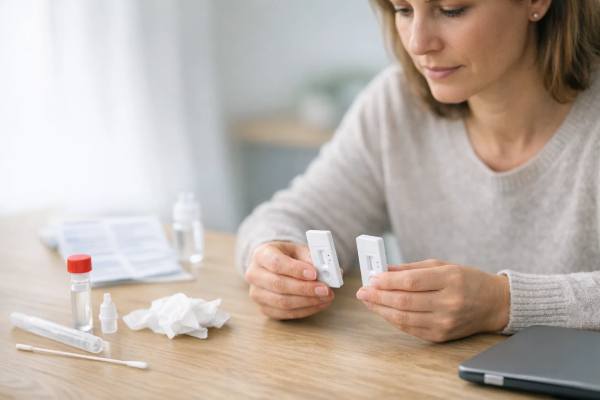
When you feel sick or learn you were exposed, the hardest part is often not taking a test—it’s choosing the right one and trusting what the result actually means. PCR, NAAT, and rapid antigen tests can all help, but they answer slightly different questions. Some tests are built to find tiny traces of viral genetic material, while others look for viral proteins that tend to track more closely with when you are most contagious. Turnaround time, sample type, and the day you test can matter as much as the brand.
This guide breaks down what each test detects in clear language, then shows how to use that knowledge in real life: when a rapid test is “good enough,” when to confirm with a molecular test, and how to interpret results for common respiratory viruses like COVID-19, flu, and RSV. The goal is confidence—not guesswork.
Quick Testing Map
- Molecular tests (PCR and other NAATs) detect viral genetic material and usually catch infection earlier than antigen tests.
- Rapid antigen tests can be most useful during the first several days of symptoms, when viral protein levels are higher.
- A single negative antigen test does not reliably rule out infection, especially early after exposure or if symptoms are present.
- Serial antigen testing (repeating a test over 24–48 hours) improves the chance of detecting infection when you cannot access a molecular test quickly.
- For decisions with higher stakes (high-risk contacts, starting antivirals, hospital care), a fast molecular test is often the safest choice.
Table of Contents
- What PCR, NAAT, and antigen detect
- When each test is most useful
- Specimen collection and timing windows
- Accuracy, false results, and viral load
- How to interpret common test scenarios
- Using these tests for flu and RSV
- Choosing the right test for your goal
What PCR, NAAT, and antigen detect
People often say “PCR” as if it is its own category, but PCR is actually one common type of NAAT. NAAT stands for nucleic acid amplification test—a broad family of tests that look for a virus’s genetic material and amplify it so it becomes easier to detect.
PCR and NAAT in plain terms
- What they detect: Viral genetic material (RNA or DNA, depending on the virus).
- How they work: They amplify tiny amounts of genetic material in cycles (PCR) or with other amplification chemistry (some rapid NAAT platforms).
- What a positive means: The test found viral genetic material in your sample.
Because NAATs amplify genetic material, they can detect infection when there is only a small amount present. That is why they are usually considered the most sensitive option for diagnosing a respiratory virus.
A key nuance: NAATs can remain positive after you start feeling better because genetic fragments can linger even when the virus is no longer actively replicating. That does not make NAAT “bad”—it just means it is excellent for diagnosis and early detection, and less reliable for answering “Am I still contagious today?”
Rapid antigen tests in plain terms
- What they detect: Viral proteins (antigens), usually from the virus’s outer structure or nucleocapsid.
- How they work: They use antibodies on a test strip to capture viral proteins, producing a visible line.
- What a positive means: The test found enough viral protein to trigger the strip.
Antigen tests generally need a higher amount of virus in the sample to turn positive. That is why they can miss infections early (before symptoms) or late (as viral protein levels fall). The flip side is that a positive antigen test often lines up with a period when viral levels are higher.
Why wording matters: “PCR” is not always slow
Some PCR tests are run in large laboratories and may take a day or more. Others are rapid, clinic-based molecular tests that can return results in under an hour. The most useful distinction is often not “PCR vs rapid,” but molecular (PCR/NAAT) vs antigen, plus the question you are trying to answer.
When each test is most useful
The best test depends on the moment you test. Respiratory viruses tend to follow a rough pattern: viral levels rise, peak, and then decline. The catch is that “peak” timing varies by virus, by person, and by whether you are vaccinated or previously infected.
If you need the earliest possible detection
Choose a molecular test (PCR or other NAAT) when:
- You tested soon after exposure and want the best chance of catching early infection.
- You have symptoms but your rapid antigen test is negative.
- You are at higher risk for complications and early treatment decisions depend on a reliable diagnosis.
- You live with or are visiting someone highly vulnerable, and you need higher confidence.
Molecular tests are designed to detect smaller amounts of virus, so they are typically better in the “gray zone” when symptoms are just beginning or inconsistent.
If you need a fast, practical answer at home
Choose a rapid antigen test when:
- You have symptoms that started recently and want an immediate result to guide behavior.
- You need to decide whether to attend a gathering, go to work, or visit a high-risk person.
- You plan to test more than once over a short period to improve detection.
Antigen testing is most informative when used during the days when viral proteins are most likely to be present in higher amounts. For many respiratory viruses, that is often in the first several days of illness.
How repeat testing changes the value of antigen
A single antigen test is a snapshot. Repeating antigen tests is closer to a short “video” of what is happening.
A practical serial-testing approach is:
- Test when symptoms begin (or when you realize you were exposed and develop any symptoms).
- If negative, test again in 24–48 hours.
- If still negative but symptoms persist or worsen, use a molecular test if possible.
This matters because many false negatives are not “bad tests”—they are tests taken before viral proteins rise above the detection threshold.
If you only remember one rule
- Negative molecular tests are more reassuring than negative antigen tests.
- Positive antigen tests are usually actionable quickly.
Specimen collection and timing windows
Two people can use the same test brand on the same day of illness and get different results for a simple reason: the sample was different. Collection quality is one of the biggest “hidden variables” in testing.
Where the sample comes from matters
Common specimen types include:
- Anterior nasal swab: Swab just inside the nostrils. Common for home antigen tests and many rapid NAATs.
- Nasopharyngeal swab: Deeper swab done by trained staff. Often used for lab-based PCR and can improve detection in some settings.
- Throat swab or combined throat and nasal swab: Used in some regions and for some tests. Can be helpful when viral load is higher in the throat, but only if the test is authorized for that specimen type.
- Saliva: Convenient for some molecular tests. Results depend heavily on instructions (no eating, drinking, or brushing teeth shortly before).
Your goal is not discomfort—it’s a good sample. A gentle, quick swab that barely touches the nostril may miss virus that is present.
Collection tips that actually improve accuracy
- Read the instructions once before you open anything, then follow them step-by-step.
- Swab both nostrils if the instructions say to.
- Rotate the swab and take enough time (many kits specify a number of rotations or seconds).
- Avoid testing immediately after nose sprays unless the instructions explicitly allow it.
- Keep the test within its temperature range; very cold kits can behave unpredictably.
- Do not reuse swabs or mix components between different kits.
Timing windows: exposure vs symptoms
A common mistake is testing too soon after exposure and treating a negative result as proof. Early after exposure, virus may be present but still below the detection threshold—especially for antigen tests.
A practical timeline mindset:
- After exposure: Molecular testing generally becomes useful earlier than antigen testing.
- At symptom onset: Both can be useful, but antigen may still be negative on day 0 for some people.
- Days 1–5 of symptoms: Antigen tends to perform better, especially if symptoms are active.
- Later in illness: Antigen may turn negative while a molecular test stays positive.
This does not mean one test is “right” and the other is “wrong.” It means they are measuring different targets with different thresholds.
Accuracy, false results, and viral load
Test accuracy is not a single number you can apply to every situation. It shifts with three big factors: the test type, when you test, and how likely infection was before you tested (often called pretest probability).
Sensitivity and specificity without the jargon
- Sensitivity: How often a test detects infection when infection is truly present. Lower sensitivity means more false negatives.
- Specificity: How often a test stays negative when infection is truly absent. Lower specificity means more false positives.
In general, molecular tests tend to have higher sensitivity than antigen tests. Many antigen tests have high specificity, meaning a clear positive is usually trustworthy—especially when symptoms are present.
Why false negatives happen
Common reasons include:
- Testing too early (virus not yet high enough in the sampled area).
- Poor sample collection (not enough material on the swab).
- Testing late (viral proteins have fallen, especially for antigen tests).
- Site mismatch (virus is more concentrated in throat or lower airways than in the nose).
- Very mild or resolving infection.
This is why “negative does not rule it out” is more than a warning label—it is a description of biology plus timing.
Why false positives happen
False positives are less common with well-made antigen and molecular tests, but they can occur due to:
- Contamination (especially with molecular tests, where amplification can magnify small errors).
- Using a test after its expiration date or outside its recommended temperature range.
- Reading an antigen test outside the time window (evaporation lines can appear later and look like a faint positive).
- Rare cross-reactivity or manufacturing issues.
If you get a surprising positive result—no symptoms, no exposures, and low community spread—confirming with a molecular test can be reasonable.
Viral load and what tests can and cannot tell you
People sometimes use molecular test metrics (like cycle threshold values) as if they measure contagiousness. In reality, many factors affect these numbers: swab quality, the platform used, and sample handling. Antigen tests also do not provide a clean “contagiousness score.” The most reliable approach is behavioral: if you have symptoms or a positive test, act as if you may be contagious, especially around high-risk people.
How to interpret common test scenarios
Most confusion comes from results that do not match how you feel. Here are common scenarios and a practical way to think about each one.
Scenario 1: Positive rapid antigen test
In most cases, treat a positive antigen test as a true positive and take action immediately:
- Stay home if you can, avoid close contact, and mask if you must be around others.
- Let close contacts know, especially if they are high risk.
- If you are eligible for antiviral treatment, contact a clinician promptly because timing matters.
Confirmation with a molecular test may be helpful when a positive result is unexpected and the stakes are high (for example, travel requirements), but do not delay protective steps while waiting.
Scenario 2: Negative antigen test but you have symptoms
This is a classic “timing” problem. Practical next steps:
- Assume you could still be infected, especially in the first 1–2 days of symptoms.
- Repeat the antigen test in 24–48 hours, or get a molecular test as soon as possible.
- If symptoms worsen, you are high risk, or you need a diagnosis to start medication, skip the wait and choose a molecular test.
If your symptoms are strongly suggestive of flu (sudden fever, body aches) and you are within the first couple of days, a molecular test can be especially helpful because treatment decisions may be time-sensitive.
Scenario 3: Negative PCR or NAAT but you still feel sick
A negative molecular test makes that specific virus less likely, but it does not guarantee “no virus.” Possibilities include:
- Another respiratory virus not covered by the test.
- Sampling issues (less common, but possible).
- Testing very early, before virus was detectable.
If symptoms continue, a clinician may recommend repeat testing or a broader multiplex respiratory panel depending on severity and risk.
Scenario 4: Positive PCR weeks after illness
This can happen because molecular tests detect genetic material that may linger. If you are feeling well and the positive is long after your peak illness, the result may not represent active, contagious infection. Interpretation depends on timing, symptoms, and risk setting, so this is a moment to involve a clinician rather than self-deciding.
Scenario 5: One positive and one negative at home
When results conflict:
- Trust the test taken closer to symptom peak and collected more carefully.
- A positive antigen test followed by a negative the next day can happen as viral proteins fall.
- A negative followed by a positive often reflects rising viral levels—act on the positive.
Using these tests for flu and RSV
PCR, NAAT, and antigen principles apply across respiratory viruses, but the “best” choice shifts with age, setting, and what you would do with the result.
Influenza: why speed and sensitivity both matter
Flu treatment works best when started early. That makes diagnosis timing important, especially for people at higher risk for complications.
- Rapid influenza antigen tests can provide quick results, but they may miss cases—particularly when flu is circulating widely.
- Rapid molecular flu tests (a type of NAAT) often balance speed and better sensitivity, making them useful in urgent care and emergency settings.
- Lab-based molecular panels are common in hospitals because they can detect flu, COVID-19, and RSV in one sample.
If you are severely ill, hospitalized, pregnant, older, immunocompromised, or have chronic heart or lung disease, clinicians often lean toward molecular testing because the consequences of missing flu can be significant.
RSV: different stakes for different people
For healthy adults, confirming RSV often does not change treatment because care is usually supportive. Testing becomes more valuable when:
- A child is young or high risk and diagnosis guides infection control decisions.
- An older adult or medically fragile person has worsening breathing symptoms.
- A facility is managing an outbreak and needs clarity on what is spreading.
Antigen testing for RSV can be faster but is generally less sensitive than NAAT. Molecular testing is often preferred in higher-risk settings when a definitive answer changes management.
Multiplex tests: when one swab answers several questions
Multiplex molecular tests can detect multiple viruses from one sample, which can be valuable when symptoms overlap and decisions depend on the cause. Situations where multiplex testing can be particularly helpful include:
- Hospital admission for respiratory illness.
- High-risk patients where missing a treatable infection has consequences.
- Outbreak investigations in congregate settings.
- When clinical decisions (antivirals, isolation measures) depend on identifying the specific virus.
The main trade-offs are cost, availability, and turnaround time. But when you need clarity fast, multiplex molecular testing can reduce guesswork.
Choosing the right test for your goal
Instead of asking “Which test is best?” ask “What decision am I trying to make?” The right test is the one that best supports the next step.
Goal: protect a high-risk person
If you will be around someone older, immunocompromised, or medically fragile:
- Use a molecular test when you need high confidence.
- If you are using antigen tests, use serial testing and combine it with practical protections (masking, ventilation, postponing if symptomatic).
Also remember a simple truth: the most meaningful “test” is whether you have symptoms. If you feel unwell, delaying the visit is often safer than any single test result.
Goal: decide about work, school, or events
Antigen tests are often used here because they are fast. Make them more reliable by:
- Testing on the day you will be around others, not days earlier.
- Testing again 24–48 hours later if symptoms appear or exposure risk was high.
- Reading the result only within the instructed time window.
Goal: qualify for treatment
When starting antivirals depends on a confirmed diagnosis, a molecular test is often the most direct route, especially if your first antigen test is negative but symptoms fit.
If you cannot access molecular testing quickly, do not wait passively. Repeat antigen testing and contact a clinician early, especially if you are at higher risk for severe disease.
Goal: reduce the chance of spreading illness at home
Think in layers:
- Test when symptoms start.
- Use a second test 24–48 hours later if the first is negative.
- Isolate the sick person as much as practical, improve airflow, and mask during close care.
- Treat a positive antigen test as actionable even if symptoms are mild.
Cost, access, and realistic planning
Rapid antigen tests are usually the most accessible. Molecular tests are often more expensive or require a clinic visit, but they can prevent lost time when the answer is urgent. If you keep tests at home, check expiration dates periodically and store them in a stable, room-temperature environment so they work as designed.
References
- Overview of Testing for SARS-CoV-2 | COVID-19 | CDC 2024 (Guideline)
- Rapid Influenza Diagnostic Tests | Influenza (Flu) | CDC 2024 (Guideline)
- Diagnostic Testing for RSV | RSV | CDC 2024 (Guideline)
- The Infectious Diseases Society of America Guidelines on the Diagnosis of COVID-19: Antigen Testing (January 2023) – PMC 2023 (Guideline)
- Comparison of diagnostic accuracy of rapid antigen tests for COVID-19 compared to the viral genetic test in adults: a systematic review and meta-analysis – PMC 2024 (Systematic Review)
Disclaimer
This article is for general educational purposes and does not provide medical advice, diagnosis, or treatment. Test performance and interpretation depend on the virus involved, the day of illness or exposure, the quality of sample collection, and your individual risk factors. Always follow the instructions for your specific test, and seek medical care promptly if you have trouble breathing, chest pain, confusion, dehydration, worsening symptoms, or if you are at higher risk for complications from respiratory infections. For personal guidance about which test to use and what to do with your result, consult a qualified healthcare professional.
If this guide helped you, please consider sharing it on Facebook, X (formerly Twitter), or any platform you prefer.