Peptides are everywhere in haircare right now. They show up in scalp serums, density drops, strengthening masks, bond-style treatments, and “multi-peptide” formulas that promise fuller roots and healthier lengths. The appeal is easy to understand: peptides sound precise, modern, and closer to science than the usual vague claims about nourishment. But that popularity has also blurred an important distinction. Some peptide products are designed to support the scalp and hair follicle environment. Others mainly improve how the hair fiber feels and behaves. A few try to do both.
That difference matters if you are deciding where to spend money and patience. Peptides are not one single ingredient, and they do not all work in the same place. Some are better understood as cosmetic conditioners for damaged strands. Others are marketed for anchoring, density, or scalp support, though the human evidence is often smaller and less standardized than people expect. The most useful question is not whether peptides are “good.” It is what kind of peptide you are using, what outcome you want, and how realistic the claims are.
Key Facts
- Peptides can help haircare in different ways: some support scalp-focused formulas, while others mainly improve strand feel, smoothness, and breakage resistance.
- The best evidence for visible density is still stronger for established hair-loss treatments than for most peptide-only serums.
- Hydrolyzed keratin and related peptide ingredients are often more convincing for strength and surface repair than for true regrowth.
- Multi-peptide serums can be useful adjuncts, but they are often studied in mixed formulas, so it is hard to credit one peptide alone.
- Use scalp peptide products consistently for at least 12 weeks before judging them, and patch test first if your scalp is reactive.
Table of Contents
- What peptides actually are in haircare
- Which peptides target density and why
- Where peptides help most with strength
- What they can and cannot do for scalp health
- How to choose a peptide product without overpaying
- When peptides are worth using and when they are not enough
What peptides actually are in haircare
In haircare, “peptide” is a broad label, not a single function. Peptides are short chains of amino acids, and their size, sequence, and chemical partners shape what they are likely to do. That is why one peptide serum can be marketed for thinning at the roots while another peptide treatment is meant to smooth and strengthen bleach-damaged lengths. Both use peptides, but they are solving different problems.
In practical terms, haircare peptides usually fall into a few groups.
- Signal or biomimetic peptides are the ones most often used in scalp serums for density claims. These are marketed to support the follicle environment, hair anchoring, or the extracellular matrix around the follicle.
- Copper peptides are often discussed separately because they have a longer scientific backstory and are associated with wound-healing and signaling pathways. In hair products, they are usually framed as scalp-supportive or growth-supportive ingredients rather than simple conditioners.
- Hydrolyzed keratin, collagen, silk, or other protein-derived peptide ingredients are more often about the hair fiber itself. These ingredients can deposit on damaged strands, improve feel, reduce roughness, and sometimes improve tensile behavior or breakage resistance.
- Multi-peptide blends combine several peptide types with botanicals, caffeine, niacinamide, panthenol, amino acids, or growth-factor-style ingredients. These formulas are common, but they make it hard to isolate which ingredient is doing what.
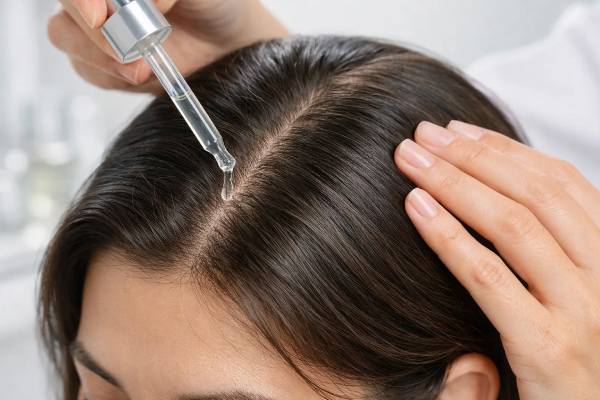
This matters because consumers often assume every peptide product is trying to regrow hair. Many are not. A leave-in peptide mask for damaged ends may be far more about cosmetic reinforcement than about the scalp. A density serum, by contrast, is meant to stay on the scalp and is often positioned as a long-term supportive product rather than a quick styling aid.
A second source of confusion is the word “protein.” Hair is made largely of keratin, so brands understandably lean on the idea that peptides are “building blocks” for stronger hair. There is some truth there, but it is easy to oversimplify. Topical peptides do not simply turn into new hair the way bricks become a wall. Some can bind, coat, or interact with damaged areas of the shaft. Others may act as signaling ingredients in the scalp environment. Those are very different mechanisms.
That is why product placement is often a clue. If the formula is a rinse-out conditioner, the peptide is probably there mainly for feel, conditioning, and damage support. If it is a leave-on scalp serum, the brand is usually aiming at density, shedding, or scalp condition. If you want a broader look at how ingredient-heavy root products fit together, scalp serum ingredient patterns help decode the category.
The simplest way to think about peptides is this: some are cosmetic support for the strand, some are scalp-directed actives, and many products blur the line. The label only becomes meaningful when you know which category you are buying.
Which peptides target density and why
When brands talk about peptide serums for fuller-looking hair, they are usually talking about scalp-focused peptides rather than shaft-repair peptides. The most common claims in this category involve improved anchoring, support for the follicle environment, reduced shedding, or better-looking density over time. The language often sounds highly technical, with phrases like extracellular matrix support, follicle stimulation, microcirculation, or stem-cell activation. Some of that is grounded in laboratory work. The harder question is how much of it translates into visible results on a real scalp.
A few names appear repeatedly in commercial formulas. Biotinoyl tripeptide-1, acetyl tetrapeptide-3, and various branded complexes are commonly positioned as density-supportive ingredients. These are often combined with botanical extracts such as red clover, ginseng, apigenin, or oleanolic acid. In theory, the blend is designed to support hair anchoring, modulate local inflammatory signaling, or create a more favorable follicle environment. In practice, many of the better-known human studies test the whole formulation, not the peptide in isolation. That makes the category more promising than definitive.
Copper peptides, especially GHK-Cu and related forms, sit slightly apart because they have a longer reputation in regenerative and signaling research. In haircare, they are often marketed as scalp actives rather than standard conditioners. They are interesting, but even here the real-world evidence is not as uniform or abundant as consumers often assume. Delivery, formulation stability, and the presence of other actives all affect whether a copper peptide product behaves like a meaningful scalp treatment or simply like a well-positioned cosmetic serum.
This is the crucial reality check: peptide serums may help some users with visible density or reduced shedding, but the evidence base is still lighter and less standardized than for established drug treatments. That does not make them pointless. It just changes how they should be used. Think of them as adjunctive or supportive rather than automatic substitutes for therapies with a stronger track record. If you need a direct benchmark, how minoxidil works makes the contrast easier to understand.
A few practical patterns are worth knowing:
- Density peptides usually need leave-on scalp contact, not rinse-off use.
- They tend to require weeks to months, not days, before any visible judgment is fair.
- The outcome is more often slowing decline or modest thickening than dramatic regrowth.
- Results are harder to predict when the formula uses ten active claims at once.
The strongest use case for peptide density products is often early or mild thinning, increased shedding without obvious scarring, or a person who wants a scalp-supportive routine alongside other measures. The weakest use case is advanced loss with expectations of a near-pharmaceutical effect from a cosmetic serum alone.
So yes, some peptides are genuinely relevant to density conversations. But the honest answer is narrower than advertising suggests. They can be useful scalp actives. They are not a guaranteed shortcut to major regrowth.
Where peptides help most with strength
If density is the most overmarketed peptide promise, strength is probably the most believable one. This is where peptide-based haircare often makes the most immediate cosmetic sense. Hydrolyzed keratin, silk peptides, collagen peptides, and related protein fragments can interact with the hair shaft, especially when the cuticle is roughened by heat, coloring, UV exposure, or repetitive wet-to-dry stress. Their job is not to wake up follicles. It is to improve the behavior of damaged hair fibers.
That distinction is important because many people say they want “hair growth” when what they are actually seeing is breakage. A strand that snaps along the mid-lengths creates the impression of poor growth, even though the follicle may be working normally. In those cases, shaft-focused peptides can be much more satisfying than scalp serums because they target the problem you can actually see. If that difference is not obvious yet, breakage versus true hair loss is often the missing framework.
Peptide and protein-derived strengthening ingredients can help in several ways:
- forming a light film over damaged cuticle areas
- increasing smoothness and reducing friction during combing
- improving temporary strength or elasticity characteristics
- lowering the rough, porous feel that often follows bleach or heat damage
- making strands more manageable, which indirectly reduces mechanical breakage
This is also where expectations need to be precise. A peptide conditioner can make hair feel stronger and behave better, but it does not restore virgin hair. The effect is partly structural and partly cosmetic. Some ingredients deposit on the cuticle. Some penetrate damaged regions better than others. Molecular size matters. Formulation matters. Repeated use matters. That is why two “peptide masks” can feel completely different in practice.
A common mistake is to judge strength products only by softness. A very soft result is not always a strong result. Some damaged hair actually needs a balance of protein-like reinforcement and conditioning slip. Too much emphasis on one side can leave the fiber stiff, rough, or over-conditioned. In that sense, peptide-based strengthening is not all-or-nothing. It works best as part of a balanced routine.
This category also overlaps with bond-repair marketing, but they are not identical concepts. Some peptide products are mainly conditioning and reinforcing; some bond-repair systems aim to address chemical damage more specifically. There can be overlap, but they are not automatically interchangeable. If you are comparing them, what bond-repair products really do helps keep the labels straight.
For most consumers, this is where peptides earn their place most clearly: damaged, color-treated, or high-friction hair that needs better resilience and less snapping. The scalp may not notice. The mirror often will.
What they can and cannot do for scalp health
Scalp health is where peptide marketing becomes both interesting and slippery. Many leave-on scalp products now combine peptides with soothing agents, humectants, niacinamide, caffeine, botanical extracts, postbiotics, or anti-inflammatory ingredients. The formula may genuinely improve comfort, hydration, or the overall look of the scalp. But it is often difficult to say whether the peptide is the main reason.
The potential appeal is understandable. A healthy scalp environment matters for hair retention, comfort, and product tolerance. If the scalp is chronically irritated, very flaky, inflamed, or reactive, even excellent styling or density products may not perform well. Some peptides are marketed as barrier-supportive or signaling molecules that help maintain a healthier scalp surface and follicle neighborhood. That idea is biologically plausible. The problem is that real-world scalp health is influenced by many overlapping factors: sebum, yeast balance, inflammation, contact allergy, washing habits, climate, styling residue, and medical conditions such as seborrheic dermatitis or psoriasis.
This means peptides may help the scalp in supportive ways, but there are clear limits.
What they may do reasonably well:
- improve the feel of a leave-on scalp product
- support a formula designed for hydration and comfort
- work alongside soothing ingredients in a barrier-focused serum
- contribute to a healthier-feeling scalp routine over time
What they do not reliably replace:
- antifungal treatment for true dandruff or seborrheic dermatitis
- medical therapy for psoriasis or eczema
- evaluation of allergic or irritant reactions
- treatment for painful, scarring, or rapidly worsening scalp disorders
This is where product context matters more than ingredient romance. A well-formulated peptide serum may improve the experience of a mildly stressed scalp. A poorly tolerated serum with fragrance, botanical overload, or a reactive solvent system may do the opposite. In other words, a peptide label does not automatically make a product “gentle.” If your scalp is already temperamental, a guide to allergy versus irritation from hair products can be more useful than chasing another active.
Another practical point is that scalp health claims are often softer than density claims for a reason. “Supports scalp balance” and “helps maintain a healthy-looking scalp” are easier to promise than “treats dandruff” because the evidence threshold is lower and the regulatory language is safer. Consumers should notice that difference.
The fairest conclusion is that peptides can be part of a scalp-health routine, especially in leave-on products designed for comfort and supportive care. But they are best understood as helpers, not as stand-alone treatment for active scalp disease. Their role is background support. When the scalp is genuinely unwell, background support is useful, but it is not enough by itself.
How to choose a peptide product without overpaying
Peptide haircare is a category where good formulation matters more than dramatic branding. Because so many products use complex names, consumers often assume the most technical label must be the most effective. That is not how this space works. The better question is whether the product matches your actual goal: fuller-looking roots, less breakage, better scalp comfort, or all three.
Start by identifying the format that fits the outcome you want.
- Choose a leave-on scalp serum if your goal is density support, reduced shedding, or scalp condition.
- Choose a mask, leave-in, or conditioner if your main goal is smoother, stronger lengths with less snapping.
- Be skeptical of products that claim major regrowth and major shaft repair in the same breath without explaining how the formula is meant to be used.
Next, look at the company around the peptide, not just the peptide itself. A scalp serum may pair peptides with caffeine, niacinamide, panthenol, humectants, or botanical extracts. A strengthening mask may combine hydrolyzed keratin with conditioning agents, silicones, or fatty alcohols. That broader formula often determines whether the product feels elegant, irritating, greasy, or useless.
A few buying rules help prevent wasted money:
- Avoid miracle language.
“Clinically proven” can mean many things, including a small in-house study on a mixed formula. - Match the timeline to the claim.
Density products need months. Strength products often show feel changes much sooner. - Do not confuse peptide presence with high concentration.
A fancy peptide low on the list may matter less than the vehicle and supporting ingredients. - Consider your scalp temperament.
Reactive scalps may do better with simpler formulas and careful patch testing. - Do not stack five peptide products at once.
That increases cost and confusion without making results easier to judge.
It is also worth remembering that haircare marketing loves to borrow medical language. A peptide serum can be a well-made cosmetic without being a medically meaningful treatment for active hair loss. That does not reduce its value. It just keeps expectations sane. If a product sounds like a pharmaceutical replacement but behaves like a cosmetic, the problem is often the advertising, not the user. For consumers who keep getting pulled into ingredient hype, hair-growth red flags translate surprisingly well to topical products too.
The most sensible peptide purchase is usually the one that solves one problem clearly. A scalp serum for roots. A strength treatment for damaged lengths. A supportive scalp product for comfort. Once the purpose is clear, the category becomes much easier to navigate and much harder to overspend on.
When peptides are worth using and when they are not enough
Peptides are worth using when they match a realistic goal and a real need. They make the most sense in three situations: you want better-looking and better-behaving damaged hair, you want a supportive scalp serum as part of a broader routine, or you are addressing early cosmetic thinning and are comfortable with gradual, modest expectations.
They are especially appealing for people who do not want to begin with a high-commitment medical approach, or who want a supportive product alongside established therapies. In that role, peptides can be quite rational. A density serum may complement an existing routine. A keratin-peptide mask may reduce breakage enough that hair looks fuller even though follicle output has not changed. A scalp-focused peptide product may make the scalp feel calmer and more manageable.
But there are equally clear situations where peptides are not enough.
- Progressive androgenetic alopecia usually needs stronger, better-studied options if visible preservation is the goal.
- Patchy hair loss should not be managed as a peptide-shopping problem.
- Heavy shedding after illness, stress, medication change, or rapid weight loss deserves cause-based thinking first.
- Painful, inflamed, crusted, or scarring scalp changes need evaluation, not just a “growth serum.”
This is the moment where many consumers get stuck. They like the idea of a cosmetically elegant peptide product and want it to behave like a treatment-level intervention. Sometimes it helps. Often it helps less than hoped. That does not mean the category failed. It means the goal and the tool were mismatched.
A good rule is to judge peptide products by the level of claim they can honestly support. For density, think supportive and gradual. For strength, think cosmetic and often useful. For scalp health, think background help rather than disease treatment. If your primary goal is genuine hair-loss management, it is worth understanding the bigger picture of the scalp environment and hair growth rather than asking one serum to do everything.
The most balanced view is this: peptides are not empty marketing, but they are not magic either. Some are genuinely interesting actives. Some are mainly smart cosmetic tools. Their value depends on where they are used, what they are combined with, and whether you are asking them to do a cosmetic job or a medical one. Used in the right lane, they can be excellent. Used as a substitute for diagnosis or evidence-based treatment, they usually disappoint.
References
- Topical Alternatives for Hair Loss: Beyond the Conventional 2025 (Review)
- Advances in Topical Therapies for Clinically Relevant and Prevalent Forms of Alopecia 2024 (Review)
- An Herbal Extract Combination (Biochanin A, Acetyl tetrapeptide-3, and Ginseng Extracts) versus 3% Minoxidil Solution for the Treatment of Androgenetic Alopecia: A 24-week, Prospective, Randomized, Triple-blind, Controlled Trial 2020 (RCT)
- Biotechnology of functional proteins and peptides for hair cosmetic formulations 2022 (Review)
- Performance and Mechanism of Hydrolyzed Keratin for Hair Photoaging Prevention 2025
Disclaimer
This article is for educational purposes and is not a medical diagnosis or a substitute for personal advice from a qualified clinician. Peptide haircare products can support cosmetic goals such as smoother strands, less breakage, or a more comfortable scalp routine, but they do not diagnose or treat the full range of hair-loss and scalp disorders. Seek medical evaluation for sudden shedding, patchy loss, scalp pain, significant inflammation, or progressive thinning that continues despite routine changes.
If this article helped you sort through the peptide hype more clearly, please share it on Facebook, X, or another platform where it may help someone choose a smarter product and a more realistic routine.