Photobiomodulation (PBM) is a form of light therapy that delivers carefully calibrated, low-intensity wavelengths to retinal tissue. For people with dry age-related macular degeneration (dry AMD), the appeal is simple: a noninvasive, clinic-based approach that aims to support retinal cell metabolism rather than replace damaged tissue. Interest has accelerated because early and intermediate dry AMD often comes with frustrating “in-between” symptoms—reduced contrast, slower reading, hazier low-light vision—long before standard eye chart scores fall dramatically.
PBM is not a cure, and it is not a substitute for routine monitoring or proven risk-reduction steps. Still, recent trials have strengthened the discussion around measurable vision outcomes in selected patients, while also highlighting limits: results can be modest, not everyone responds, and the durability of benefit matters. This evidence update focuses on what PBM is, what studies suggest so far, and the practical question most people actually have—who may benefit and how to approach it safely.
Core Points
- PBM may produce small-to-moderate visual function gains in some people with early to intermediate dry AMD, especially when central vision is still relatively good.
- Benefits reported in trials often relate to letter-score changes and functional vision measures, but not all studies find clinically meaningful improvements.
- Treatment schedules require repeated sessions and periodic re-treatment, which affects cost, time, and long-term adherence.
- PBM is not appropriate for everyone; photosensitivity risks, certain neurologic histories, and advanced central geographic atrophy can change the risk-benefit balance.
Table of Contents
- How photobiomodulation could help dry AMD
- What the clinical trials show so far
- Who is most likely to benefit
- Treatment protocols and what a session feels like
- Safety, side effects, and who should avoid it
- How PBM compares with other options
How photobiomodulation could help dry AMD
PBM uses nonthermal light—most commonly in the visible red to near-infrared range—to influence cellular activity rather than to burn, cut, or cauterize tissue. The working premise in dry AMD is that retinal pigment epithelium (RPE) and photoreceptors are under chronic metabolic stress. Mitochondria in these cells do much of the energy work, and multiple lines of lab research suggest that stressed mitochondria can become less efficient, produce more oxidative byproducts, and signal inflammatory pathways that compound damage over time.
PBM is designed to “nudge” that environment toward a healthier balance. Proposed effects include improved mitochondrial electron transport efficiency, better cellular energy production (ATP), and modulation of oxidative stress signals. In practical terms, that could translate into improved function in retinal cells that are impaired but not yet irreversibly lost—an important distinction, because dry AMD spans a wide spectrum from mild drusen with good acuity to geographic atrophy (GA) with permanent blind spots.
One reason PBM is discussed in the context of early and intermediate disease is that many people notice real-world limitations before standard acuity tests collapse. Contrast sensitivity can fall; reading can become slower; face recognition in dim restaurants becomes harder; glare recovery can worsen. These are the kinds of “quality of seeing” issues that energy-starved retinal cells might plausibly influence.
It is also worth understanding what PBM is not. It is not the same as high-energy retinal laser treatments used historically for certain retinal conditions. PBM does not aim to create scars or reduce fluid. It also does not directly target abnormal blood vessels (that is the domain of anti-VEGF injections for wet AMD). Instead, PBM is best thought of as a supportive, metabolic intervention—more similar in spirit to conditioning than to surgery.
That framing matters for expectations: if PBM helps, it may help by improving function in vulnerable tissue and potentially slowing functional decline, not by restoring areas where cells have already disappeared. For someone deciding whether PBM is worth pursuing, the key question becomes whether they still have enough “at-risk but viable” retinal tissue to respond—and whether the treatment’s demands match their goals and lifestyle.
What the clinical trials show so far
Clinical evidence for PBM in dry AMD has expanded, but it remains a field where interpretation depends on details: disease stage, outcome measures, treatment schedule, and how “sham” treatment was designed. The most discussed modern data come from multiwavelength PBM protocols that use repeated treatment series across months rather than a single short course.
Across randomized, masked trials, the most frequently reported positive signal is a modest improvement in best-corrected visual acuity measured by standardized letter charts (often ETDRS letters). In some studies, the average gain is a few letters greater than control, and a subset of participants achieve larger gains (for example, gaining a line or more). Trials also evaluate other measures such as contrast sensitivity, reading performance, patient-reported visual function, and anatomical imaging markers like drusen volume and GA area.
Two themes consistently show up when you look beyond the headlines:
- Magnitude versus meaning: A statistically significant difference does not always meet thresholds people would notice in daily life. Many clinicians consider changes like 5 letters (one line) as a meaningful benchmark, while smaller mean differences may not be obvious to an individual patient—especially if day-to-day fluctuation is already present.
- Heterogeneous response: PBM does not act like a switch that helps everyone equally. Trial results often suggest a responder subgroup. That makes patient selection and baseline characteristics critical: the same protocol can look “mixed” overall while still being meaningful for the right candidate.
Importantly, some analyses point out limitations that reduce certainty: relatively small sample sizes, variable risk of bias, and short-to-moderate follow-up for outcomes that matter most (such as progression to central GA). Another nuance is the sham condition. If sham treatment still delivers some visible light or stimulation, it may not be a biologically inert placebo. That can shrink the apparent difference between groups and make the true effect harder to estimate.
Anatomical outcomes are also complex. Drusen volume may change without a predictable one-to-one relationship with vision. GA growth is slow and can require longer follow-up and larger cohorts to detect robust differences. Some data suggest trends toward less new-onset GA in treated groups, but this is precisely the type of outcome that demands confirmation in larger, long-duration studies.
The most practical way to interpret the evidence today is this: PBM is supported by randomized trial data suggesting potential benefit in selected early to intermediate dry AMD, but the overall evidence base still has enough uncertainty that treatment should be framed as an option with variable response, rather than a standard-of-care certainty. The “evidence update” is real—there is more data than a few years ago—but it is not the end of the story.
Who is most likely to benefit
In real-world decision-making, PBM is less about whether dry AMD exists and more about which type of dry AMD you have today. Evidence and regulatory indications for specific PBM systems commonly focus on people who still have relatively preserved central vision and who are in early or intermediate nonexudative disease—often characterized by drusen (and sometimes non-central GA), without active neovascular (wet) changes.
Profiles that tend to align best with likely benefit include:
- Early to intermediate dry AMD with mild functional loss: People who report low-light difficulty, reduced contrast, or slower reading, yet still have decent best-corrected acuity. The rationale is that retinal cells may be stressed but not yet irreversibly lost.
- No center-involving GA: Once GA involves the foveal center, lost tissue cannot be “revived,” so any metabolic support strategy has less to work with. PBM may still be discussed for symptom support or non-central disease, but expectations must shift.
- Stable ocular media and imaging quality: Significant cataract or other media opacities can reduce the accuracy of acuity testing and retinal imaging, and may also affect light delivery. In practice, clinicians often prefer to optimize treatable factors (like cataract) before judging whether PBM is helping.
- Ability to adhere to repeated sessions: PBM is a commitment. People who can reliably attend a series of short appointments—often clustered over several weeks and repeated periodically—are more likely to realize any potential benefit.
On the other hand, several scenarios call for extra caution or a different approach:
- Suspicion of wet AMD: Any new distortion, sudden central blur, or rapid change warrants urgent evaluation. PBM is not a treatment for wet AMD, and delaying anti-VEGF therapy can be vision-threatening.
- Advanced atrophy with central involvement: PBM should not be positioned as restorative therapy when structural loss is already central and extensive. The priority becomes monitoring, low-vision strategies, and (when appropriate) therapies specifically aimed at GA progression.
- High expectations for dramatic improvement: PBM can be psychologically attractive because it is noninvasive. But if someone expects “back to normal,” they are at high risk of disappointment. The healthier expectation is: possible modest improvement or stabilization, with the understanding that not all patients respond.
A useful way to think about candidacy is to ask: “Do I have symptoms that reflect stress more than loss?” If the answer is yes, PBM may be worth discussing. If the answer is no—or if vision loss is largely from established central atrophy—then PBM is less likely to be a good match. Ultimately, candidacy should be confirmed with a retinal exam and imaging (especially OCT and fundus autofluorescence) to stage disease accurately and rule out treatable mimics.
Treatment protocols and what a session feels like
Most clinic-based PBM protocols for dry AMD are structured as treatment series rather than one-off sessions. A common regimen in major trials has been three sessions per week for three to five weeks, totaling nine sessions per series. In longer protocols, that series is repeated every few months across a year or more. The logic is that PBM’s cellular effects may fade over time, so periodic re-dosing is used to maintain the biologic signal.
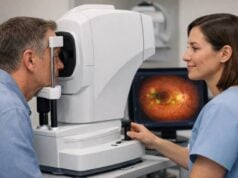
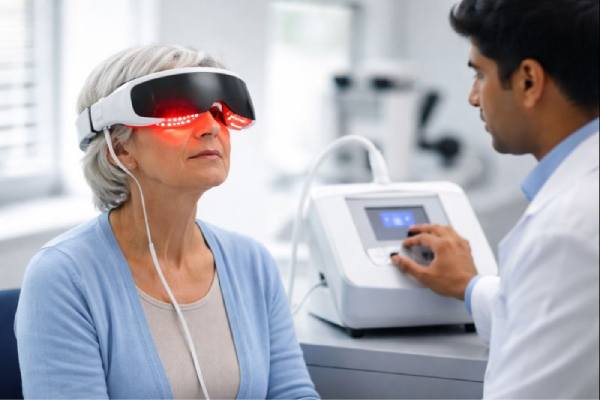
A typical visit is brief. You sit at a device somewhat like a diagnostic instrument, rest your chin and forehead, and look toward a fixation target while the device delivers light. Sessions are often measured in minutes per eye. Many patients describe the experience as seeing bright colored light patterns or a glow, without pain. The treatment is designed to be nonthermal, so heat is not the goal.
What patients often want to know is: When would I notice anything? In trials and clinical anecdotes, some people report changes within weeks—usually in functional tasks like contrast or “sharpness” rather than dramatic chart changes. Others notice nothing until after multiple series, and many notice no meaningful difference at all. That variability is why baseline testing and consistent follow-up matter.
A practical monitoring plan commonly includes:
- Baseline acuity and functional measures: Best-corrected acuity, and ideally at least one functional metric (contrast sensitivity, reading speed, or low-luminance acuity if available).
- Baseline imaging: OCT for retinal structure, plus photography or autofluorescence when GA risk is a concern.
- Repeat testing at consistent intervals: Results can fluctuate day to day. Comparing measurements at similar times of day and with the same correction reduces noise.
If you pursue PBM, it helps to define success in advance. For example, you might decide that success means any of the following sustained outcomes over 6 to 12 months:
- A gain of at least one line of acuity in the treated eye
- Noticeably improved reading endurance or contrast in daily life
- Objective stability compared with expected decline, especially if you were trending downward previously
Because PBM schedules can extend across months, logistics matter. Transportation, caregiver support, and appointment timing become part of the treatment’s real-world effectiveness. Someone who cannot realistically complete a full series will have trouble judging whether PBM works for them. If you are evaluating PBM, consider it like a trial period: commit to the recommended initial series, track outcomes, and then decide whether ongoing series are justified.
Safety, side effects, and who should avoid it
PBM for dry AMD is designed to stay below damaging light exposure thresholds, and modern devices used in clinical settings incorporate safety standards intended to reduce phototoxic risk. In trials, PBM has generally been well tolerated, with no consistent signal of retinal injury attributable to treatment when used as directed. That said, “safe in studies” is not the same as “risk-free for everyone,” and the safety conversation should be individualized.
Commonly reported side effects are usually mild and transient, such as:
- Temporary visual afterimages or light sensitivity immediately after a session
- Mild headache or eye strain
- Brief irritation from positioning at the device (chin or forehead rest discomfort)
The more important safety issues are about who should not receive PBM or who requires a more cautious approach.
Situations that typically warrant avoiding PBM or delaying it until clarified include:
- Known photosensitivity or use of photosensitizing agents: Some medications and topical agents can increase light sensitivity. If a person has a history of abnormal reactions to light exposure, PBM should be approached conservatively.
- History of light-activated neurologic disorders: Certain seizure disorders or migraine patterns can be triggered by light stimuli in susceptible individuals. This does not automatically mean PBM is impossible, but it demands careful risk assessment.
- Active or suspected neovascular (wet) AMD: PBM is not a replacement for anti-VEGF therapy. Any signs of new wet conversion require prompt evaluation and, if confirmed, treatment that targets neovascular activity.
- Center-involving GA or advanced vision loss beyond studied ranges: When central tissue is already lost, PBM is less likely to provide benefit, and the burden of treatment may not be justified.
Another safety dimension is opportunity cost. PBM should not distract from steps with established benefit: smoking cessation, cardiovascular risk management, consistent monitoring, and evidence-based supplementation when appropriate. Similarly, regular follow-up is essential because dry AMD can convert to wet AMD, and early treatment of wet AMD is one of the strongest ways to preserve vision.
Finally, be cautious with non-clinic devices marketed online. PBM dosing depends on wavelength, irradiance, duty cycle, exposure time, and treatment geometry. Without validated parameters and ocular safety engineering, at-home “red light” products may be ineffective at best and risky at worst. If you are considering light therapy, it is safer to do so under professional supervision with a system designed and evaluated for ocular use.
How PBM compares with other options
People exploring PBM often do so because dry AMD has historically offered limited choices. Today, the landscape is broader, but each option targets a different goal. PBM is best compared as a function-support and possibly disease-modifying approach for earlier stages, while other therapies may target specific late-stage processes.
Here is how PBM fits alongside common alternatives and complements:
- AREDS2-style supplementation: Supplements are aimed at reducing risk of progression in intermediate AMD for selected patients. They do not typically improve vision quickly, and they are not designed to treat symptoms day to day. PBM is different: it is a device-based intervention that may improve functional outcomes in some people. Many clinical protocols allow continued supplementation, but supplement choice should be personalized (for example, based on smoking history and other factors).
- Lifestyle and vascular risk optimization: Blood pressure control, lipid management, exercise, and dietary patterns rich in leafy greens and omega-3 sources support overall retinal health. These steps rarely produce immediate “wow” changes, but they matter for long-term risk. PBM should not be viewed as a shortcut around foundational health measures.
- Complement inhibitors for geographic atrophy: For people with GA, certain therapies aim to slow lesion growth. They are not primarily designed to improve acuity, and they may require repeated injections and careful monitoring. PBM is not a substitute for GA-focused therapy when GA is the central problem, but it may be discussed in earlier disease where GA is absent or non-central.
- Low-vision rehabilitation and assistive tech: If central function is already compromised, tools like enhanced lighting, magnifiers, e-readers, contrast settings, and training strategies can meaningfully improve daily independence. For advanced stages, these can deliver more tangible benefit than a metabolic therapy with uncertain effect.
- Home monitoring and early detection tools: Whether or not PBM is used, earlier detection of wet conversion is critical. Structured monitoring (including symptom vigilance and, when recommended, device-based home monitoring) can protect vision by enabling rapid treatment when wet changes occur.
A practical decision framework is to match the intervention to the goal:
- If your goal is risk reduction over years, prioritize proven steps (supplements when indicated, lifestyle and cardiovascular management, consistent follow-up).
- If your goal is functional improvement or stabilization in early to intermediate disease, PBM may be a reasonable option to discuss—especially if you can commit to the full schedule and you understand response variability.
- If your goal is coping better right now with established vision loss, low-vision strategies often provide the most reliable, immediate improvement in daily function.
PBM can be a worthwhile part of a dry AMD plan for the right person, but it works best when placed in a balanced strategy: clear staging, clear expectations, consistent monitoring, and a willingness to reassess after a defined trial period.
References
- LIGHTSITE III: 13-Month Efficacy and Safety Evaluation of Multiwavelength Photobiomodulation in Nonexudative (Dry) Age-Related Macular Degeneration Using the Lumithera Valeda Light Delivery System – PMC 2024 (RCT)
- LIGHTSITE II Randomized Multicenter Trial: Evaluation of Multiwavelength Photobiomodulation in Non-exudative Age-Related Macular Degeneration – PMC 2023 (RCT)
- Photobiomodulation efficacy in age-related macular degeneration: a systematic review and meta-analysis of randomized clinical trials – PMC 2024 (Systematic Review and Meta-analysis)
- Photobiomodulation for non‐exudative age‐related macular degeneration – PMC 2021 (Cochrane Review)
- DEN230083, Valeda Light Delivery System, LumiThera, Inc. 2023 (Regulatory Decision Summary)
Disclaimer
This article is for general educational purposes and does not replace individualized medical advice, diagnosis, or treatment. Dry age-related macular degeneration varies widely in stage and progression, and treatments such as photobiomodulation may be appropriate only for specific patient profiles. Always consult a qualified eye care professional for a full retinal evaluation, imaging-based staging, and guidance tailored to your vision, medical history, and medications. Seek urgent care for sudden vision changes, new distortion, or a rapid decline, as these may signal conversion to wet AMD and require prompt treatment.
If you found this helpful, consider sharing it on Facebook, X (formerly Twitter), or any platform you prefer.