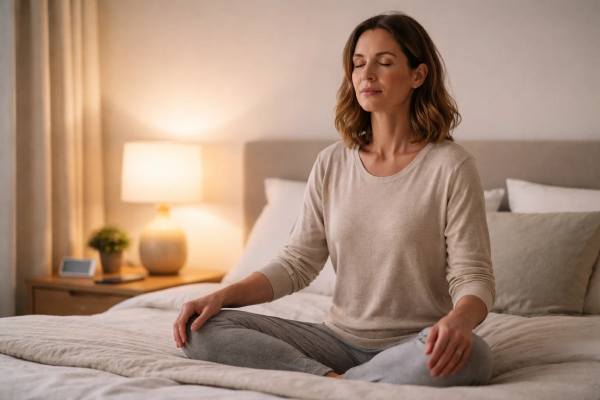
Pineal gland meditation is often marketed as a direct path to deeper sleep—sometimes through “activating” the pineal gland, boosting melatonin, or calming the nervous system by focusing on the “third eye” area between the eyebrows. The appeal is understandable: sleep problems feel intensely physical, and practices that involve breath, attention, and relaxation can make the body feel different within minutes. But the science is more nuanced than many online claims suggest.
This article breaks down what pineal gland meditation typically involves, what the pineal gland actually does in the sleep-wake cycle, and what research says about meditation for insomnia and sleep quality. You will also learn where claims go beyond evidence, how to practice safely, and what evidence-based options to prioritize if sleep remains difficult. The goal is grounded clarity—so your sleep plan is both calming and credible.
Quick Overview
- Relaxation-based meditation can lower pre-sleep arousal and make it easier to fall asleep, even if it does not “activate” the pineal gland directly.
- The pineal gland’s main sleep-related role is nighttime melatonin signaling, which is strongly influenced by light exposure and circadian timing.
- Claims about “decalcifying” the pineal gland with meditation are not supported by strong clinical evidence and can distract from proven sleep strategies.
- For a practical routine, try 10–15 minutes nightly of slow exhale breathing plus a gentle attention anchor, then pair it with consistent wake time and light management.
Table of Contents
- What pineal gland meditation claims
- What the pineal gland does for sleep
- Can meditation increase melatonin
- Pineal calcification and decalcify myths
- What research says about meditation and sleep
- How to try it safely for sleep
What pineal gland meditation claims
“Pineal gland meditation” is not one standardized method. It is a label used for a family of practices that borrow from meditation traditions, yoga-inspired “third eye” focus, breathwork, visualization, and modern guided audio. What they share is an intent to influence sleep and mental state by directing attention toward the center of the forehead (often called the third eye) or toward the idea of the pineal gland deep in the brain.
Common claims include:
- It “activates” the pineal gland and improves sleep by increasing melatonin.
- It enhances vivid dreams or lucid dreaming by “opening” the third eye.
- It reduces stress and anxiety by shifting the nervous system into a calmer state.
- It “decalcifies” the pineal gland (sometimes tied to fears about fluoride or “toxins”).
- It improves intuition, mood, or spiritual insight and therefore improves sleep indirectly.
Some of these claims map onto real pathways (stress reduction can improve sleep). Others rely on language that sounds biological but is poorly defined (what does “activation” mean in measurable terms?). A useful way to approach pineal meditation is to split it into two parts: the practice and the story.
The practice usually includes at least one of the following:
- Slow, steady breathing or breath counting
- Body relaxation (jaw, shoulders, belly)
- Attention anchoring (forehead point, breath, sound, or a mantra)
- Visualization (darkness, light, a calm place, or a “glow” in the head)
- Gentle stillness and non-judgmental awareness
These components are plausible for sleep because they reduce cognitive noise and physiological arousal. The story—“this directly turns on the pineal gland”—is where many descriptions drift beyond evidence.
Another important nuance is expectation. If you are told a practice will “trigger melatonin release,” you may interpret relaxation sensations as proof. That does not mean you are imagining benefits; it means perception and physiology interact. For sleep, that can be helpful when it leads to consistency. It becomes a problem when it pressures you to chase dramatic sensations or to believe you are doing it “wrong” if you do not feel a special effect.
A grounded goal is simple: use the practice to reduce pre-sleep arousal and support a stable sleep rhythm, while staying cautious about claims that sound precise but are not measured.
What the pineal gland does for sleep
The pineal gland is a small endocrine structure near the center of the brain. Its best-known role in humans is producing melatonin, a hormone that signals “biological night.” Melatonin helps coordinate circadian timing—your internal clock—so that sleepiness, body temperature, and many other processes shift in a predictable daily pattern.
A key point: melatonin is not exactly a sedative. For most people, it acts more like a time cue than a knockout drug. It helps the body recognize that it is nighttime and can support sleep onset when timing is off, such as in delayed sleep phase, jet lag, or shift-work misalignment. Sleep itself still depends on multiple systems: sleep pressure (how long you have been awake), arousal level (stress, worry, stimulation), environment (light, noise, temperature), and health factors (pain, breathing disorders, medications).
What controls pineal melatonin release
The pineal gland does not decide on its own when to make melatonin. It is strongly regulated by the brain’s circadian pacemaker and by light signals entering through the eyes. In practical terms:
- Bright light in the evening can suppress melatonin and delay sleepiness.
- Dim light in the evening supports normal melatonin rise.
- Morning light helps anchor the clock and can make nighttime melatonin timing more stable.
This is why “sleep hacks” that ignore light exposure often disappoint. You can meditate perfectly, but if you are exposed to bright screens late at night and sleeping in on weekends, your circadian rhythm may still be drifting.
Why the “third eye” idea persists
Meditation traditions use the forehead area as an attention anchor because it is easy to locate and can encourage stillness. That does not mean attention there physically stimulates the pineal gland. The pineal gland is deeper and not directly controlled by focusing on a point in the forehead. However, attention anchors can shift breathing, muscle tone, and emotional regulation, which can indirectly support sleep.
What melatonin can and cannot explain
People often attribute all sleep improvement to melatonin. In reality, melatonin is only one piece. Many insomnia patterns are driven more by hyperarousal: the mind stays alert, the body stays tense, and sleep becomes a performance problem. In those cases, the most reliable improvements often come from calming the arousal system and strengthening sleep rhythm—both of which can be supported by meditation, but also by consistent wake time, stimulus control, and behavioral approaches.
So, when pineal meditation “works,” the most plausible explanation is usually not that the pineal gland was directly activated. It is that the practice helped your nervous system downshift and helped your routine become more consistent—two of the most important ingredients for sleep.
Can meditation increase melatonin
It is reasonable to ask whether meditation changes melatonin, because meditation can change stress hormones, breathing patterns, and the nervous system. Some small studies have reported shifts in melatonin or related markers after certain practices, but results are not consistent, and the direction and meaning of those changes are often unclear. Even when changes are seen, they do not prove that meditation “targets the pineal gland” as a specific mechanism.
Here is the most practical way to think about it: meditation can support sleep through multiple pathways, and melatonin may be only a minor or indirect one.
Pathway 1: Reduced arousal makes sleep easier
For many people, the biggest barrier to sleep is not melatonin deficiency—it is a nervous system that stays “on.” Meditation can reduce pre-sleep arousal by:
- slowing the breath and reducing the sense of urgency
- lowering muscle tension that keeps the body alert
- reducing rumination and repetitive worry
- shifting attention away from clock-watching and sleep effort
When arousal drops, sleep onset becomes more likely, even if melatonin levels are unchanged.
Pathway 2: Evening practice changes light and behavior
Many people meditate in dimmer light, with fewer screens, and with a more consistent bedtime routine. Those changes are strongly tied to melatonin timing. In other words, the “meditation effect” may partly be a routine and light exposure effect. That still counts as real help, but it is not unique to pineal-focused imagery.
Pathway 3: Circadian support through consistency
If you meditate at roughly the same time each night, it can become a “wind-down cue” that supports circadian regularity. The brain learns patterns. A consistent pre-sleep sequence reduces uncertainty and can shorten the time it takes to transition into sleep mode.
What to watch out for
If you approach pineal meditation as a way to force sleep, it can backfire. People sometimes become hyper-focused on “doing it right” or on producing a certain sensation in the forehead. That effort can increase arousal. A better aim is: “I’m practicing settling. Sleep will come when it comes.”
Also note that melatonin is not always the limiting factor. If you have loud snoring, gasping at night, persistent early morning headaches, restless legs, severe reflux, or frequent nighttime urination, a medical contributor may be disrupting sleep. In those cases, meditation can be supportive, but it will not fix the underlying driver.
In short, meditation may influence melatonin indirectly through behavior and light exposure, but its most dependable sleep benefit is usually reducing hyperarousal and strengthening a predictable wind-down routine.
Pineal calcification and decalcify myths
Many pineal-focused sleep programs include a “decalcify your pineal gland” narrative. This idea is often presented as if calcification is a toxin buildup that blocks melatonin, and that specific meditations, supplements, or detox routines can reverse it. The reality is more complicated.
Calcification of the pineal gland—sometimes called “brain sand”—is common and tends to increase with age. It is often seen incidentally on imaging done for other reasons. The presence of calcification does not automatically mean the pineal gland is failing, and it does not reliably explain insomnia on its own.
What science can and cannot say about calcification
Researchers have studied how common pineal calcification is and whether it correlates with melatonin levels or sleep problems. Findings are mixed, partly because studies use different imaging methods, different populations, and different melatonin measurements. A careful interpretation looks like this:
- Calcification is common, especially in adults.
- The relationship between calcification and melatonin output is not straightforward.
- Even if melatonin is lower in some people, many other sleep drivers may be more important.
The most important practical point is that sleep is rarely solved by chasing a single structure. When a claim is framed as “Fix the pineal gland and your sleep will be perfect,” it is usually a sign that the story is oversimplified.
Does meditation decalcify the pineal gland
There is no strong clinical evidence that meditation reverses pineal calcification. Meditation can change stress physiology and attention, but calcification is a structural finding. Even if future research discovers ways to influence it, it would not make sense to assume that focusing on the forehead point dissolves calcium deposits.
Similarly, claims that everyday exposures inevitably “calcify” the pineal gland are often presented without context. People can become anxious and obsessive, trying to eliminate every possible exposure, which increases stress and can worsen sleep.
A better use of the concept of “pineal health”
If the word pineal motivates you to improve sleep habits, you can redirect that energy toward strategies with stronger support:
- Reduce bright light in the 1–2 hours before bed.
- Get outdoor light exposure in the morning when possible.
- Keep wake time steady most days of the week.
- Treat snoring and breathing issues if present.
- Reduce late caffeine and heavy late-night meals.
These steps influence circadian timing and sleep depth far more predictably than “decalcification” routines. You can still do meditation—just place it where evidence is strongest: calming hyperarousal and strengthening a consistent pre-sleep rhythm.
If you are worried about brain health or have neurologic symptoms, the right next step is not a detox protocol. It is a medical evaluation. Sleep problems deserve serious attention, but they also deserve explanations that are proportionate to the evidence.
What research says about meditation and sleep
When people search “pineal gland meditation for sleep,” they often want a simple verdict: does it work or not? The best evidence does not test “pineal gland meditation” specifically. Instead, it evaluates related interventions—mindfulness-based programs, relaxation training, and guided meditation—and their effects on insomnia symptoms and sleep quality.
Overall, meditation-based approaches tend to show modest improvements in sleep outcomes for many people, particularly when insomnia is tied to stress, anxiety, or rumination. Effects vary by program type, practice consistency, and the severity of insomnia.
Where meditation helps most
Meditation often helps by addressing pre-sleep processes that keep the brain awake:
- reducing cognitive arousal (worry, planning, rehashing)
- improving emotional regulation so stress does not spike at bedtime
- lowering somatic tension (jaw clenching, shallow breathing)
- improving acceptance, which reduces the struggle to force sleep
Many people also sleep better because meditation encourages a consistent wind-down routine and reduces late-night screen use.
Where meditation is not enough
If insomnia is chronic and entrenched—especially if it includes conditioned wakefulness in bed, long time awake at night, or fear of not sleeping—meditation alone may not address the behavioral pattern. In those cases, cognitive behavioral therapy for insomnia is widely considered the first-line behavioral treatment. It targets the habits and conditioned associations that keep insomnia going, such as spending too long awake in bed, irregular wake times, and safety behaviors that accidentally reinforce insomnia.
Meditation can still play an important supporting role, but it works best when paired with a structured insomnia plan rather than used as the only tool.
Choosing a style that fits your brain
Different meditation styles suit different insomnia profiles:
- If your mind is busy, try guided meditation, body scan, or gentle labeling of thoughts.
- If you get anxious when focusing inward, try external anchors like sound, a neutral phrase, or visual orienting.
- If you feel shut down or depressed, a brief gentle movement practice before meditation may be more effective than starting with stillness.
A useful principle is “less effort, more repetition.” A shorter practice done consistently tends to help sleep more than long sessions done sporadically.
Measuring whether it is working
Give a practice a fair test—often 2–3 weeks—while tracking one or two markers:
- time to fall asleep
- number of nighttime awakenings
- how rested you feel in the morning
- pre-sleep worry intensity
If you see no meaningful shift, that is information, not failure. It may mean your main driver is circadian timing, untreated sleep apnea, restless legs, depression, medication effects, or a learned insomnia pattern that needs a different strategy. Evidence-based sleep care is about matching the tool to the problem, not repeating a single tool harder.
How to try it safely for sleep
If you want to try pineal gland meditation, the safest and most effective approach is to treat it as a sleep-supporting relaxation routine, not as a test of spiritual or biological “activation.” Keep it gentle, predictable, and easy to repeat.
A simple 10 to 15 minute routine
Try this nightly for two weeks:
- Set the environment: dim the lights, lower noise, and keep the room slightly cool. Put your phone out of reach if possible.
- Choose a posture: lying down is fine if it does not make you tense about falling asleep “on time.” Sitting is fine if lying down triggers performance pressure.
- Breathe to downshift: inhale through the nose for a comfortable count, then exhale a little longer than you inhaled. Keep it mild—no breath holds.
- Pick an attention anchor: you can gently rest attention on the space between the eyebrows, but do not force sensations. If that feels strange, anchor on the breath, a neutral word, or ambient sound.
- Use a realistic phrase: “My job is to practice settling. Sleep will arrive when it is ready.”
- End with a soft transition: after 10–15 minutes, either turn off the light and allow sleep, or do a low-stimulation activity if you feel wired.
What to do if it makes you more alert
This happens more often than people expect. If focusing on the forehead increases tension or triggers headaches:
- shift attention to the exhale or to sounds in the room
- reduce effort and shorten the session to 3–5 minutes
- avoid bright visualizations and choose calming, darker imagery
- try the practice earlier in the evening rather than in bed
If meditation increases anxiety or brings up intense memories, consider working with a qualified clinician and using grounding practices that keep you oriented to the present.
Safety considerations
Meditation is generally low-risk, but it is not risk-free for everyone. Use extra caution if you have:
- panic disorder and feel worse with breath-focused practices
- trauma symptoms that worsen when you close your eyes or go inward
- a history of psychosis or bipolar mania, where intensive meditation can sometimes destabilize sleep and perception
- dizziness disorders that worsen with slow breathing or certain postures
In these situations, gentler and more external regulation strategies may be a better starting point.
When to prioritize evidence-based sleep care
Consider professional support if insomnia lasts longer than three months, if you regularly function poorly during the day, or if you suspect a medical sleep disorder. A good clinician can help you evaluate sleep apnea, restless legs, circadian rhythm issues, medication effects, and mental health contributors. Meditation can be part of your plan—but it should not be the only plan when sleep is significantly impaired.
Used wisely, pineal-focused meditation can be a calming nightly ritual. The most reliable path to better sleep is consistency, reduced arousal, and a stable circadian rhythm—whether or not you ever feel a “third eye” sensation.
References
- Behavioral and psychological treatments for chronic insomnia disorder in adults: an American Academy of Sleep Medicine clinical practice guideline – PMC 2021 (Guideline)
- Effects of mindfulness-based intervention programs on sleep among people with common mental disorders: A systematic review and meta-analysis – PMC 2022 (Systematic Review and Meta-Analysis)
- Prevalence of pineal gland calcification: systematic review and meta-analysis – PMC 2023 (Systematic Review and Meta-Analysis)
- Dual sources of melatonin and evidence for different primary functions – PMC 2024 (Review)
- Systematic review and meta-analysis of effects of standalone digital mindfulness-based interventions on sleep in adults – PMC 2025 (Systematic Review and Meta-Analysis)
Disclaimer
This article is for educational purposes and does not provide medical advice, diagnosis, or treatment. Sleep problems can have many causes, including medical sleep disorders (such as obstructive sleep apnea), medication effects, chronic pain, hormonal factors, and mental health conditions. Meditation and relaxation practices may support sleep for some people, but they are not a substitute for individualized evaluation or evidence-based treatment for chronic insomnia. Seek prompt medical care if you have symptoms such as loud snoring with choking or gasping, significant daytime sleepiness, chest pain, fainting, new neurologic symptoms, or severe mood changes. If you feel unsafe or have thoughts of self-harm, seek urgent help through local emergency services or a crisis resource in your region.
If you found this article helpful, please consider sharing it on Facebook, X (formerly Twitter), or any platform you prefer.