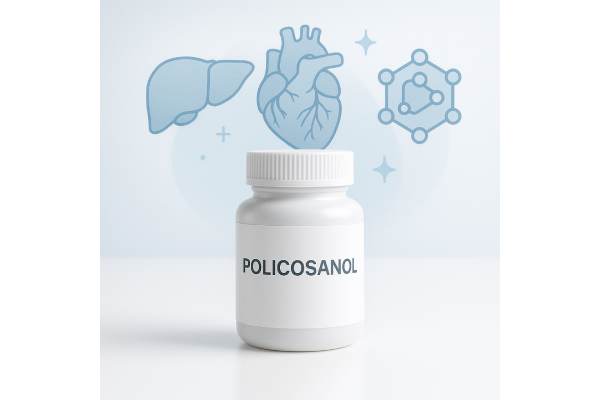
Policosanol is a mixture of long-chain alcohols originally isolated from sugar cane wax and now also derived from beeswax, rice bran, and wheat germ. It is marketed worldwide as a “natural” way to support healthy cholesterol and cardiovascular function. Most supplements target adults who want additional lipid support, cannot tolerate statins, or prefer nutraceutical approaches.
Research suggests policosanol may modestly improve total and LDL cholesterol, raise HDL cholesterol, and slightly lower blood pressure, although findings are inconsistent and depend on the specific product used. At the same time, major lipid guidelines remain cautious and generally do not recommend it as a primary treatment for high cholesterol.
This guide explains what policosanol is, how it seems to work, where the evidence is strong or weak, how to use it safely, and who should avoid it. It is written for informed readers who want a clear, realistic view of the benefits and limits of this supplement, not a sales pitch.
Quick Summary for Policosanol
- Policosanol is a wax-alcohol mixture, often from sugar cane, used mainly to support cholesterol and cardiovascular health.
- Studies suggest modest improvements in LDL, total cholesterol, HDL, and small reductions in blood pressure, but results vary widely.
- Typical supplemental dosages range from 5–20 mg per day, often taken with the evening meal; some research uses up to 40 mg daily.
- It appears generally well tolerated at studied doses, with mostly mild side effects when they occur.
- People who are pregnant or breastfeeding, have significant liver disease, bleeding disorders, or take anticoagulants should avoid policosanol unless advised otherwise by a clinician.
Table of Contents
- What is policosanol?
- How does policosanol work in the body?
- What are the main benefits of policosanol?
- How to use policosanol and typical dosage
- Policosanol with other supplements and medications
- Side effects, safety, and who should avoid policosanol
- What current research and guidelines say about policosanol
What is policosanol?
Policosanol is not a single molecule but a mixture of long-chain primary alcohols, typically including octacosanol, triacontanol, hexacosanol, and related compounds. It was first isolated from sugar cane (Saccharum officinarum) wax and promoted as a natural lipid-lowering agent. Products sold today may be derived from sugar cane, beeswax, wheat germ, or rice bran, and the exact composition can differ between manufacturers.
Most of the early and most positive clinical trials used a standardized sugar cane policosanol product developed in Cuba. Later studies from other regions, using different raw materials or manufacturing methods, often reported smaller or absent effects on blood lipids. This matters, because “policosanol” on a supplement label does not guarantee the same composition or potency as the products used in earlier trials.
Policosanol is sold as a dietary supplement rather than a prescription medicine in most countries. That means it is not regulated to the same standard as pharmaceutical lipid-lowering drugs. Purity, dose accuracy, and consistency between batches can vary depending on the brand and local regulations.
You will usually find policosanol in:
- Stand-alone capsules or tablets labeled simply as “policosanol”
- Combination “cholesterol support” formulas with red yeast rice, plant sterols, berberine, omega-3s, or niacin
- Some cardiovascular and “healthy aging” nutraceutical blends
Because many products combine several active ingredients, it can be difficult to tell how much of any observed benefit comes from policosanol itself.
In everyday use, people take policosanol mainly for:
- Additional LDL and total cholesterol support
- Modest HDL cholesterol support
- Extra help with blood pressure or vascular health, often alongside other lifestyle or medication approaches
However, it should be viewed as a complementary option rather than a replacement for evidence-based therapies such as statins, ezetimibe, or PCSK9 inhibitors when those are indicated.
How does policosanol work in the body?
The precise mechanisms of policosanol in humans are still being clarified, but several plausible pathways have been proposed based on cell, animal, and clinical research.
- Cholesterol synthesis and metabolism
Experimental work suggests that policosanol may interfere with cholesterol production in the liver, partly by down-regulating 3-hydroxy-3-methylglutaryl-coenzyme A (HMG-CoA) reductase, the same enzyme targeted by statins. Unlike statins, policosanol’s effect appears weaker and may involve indirect regulatory pathways rather than direct enzyme inhibition. This may help explain the modest lipid changes seen in many studies. Policosanol may also enhance LDL receptor activity on liver cells, increasing the clearance of LDL particles from the bloodstream. This mechanism would be consistent with reductions in LDL cholesterol observed in several clinical trials. - Effects on lipoprotein quality
Beyond simple LDL and HDL levels, a few studies suggest policosanol might influence lipoprotein particle size and resistance to oxidation. Reducing oxidized LDL, for example, could theoretically lower vascular inflammation and plaque progression, even if total LDL reduction is moderate. The data here are still early and not fully consistent. - Blood pressure and arterial function
Some randomized trials and meta-analyses report that policosanol supplementation is associated with small but statistically significant reductions in systolic and diastolic blood pressure, typically a few millimetres of mercury. Possible reasons include improved endothelial (vessel lining) function, reduced arterial stiffness, and mild antiplatelet effects. - Antioxidant and antiplatelet activity
Laboratory and limited clinical data suggest that policosanol has antioxidant actions and can reduce platelet aggregation, which might support vascular health and reduce thrombosis risk. These effects appear modest compared with standard antiplatelet drugs and should not be relied on as a substitute for prescribed therapy.
Overall, policosanol seems to act as a mild, multi-target metabolic and vascular modulator rather than a powerful single-pathway drug. That helps explain why effects are often subtle, why results vary between studies and formulations, and why major guidelines remain cautious about recommending it as a frontline treatment.
What are the main benefits of policosanol?
When people consider policosanol, they usually hope for improvements in cholesterol, blood pressure, or overall cardiovascular risk. The evidence base is mixed but allows a few cautious conclusions.
1. Lipid profile (cholesterol and triglycerides)
Meta-analyses of randomized controlled trials report that sugar cane–derived policosanol can:
- Lower total cholesterol by roughly 5–15% in some studies
- Lower LDL cholesterol by around 10–25% in early work using specific Cuban preparations
- Modestly raise HDL cholesterol in certain populations
- Show little consistent effect on triglycerides
However, these pooled results show very high heterogeneity. Trials using the original Cuban formulation tend to report larger benefits, while several well-designed studies from other countries using non-Cuban products have found little or no impact compared with placebo. In practical terms, this means some individuals may see small improvements in LDL and HDL with policosanol, while others notice little change. The specific product and formulation likely play a significant role.
2. Blood pressure and vascular health
A number of randomized trials suggest policosanol can modestly reduce systolic and diastolic blood pressure. Improvements in central blood pressure, arterial stiffness, and some markers of endothelial function have also been reported, especially with longer-term use. These changes are small on an individual level but may contribute to overall cardiovascular risk reduction when combined with lifestyle changes and evidence-based medications.
3. Possible metabolic and anti-inflammatory effects
Some research hints that policosanol may:
- Help reduce oxidized LDL and markers of oxidative stress
- Slightly improve aspects of metabolic syndrome, such as central blood pressure and HDL function
These findings are promising but not yet robust enough to treat policosanol as a primary metabolic therapy.
4. Symptom-level benefits
Most trials focus on laboratory markers rather than symptoms. Some participants report increased exercise tolerance or reduced leg discomfort, but these outcomes are not consistently measured or defined, so they should be interpreted with caution.
Overall, policosanol may be reasonable as an adjunct for mild dyslipidemia or in people already following diet and exercise programs, as long as expectations remain modest and it is not used as a stand-alone replacement for proven therapies when those are needed.
How to use policosanol and typical dosage
There is no globally agreed “standard” dose for policosanol, but clinical research and common commercial formulations point to a relatively narrow, practical range.
Typical adult dosages
- Starting dose: 5–10 mg once daily
- Common dose for lipid support: 10–20 mg per day
- Upper end used in some studies: up to 40 mg per day, usually divided into two doses
Many trials have used 10 mg once daily, sometimes increasing to 20 mg when needed. In supplement products, a single capsule often contains 10 or 20 mg.
Timing and administration
- Frequently taken with the evening meal or at bedtime, mirroring the timing of several cholesterol medicines whose targets are more active overnight.
- Can be taken with food to reduce the chance of mild stomach upset.
- Capsules or tablets should be swallowed whole with water; any special coatings should not be crushed or chewed.
How long before you see effects?
- Small changes in LDL, total cholesterol, or HDL may appear after about 6–8 weeks of consistent use.
- Many clinical studies evaluate outcomes at 8–12 weeks, and some longer-term work follows participants for many months or up to a few years.
If there is no measurable improvement in your lipid profile or blood pressure after 3–4 months, continuing policosanol alone is unlikely to provide a major benefit, and your clinician may recommend other strategies.
Who might consider policosanol?
- Adults with borderline or mild dyslipidemia who are working on diet and lifestyle and want an adjunctive nutraceutical
- People who cannot tolerate statins and are exploring alternative options, with the understanding that evidence is weaker and benefits usually smaller than with statins
- Individuals already on guideline-directed therapy who wish to add a low-risk supplement after discussion with their healthcare professional
Important usage principles
- Do not stop prescribed cholesterol or blood pressure medication to start policosanol without specific medical advice.
- Always share supplement use with your doctor or pharmacist, especially if you have cardiovascular disease, liver disease, or take multiple medications.
- Re-check lipids and blood pressure after 8–12 weeks to judge whether it adds meaningful benefit for you.
- Use products from reputable manufacturers that clearly state the source (such as sugar cane wax) and dose per capsule, and avoid taking several overlapping “cholesterol support” blends at the same time.
Policosanol with other supplements and medications
Policosanol is frequently sold as part of combination formulas designed for cholesterol or heart health. Understanding how these combinations work, and their possible interactions, helps you use them more safely and realistically.
Common supplement combinations
- Red yeast rice and policosanol
Red yeast rice provides monacolin K, a naturally occurring form of lovastatin. Many formulations combine it with policosanol, plant sterols, and other ingredients. In such blends, most of the LDL-lowering effect likely comes from the monacolin (statin-like) component, with policosanol playing a secondary or supportive role. - Plant sterols/stanols, berberine, or artichoke extract with policosanol
These products aim to target multiple pathways: intestinal cholesterol absorption (plant sterols), hepatic cholesterol synthesis and glucose metabolism (berberine), and bile secretion (artichoke). Policosanol is usually one of several contributors, and its independent effect can be difficult to isolate. - Omega-3 fatty acids and policosanol
Omega-3s mainly affect triglycerides and inflammatory markers, while policosanol is aimed more at LDL/HDL and blood pressure. Together, they may provide a broader lipid effect, although the specific impact of policosanol remains hard to measure separately.
Because of this, when you see large improvements in a combination product trial, you should not assume policosanol alone would achieve the same result.
Potential interactions with medications
- Statins and other lipid-lowering drugs
Combining statins with policosanol could, in theory, provide additive LDL-lowering effects. In practice, any extra reduction appears relatively modest and not well quantified. If you are already on statins, ezetimibe, or PCSK9 inhibitors, ask your clinician whether adding policosanol offers enough potential benefit to justify the cost and complexity. - Antiplatelet and anticoagulant drugs
Policosanol has mild antiplatelet properties in some studies, which might slightly increase bleeding risk when combined with aspirin, clopidogrel, warfarin, or direct oral anticoagulants. Serious bleeding events have not been strongly linked to policosanol, but prudence suggests careful monitoring and avoiding self-prescribed combinations, especially at higher doses or in people with bleeding risk. - Antihypertensive medications
Because policosanol can modestly lower blood pressure, it may have additive effects with blood pressure drugs. This is usually not dramatic but can contribute to occasional dizziness or lightheadedness, especially in older adults or when standing up quickly.
Practical tips for combining policosanol
- Avoid using multiple “cholesterol support” blends at once to prevent ingredient duplication.
- Keep a list of all supplements and medications and share it with your healthcare team.
- When a new prescription is added (especially anticoagulants, antiplatelets, or statins), ask whether you should continue, pause, or stop policosanol.
- Before surgery or invasive procedures, inform your surgeon and anesthesiologist; they may advise stopping policosanol beforehand as a precaution.
Used thoughtfully, policosanol can be part of a broader cardiovascular strategy, but it should not be layered on top of complex medication regimens without professional oversight.
Side effects, safety, and who should avoid policosanol
Overall, policosanol has shown a favorable safety profile in clinical trials and post-marketing experience. Most studies report similar rates of side effects in policosanol and placebo groups, and serious adverse events are rare. Nonetheless, no supplement is entirely risk-free.
Commonly reported side effects
When they occur, side effects are usually mild and transient, such as:
- Headache
- Insomnia or vivid dreams
- Dizziness or lightheadedness
- Mild digestive upset (nausea, stomach discomfort, loose stool)
- Skin rash or flushing
- Reduced appetite or mild, unintended weight loss
Doses between about 5–80 mg daily have been used in studies for up to around 3 years without major safety signals, but data beyond this time frame are limited, and there is little information regarding use in children or adolescents.
Less common or theoretical risks
- Bleeding risk: Because of possible antiplatelet effects, there may be a small increased bleeding risk, especially in combination with anticoagulants or dual antiplatelet therapy.
- Liver function: Policosanol has not been consistently associated with clinically important elevations in liver enzymes, but people with substantial liver disease should only use it under specialist supervision.
- Blood pressure: For individuals with already low blood pressure or those on several antihypertensive medications, its modest additional effect might occasionally contribute to dizziness or faintness.
Who should avoid or use policosanol only with medical supervision?
- Pregnant or breastfeeding individuals (due to insufficient safety data)
- Children and adolescents
- People with active or severe liver disease
- Those with known bleeding disorders or on warfarin, direct oral anticoagulants, or multiple antiplatelet drugs, unless the prescriber explicitly agrees
- Individuals with unexplained weight loss, persistent insomnia, or significant dizziness that may be linked to supplements
When to stop policosanol and seek medical advice
Stop policosanol and contact your healthcare professional if you experience:
- Persistent or severe headaches, dizziness, or fainting
- Unusual bruising, nosebleeds, or bleeding gums
- Dark urine, jaundice, or marked fatigue
- New chest pain, shortness of breath, or neurological symptoms
With appropriate selection and monitoring, policosanol appears to be a relatively low-risk supplement, but long-term outcome data are limited, and it should not replace proven medical therapies when those are needed.
What current research and guidelines say about policosanol
Policosanol’s research story is unusual. Early trials, mostly from one Cuban research group using a specific sugar cane product, reported large and impressive improvements in lipids and cardiovascular markers. Later independent trials have often found much smaller or no effects, raising questions about generalizability and product differences.
Key points from modern evidence
- Meta-analyses of randomized trials focusing on sugar cane policosanol suggest that it can significantly reduce total and LDL cholesterol and raise HDL, but they also highlight very high variability between studies, stronger effects in Cuban work, and a lack of clear dose–response relationships.
- Another meta-analysis in dyslipidemic patients reported clinically relevant improvements in total cholesterol, LDL, and HDL at 10 mg for 8 weeks, again with considerable variability and little impact on triglycerides.
- A systematic review and meta-analysis of randomized controlled trials found modest but significant reductions in systolic and diastolic blood pressure with policosanol, while calling for more long-term, high-quality studies to confirm these effects in broader populations.
- Well-designed independent randomized trials in Western populations have reported that policosanol does not significantly lower LDL or total cholesterol compared with placebo, especially when non-Cuban products are used.
What expert panels and guidelines say
An influential international expert panel reviewing nutraceuticals concluded that, given the inconsistent data and lack of strong outcome studies, policosanol should not be routinely recommended in clinical practice as a primary lipid-lowering therapy. Many contemporary dyslipidemia guidelines either do not mention policosanol or emphasize that statins and other approved medications remain the cornerstone of risk reduction.
In practice, this means:
- For people at high cardiovascular risk (such as those with established cardiovascular disease, diabetes with multiple risk factors, or familial hypercholesterolemia), evidence-based drug therapy plus lifestyle change is the recommended foundation. Policosanol, if used at all, is an optional add-on.
- For people at lower risk who are close to guideline targets or unable to tolerate standard drugs, policosanol might be considered as part of a broader nutraceutical strategy, with careful monitoring and an understanding that benefits are likely modest.
How to interpret the mixed data as a patient
- Product variability matters: not all policosanol supplements match the sugar cane product used in many early trials.
- Expect small changes rather than dramatic transformations.
- Prioritize proven therapies first when they are indicated; they typically offer larger and better-documented risk reductions.
- If you and your clinician decide to try policosanol, monitor your lipids and blood pressure before and after several months of use to see whether it makes a meaningful difference for you.
References
- Efficacy and safety of sugarcane policosanol on dyslipidemia: A meta-analysis of randomized controlled trials 2017 (Systematic Review)
- The Effects of Sugar Cane Policosanol on the LDL, HDL, Triglyceride and Total Cholesterol Levels of Dyslipidemic Patients: A Meta-Analysis 2017 (Systematic Review)
- Policosanol supplementation significantly improves blood pressure among adults: A systematic review and meta-analysis of randomized controlled trials 2019 (Systematic Review)
- Effect of Policosanol on Lipid Levels Among Patients With Hypercholesterolemia or Combined Hyperlipidemia: A Randomized Controlled Trial 2006 (RCT)
- Lipid-lowering nutraceuticals in clinical practice: position paper from an International Lipid Expert Panel 2017 (Guideline/Position Paper)
Disclaimer
This guide is for general informational purposes only and does not provide medical advice, diagnosis, or treatment. Policosanol is a dietary supplement, not a substitute for professional care. Always discuss new supplements, changes to your medication regimen, and strategies for managing cholesterol or blood pressure with a qualified healthcare professional who understands your medical history, medications, and risk factors. Never delay or disregard professional medical advice because of something you have read online.
If you found this article helpful, you are warmly encouraged to share it with friends, family, or colleagues on Facebook, X (formerly Twitter), or any platform you prefer, and to follow our future updates on social media. Your support by sharing our work helps our team continue to research, review, and provide balanced, evidence-informed health content.