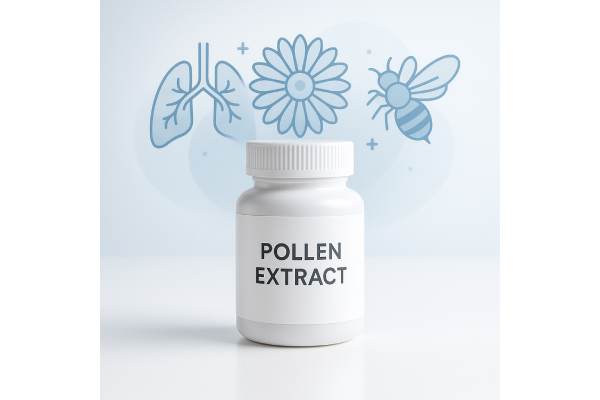
Pollen extract is marketed as a nutrient-dense natural supplement, often promoted for energy, immunity, prostate health, and general vitality. It usually comes from either bee-collected pollen granules or standardized flower or rye grass pollen extracts that are concentrated and purified. These extracts are rich in proteins, essential amino acids, vitamins, minerals, polyphenols, and plant sterols, which together give pollen its antioxidant and anti-inflammatory profile.
At the same time, pollen is a powerful allergen for many people. The same microscopic grains that plants use to reproduce can provoke strong immune reactions when eaten, especially in those with seasonal allergies or a history of anaphylaxis. That is why pollen extract sits in a middle ground: potentially useful in very specific situations, but not a universal “superfood.”
This guide walks you through what pollen extract is, how it may work, where the evidence stands, how it is usually used, and who should avoid it.
Key Insights for Pollen Extract
- Pollen extract provides proteins, polyphenols, and plant sterols that may support antioxidant and anti-inflammatory activity.
- Standardized flower or rye grass pollen extracts have been studied most for prostate and urinary symptoms in men.
- Typical supplement doses range from about 2–10 g per day of bee pollen granules or roughly 375–1000 mg per day of standardized pollen extracts, depending on the product and indication.
- Severe allergic reactions, including anaphylaxis, have been reported even after the first dose of bee pollen.
- People with pollen or bee allergies, asthma, or previous anaphylaxis, and those who are pregnant, breastfeeding, or giving the product to children should avoid pollen extract unless a specialist explicitly recommends it.
Table of Contents
- What is pollen extract and how is it made?
- How does pollen extract work in the body?
- Potential benefits and who it may help
- How to use pollen extract and typical dosage
- Side effects, risks, and who should avoid it
- What the research says and how to decide
What is pollen extract and how is it made?
“Pollen extract” is a broad term that can refer to several related products:
- Bee pollen granules – pollen grains collected by honeybees, mixed with small amounts of nectar and enzymes from the bees. These are usually dried and sold as loose granules or capsules.
- Flower pollen extracts – pollen collected directly from plants, then processed to isolate specific fractions such as water-soluble and fat-soluble components.
- Rye grass pollen extract (often called Cernilton) – a standardized extract from rye grass (Secale cereale) and other grass pollens used primarily in urological research and practice.
In their raw state, pollen grains are tiny packages of plant genetic material and nutrients. They contain proteins, carbohydrates, healthy fats, B vitamins, minerals, and a wide range of polyphenols and carotenoids. Bee pollen in particular has a high protein content (often 10–30 percent by weight) and carries a spectrum of essential amino acids, making it attractive as a “whole food” supplement.
However, the composition of pollen is not fixed. It varies with:
- Plant species
- Soil and climate
- How and when the pollen is harvested
- Processing methods (drying, solvent extraction, standardization)
Standardized pollen extracts, such as Cernilton or specific Graminex-based formulas, are produced by carefully extracting water-soluble and fat-soluble fractions. Manufacturers then adjust the final product so that each tablet or capsule contains a consistent amount of these fractions. This is important because most clinical trials have used specific standardized extracts rather than generic bee pollen from a health-food shop.
In contrast, non-standardized bee pollen granules are closer to a whole food. They may be nutritionally rich but can vary significantly from batch to batch. Two jars from different regions or seasons may differ in color, taste, nutrient profile, and allergenic potential.
When you see “pollen extract” on a label, it is worth checking:
- Source – bee pollen granules, mixed flower pollen, or rye grass pollen.
- Standardization – whether specific fractions are quantified and named on the label.
- Added ingredients – many products combine pollen extract with vitamins, minerals, or other botanicals.
Understanding which type you are looking at makes a big difference when you compare it to research or try to match a clinical protocol.
How does pollen extract work in the body?
The proposed mechanisms of pollen extract come mainly from cell experiments, animal studies, and a smaller number of human trials. Broadly, its actions can be grouped into a few themes.
1. Antioxidant activity
Pollen is rich in polyphenols, flavonoids, and carotenoids, which can neutralize reactive oxygen species. In laboratory models, bee pollen extracts reduce markers of oxidative stress and support the activity of endogenous antioxidant enzymes such as superoxide dismutase and glutathione peroxidase.
Because chronic oxidative stress is linked with cardiovascular disease, metabolic syndrome, neurodegeneration, and inflammation, this antioxidant potential is often cited as a key rationale for using pollen extracts.
2. Anti-inflammatory and anti-edema effects
Standardized flower and rye grass pollen extracts have shown anti-inflammatory effects in prostate and urinary tissues. Experimental work suggests they can:
- Inhibit the synthesis of pro-inflammatory prostaglandins and leukotrienes
- Reduce inflammatory cell infiltration in prostate tissue
- Decrease tissue edema (swelling), which may ease urinary outflow resistance
These mechanisms are consistent with clinical observations of decreased pain and improved urinary flow in men with chronic prostatitis or benign prostatic hyperplasia (BPH) who used standardized pollen extracts as part of their management.
3. Smooth muscle and hormonal modulation
Some rye grass pollen extracts appear to relax smooth muscle in the urethra and bladder neck. This could help reduce urinary urgency and hesitancy. There is also preliminary evidence that certain fractions of pollen extracts may have mild hormone-modulating activity, although the clinical significance of this remains uncertain.
4. Immune system effects
Pollen extracts can influence immune cell signaling in vitro, sometimes shifting the balance toward a less inflammatory profile. At the same time, pollen is a potent allergen, so the same immune-active properties that might help in some contexts can trigger severe reactions in susceptible individuals.
Altogether, pollen extracts likely act through a combination of antioxidant, anti-inflammatory, micro-circulatory, and possibly hormonal pathways. The exact contribution of each will differ between products and between individuals.
Potential benefits and who it may help
Most of the structured human data on pollen extracts falls into a few key areas. It is important to keep in mind that evidence often comes from relatively small or moderate-size trials and specific branded products.
Prostate and urinary symptoms in men
Standardized flower and rye grass pollen extracts have been studied for:
- Chronic prostatitis / chronic pelvic pain syndrome (CP/CPPS)
- Benign prostatic hyperplasia (BPH) and related lower urinary tract symptoms
Reviews and clinical trials suggest these extracts can reduce pelvic pain, improve urinary flow and frequency, and enhance quality of life compared to baseline or placebo in some patients. Benefits often appear after several weeks to a few months of continuous use.
These supplements are usually used alongside, not instead of, standard medical care. Men with urinary symptoms still need proper evaluation to rule out infection, obstruction, or cancer.
General wellness, fatigue, and nutrient support
Because bee pollen is dense in protein, B vitamins, minerals, and polyphenols, it is often marketed for:
- General energy and vitality
- Nutrient support for physically active adults
- Recovery from stress or illness
Human data here is more limited than for prostate health. Some small studies and observational reports point to improvements in perceived energy or well-being, but they are not robust enough to draw firm conclusions. Most of the rationale in this area rests on nutritional composition and preclinical findings.
Metabolic and cardiovascular markers
Animal and early human data suggest bee pollen may influence:
- Blood lipid profiles such as total and LDL cholesterol
- Uric acid levels in specific forms of bee pollen
- Markers of oxidative stress associated with metabolic syndrome
However, there are not yet large, long-term randomized trials showing that pollen extract prevents heart attacks, strokes, or diabetes. It remains an experimental adjunct rather than a proven cardiometabolic therapy.
Other potential areas
Preclinical work is exploring pollen extracts as supportive agents in neurodegenerative disease and cancer research, mostly for their antioxidant and immune-modulating effects. These are early-stage, mechanistic studies, not standard clinical treatments.
In practice, the people most likely to consider pollen extracts are:
- Men with chronic prostatitis or mild to moderate BPH symptoms, under urology supervision
- Adults looking for a nutrient-dense supplement and willing to accept the allergy risk
- Individuals interested in complementary approaches to oxidative stress or inflammation, again in coordination with their clinicians
For all of these, clear expectations are crucial: pollen extract may provide modest support, not a cure.
How to use pollen extract and typical dosage
There is no single standardized dose for pollen extract. Dosage depends on:
- Type of product (bee pollen granules versus standardized extract)
- Brand and formulation
- Target use (general wellness versus prostate support)
- Individual tolerance and medical conditions
The following ranges summarize what has been used in research and practice. They are not personal medical advice.
Bee pollen granules (whole or ground)
Bee pollen granules are usually taken by teaspoon and mixed into yogurt, smoothies, or cereals. Common practice and small clinical reports suggest:
- Starting from about ¼ teaspoon daily to test tolerance
- Gradually increasing to about 1–2 teaspoons per day, often equivalent to roughly 2–10 g
- Some therapeutic protocols have used around 6–7.5 g per day in adults, although this is not a universal standard
Because of the risk of allergy, it is wise to start with a few grains on the tongue and increase only if no reaction occurs.
Standardized flower or rye grass pollen extracts
Clinical trials and product information for prostate and urinary indications commonly use:
- Cernilton (rye grass pollen extract)
- Classic regimen: 126 mg three times daily (total 378 mg/day) for at least 12 weeks.
- Newer studies have used total daily doses in the range of 375–750 mg over longer periods, with higher doses sometimes showing stronger effects.
- Graminex-based formulas such as Deprox 500
- Each administration often provides about 1 g of pollen extract per day (for example, two tablets of 500 mg) along with B vitamins.
- Typical regimens range from 30 days to 90 days or longer, depending on the clinical scenario.
These doses are specific to the named products and cannot be directly translated to a random pollen capsule from another manufacturer.
Practical usage guidelines
If you and your clinician decide to try a pollen extract:
- Clarify the goal – for example, adjunct support for chronic prostatitis versus a general vitality supplement.
- Choose a standardized product whenever you want to approximate a clinical protocol, especially for prostate indications.
- Follow the manufacturer’s dosing, unless your clinician advises a different schedule.
- Start low and increase cautiously, particularly with bee pollen granules.
- Take notes on symptoms, energy, sleep, digestion, and any side effects over several weeks.
- Reassess regularly rather than staying on pollen indefinitely by default.
People on multiple medications, especially blood thinners or immunosuppressants, should have their regimen reviewed by a healthcare professional before adding pollen extract.
Side effects, risks, and who should avoid it
Despite its natural origin, pollen extract can cause significant adverse reactions, particularly allergic ones. Safety varies by individual and by product.
Common, usually mild effects
Some users report:
- Digestive upset (nausea, bloating, loose stools)
- Headache or a feeling of agitation when starting higher doses
- Mild skin itching or flushing
These effects often improve when the dose is reduced or the product is taken with food, but they should not be ignored if they persist or worsen.
Allergic reactions and anaphylaxis
The major safety concern with pollen extract is allergy. Case reports describe reactions ranging from localized itching and hives to full-blown anaphylaxis after ingesting bee pollen supplements, sometimes on the very first exposure. Symptoms can include:
- Itching in the mouth or throat
- Swelling of the lips, face, or tongue
- Wheezing, chest tightness, or shortness of breath
- Generalized hives and flushing
- Drop in blood pressure, dizziness, or collapse
These events occur predominantly in people with a history of seasonal allergic rhinitis, asthma, or prior severe allergies, but not exclusively.
Because of this, most clinicians recommend that anyone with known pollen allergy, bee or wasp venom allergy, asthma, or prior anaphylaxis avoid bee pollen supplements entirely unless evaluated and monitored by an allergy specialist.
Other cautions
It is also prudent to avoid pollen extract, or to use it only under specialist guidance, in:
- Pregnancy and breastfeeding, because of insufficient safety data
- Children, due to higher relative risk of severe allergic reactions and limited controlled data
- People on blood thinners or multiple medications, since supplements can alter drug metabolism or interact in unpredictable ways
- Individuals with autoimmune or systemic inflammatory diseases, where immune-modulating products should be chosen carefully
Quality and contamination issues
Like many supplements, pollen products can vary in quality. Potential concerns include:
- Microbial contamination if drying and storage are inadequate
- Pesticide residues from treated crops
- Mislabeling of plant species, which can alter allergenic risk
Choosing reputable brands that provide batch testing, clear labeling, and traceable sourcing helps mitigate these risks, but does not eliminate them.
Anyone who experiences breathing difficulty, facial swelling, rapid heart rate, or severe dizziness after taking pollen extract needs immediate emergency care and should not attempt to retry the product later without specialist supervision.
What the research says and how to decide
When you look across the scientific literature, a few themes emerge.
Where the evidence is relatively strongest
- Prostate and urinary health – Multiple clinical trials and reviews report that standardized flower or rye grass pollen extracts can reduce pain and urinary symptoms in men with chronic prostatitis or BPH, with generally good tolerability. Most of these trials are small to moderate in size, and often open-label or with design limitations, but they are consistent enough to support cautious clinical use as an adjunct under urological guidance.
Areas with promising but preliminary data
- General antioxidant and anti-inflammatory support – Reviews of bee pollen highlight its rich composition and demonstrate biochemical benefits in cell and animal models. Early human data suggest possible favorable effects on oxidative stress and some metabolic markers, but more large, controlled trials are needed before making strong claims.
- Neurodegeneration and cancer research – Recent reviews explore bee pollen as a source of candidate compounds for brain and cancer health. These are translational research discussions, not clinical recommendations for patients at this stage.
Gaps and limitations
- Many studies use specific branded products whose composition may not match generic supplements.
- Study durations are often limited to a few months, so long-term safety and sustained benefit are less clear.
- Adverse events may be under-reported in smaller studies, making allergy risk seem lower than in real-world case reports.
- There are very few high-quality trials in women, children, or older adults outside urology settings.
How to decide if pollen extract is right for you
A structured approach can help:
- Clarify your health priorities. Is your main concern prostate symptoms, energy, or general wellness?
- Review your medical history. Any allergies, asthma, autoimmune conditions, or serious chronic diseases should prompt a discussion with your clinician before considering pollen extract.
- List your medications and supplements. Bring this list to your doctor or pharmacist to check for possible interactions.
- Discuss evidence and expectations. Ask about what the research really shows for your condition and what a realistic benefit might look like.
- If you proceed, start cautiously. Use standardized products where possible, begin at the lower end of the dosing range, and monitor how you feel over several weeks.
- Reevaluate periodically. If there is no clear benefit, or if side effects appear, it is reasonable to discontinue and explore other options.
Used thoughtfully, pollen extract can sometimes play a supportive role in a broader care plan. It is not, however, a substitute for established medical evaluation and treatment.
References
- Bee Pollen: Current Status and Therapeutic Potential 2021 (Systematic Review)
- Bee Pollen: Clinical Trials and Patent Applications 2022 (Systematic Review)
- The role of flower pollen extract in managing patients affected by chronic prostatitis/chronic pelvic pain syndrome: a comprehensive analysis of all published clinical trials 2017 (Systematic Review)
- Bee Pollen as a Source of Biopharmaceuticals for Neurodegeneration and Cancer Research: A Scoping Review and Translational Prospects 2024 (Scoping Review)
- Anaphylaxis from bee pollen supplement 2012 (Case Report)
Disclaimer
The information in this article is for general educational purposes only and is not intended to replace professional medical advice, diagnosis, or treatment. Pollen extract can interact with medical conditions and medications, and it may cause severe allergic reactions in some individuals. Always consult a qualified healthcare professional before starting, changing, or stopping any supplement, including pollen extract, especially if you have existing health conditions, are pregnant or breastfeeding, or are considering use in a child.
If you found this guide helpful, you are warmly invited to share it with others on Facebook, X (formerly Twitter), or any social platform you prefer, and to follow our work on social media. Your supportive sharing helps our team continue creating clear, carefully researched health content for readers like you.