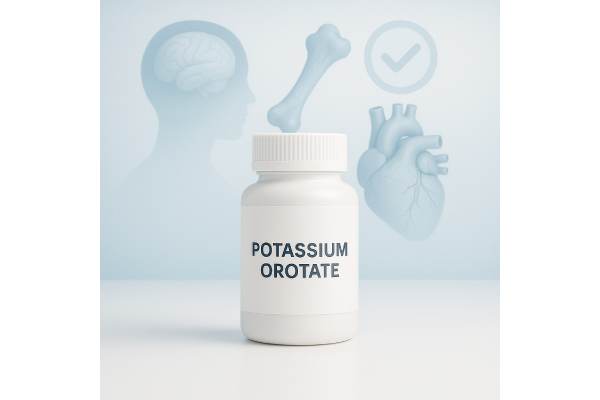
Potassium orotate is a mineral salt that combines potassium with orotic acid, a compound involved in the synthesis of DNA and RNA. It is marketed as a “bioavailable” form of potassium that may support heart function, cellular energy, and recovery in people with high physical or mental demands. In practice, most supplements provide only small amounts of elemental potassium and are used as a niche option alongside a generally potassium-rich diet.
Interest in potassium orotate comes from two directions. First, potassium itself is essential for normal blood pressure, nerve signaling, and muscle contraction. Second, orotic acid has been explored for its potential to help shuttle minerals into cells more effectively than standard salts like potassium chloride. Research in animals and small human studies has raised this possibility, but high-quality clinical data in modern doses are still limited. This guide walks you through what potassium orotate does, where it may be useful, how to dose it sensibly, and when it is safer to avoid it.
Essential Insights for Potassium orotate
- Potassium orotate provides small amounts of elemental potassium that may help support healthy blood pressure and muscle and nerve function when dietary intake is low.
- The orotate component may modestly influence cellular uptake of minerals, but current human data do not show clear advantages over standard potassium salts.
- Typical supplement doses supply about 30–90 mg elemental potassium per day, well below daily requirements of roughly 2,600–3,400 mg from food.
- People with kidney disease, those using potassium-sparing drugs, or anyone with a history of high potassium levels should avoid unsupervised potassium orotate use.
Table of Contents
- What is potassium orotate and how does it work?
- Main health benefits of potassium orotate
- How to take potassium orotate safely
- Typical dosage of potassium orotate
- Side effects and who should avoid it
- What the research says about potassium orotate
What is potassium orotate and how does it work?
Potassium orotate is a compound made by binding potassium, an essential electrolyte, to orotic acid, an organic acid that the body normally uses as a building block in the pathway that makes pyrimidine nucleotides. Those nucleotides are needed to synthesize DNA and RNA, so orotic acid is present in all dividing cells.
In supplements, potassium orotate is usually sold in low-dose tablets or capsules. A typical product might provide 150–175 mg of potassium orotate per capsule, yielding about 30–35 mg of elemental potassium. Recommended use is often one to three capsules daily with meals.
Manufacturers claim that pairing minerals with orotic acid forms “orotates” that cross cell membranes more efficiently. Mechanistically, orotic acid can enter cells and be converted into nucleotides, and early experimental work suggested that minerals bound to orotate might hitchhike into tissues. This idea has been best explored for magnesium orotate and, to a lesser extent, potassium orotate.
However, it is important to separate theory from practice. In healthy people, intestinal absorption of potassium from ordinary food or standard supplements is already high, often around the majority of ingested potassium. The main bottleneck for potassium status is usually overall intake and kidney handling, not intestinal transport. Once absorbed, the kidneys regulate blood potassium tightly, and most excess potassium is excreted in urine.
Because of this, potassium orotate is best viewed as a niche form of potassium designed to provide modest amounts of the mineral, potentially with different tissue distribution, rather than a way to dramatically boost total potassium intake. For most people, diet remains the primary and safest way to meet daily potassium needs, while orotate-based supplements occupy a small, specific role.
Main health benefits of potassium orotate
When assessing the benefits of potassium orotate, it helps to separate what is well-supported for potassium as a nutrient from what is speculative for the orotate form itself.
Adequate potassium intake in general is linked to several health advantages. Higher potassium consumption from food is associated with lower blood pressure, reduced risk of stroke, and better cardiovascular outcomes in populations that consume enough fruits, vegetables, and other potassium-rich foods. International guidelines encourage adults to consume several grams of potassium per day from food to support these outcomes.
Because potassium orotate is only one way to deliver elemental potassium, some of these broad benefits may apply if the supplement is used to help correct a low intake in someone who cannot meet needs through diet alone. For example, a person with low fruit and vegetable intake, or someone on a medically restricted diet that limits potassium-rich foods, might use small potassium doses from supplements under medical supervision.
Beyond general potassium effects, several niche benefits are sometimes claimed:
- Support for heart performance and exercise capacity
- Faster recovery from physical stress
- Improved cellular energy or oxygen use
Most of these claims come from older or small studies, often focusing on mineral orotates such as magnesium orotate in heart failure or athletic settings. Data specific to potassium orotate are sparse and do not yet demonstrate clear advantages over standard potassium salts or, more importantly, over a well-structured diet rich in whole foods.
It is reasonable to say that potassium orotate can contribute to:
- Normal nerve transmission and muscle contraction
- Maintenance of normal blood pressure when overall intake is adequate
- Supporting normal acid–base balance as part of total dietary potassium
But it is not accurate to treat it as a stand-alone cure or primary therapy for cardiovascular disease, fatigue, or performance problems. In clinical practice, physicians rely on established potassium salts and prescription treatments to manage serious heart or electrolyte issues, not low-dose potassium orotate.
How to take potassium orotate safely
Because potassium affects heart rhythm and nerve function, safe use always comes before potential benefits. Even though typical potassium orotate supplements are relatively low in elemental potassium per dose, they still add to your total daily potassium load and must be considered alongside diet and medications.
Most supplements advise taking potassium orotate with meals, one to three times daily. Taking it with food can reduce mild stomach upset and mirrors how the body usually encounters potassium in a mixed meal. Splitting the daily intake into two or three doses also prevents a sudden spike in absorbed potassium, which is particularly important for people with borderline kidney function, though such individuals should only use potassium supplements under direct medical care.
A practical approach is:
- Review your current medications and conditions
- Blood pressure drugs such as ACE inhibitors, ARBs, potassium-sparing diuretics, and some heart medications can all raise blood potassium.
- Chronic kidney disease, diabetes, adrenal disorders, and some genetic conditions increase the risk of dangerous potassium elevations.
- Confirm with a healthcare professional
- This is especially important if you have ever been told your potassium was high or low on a blood test, or if you have heart or kidney problems.
- Start with the lowest manufacturer-recommended dose
- For many products, this means one capsule providing around 30–35 mg elemental potassium.
- Avoid combining multiple potassium-containing supplements unless specifically instructed by a clinician.
- Monitor how you feel
- Seek medical attention promptly for warning signs such as palpitations, chest discomfort, unexplained muscle weakness, or severe fatigue, because these can accompany abnormal potassium levels.
Remember that potassium orotate is not designed to replace medical treatment. It should not be used as an emergency remedy for cramps, heart symptoms, or blood pressure spikes. For most healthy adults, the first line of potassium optimization remains food: fruits, vegetables, legumes, and other whole foods are more effective and provide many additional nutrients.
Typical dosage of potassium orotate
Understanding dosage with potassium orotate requires separating the weight of the compound from the actual elemental potassium it provides.
Daily potassium needs for healthy adults are measured in grams. Common reference intakes suggest around 3,400 mg per day for many men and about 2,600 mg per day for many women, mostly from food. Some guidelines recommend at least 3,000–3,500 mg per day to help reduce blood pressure and cardiovascular risk.
By contrast, a typical potassium orotate capsule might look like this:
- 150–175 mg potassium orotate per capsule
- Providing about 30–35 mg elemental potassium
Common label directions recommend:
- 1–3 capsules daily with meals
- Total elemental potassium: roughly 30–90 mg per day
That means most potassium orotate products supply only a small fraction—often less than 5%—of daily potassium needs. They are structured to be gentle, not to correct major potassium deficits.
There is another reason doses stay small: high-dose oral potassium can be dangerous, especially in people with reduced kidney function or those taking certain medications. Many over-the-counter potassium supplements are intentionally limited in elemental potassium content per serving for safety reasons, unless used under medical supervision.
When deciding on a dosage, consider the following:
- If you are healthy, not on potassium-affecting drugs, and simply want a small supplemental amount, staying within the product’s recommended range (for example, 30–90 mg elemental potassium per day) is usually sensible.
- If you have a medical condition, especially kidney disease, heart disease, diabetes, or adrenal problems, any potassium supplementation should be individualized and supervised by a clinician who can monitor blood tests.
- Do not use potassium orotate to “push” your intake toward guideline levels on its own. Rely on food as the base, with supplements, if appropriate, playing a small supporting role.
Because formulas and strengths vary between brands, always read labels carefully. If the label only lists “potassium orotate 175 mg” without clarifying elemental potassium content, assume the actual potassium contribution is modest and ask the manufacturer or your healthcare professional if you need exact numbers.
Side effects and who should avoid it
At the low doses typically used in supplements, potassium orotate is generally well tolerated in healthy adults. Mild side effects may include digestive discomfort, such as nausea, a feeling of fullness, or loose stools, especially if taken on an empty stomach. Taking the supplement with food and dividing the total daily amount into smaller doses often reduces these minor issues.
More serious risks relate to potassium itself. High blood potassium (hyperkalemia) can cause:
- Muscle weakness or heaviness in the limbs
- Abnormal heart rhythms, palpitations, or chest discomfort
- In severe cases, life-threatening disturbances in heart conduction
These events are uncommon in healthy people at low supplement doses but become much more likely when kidney function is impaired, when high-dose potassium is used, or when medications that limit potassium excretion are present.
The orotic acid component also has its own safety considerations. In experimental models, high doses of orotic acid have been used to induce fatty liver and to study liver metabolism. These doses are far higher than those supplied by typical human supplements, but they underline why regulators have examined orotate salts and set limits on allowable intakes.
You should avoid unsupervised potassium orotate use if:
- You have chronic kidney disease or reduced kidney function
- You are taking ACE inhibitors, ARBs, potassium-sparing diuretics, certain heart medicines, or other drugs that can raise potassium
- You have a history of hyperkalemia or unexplained high potassium on blood tests
- You follow a very high-potassium diet or use other potassium supplements or salt substitutes
- You are pregnant or breastfeeding and have not discussed supplementation with your clinician
Use particular caution and seek professional advice if you have heart failure, diabetes, adrenal disorders, or conditions that affect acid–base balance. For these groups, even relatively small additions of potassium may matter.
Children and adolescents generally should not take potassium orotate unless recommended and monitored by a pediatric clinician. Their potassium needs and safety margins are different from those of adults, and treatment decisions should be individualized.
Overall, if there is any doubt about kidney function, heart rhythm, or medication interactions, it is safer to rely on dietary strategies for potassium and to use supplements only when your healthcare provider agrees they are appropriate.
What the research says about potassium orotate
The scientific literature on potassium orotate is much smaller than the large body of work on overall potassium intake and on standard potassium salts.
Several key points emerge:
- Strong evidence supports potassium itself, not specifically potassium orotate.
Studies and guidelines consistently show that higher potassium intake from dietary sources helps lower blood pressure and may reduce the risk of stroke and cardiovascular disease in the general population. These data underpin global recommendations for daily potassium intake. - Orotic acid is a biologically active molecule with multiple roles.
Orotic acid is more than just an intermediate in nucleotide synthesis, and has been linked to hepatic metabolism, red blood cell function, and experimental models of fatty liver. Research has explored how orotate forms of minerals may have distinct biological effects, but high doses of orotic acid in animals can induce liver changes, so controlled dosing is important. - Human trials with mineral orotates are small and often older.
Some studies with magnesium orotate in heart failure and other conditions suggested potential benefits, such as improved symptoms or exercise tolerance. However, these trials were often limited in size, design quality, or reporting. Data focusing purely on potassium orotate are even more sparse, making it hard to draw firm conclusions about unique advantages. - Safety evaluations focus on orotic acid exposure.
Regulatory assessments in Europe and elsewhere have examined salts of orotic acid used as mineral carriers in supplements. Their conclusions generally allow use at controlled doses but do not present compelling evidence that orotate forms are superior to standard salts in safety or efficacy. Instead, they emphasize observing limits on total orotic acid intake to avoid replicating the very high experimental doses that caused problems in animals. - Clinical practice still favors established potassium forms.
In medical management of low potassium or heart rhythm disorders, clinicians use well-characterized salts such as potassium chloride, citrate, or bicarbonate, often in prescription formulations. Potassium orotate does not appear in major treatment guidelines as a first-line therapy. Supplements may be used in wellness or sports contexts, but this use is based more on tradition and marketing than on robust head-to-head trials.
Taken together, current evidence supports a cautious, realistic view: potassium orotate is a valid but modest way to provide small amounts of potassium. It may suit individuals who tolerate this form better than others or who follow specific supplement regimens, but it should not be seen as a proven superior form of potassium. For disease treatment, established medical therapies and dietary strategies remain central.
References
- Potassium – Health Professional Fact Sheet 2019 (Guideline)
- Guideline: potassium intake for adults and children 2012 (Guideline)
- Orotic Acid, More Than Just an Intermediate of Pyrimidine de novo Synthesis 2015 (Systematic Review)
- Hyperkalemia (High Potassium): Symptoms & Treatment 2023 (Clinical Overview)
Disclaimer
The information in this article is for general educational purposes only and is not intended to provide medical advice, diagnosis, or treatment. Potassium orotate and other supplements can interact with medical conditions and prescription medications, and inappropriate use may cause harm. Always speak with a qualified healthcare professional before starting, changing, or stopping any supplement, especially if you have kidney, heart, hormonal, or metabolic conditions, are pregnant or breastfeeding, or are taking prescription or over-the-counter medicines. Never disregard professional medical advice or delay seeking it because of something you have read here.
If you found this guide useful, you are warmly invited to share it with others on Facebook, X (formerly Twitter), or any platform you prefer, and to follow our work on social media. Your thoughtful sharing helps support our team in continuing to create careful, evidence-informed health content.