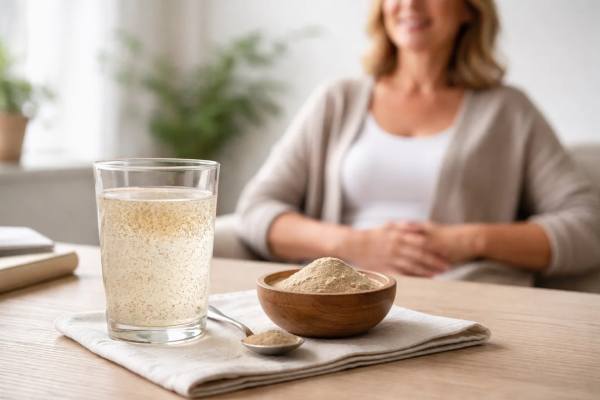
Psyllium husk is a simple tool with surprisingly flexible effects: it can soften hard stools, bulk loose stools, and make bowel habits feel more predictable—often with fewer downsides than harsher laxatives. That’s why it shows up in conversations about both constipation and irritable bowel syndrome (IBS), including IBS with constipation and IBS with diarrhea. Psyllium is not a stimulant, and it does not “force” the gut to move. Instead, it works mainly by forming a gentle gel that holds water, changes stool texture, and supports more coordinated transit.
The details matter, though. Many people quit psyllium too quickly because they start with too much, take it without enough fluid, or use it during a flare when their gut is already reactive. This guide breaks down how psyllium works, who it tends to help most, and how to dose it in a way that improves results and reduces gas, bloating, and other common side effects.
Essential Insights for Psyllium Use
- Psyllium can improve constipation and some IBS patterns by normalizing stool form rather than “pushing” the bowel.
- Starting low and increasing slowly is one of the best ways to reduce bloating and cramping.
- Adequate fluid with each dose is non-negotiable for safety and comfort.
- Psyllium can interfere with medication absorption if taken too close to pills.
- A practical approach is a 2–4 week titration, then a steady dose for another 4–8 weeks to judge results.
Table of Contents
- What psyllium is and how it works
- How psyllium fits IBS subtypes
- Psyllium for constipation and regularity
- Best dosing and timing strategies
- Side effects and common troubleshooting
- Who should avoid and red flags
What psyllium is and how it works
Psyllium husk (often labeled as ispaghula or Plantago ovata) is a soluble, viscous fiber. “Viscous” is the key word: when mixed with liquid, psyllium swells and forms a gel-like structure. That gel changes the physical environment inside your gut in ways that can be helpful for both constipation and IBS.
Here’s what that looks like in practical terms:
- It holds water in the stool. For constipation, this can soften dry stools and reduce the “brick-like” feeling that makes bowel movements painful. For diarrhea or urgency, the same water-binding effect can make stools more formed and easier to control.
- It adds gentle bulk and improves stool consistency. Psyllium can increase stool volume in a way that supports the body’s natural reflexes for bowel movement—without the “whip crack” effect of stimulants.
- It smooths transit rather than accelerating it aggressively. Many people assume all fiber speeds things up. Psyllium is more of a regulator: it can support steadier movement, which matters in IBS where swings between slow and fast can drive symptoms.
- It may reduce irritation from excess bile acids. In some people, loose stools are worsened by bile acids reaching the colon. Psyllium can bind bile acids, which may help stool form and urgency for certain patterns.
- It’s only partially fermented. Highly fermentable fibers can produce a lot of gas for sensitive people. Psyllium tends to be better tolerated than “gassy” fibers when introduced slowly, although it can still cause bloating if dosed too high too soon.
Forms also matter. Powdered husk is easy to titrate and often works well at modest doses. Capsules can be convenient but often require many capsules to reach an effective amount. Some flavored mixes add sweeteners that can worsen gas or diarrhea in sensitive people, so reading the ingredient list is worth the minute it takes.
Psyllium’s biggest advantage is that it changes stool texture—one of the most direct levers for improving IBS discomfort and constipation. Its biggest downside is that it demands good technique: enough fluid, slow titration, and the patience to let your gut adapt.
How psyllium fits IBS subtypes
IBS is best thought of as a gut-brain interaction disorder: the bowel is sensitive, and normal sensations can feel painful, urgent, or unpredictable. Psyllium cannot “cure” IBS, but it can reduce symptom triggers by making stool form and transit more stable. That stability matters because in IBS, stool consistency and urgency often drive anxiety, dietary restriction, and fear of leaving the house.
How psyllium may help depends on IBS subtype:
- IBS with constipation (IBS-C): Psyllium can soften stool, reduce straining, and improve the feeling of incomplete evacuation for some people. It is often most helpful when constipation is “dry and stuck” rather than when the primary problem is pelvic floor coordination.
- IBS with diarrhea (IBS-D): Psyllium can bulk loose stools and reduce the watery urgency that makes mornings stressful. Some people notice fewer “aftershocks” (multiple trips) because the stool becomes more cohesive.
- Mixed IBS (IBS-M): Psyllium can be a stabilizer—reducing extremes on both ends—if titrated carefully and adjusted based on stool form.
A useful way to decide whether psyllium is a good fit is to ask: Are my symptoms tightly linked to stool form and timing? If you notice that your abdominal pain, bloating, and anxiety worsen when stools are very hard or very loose, psyllium is more likely to help. If your primary IBS complaint is pain without stool issues, the benefit may be smaller.
Psyllium also interacts with diet strategies. If you are eating low-fiber because fiber “always makes IBS worse,” it’s possible that the problem is type and dose rather than fiber itself. Psyllium is often better tolerated than coarse wheat bran, and it can be easier to dose than high-fiber foods during a sensitive period. That said, if you are in a flare with severe cramps and food sensitivity, starting any new fiber can backfire. In that situation, it may be wiser to wait for symptoms to calm, then introduce psyllium gently.
Practical expectations for IBS:
- Timeframe: Some people notice stool changes within days, but global symptom changes often require 2–6 weeks of steady dosing.
- Bloating risk: Bloating usually reflects dose speed. A smaller dose taken consistently is often better than a larger dose taken “when desperate.”
- Pain and cramping: If cramping increases, reduce the dose and slow the titration. If cramping is severe or persistent, stop and reassess.
Think of psyllium as a “stool engineering” tool. When stool consistency becomes more predictable, many IBS symptoms become easier to manage—even when the underlying sensitivity remains.
Psyllium for constipation and regularity
Constipation is not only “not going.” It can also mean hard stools, straining, incomplete evacuation, or the sense that the bowel is always behind schedule. Psyllium can help because it addresses two common drivers at once: low stool water content and low stool bulk.
For many people, constipation worsens when fiber intake is inconsistent and fluid intake does not match fiber needs. Psyllium helps by holding water in the stool and creating a softer, bulkier mass that is easier for the colon to move. This can reduce straining and improve stool frequency over time.
What psyllium tends to improve most reliably:
- Stool consistency: stools become softer and easier to pass
- Straining: less pushing and less “stuck” sensation
- Regularity: fewer long gaps between bowel movements for some people
- “Cleanup” effect: less fragmentation and fewer repeated trips in a short window
What psyllium is less likely to fix on its own:
- Pelvic floor dysfunction (dyssynergia): if the muscles do not coordinate, stool can remain difficult to pass even when it is softer
- Severe slow-transit constipation: psyllium may help, but some people need additional strategies
- Constipation caused by medications: it can still help, but results vary and may require combining approaches
A helpful mindset is to treat psyllium as part of a constipation foundation:
- Stool texture: psyllium (slow titration)
- Fluid: enough water to match fiber and activity level
- Routine: a consistent “bowel window” (often after breakfast)
- Movement: even a daily walk can support motility
- Position and technique: foot support can reduce straining
If you are prone to constipation, psyllium may work best as a daily maintenance tool rather than an emergency rescue. Using it only after several days without a bowel movement often leads to overly large doses, which increases bloating risk and makes the experience feel unpleasant.
When to expect results:
- Early changes (first week): stool becomes bulkier or softer; gas may increase temporarily
- Meaningful pattern shift (weeks 2–4): more predictable frequency and easier passage
- Stable maintenance (weeks 4–12): best window to judge whether the dose is right
If you have constipation with significant abdominal distention, nausea, or pain that worsens after fiber, stop and seek evaluation. Constipation is common, but obstruction and other medical causes should not be missed—especially if symptoms are new or escalating.
Best dosing and timing strategies
The “right” psyllium dose is rarely one number. It is a range you adjust based on your stool pattern, sensitivity, and goals. The most effective strategy for most people is simple: start low, hydrate well, and increase slowly.
Start low and increase in steps
Many people tolerate psyllium best when they begin with about 2.5–5 grams once daily (often roughly 1/2 to 1 teaspoon of plain husk powder, but the label is the most reliable guide). Stay there for 3–7 days, then increase by a small step if needed. A common effective daily range for symptom support is 5–10 grams per day, sometimes split into two doses. Some people need more, but bigger is not automatically better.
A gentle titration plan:
- Days 1–7: 2.5–5 g once daily
- Days 8–14: 5 g once daily or 2.5 g twice daily
- Weeks 3–4: 5 g twice daily if needed and tolerated
- Weeks 5–8: adjust based on stool form and comfort
Fluid is part of the dose
Psyllium without enough liquid can worsen constipation and may be a choking risk. A practical rule is at least 240–350 mL (8–12 oz) of water with each dose, followed by additional fluids across the day. If you are already dehydrated, psyllium can feel harsh until hydration improves.
Timing: morning, evening, or with meals
- For constipation: many people do well taking psyllium in the morning or with breakfast, when the gut’s natural reflexes are stronger.
- For loose stools: taking it before the time you tend to have urgency (often morning) can help stool form.
- For sensitive stomachs: taking it with a meal may reduce discomfort.
Consistency matters more than the “perfect” time. Choose a schedule you can keep.
How to mix it so it is easier to stick with
- Stir briskly into water and drink promptly before it thickens too much.
- Follow with a few more sips of water to clear the glass and your throat.
- If texture is a barrier, try mixing into a thinner smoothie or a non-carbonated beverage, but avoid adding it to very thick foods until you know you tolerate it.
Let stool form guide your dose
Using the Bristol stool pattern can be helpful:
- very hard or pellet-like: increase slowly
- soft and formed: stay steady
- loose or urgent: consider a smaller morning dose, not a larger one
- watery with cramps: reduce or pause and reassess
If you do nothing else, do this: increase your dose slowly enough that your gut can adapt. Most “psyllium side effects” are really “psyllium started too fast.”
Side effects and common troubleshooting
Psyllium is usually well tolerated, but it is not uncommon to experience an adjustment period—especially if your baseline fiber intake is low. The goal is to tell the difference between normal adaptation and a sign that your approach needs to change.
Common side effects
- Gas and bloating: most often from increasing the dose too quickly
- Cramping: can occur if the gut is sensitive or the dose is too high
- Constipation that worsens: usually from inadequate fluid or a dose jump
- Loose stools: sometimes from taking too much for your current needs
- Texture aversion or nausea: can happen if it thickens quickly or is taken on an empty stomach
Safety considerations
The most important safety rule is to never take psyllium dry and never take it with minimal fluid. People with swallowing difficulties or a history of strictures should be cautious and seek medical guidance before using it.
Medication timing and absorption
Psyllium can bind or delay the absorption of some medications and supplements. A practical safety habit is to separate psyllium from other pills by at least 2 hours (and longer if you are taking medications with narrow dosing requirements). If you take thyroid medication, certain antidepressants, iron, or other critical prescriptions, spacing is especially important.
Troubleshooting: what to do if you feel worse
If you become more bloated or cramped:
- Reduce to the last comfortable dose.
- Hold that dose for 7–10 days.
- Increase again only if symptoms are calm.
If constipation worsens:
- increase fluid with the dose
- consider splitting the dose rather than taking it all at once
- confirm you are not mixing it into thick foods without enough liquid
- consider whether your constipation pattern suggests pelvic floor dysfunction (persistent straining despite softer stool)
If diarrhea worsens:
- reduce the dose and focus on timing (often morning)
- check for added ingredients like sugar alcohols or inulin that can loosen stools
- consider whether your symptoms suggest an infection, food intolerance flare, or medication effect
When to stop
Stop and reassess if you experience severe pain, persistent vomiting, inability to pass stool or gas, worsening distention, or any symptom that feels medically concerning. Psyllium should make bowel function feel easier, not risky.
A successful psyllium routine feels boring in the best way: steady, predictable, and easy to maintain.
Who should avoid and red flags
Psyllium is widely used, but there are situations where it should be avoided or used only with medical guidance. This matters because constipation and IBS symptoms can overlap with conditions that require a different approach.
Do not start psyllium without medical guidance if you have
- a history of bowel obstruction, strictures, or severe narrowing
- significant swallowing problems or conditions that increase choking risk
- severe inflammatory bowel disease flares or complicated bowel disease
- recent abdominal surgery with unresolved bowel symptoms
- unexplained severe abdominal distention with pain and nausea
If you have diabetes, psyllium can modestly affect post-meal blood sugar. That can be beneficial, but if you use glucose-lowering medications, monitor your response and discuss changes with a clinician.
Red flags that warrant evaluation
Seek medical evaluation if you have constipation or IBS-type symptoms plus:
- blood in the stool or black, tarry stool
- unexplained weight loss
- anemia or persistent fatigue without a clear reason
- fever, persistent night symptoms, or severe pain
- new bowel habit changes after age 50
- a strong family history of colorectal cancer, inflammatory bowel disease, or celiac disease
- constipation that steadily worsens despite appropriate hydration and a careful fiber trial
When “IBS” is not the full explanation
Some people labeled with IBS-C actually have pelvic floor coordination problems. A clue is this: stool may be soft enough, but evacuation still feels mechanically difficult, with prolonged straining or the need for manual maneuvers. In that case, more fiber may not solve the problem, and targeted therapy can be far more effective.
How to use psyllium responsibly if you have IBS
If you are prone to flares, consider these guardrails:
- do not increase the dose during a flare
- avoid adding other new supplements during your psyllium trial
- use symptom tracking for 2–8 weeks so you do not rely on memory
- aim for the smallest dose that produces a meaningful change
Psyllium is best viewed as a steady support, not an aggressive fix. Used thoughtfully, it can improve day-to-day comfort and predictability—two outcomes that matter deeply when IBS and constipation interfere with life.
References
- ACG Clinical Guideline: Management of Irritable Bowel Syndrome 2021 (Guideline)
- American Gastroenterological Association-American College of Gastroenterology Clinical Practice Guideline: Pharmacological Management of Chronic Idiopathic Constipation – PMC 2023 (Guideline)
- The Effect of Fiber Supplementation on Chronic Constipation in Adults: An Updated Systematic Review and Meta-Analysis of Randomized Controlled Trials – PMC 2022 (Systematic Review and Meta-Analysis)
- Efficacy and Safety of Over-the-Counter Therapies for Chronic Constipation: An Updated Systematic Review – PMC 2021 (Systematic Review)
Disclaimer
This article is for educational purposes only and does not provide medical advice, diagnosis, or treatment. IBS and constipation can have multiple causes, and symptoms that seem “functional” may sometimes reflect conditions that require medical evaluation. Do not use psyllium as a substitute for professional care, especially if you have red-flag symptoms (such as bleeding, unexplained weight loss, severe pain, persistent vomiting, or rapidly worsening bowel changes) or if you have a history of bowel obstruction or swallowing difficulties. If you take prescription medications, separate psyllium from pills and consult a qualified clinician if you are unsure about safety or timing.
If you found this article useful, please consider sharing it on Facebook, X (formerly Twitter), or any platform you prefer.