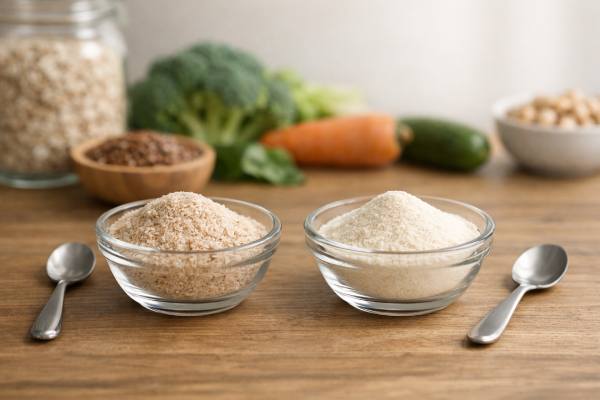
Fiber supplements look interchangeable from a distance: a scoop, a glass of water, and the promise of better digestion. In practice, which fiber you choose can shape your results—especially if you live with IBS, recurring constipation, or persistent bloating. Psyllium husk and wheat dextrin are both “soluble fiber,” but they behave very differently once they reach your gut. Psyllium forms a gel that changes stool texture and can steady bowel habits in more than one direction. Wheat dextrin dissolves cleanly, tends to ferment more, and may be easier to take consistently—but it can also create more gas during the adjustment period.
This guide compares them using the outcomes people actually care about: stool frequency, urgency, pain, bloating, and day-to-day tolerance—plus how to dose each one safely and intelligently.
Core points for choosing fiber wisely
- Psyllium is usually the better first choice when you need firmer, more predictable stools (constipation or IBS with mixed patterns).
- Wheat dextrin is often easier to mix and stick with, but early gas and bloating are more common if you increase too fast.
- Either fiber can backfire if you start at a full dose, take it without enough fluid, or use it during a suspected blockage or severe flare.
- Run a two-week trial with symptom tracking and slow titration to identify which fiber fits your gut’s “response pattern.”
Table of Contents
- Why these fibers act differently
- IBS outcomes and symptom matching
- Constipation support and stool changes
- Bloating and gas management
- Dosing, timing, and product labels
- A practical two-week comparison plan
Why these fibers act differently
“Soluble fiber” is a category, not a personality. Psyllium and wheat dextrin can both dissolve in water, but the way they behave in your intestines depends on a few traits that matter more than marketing terms.
Psyllium is gel-forming and viscous. When it meets fluid, it swells into a thick gel. That gel can:
- Hold water in the stool (helpful when stools are dry and hard).
- Add structure and bulk (helpful when stools are loose and urgent).
- Slow down how quickly stool moves through the colon for some people, which can reduce urgency.
- Reduce “spikiness” in stool form—fewer extremes between pebbly and watery days.
Wheat dextrin is typically low-viscosity and more fermentable. It dissolves almost completely without thickening much. Instead of forming a strong gel, it behaves more like a gently fermentable carbohydrate in the colon. That can:
- Support bowel regularity by increasing stool mass through bacterial growth and water shifts.
- Produce short-chain fatty acids (helpful for colon health and motility in some people).
- Trigger more gas during the early adaptation phase, because fermentation makes gas.
Translation: psyllium is more mechanical; wheat dextrin is more microbial. Neither is “better” in a vacuum. If you need predictable stool structure, psyllium’s gel is often the main advantage. If you need a fiber you can take without texture issues and you tolerate fermentation well, wheat dextrin can be easier to live with.
One more nuance: IBS symptoms are not just about stool. They are also about sensitivity—how strongly your gut reacts to stretching, gas, and shifts in motility. A fiber that helps stool frequency can still feel “wrong” if it increases pressure or gas in a sensitive intestine. That is why the best fiber choice is usually the one that improves your stool pattern without increasing bloating, cramping, or urgency beyond your comfort threshold.
IBS outcomes and symptom matching
IBS is a spectrum: constipation-predominant (IBS-C), diarrhea-predominant (IBS-D), mixed (IBS-M), and patterns that shift with stress, hormones, diet, travel, and sleep. Fiber works best when you match it to the symptom pattern you want to change—rather than taking the same product year-round out of habit.
When psyllium is often the better IBS fit
- IBS-C or IBS-M with “hard-start” constipation: The gel helps soften and bulk stool at the same time, which can make bowel movements feel more complete.
- Loose stools with urgency (IBS-D or IBS-M): The gel can firm stool and reduce the “watery rush” sensation for some people.
- Days that swing between extremes: Psyllium often works like a stabilizer, making stool form less dramatic.
When wheat dextrin may fit better
- IBS with low fiber intake and mild constipation: If you mainly need gentle regularity and you do not have major bloating sensitivity, dextrin can be a smooth entry point.
- Texture and compliance issues: Some people simply cannot tolerate thick drinks. If you will not take psyllium consistently, it cannot help you.
- Microbiome-focused goals: Dextrin’s fermentation may support bacterial shifts that some people find helpful over time.
Where either one can backfire
- High bloating sensitivity: If gas and pressure strongly amplify pain, a fermentable fiber (often dextrin) can worsen symptoms early on.
- Active flare with sharp pain, nausea, or new severe diarrhea: Adding fiber can complicate the picture and make symptom interpretation harder.
- Undiagnosed red flags: Blood in stool, unexplained weight loss, persistent fever, anemia, nighttime symptoms that wake you repeatedly, or new constipation after age 50 should be evaluated before experimenting aggressively.
A practical way to choose is to identify your primary IBS “target” for the next month:
- If it is stool form stability, start with psyllium.
- If it is routine and consistency of taking it, dextrin might win.
- If it is bloating control, your dose strategy matters as much as the fiber type—and psyllium is often easier to titrate without fermentation-related spikes.
Think of fiber as a tool that can reduce friction, not a cure-all. In IBS, the best outcome often comes from combining the right fiber with meal timing, hydration, and a personalized approach to trigger foods—rather than expecting one supplement to override everything else.
Constipation support and stool changes
For constipation, the most useful question is not “Which fiber is strongest?” It is “Which fiber changes my stool in the direction I need, without making me miserable?” Constipation can involve slow transit, pelvic floor coordination problems, dehydration, low food volume, low fiber intake, or medication effects—so the same product will not work equally well for everyone.
What psyllium tends to do for constipation
- Increases stool water content and stool bulk, which can reduce straining.
- Produces a more formed, cohesive stool that is easier to pass than dry fragments.
- Often supports regularity when taken consistently, especially when constipation is linked to low fiber intake or inconsistent meal patterns.
What wheat dextrin tends to do
- Adds soluble fiber without thickening, which can improve adherence.
- May increase stool frequency more gradually through fermentation-related effects.
- Can be a better “maintenance” fiber for some people once bowel movements are more regular.
A simple way to evaluate effect: the Bristol Stool Scale
You do not need to obsess over perfect stool form, but it helps to know what you are aiming for:
- Types 1–2: too hard (constipation pattern)
- Types 3–4: generally ideal
- Types 5–7: too loose (diarrhea pattern)
Many people with constipation want to move from types 1–2 toward types 3–4. Psyllium is often more reliable for that shift because of its gel mechanics. Dextrin may still help, but it can take longer and may be limited by bloating if you push dose too quickly.
Common reasons fiber “does nothing”
- Dose is too low to change stool (common with a single small serving).
- Fluid intake is too low for gel-forming fiber.
- Meal timing is chaotic (the gut often responds to routine and morning intake).
- Constipation is not fiber-responsive (for example, significant pelvic floor dysfunction or medication-related slow transit).
If constipation is stubborn, fiber may still be part of the plan—but it may need to be paired with other steps (hydration, movement, targeted laxatives, or pelvic floor therapy). The goal is not maximum fiber. The goal is comfortable, predictable bowel movements with minimal side effects.
Bloating and gas management
Bloating is where “good for constipation” and “good for IBS” can diverge. Gas is not always the enemy—fermentation is normal—but how your gut feels during fermentation is what determines whether a fiber is tolerable.
Why wheat dextrin can cause more gas at first
Because it is generally more fermentable, bacteria can use it as fuel. That often increases:
- Gas production
- Gut pressure and distension
- Audible rumbling
- A “too full” feeling even with normal meal sizes
Some people adapt after 1–3 weeks as the microbiome shifts and fermentation pathways change. Others remain sensitive, especially if they also eat a high-fermentable diet.
Why psyllium is often better tolerated for bloating
Psyllium can still cause gas, but its primary effect is water-binding and gel formation. For many people, that creates less of an abrupt fermentation surge than dextrin. Psyllium can also reduce the erratic stool patterns that trap gas behind hard stool.
How to reduce bloating with either fiber
- Start smaller than you think you need. Bloating is often a dosing problem, not a fiber problem.
- Increase in steps, not leaps. Give your gut several days at one dose before raising it.
- Split the dose. Smaller servings twice daily are often easier than one larger serving.
- Pair with steady meals. Taking fiber into a day of irregular snacking and large late meals can magnify symptoms.
- Avoid stacking fermentables. If you add wheat dextrin on top of a high inulin-chicory “fiber” bar and a large serving of beans, you may be creating a gas storm that has nothing to do with the dextrin alone.
When bloating suggests you should pause and reassess
- Rapidly worsening abdominal pain
- Vomiting, inability to pass stool or gas
- Significant abdominal swelling with severe discomfort
- New fever or blood in stool
Those situations warrant medical evaluation rather than continued self-experimentation. For everyday bloating, though, the most effective approach is usually “lower dose, slower titration, and clearer tracking.” If you cannot tell whether your fiber is helping because it is making you feel worse, the plan is not yet calibrated.
Dosing, timing, and product labels
A fiber supplement is only as good as its dosing strategy. Many negative experiences happen because the first dose is too large, the label is misread, or the fiber is taken without enough liquid.
Psyllium dosing basics
- Start low: Many people do well starting with about 1 teaspoon once daily (often around 3–4 grams of fiber, depending on product).
- Build gradually: Increase every 3–7 days based on stool response and bloating.
- Common effective range: Often around 7–12 grams of psyllium fiber per day, split into 1–2 doses.
- Fluid is non-negotiable: Take it with a full glass of water and follow with extra fluids if you are prone to hard stools.
Wheat dextrin dosing basics
- Start very low if you bloat easily: A half serving daily for several days can be a smarter entry point.
- Increase slowly: Many products build toward about 10–15 grams per day, but your best dose may be lower.
- Mixing is easier: It dissolves well in water, coffee, or soft foods, which can improve consistency.
Timing tips that matter
- Morning can be helpful for constipation, because the gut is naturally more active after waking and after breakfast.
- Evening dosing can reduce daytime bloating for some people, but it can backfire for others who feel overly full at night.
- Separate fiber from medications and supplements when possible (often by about 2 hours), since gel-forming fiber can interfere with absorption for some drugs.
Label literacy: what to check
- Fiber grams per serving: Do not assume “one scoop” equals a meaningful dose.
- Added fermentable fibers: Inulin, chicory root, and some “prebiotic blends” can significantly increase gas.
- Sweeteners and sugar alcohols: These can worsen bloating in sensitive people, independent of the fiber.
- Gluten-related concerns: Wheat dextrin is derived from wheat, and many products are labeled gluten-free, but if you have celiac disease or strong sensitivity, choose products that clearly state gluten-free testing and discuss supplement choices with your clinician.
Finally, keep expectations realistic. Fiber rarely works like a stimulant laxative. The goal is gradual normalization: better stool form, less straining, and fewer “bad gut days” over weeks—not overnight transformation.
A practical two-week comparison plan
If you are stuck between psyllium and wheat dextrin, a short, structured trial can save months of guesswork. The key is to test one variable at a time and track outcomes that reflect your real quality of life.
Step 1: Set your targets (2 minutes)
Pick your top two goals:
- More bowel movements per week
- Less straining
- Better stool form (closer to Bristol types 3–4)
- Less urgency
- Less bloating or gas discomfort
- Less abdominal pain tied to bowel movements
Step 2: Track a baseline for 3 days
Write down:
- Bowel movements per day
- Bristol stool type
- Straining (none, mild, moderate, severe)
- Bloating (0–10)
- Abdominal pain (0–10)
- Any notable triggers (large meals, high-fermentable foods, alcohol, poor sleep)
Step 3: Trial A (days 1–7)
Choose one fiber to start:
- If constipation or mixed stool is your main problem, start with psyllium.
- If compliance is your main problem, start with wheat dextrin.
Rules for week 1:
- Start with a low dose.
- Keep diet and caffeine patterns as consistent as possible.
- Increase dose only once if needed—and only after at least 3 days.
Step 4: Washout (days 8–9)
Stop the fiber for 48 hours. This reduces overlap so you are not comparing “both fibers at once.”
Step 5: Trial B (days 10–14)
Run the same approach with the other fiber:
- Same tracking
- Same meal rhythm
- Same gradual dosing logic
How to decide “winner”
Choose the fiber that improves your targets with the fewest side effects. A useful decision rule:
- If one option improves stool but worsens bloating by 3+ points most days, it may not be the right fit right now.
- If both help, pick the one you will realistically take for the next 8–12 weeks.
When to involve a clinician sooner
- Symptoms are severe, new, or worsening quickly
- You suspect pelvic floor dysfunction (frequent incomplete evacuation, significant straining, little response to fiber)
- You rely on frequent laxatives and still feel “stuck”
- You have red-flag symptoms (bleeding, unexplained weight loss, anemia, persistent fever)
A fiber supplement should make life simpler, not more confusing. A short, structured comparison often clarifies which tool your gut actually responds to—and helps you use it with confidence.
References
- ACG Clinical Guideline: Management of Irritable Bowel Syndrome – PubMed 2021 (Guideline)
- American Gastroenterological Association-American College of Gastroenterology Clinical Practice Guideline: Pharmacological Management of Chronic Idiopathic Constipation – PMC 2023 (Guideline)
- The Effect of Fiber Supplementation on Chronic Constipation in Adults: An Updated Systematic Review and Meta-Analysis of Randomized Controlled Trials – PMC 2022 (Systematic Review)
- Gastrointestinal Effects and Tolerance of Nondigestible Carbohydrate Consumption – PMC 2022 (Review)
- Effect of Resistant Dextrin on Intestinal Gas Homeostasis and Microbiota – PubMed 2022 (Clinical Study)
Disclaimer
This article is for educational purposes only and does not replace personalized medical care. Fiber supplements can interact with medications and may be inappropriate in certain conditions, including suspected bowel obstruction, significant swallowing difficulty, severe or rapidly worsening abdominal symptoms, or unexplained gastrointestinal bleeding. If you are pregnant, have a chronic medical condition (including celiac disease), take prescription medications, or have persistent IBS or constipation symptoms, consult a qualified clinician for individualized guidance.
If you found this article helpful, consider sharing it on Facebook, X (formerly Twitter), or any platform you prefer so others can make more informed choices about fiber and digestive comfort.