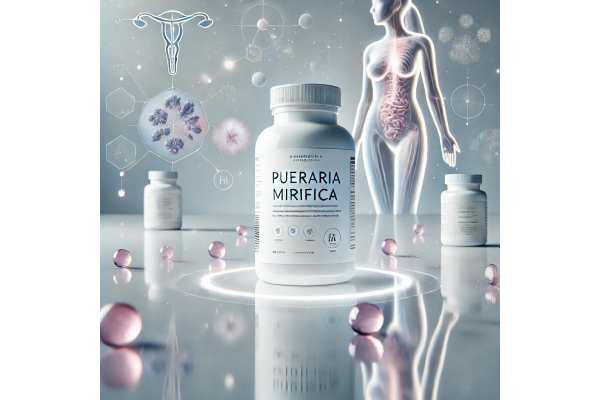
Pueraria mirifica, also known as white kwao krua, is a tuberous plant native to Thailand and parts of Southeast Asia. It has a long history of traditional use for women’s health, particularly around menopause. Modern supplements are typically standardized extracts rich in phytoestrogens, plant compounds that can interact with estrogen receptors in the body. Because of this, Pueraria mirifica is often marketed for hot flashes, vaginal dryness, skin and hair appearance, and even bone and heart health.
At the same time, it is a hormonally active herb. That means it may carry some of the same concerns seen with conventional estrogen therapy, especially for people with a history of hormone-sensitive conditions. Evidence in humans is still limited to relatively small and short-term clinical trials. This guide walks you through what Pueraria mirifica is, how it appears to work, where the evidence is strongest, how it is typically used, and the main safety questions to consider before deciding whether it fits your situation.
Quick Overview
- Pueraria mirifica is a Thai herb rich in phytoestrogens that may ease menopausal symptoms such as hot flashes and vaginal dryness.
- Short-term studies suggest possible benefits for lipid profiles and markers of bone health in postmenopausal women.
- Typical oral doses in clinical trials range from about 20–50 mg of standardized extract per day, often taken with food.
- Because it has estrogen-like activity, it should be avoided by people with current or past hormone-sensitive cancers or unexplained vaginal bleeding.
- Use only under medical supervision if you take hormone therapy, blood clot–related medicines, or have a history of stroke, blood clots, or severe liver disease.
Table of Contents
- What is Pueraria mirifica?
- Potential benefits of Pueraria mirifica
- How to take Pueraria mirifica in practice
- Pueraria mirifica dosage and forms
- Side effects and risks of Pueraria mirifica
- Who should avoid Pueraria mirifica?
- What the research says about Pueraria mirifica
What is Pueraria mirifica?
Pueraria mirifica (white kwao krua) is a climbing plant native to Thailand, Cambodia, and neighboring regions. Traditional Thai medicine has used its starchy underground tuber as a “rejuvenating” tonic for women, especially in mid-to-late life. Today, dietary supplements usually contain powdered tuber or standardized extracts in capsules, tablets, or topical creams.
The key reason this herb attracts attention is its unusually rich content of phytoestrogens. These are plant-derived compounds that can bind to estrogen receptors in the human body. Well-known phytoestrogens from other plants include genistein and daidzein from soy. Pueraria mirifica contains its own unique molecules, notably miroestrol and deoxymiroestrol, along with isoflavones and related compounds.
Laboratory and animal studies suggest that these constituents can show estrogen-like effects, sometimes approaching the potency of estradiol in specific models. In traditional and modern use, people are most interested in symptom relief around menopause: hot flashes, night sweats, mood changes, and vaginal dryness. There is also interest in potential effects on bone density, lipid profiles, skin elasticity, and hair.
However, Pueraria mirifica is not a vitamin or mineral; it is a hormonally active herbal extract. Its actions are not fully mapped out, and there is variation in potency between products. Many supplements are marketed for aesthetic benefits (such as breast fullness or skin changes), but these claims are not well tested in rigorous human studies. Approaching this herb as a mild, natural form of hormone-like therapy, rather than a harmless “beauty supplement,” is a safer mindset.
Potential benefits of Pueraria mirifica
Most of the clinical interest in Pueraria mirifica focuses on postmenopausal women. Several controlled trials have explored its impact on specific symptoms and health markers. These studies are generally small and short in duration, but they do offer some insights into where the herb may be most helpful.
One of the most consistent findings is improvement in vulvovaginal symptoms. In a randomized, placebo-controlled trial of healthy postmenopausal women, daily Pueraria mirifica at doses around 20–50 mg improved vaginal dryness, discomfort during intercourse, and clinical measures of vaginal atrophy over several months. The treatment group showed changes in vaginal cell types and pH that resemble those seen with low-dose estrogen therapy, along with symptom relief.
There is also evidence that Pueraria mirifica may support certain aspects of cardiovascular and bone health after menopause. Some studies report modest reductions in total and LDL cholesterol and improvements in biochemical markers of bone turnover when women take standardized extracts for several months. These changes hint that the herb may help slow menopause-related shifts in lipid profiles and bone metabolism, although actual fracture or cardiovascular outcomes have not been tested.
Anecdotally and in small pilot trials, women report improvements in hot flashes, night sweats, mood, sleep, and overall quality of life. In some comparative work, Pueraria mirifica has performed similarly to low-dose conventional hormone therapy for certain subjective symptoms, though not consistently across all measures.
Beyond menopause, there is early-stage research on skin hydration, elasticity, and hair quality, likely linked to estrogen-like effects on collagen and skin structure. Some cosmetic products include Pueraria mirifica in topical formulations for the breast or facial skin, but robust evidence from well-designed trials is limited.
Overall, the strongest human data are for relief of vaginal atrophy and related symptoms, with secondary signals for lipid and bone markers. Benefits for hot flashes, mood, sleep, and aesthetic effects remain plausible but incompletely documented, and responses vary widely between individuals.
How to take Pueraria mirifica in practice
If you and your clinician decide to trial Pueraria mirifica, it is worth approaching it as you would any hormone-like therapy: with a clear goal, conservative dosing, and scheduled reassessment. Start by defining what you hope to improve—such as vaginal dryness, hot flashes, or sleep quality—and how you will track that change over time.
Most oral supplements are taken once daily, usually with food to reduce the chance of stomach upset. In clinical studies, doses are often split between morning and evening when higher totals are used, but for the common lower doses used in supplements, once-daily dosing is typical. Because hormonal symptoms can fluctuate day to day, it may take several weeks before any consistent pattern of improvement is apparent.
It is wise to avoid combining Pueraria mirifica with other strongly estrogenic herbs or high-dose isoflavone concentrates unless a healthcare professional is overseeing the combination. Many menopausal blends include ingredients like red clover, soy isoflavones, or black cohosh. While some people tolerate such combinations, it becomes harder to interpret both benefits and side effects when several active botanicals are introduced at once.
Topical preparations, such as creams applied to the breast area or skin, may deliver lower systemic exposure but can still exert estrogen-like effects locally and potentially systemically. Their actual absorbed dose is harder to quantify, and quality control can be inconsistent. If you are using a cream, it is still important to inform your clinician, especially if you are being monitored for breast or endometrial health.
Plan from the outset to reassess after a defined period, commonly 8–12 weeks. At that point, you and your clinician can review symptoms, any side effects, and possibly relevant lab tests (such as lipids or liver enzymes, if indicated). If there is no meaningful improvement, continuing longer is less likely to change the outcome and only extends exposure.
Finally, treat any new or unusual symptoms—such as breast pain, unexpected vaginal bleeding, severe headaches, leg swelling, or visual changes—as reasons to stop the supplement and seek medical advice promptly, rather than waiting for a scheduled follow-up.
Pueraria mirifica dosage and forms
Pueraria mirifica is most commonly sold as oral capsules or tablets, although powders, liquid extracts, and topical creams are also available. Because products differ widely in standardization and potency, dosage recommendations on labels can vary.
In controlled clinical trials with postmenopausal women, oral doses between about 20 mg and 50 mg of standardized Pueraria mirifica extract per day have been used. In one well-known study of vaginal health, women were randomly assigned to 20, 30, or 50 mg per day or placebo for 24 weeks, with benefits seen across active doses. Some trials of lipid profiles and bone turnover have used similar ranges or modestly higher doses for several months.
Commercial supplements sometimes list higher amounts, especially when the product is not standardized to a specific phytoestrogen content. A capsule might contain, for example, 100–500 mg of root powder, which is not directly comparable to a 20–50 mg standardized extract. When evaluating a product, look for information on standardization, such as “standardized to X% miroestrol and deoxymiroestrol” or “X% total isoflavones.” Products that disclose these details allow more meaningful comparison to clinical research.
As a practical approach, many clinicians prefer starting at the lower end of the range that has been studied, such as 20–25 mg per day of standardized extract or the nearest equivalent stated on the label. If tolerated and if symptoms remain troublesome after several weeks, a gradual increase toward 40–50 mg per day might be considered under supervision, staying within manufacturer guidelines.
Topical preparations (creams, serums, gels) usually provide a stated amount per application, but actual absorption can vary with skin thickness, application site, and formulation. Because of this uncertainty and the potential for systemic effects, topical Pueraria mirifica should not be assumed to be risk-free or purely local.
Regardless of form, it is sensible to:
- Follow manufacturer dosing instructions and not exceed the maximum recommended daily amount.
- Avoid long-term continuous use without periodic medical review.
- Store products away from heat and light to limit degradation of active compounds.
- Choose brands that provide batch testing or third-party quality certifications where possible.
Given the hormone-like nature of this herb, using “as little as needed, for as short as needed” to achieve a defined benefit is a conservative, safety-oriented strategy.
Side effects and risks of Pueraria mirifica
Because Pueraria mirifica has estrogen-like activity, its potential side effects overlap with those of other estrogenic therapies. In short-term clinical trials using doses around 20–50 mg of standardized extract per day, most participants have tolerated the herb reasonably well. Reported side effects were often mild and included breast tenderness, bloating, headache, or gastrointestinal discomfort. In many studies, the rate of side effects was similar between Pueraria mirifica and placebo.
However, absence of serious short-term events in small trials does not guarantee long-term safety. The main theoretical concerns involve tissues that respond strongly to estrogen: breast, uterus, ovary, blood vessels, and liver. Estrogenic stimulation can promote growth in hormone-sensitive cancers or precancerous cells and can influence clotting factors and lipid metabolism.
Key potential risks include:
- Breast and gynecologic health: In people with current or past breast, uterine, or ovarian cancer, additional estrogen-like stimulation is generally considered undesirable unless specifically supervised by an oncology team. The same caution applies to those with atypical hyperplasia or unexplained vaginal bleeding.
- Endometrial stimulation: Estrogens can thicken the uterine lining, which in some situations raises the risk of abnormal bleeding or, over longer periods, endometrial changes. Trials of Pueraria mirifica have included endometrial monitoring and have not reported alarming short-term changes, but the sample sizes and durations are limited.
- Thrombosis and cardiovascular events: Estrogen therapies can increase the risk of blood clots and, in some individuals, stroke or heart attack. It is not yet clear whether Pueraria mirifica meaningfully alters clotting risk, but people with a history of deep vein thrombosis, pulmonary embolism, or certain clotting disorders should be cautious.
- Liver function: Herbal and hormonal products can, in rare cases, affect liver enzymes or cause injury. Those with pre-existing liver disease or taking multiple medications that strain the liver should discuss any Pueraria mirifica use with a clinician and may need monitoring.
There is also the broader issue of product variability. Without strict regulation, some supplements may contain higher or lower amounts of active constituents than stated, or they may be contaminated with adulterants or pharmaceutical agents.
If you choose to use Pueraria mirifica and experience breast pain, new or heavier vaginal bleeding, persistent pelvic pain, severe headache, visual disturbances, chest pain, shortness of breath, or leg swelling, you should stop the product and seek medical care immediately. Even milder new symptoms that persist should prompt a discussion with your healthcare provider.
Who should avoid Pueraria mirifica?
Given its estrogen-like effects, Pueraria mirifica is not appropriate for everyone. Some individuals should avoid it completely, while others should only consider it under careful medical supervision.
People who should generally avoid Pueraria mirifica include:
- Anyone with a current or past history of estrogen-sensitive cancers, such as many types of breast, uterine (endometrial), or ovarian cancer, unless their oncology team explicitly approves and monitors its use.
- Individuals with unexplained vaginal bleeding, particularly after menopause, until the cause is clearly diagnosed.
- Those with a history of blood clots in the legs or lungs, stroke related to clotting, or known clotting disorders, unless a specialist determines that the potential benefits outweigh the risks.
- Pregnant or breastfeeding people, since hormonal exposures during these periods can affect both parent and baby, and safety data are lacking.
- Children and adolescents, whose reproductive and endocrine systems are still developing.
Caution and close medical oversight are advisable for:
- People already using hormone therapy (such as estrogen with or without progestogen) for menopausal symptoms or other conditions. Combining therapies could increase overall estrogenic exposure beyond what was originally intended.
- Individuals with significant liver disease, uncontrolled high blood pressure, complicated migraines, or a strong family history of hormone-sensitive cancers.
- People taking medications that are sensitive to changes in liver enzyme activity or clotting status, including some anticoagulants, hormone therapies, and certain cancer drugs.
Men, non-binary individuals, or transgender people considering Pueraria mirifica for body-contouring or feminizing effects should be particularly cautious. Although phytoestrogens can influence tissues, using them as a substitute for medically supervised hormone therapy can lead to unpredictable and uneven effects, may not achieve the desired results, and may complicate later medical management. Any such use should be discussed with clinicians experienced in gender-affirming care.
Finally, anyone who is unable to access regular medical follow-up or appropriate investigations (such as breast exams, gynecologic assessment, or relevant blood tests when indicated) should be cautious about starting a hormone-like herbal supplement, because early detection of potential problems is more difficult in those circumstances.
What the research says about Pueraria mirifica
The scientific evidence on Pueraria mirifica is still developing. Compared with conventional hormone therapy, the number of human studies is small, and the follow-up periods are relatively short. That said, there is a meaningful body of work that helps frame both its potential and its limitations.
Clinical trials in postmenopausal women have evaluated Pueraria mirifica for vasomotor symptoms (hot flashes and night sweats), vaginal health, lipid profiles, and bone turnover markers. In a randomized, placebo-controlled trial, daily doses of 20–50 mg over 24 weeks improved vaginal dryness, discomfort, and objective measures of vaginal atrophy, with no major short-term safety signals. Other trials have reported modest improvements in total and LDL cholesterol and favorable shifts in bone turnover markers, consistent with an estrogen-like protective effect on bone and cardiovascular risk factors.
More recent work has examined Pueraria mirifica–rich supplements labeled as “white kwao krua” in menopausal women, focusing on LDL cholesterol and oxidative stress markers. These studies suggest the herb may help reduce LDL cholesterol and certain oxidative stress indicators when used as a daily supplement, again over a period of a few months.
Systematic reviews that pool data from available clinical trials conclude that Pueraria mirifica appears to offer some benefit for menopausal symptoms and surrogate markers of bone and cardiovascular health, with generally acceptable short-term tolerability. However, reviewers consistently emphasize the limitations: small sample sizes, heterogeneous formulations and doses, lack of long-term safety data, and limited information on hard outcomes such as fractures, cardiovascular events, or cancer incidence.
Laboratory and animal studies provide additional mechanistic clues. They show that Pueraria mirifica phytoestrogens can bind to estrogen receptors, influence gene expression, and affect tissues such as bone, uterus, and fat depots. Some models report beneficial effects on bone density and metabolic parameters; others raise questions about proliferative effects on breast or uterine tissue under certain conditions. These mixed findings reinforce the need for cautious interpretation and more robust human research.
In practical terms, the current evidence supports viewing Pueraria mirifica as a potentially helpful option for some menopausal women who cannot or do not wish to use standard hormone therapy, particularly for vaginal symptoms, while recognizing that its long-term impact on major health outcomes is still unknown. Any decision to use it should weigh these uncertainties alongside personal risk factors and preferences.
References
- Effect of Pueraria mirifica on vaginal health 2007 (Randomized Controlled Trial)
- Daily White kwao krua dietary supplement alleviates LDL cholesterol and oxidative stress in menopausal women 2020 (Randomized Controlled Trial)
- Botanicals in Postmenopausal Osteoporosis 2021 (Systematic Review)
Disclaimer
The information in this article is intended for general educational purposes and does not replace personalized medical advice, diagnosis, or treatment. Pueraria mirifica is a hormonally active herbal supplement, and its suitability depends on your individual medical history, medications, and risk factors. Never start, stop, or change any supplement or medication regimen based solely on online information. Always discuss Pueraria mirifica and any other supplements with your physician, pharmacist, or qualified healthcare professional, and seek prompt medical attention if you experience unusual or concerning symptoms.
If you found this guide helpful, you are warmly invited to share it with others on Facebook, X (formerly Twitter), or any platform you prefer, and to follow our work on social media. Your thoughtful sharing helps support the ongoing creation of clear, evidence-informed health content for the community.