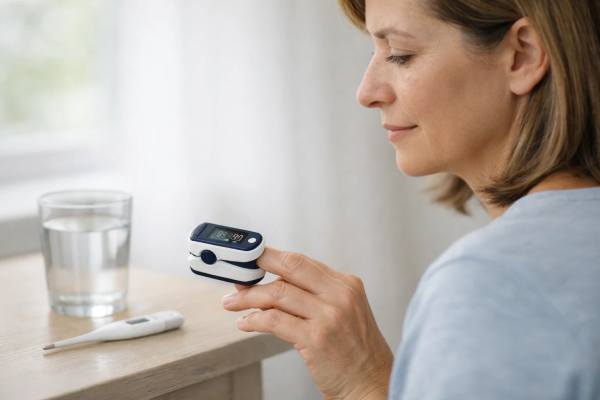
A pulse oximeter can turn a vague worry—“Am I getting enough oxygen?”—into a number you can track at home. That is powerful during colds, flu, asthma flares, or recovery from pneumonia, when breathing can change quickly and symptoms do not always match severity. But oximeters are not mind readers. They estimate oxygen saturation using light, and the reading can drift with cold hands, movement, nail products, poor circulation, and even skin tone. Used well, the device helps you notice trends early, decide when rest is enough, and recognize when you need urgent care. Used poorly, it can create false reassurance or unnecessary panic. This article walks you through what SpO2 numbers mean, what is normal in everyday life, how to get reliable readings, and which thresholds and symptoms should make you act.
Key Takeaways
- A typical resting SpO2 for healthy people at sea level is often in the mid-90s to 100, but “normal” depends on your baseline, altitude, and lung health.
- A single low number is less important than a repeated low reading or a clear drop from your usual level, especially with symptoms.
- Many false lows are fixable with technique: warm hands, remove nail products, stay still, and wait for a stable number.
- Seek urgent help for severe breathing symptoms regardless of the oximeter number, and treat suspected allergic or rapidly worsening illness as an emergency.
Table of Contents
- What a pulse oximeter measures and what it misses
- What numbers are normal in real life
- When to worry about a reading
- How to get an accurate reading at home
- Common reasons readings are wrong
- Using trends during colds, flu, and respiratory illness
- Choosing an oximeter and knowing when to escalate
What a pulse oximeter measures and what it misses
A pulse oximeter estimates SpO2, which is the percentage of hemoglobin in your blood that is carrying oxygen. The device clips onto a finger (or sometimes an earlobe) and shines red and infrared light through tissue. As blood pulses through tiny vessels, the pattern of light absorption changes. The oximeter uses that signal to estimate oxygen saturation and usually also displays a pulse rate.
That sounds straightforward, but two practical truths matter for home use:
- SpO2 is an estimate, not a direct oxygen measurement. A lab test such as an arterial blood gas can measure oxygen more precisely when accuracy is critical.
- The number has an error range. Even with good technique, home readings can be a few percentage points higher or lower than the “true” value.
It also helps to know what SpO2 does not tell you. An oximeter cannot measure:
- How hard you are working to breathe (your effort matters clinically).
- Carbon dioxide levels (you can retain carbon dioxide while SpO2 looks fine).
- The cause of a problem (viral infection, asthma, pneumonia, blood clot, or heart issue can all affect breathing in different ways).
Think of SpO2 as one piece of information, like a thermometer. A fever suggests infection or inflammation, but it does not name the cause. In the same way, a lower SpO2 suggests reduced oxygenation, but the next steps depend on symptoms, history, and trends.
Finally, do not forget the “pulse” part. A stable SpO2 reading is more believable when the displayed pulse roughly matches your actual pulse. If the oximeter says 98% but the pulse is wildly off, the device may be reading noise rather than blood flow.
What numbers are normal in real life
Most people want a simple cutoff for “normal.” In reality, normal is a range that depends on your baseline, where you live, and what your lungs and heart are doing day to day.
Here is a practical way to think about typical readings at rest:
- Often normal at sea level (healthy adults and children): about 95% to 100%
- Possibly acceptable in context: 92% to 94% can be seen with certain lung conditions, during recovery from respiratory illness, or at higher elevation.
- Usually concerning if repeated at rest: 91% or lower, especially if this is new for you.
Altitude deserves special mention. At higher elevation, there is less oxygen in the air, and your baseline SpO2 can run lower than it would at sea level. People who live at elevation often feel well at numbers that would be unusual at sea level. The key is to learn your personal baseline when you are well.
Chronic lung disease can also change what “normal” means. Some people with COPD or advanced lung scarring are given individualized target ranges, and trying to force a reading to 99% may be unrealistic or even counterproductive. If you have a diagnosed lung condition, your clinician’s target range is more important than a generic internet cutoff.
A few everyday situations can cause small, temporary dips:
- Sleeping (especially if you snore or have sleep apnea risk)
- Mild illness with congestion and mouth breathing
- Cold hands or tight grip on the device (a technical issue rather than true hypoxemia)
One of the most useful habits is to record two baseline values when you are healthy:
- A resting SpO2 after sitting quietly for 5 minutes
- An “easy activity” SpO2 after a short, comfortable walk inside your home
That baseline gives you a personal reference point. For many people, the most meaningful signal is not “Is it 95% today?” but “Is this several points lower than my usual, and is it staying there?”
When to worry about a reading
A pulse oximeter is most helpful when it clarifies whether you can safely monitor at home or should seek care now. The safest approach combines numbers, symptoms, and change over time.
Start by asking two questions:
- Does the number make sense with how I feel?
- Is this a one-off reading, or is it repeatable?
A reasonable, cautious home approach looks like this:
- If you get a low reading, repeat it after fixing technique (warm hands, remove nail products, sit still).
- Take two to three readings over 5 to 10 minutes and look for a stable pattern rather than a single spike or dip.
- Pay attention to trend: a drop of several points from your usual baseline that persists is more meaningful than a number you have never measured before.
Many clinicians use these practical thresholds for home guidance:
- Around 92% or lower at rest: contact a clinician for advice, especially if new or accompanied by symptoms.
- Around 88% or lower at rest: seek urgent evaluation, particularly if the reading is repeatable and you feel unwell.
Symptoms can override the device. Seek urgent care now (and emergency care if severe) if you have:
- Severe shortness of breath, gasping, or inability to speak in full sentences
- Chest pain, pressure, or new confusion
- Blue or gray lips or face, fainting, or profound weakness
- Rapid worsening over hours
A special caution: some people can feel “not too bad” while oxygen levels are falling, especially during certain respiratory infections. That is one reason the oximeter is useful. But the reverse is also true: anxiety, asthma tightness, or painful breathing can feel severe even when oxygen saturation is normal. In those cases, the oximeter can prevent false reassurance from symptoms alone, but it should not stop you from seeking care if you are frightened, deteriorating, or unable to function.
How to get an accurate reading at home
Most “scary” home readings are not emergencies. They are technique problems. A good reading requires good blood flow and a clean, steady signal.
Step-by-step technique
- Rest first. Sit quietly for about 5 minutes. If you just climbed stairs, your pulse is elevated and your hands may be cooler.
- Warm your hands. Cold fingers reduce circulation and cause false lows. Rub your hands, use warm water briefly, then dry completely.
- Remove nail barriers. Dark nail polish, thick gels, and artificial nails can interfere with the light signal. If you cannot remove them, try a different finger, an earlobe sensor (if you have one), or a toe in a pinch.
- Position your hand well. Rest your hand on a table at heart level. Avoid dangling your arm or squeezing your fist.
- Clip and wait. Insert the finger fully, keep still, and wait for the number to settle. Many devices fluctuate for the first 10 to 30 seconds.
- Confirm the pulse. Compare the displayed pulse to your actual pulse (at the wrist or neck) or to a known reliable device.
What a “good” reading looks like
A reliable reading is usually:
- Stable for at least 15 to 30 seconds
- Accompanied by a plausible pulse rate
- Consistent across two or three repeats
If you are monitoring illness, consistency matters more than perfection. Try to measure under similar conditions each time: same finger, same body position, similar time of day, and the same rest period before the reading.
Common quick fixes
If a reading looks low but you feel okay, try this sequence:
- Re-warm hands and sit still
- Switch fingers (index or middle finger often works well)
- Clean the fingertip (lotions can affect light transmission)
- Replace batteries or charge the device
- Take the reading in a room with less direct sunlight
If the reading stays low after troubleshooting, treat it as real until proven otherwise and follow the action steps in the “when to worry” section.
Common reasons readings are wrong
Pulse oximeters can be remarkably useful, but they have known blind spots. Understanding them prevents overreaction to noise and underreaction to false reassurance.
Low blood flow to the finger
The oximeter needs a strong pulse signal. Readings can be unreliable with:
- Cold hands, Raynaud phenomenon, or poor circulation
- Low blood pressure or dehydration
- Tight gripping, shivering, or motion
If the oximeter pulse rate is jumping around or seems incorrect, assume the oxygen number may be unreliable too.
Movement and vibration
Motion artifact is one of the most common problems at home. Tremor, tapping, talking with hand gestures, or even riding in a car can disrupt the signal. If you need a meaningful reading, sit down and keep your hand still on a surface.
Nail polish, artificial nails, and bright light
Dark polish, thick gels, and artificial nails can block or scatter light. Bright sunlight or intense indoor lighting can also interfere. These issues often create confusing patterns: the number may be low, or it may fluctuate wildly.
Skin tone and measurement bias
Research has shown that pulse oximetry can be less accurate in people with darker skin pigmentation, particularly at lower oxygen saturations. A key risk is overestimation—the device may read higher than the true oxygen saturation, which can delay recognition of hypoxemia. This does not mean the device is useless, but it means you should:
- Take symptoms seriously even if the number looks “okay”
- Use trends and repeatability rather than a single reading
- Seek evaluation sooner if you feel worse or have risk factors
Hemoglobin and unusual blood chemistry
Pulse oximetry estimates saturation of hemoglobin, so conditions that change hemoglobin behavior can mislead the reading. Examples include:
- Carbon monoxide exposure: readings may look normal despite dangerous oxygen delivery problems.
- Certain rare blood conditions (such as methemoglobinemia) can distort readings.
If you suspect smoke inhalation, faulty heaters, or enclosed-space exhaust exposure, do not rely on a pulse oximeter to clear you.
The safest way to use an oximeter is to treat it like a helpful instrument with known limitations: excellent for trend monitoring in many everyday illnesses, not a substitute for clinical assessment when warning signs are present.
Using trends during colds, flu, and respiratory illness
During respiratory infections, people often check SpO2 repeatedly, which can amplify anxiety and create confusion. A simple monitoring plan keeps the device helpful rather than overwhelming.
When monitoring helps
Home SpO2 checks can be useful if you have:
- Fever and cough with fatigue that feels “worse than a typical cold”
- A history of asthma, COPD, pneumonia, or heart failure
- Older age or other risk factors where early worsening matters
- A clinician-directed plan to monitor after a diagnosis
A practical monitoring schedule
For uncomplicated illness in otherwise healthy adults:
- Check 1 to 2 times per day when symptoms are active, plus an extra check if you feel noticeably worse.
- Always measure after resting and warming hands.
For higher-risk situations or clinician-directed monitoring:
- Many people do best with two daily resting readings (morning and evening).
- If shortness of breath is a concern, a clinician may recommend an easy exertion check, such as a short walk in the home, then re-checking SpO2. Do not do this if you are dizzy, unstable, or at fall risk.
What to record
Write down:
- SpO2 at rest and (if used) after easy activity
- Pulse rate
- Key symptoms: breathlessness, chest pain, confusion, ability to drink fluids
- Temperature and any new medications
Patterns become clearer when you can compare “today” to “yesterday” with context.
What changes matter
During a cold or flu, a meaningful warning pattern can be:
- A sustained drop several points from your baseline
- A number that stays low even after technique fixes
- Worsening breathlessness that does not match the number, especially in people at higher risk of inaccurate readings
Remember that oxygen saturation is only one part of illness severity. Hydration, mental clarity, urine output, and the ability to breathe and speak comfortably are equally important. If your gut says something is wrong, seek care even if the device is not alarming.
Choosing an oximeter and knowing when to escalate
Not all pulse oximeters are built or tested the same way. Choosing wisely can reduce confusion, especially if you plan to use the device during illness rather than for sports or curiosity.
What to look for in a home device
Helpful features include:
- Clear display that is easy to read in low light
- Consistent readings that stabilize quickly
- A snug, comfortable fit that does not pinch
- A low-battery indicator and dependable power source
- Optional signal indicators (such as a pulse waveform), which can help you judge whether the reading is trustworthy
If you are buying for medical monitoring, consider devices marketed for medical use rather than general wellness. Some consumer models are sold for sports or aviation and may not be intended for clinical decision-making.
How to sanity-check your oximeter
A realistic home check is not to “prove it is perfect,” but to confirm it behaves sensibly:
- Compare your oximeter reading to a reading taken in a clinic when you are well.
- Confirm that pulse rate is accurate compared with a manual pulse count.
- See whether readings are consistent across fingers when your hands are warm.
If your device produces erratic numbers, slow stabilization, or implausible pulse readings, replace it rather than trying to interpret noise.
When you need more than an oximeter
An oximeter is a screening tool. You should seek medical evaluation, and sometimes lab testing, if:
- Resting SpO2 is persistently low or dropping over time
- Symptoms are severe, rapidly worsening, or out of proportion
- You have risk factors that increase the consequences of low oxygen
- There is concern about conditions the oximeter cannot evaluate, such as carbon dioxide retention, blood clots, or serious pneumonia
If a clinician suspects your reading is unreliable or needs confirmation, they may order a more direct measurement, such as an arterial blood gas, or assess you with additional tools. That is not a failure of the oximeter. It is the correct use of a home estimate within a broader medical decision.
Used thoughtfully, a pulse oximeter can help you act earlier and with less uncertainty. The best results come from combining good technique, trend awareness, and a low threshold for care when symptoms signal danger.
References
- Pulse Oximetry: MedlinePlus Medical Test 2024 (Patient Education)
- FDA In Brief: FDA warns about limitations and accuracy of pulse oximeters | FDA 2021 (Safety Communication Summary)
- Pulse Oximeters | FDA 2025 (Government)
- Skin Pigmentation Influence on Pulse Oximetry Accuracy: A Systematic Review and Bibliometric Analysis – PMC 2022 (Systematic Review)
- A review of the effect of skin pigmentation on pulse oximeter accuracy – PMC 2023 (Review)
Disclaimer
This article is for general educational purposes and does not provide medical advice, diagnosis, or treatment. Pulse oximeters estimate oxygen saturation and can be inaccurate under certain conditions, so readings should be interpreted alongside symptoms and medical history. If you have chronic lung disease, heart disease, pregnancy-related complications, or are immunocompromised, follow a clinician-directed monitoring plan rather than generic thresholds. Seek urgent care for severe shortness of breath, chest pain, confusion, fainting, blue or gray lips or face, inability to swallow fluids, or rapidly worsening symptoms, even if a home device shows a “normal” number.
If you found this helpful, please share the article on Facebook, X (formerly Twitter), or any platform you prefer.