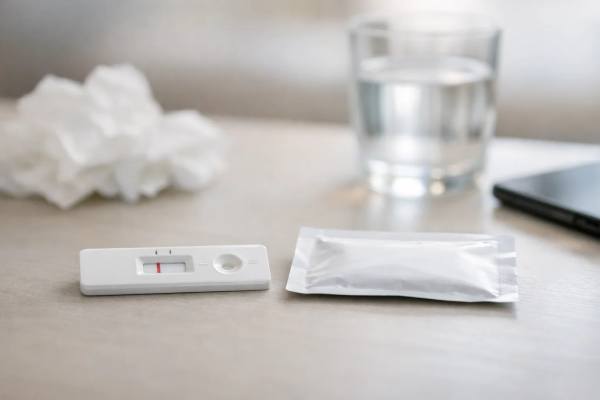
A negative rapid test can feel like a green light—especially when you are tired, congested, and hoping to get back to normal. But rapid tests are designed for speed, not certainty. Early in an infection, the amount of virus in your nose and throat can be below the test’s detection threshold even though you are already contagious or headed there. With both COVID and flu, timing matters: a result that is negative on day 1 can turn positive 24–72 hours later, and that change can affect practical decisions like staying home, masking around vulnerable people, and asking about treatment windows.
Repeat testing is not about “testing forever.” It is about using a small, well-timed series of tests to reduce false reassurance when the stakes are higher—because of symptoms, exposure, or risk factors—and to guide your next step with more confidence.
Key Insights
- Serial testing 48 hours apart is most useful when symptoms are new or exposure was significant.
- A second negative rapid test lowers (but does not eliminate) the chance of COVID or flu, especially if symptoms persist.
- If you are high-risk or worsening, waiting on repeated home tests can delay treatment that works best early.
- Better sampling technique and correct timing can improve the usefulness of repeat rapid testing.
Table of Contents
- What a negative rapid test can miss
- Timing the sweet spot for retesting
- Who should retest even if the first test is negative
- How to retest so the result is more trustworthy
- When to switch to PCR or see a clinician
- Flu-specific retesting and the antiviral clock
- Practical scenarios and next steps
What a negative rapid test can miss
Rapid tests (most commonly antigen tests) look for viral proteins. That makes them fast and convenient, but it also means they generally need a higher amount of virus to turn positive compared with molecular tests (like PCR). A negative result can be “true negative,” but it can also mean the test missed an early or low-level infection.
Here are the most common reasons a rapid test is negative when you are actually infected:
- You tested too early. Many respiratory viruses ramp up over the first few days. Symptoms can start from immune response before the viral load peaks in the nose.
- Sampling did not collect enough material. A quick swab that barely touches the nasal lining can miss virus even when it is present.
- The virus is concentrated somewhere else. Some people have more virus in the throat early on, or deeper in the respiratory tract. A nose-only sample may lag behind.
- The test is less sensitive by design. That is the tradeoff for speed and simplicity.
- Your symptoms are from something else. RSV, adenovirus, rhinovirus, seasonal coronaviruses, and even strep throat can mimic flu and COVID. In that case, repeating the same rapid test may not clarify the real cause.
A useful way to think about a negative rapid test is this: it is strongest when your pre-test probability is low (no known exposure, mild symptoms that are improving, low community spread), and weakest when your pre-test probability is high (classic symptoms, close exposure, household outbreak, or high-risk medical status). In high-probability situations, repeating the test is not “paranoia”—it is a way to match the testing strategy to the biology of how infections unfold.
Timing the sweet spot for retesting
Retesting works when it is timed to catch the rise in viral load. The goal is not daily testing indefinitely; it is a short sequence that covers the window when an early false negative is most likely to flip.
For COVID home antigen tests, a widely used approach is serial testing spaced about 48 hours apart. In practical terms:
- If you have symptoms and your first rapid test is negative, test again 48 hours later.
- If you do not have symptoms but you are testing because of exposure or screening, a longer series (spanning several days) may be recommended.
This 48-hour spacing is not arbitrary. It balances two realities: (1) viral levels can change meaningfully over 1–2 days, and (2) testing too soon after a negative result often just repeats the same uncertainty.
In the U.S., U.S. Food and Drug Administration explicitly describes repeat testing after a negative antigen result, with different total test counts depending on whether you have symptoms. In other words, retesting is a built-in part of how many rapid tests are intended to be used—not a workaround.
For flu, the timing logic is similar but the details differ. Rapid influenza antigen tests can be less sensitive, and false negatives are more common when testing is done late (after several days) or when specimen quality is poor. Retesting with another rapid flu antigen test can help in some situations, but more often the better “repeat” is a different kind of test (such as a rapid molecular test or PCR), especially if the result will affect antiviral decisions.
A simple timing framework that works for many people:
- Day 0 (symptom onset or first day you feel clearly ill): Test if you need an answer to guide isolation or work decisions.
- Day 2: Retest if symptoms persist, worsen, or your exposure risk was high.
- Day 3–4: If still negative but clearly sick, consider switching to a clinician-ordered molecular test or focusing on supportive care and staying home until fever-free and improving.
The main exception: if you are high-risk or getting worse, it can be worth escalating sooner rather than waiting for a day-2 retest.
Who should retest even if the first test is negative
Repeat testing is most worth doing when the result will change what you do next. These are the situations where a second test often provides real value.
1) You have high-likelihood symptoms
Certain symptom patterns raise the odds enough that a single negative rapid test is not very reassuring, especially in the first 1–2 days:
- Fever or chills with body aches and marked fatigue
- New cough plus sore throat and congestion that escalates quickly
- Sudden loss or change in taste or smell (less common now, but still suggestive for COVID when it happens)
- A clear “I was fine yesterday, today I am flattened” onset that often fits flu
2) A close, meaningful exposure
Retesting matters most when exposure involved time and proximity:
- Living with, kissing, or caring for someone who is sick
- Being indoors with a coughing person for an extended period
- Workplace or classroom clusters where multiple people become ill in the same week
3) You are around people who would be harmed by a missed infection
Even mild illness can be dangerous to others. Retest sooner and be stricter with precautions if you will be near:
- Infants under 6 months
- Older adults
- People with weakened immune systems (from medications or illness)
- People with chronic lung or heart disease
- Pregnant people
4) You might qualify for time-sensitive treatment
For both COVID and flu, treatment is most effective early. If you are in a group that may qualify for antivirals, a single negative rapid test should not be the end of the evaluation when symptoms are consistent.
5) Your first test was “technically questionable”
Retesting is wise if you suspect any of the following:
- You swabbed too gently or only one nostril
- You tested in a very dry nose without good contact
- The kit was expired, stored in heat/cold, or used incorrectly
- The control line was faint or unclear
If none of these apply—your symptoms are mild and improving, no known exposure, and you can easily stay home—retesting may add little beyond common-sense precautions. But when risk or uncertainty is higher, repeating is a reasonable step.
How to retest so the result is more trustworthy
If you are going to repeat a rapid test, it is worth doing it in a way that reduces “user-error negatives.” Small technique improvements can meaningfully increase the chance that a true infection is detected.
Before you test
- Check timing and conditions. Make sure the kit is not expired and has been stored at the recommended temperature range.
- Avoid quick fixes that can interfere. If you just used a nasal spray or did a vigorous saline rinse, wait a bit so you are not sampling mostly fluid.
- Blow your nose gently once if it is heavily congested, then wait a minute or two. You want mucus cleared, but you still need contact with nasal lining.
Swabbing technique that tends to work well
- Swab both nostrils (unless instructions specify otherwise).
- Insert to the recommended depth (many kits call for about 1–1.5 cm for anterior nasal swabs).
- Rotate with firm, steady contact against the inside wall of the nostril for the full recommended time or number of circles.
- If one side is blocked, spend extra time on the clearer side rather than rushing.
Run the test like a lab would
- Use the correct number of drops.
- Start a timer immediately.
- Read the result only in the allowed window (too early or too late can mislead).
- Treat any visible test line in the time window as positive, even if faint.
Choose the right repeat strategy
- If you are repeating after an early negative, use the same brand and method if possible so your process is consistent.
- If your goal is clarity (for example, before visiting someone vulnerable), consider switching from a second antigen test to a molecular test if you can access one, because that changes the sensitivity rather than repeating the same limitation.
Finally, remember that “more testing” is not the same as “better information.” Two well-timed, well-collected tests can be more informative than four rushed tests done on the same day.
When to switch to PCR or see a clinician
Repeat rapid testing is helpful up to a point. If your situation demands a more definitive answer—or if your symptoms suggest you may need treatment—switching to clinician-guided care is often the smarter move.
Consider a molecular test (PCR or rapid molecular) when:
- You have classic symptoms and two antigen tests 48 hours apart are negative.
- You need a higher-confidence result for work, caregiving, travel, or congregate settings.
- You are immunocompromised, where viral dynamics can differ and missing an infection has higher consequences.
- You are being evaluated for a complication (pneumonia, asthma flare, dehydration), where diagnosis helps guide management.
In the U.S., Centers for Disease Control and Prevention notes that antigen results should be followed according to recommendations for repeat testing, and that a negative test does not fully rule out infection—especially when symptoms and timing point strongly toward illness.
See a clinician promptly (do not wait for serial home testing) if you have:
- Shortness of breath at rest, chest pain, blue lips, confusion, or fainting
- Persistent high fever, or fever that returns after improving
- Signs of dehydration (very dark urine, dizziness, inability to keep fluids down)
- Worsening symptoms after day 4–5 rather than gradual improvement
- High-risk status plus early symptoms (for example, significant heart or lung disease, immune suppression, pregnancy)
When a “negative” is practically positive
Even if you never test positive, you can act as though you are infectious when you have a compatible illness during a period of high respiratory virus circulation:
- Stay home when possible.
- Wear a high-quality mask if you must be around others.
- Improve ventilation.
- Avoid close contact with high-risk people until you are clearly improving and fever-free (without fever-reducing medicine).
For flu in particular, antiviral benefit is time-sensitive. If you are in a group likely to benefit, a clinician may recommend treatment based on symptoms and risk—without waiting for confirmatory testing.
One more useful nuance: if you have prominent sore throat with fever and minimal cough, ask about strep testing. A “COVID and flu only” testing plan can miss other treatable causes of illness.
Flu-specific retesting and the antiviral clock
Flu testing has its own twist: the main reason to identify influenza early is not just isolation—it is that antivirals work best when started quickly. That changes the cost-benefit calculation of waiting for repeat tests.
Why a negative rapid flu test is often less reassuring
Many rapid influenza tests detect viral antigens and can miss cases, especially when:
- The sample is collected late (after the first few days)
- The swab quality is poor
- Community flu activity is high (false negatives become more common)
- The illness is primarily in the lower respiratory tract
Because of that, repeating the same rapid antigen flu test may help a little, but the more effective step is often to upgrade the test type (rapid molecular or PCR) or to treat based on clinical suspicion in high-risk cases.
The 48-hour treatment window
For uncomplicated flu, antivirals provide the most benefit when started within about 48 hours of symptom onset. After that, they may still be recommended for people who are hospitalized, severely ill, or at high risk of complications, but the “time advantage” is greatest early.
That leads to two practical rules:
- If you are high-risk and your symptoms look like flu, do not wait several days for repeat home tests before seeking advice.
- If you are not high-risk, and you are already improving by day 3–4, testing has less ability to change management beyond confirming what you likely already know: rest, fluids, and reducing spread.
Where Infectious Diseases Society of America guidance fits
Specialty guidance has long emphasized that molecular testing is more sensitive than rapid antigen testing for influenza, particularly for patients where missing the diagnosis would change care (for example, older adults, hospitalized patients, or those with complications). That supports a common-sense approach: use rapid antigen tests as a quick screen, but escalate to a more sensitive method when stakes are higher.
When retesting is worth it for flu
- Your first test was very early (first 24 hours) and symptoms are worsening.
- You are in a setting with high exposure risk (household outbreak, nursing facility, dorm).
- The result will change behavior (protecting a vulnerable person, deciding whether to pursue treatment).
In many households, the most useful “retest” is simply: if you are still clearly sick 48 hours later, treat the illness seriously, limit contact, and consider a clinician test that can differentiate flu from COVID and other viruses.
Practical scenarios and next steps
Sometimes the hardest part is translating test logic into a real plan. These scenarios can help you decide whether repeating a test is worth doing.
Scenario 1: New symptoms, no known exposure
- If symptoms are mild: rest, mask around others if needed, and consider a single test if you want clarity.
- If symptoms are moderate or classic: test now, then retest in 48 hours if negative and you are still symptomatic.
Scenario 2: Household member is sick and you are starting to feel it
- Test at first symptoms, but assume exposure is meaningful.
- If negative, retest in 48 hours, and behave cautiously in the meantime (mask, ventilation, separate rooms if feasible).
Scenario 3: You need to visit an older relative
- A single negative rapid test the morning of the visit is not a guarantee.
- If you have any symptoms or recent exposure, the safer plan is: postpone, or test serially (including a test 48 hours after the first) and add extra precautions even if results remain negative.
Scenario 4: Two negative antigen tests but you feel worse
- Stop relying on home testing as the deciding factor.
- Seek clinician advice, especially if you have fever, chest symptoms, asthma worsening, or dehydration.
Scenario 5: You are high-risk and within the first two days
- Do not wait for multiple home tests before contacting a clinician. Early treatment decisions may depend on timing more than test confirmation.
A “good enough” decision rule
If you want a simple rule you can remember:
- If you feel sick and your first rapid test is negative, treat it as uncertain, not as cleared.
- Retest in 48 hours if you still have symptoms or your risk is meaningful.
- Escalate to molecular testing or clinical care sooner if you are high-risk, worsening, or need a definitive answer for safety-critical decisions.
Finally, it helps to separate two questions: “Do I have COVID or flu?” and “Am I likely contagious today?” A negative rapid test partly addresses the first question, but your symptoms, timing, and exposure often answer the second more reliably. Acting cautiously for a few days is often the right move even when test results lag behind.
References
- At-Home COVID-19 Diagnostic Tests: Frequently Asked Questions | FDA 2025 (Guidance). ([U.S. Food and Drug Administration][1])
- Testing for COVID-19 | Covid | CDC 2025 (Guidance). ([CDC][2])
- Rapid, point‐of‐care antigen tests for diagnosis of SARS‐CoV‐2 infection – PMC 2025 (Systematic Review). ([PMC][3])
- Information for Clinicians on Rapid Diagnostic Testing for Influenza | Influenza (Flu) | CDC 2026 (Guidance). ([CDC][4])
- Influenza Antiviral Medications: Summary for Clinicians | Influenza (Flu) | CDC 2026 (Guidance). ([CDC][5])
Disclaimer
This article is for general educational purposes and does not provide medical diagnosis, treatment, or individualized advice. Rapid test performance and appropriate next steps depend on timing, symptoms, medical history, and local guidance. If you are at higher risk of complications, feel worse instead of gradually improving, or have concerning symptoms (such as trouble breathing, chest pain, confusion, dehydration, or persistent high fever), seek urgent medical evaluation. For medication decisions—especially antivirals—contact a licensed clinician as early as possible.
If you found this helpful, consider sharing it on Facebook, X (formerly Twitter), or any platform you prefer so others can make more confident decisions about repeat testing and respiratory illness precautions.