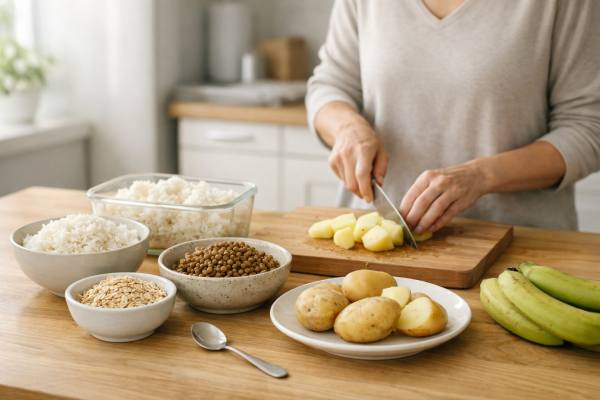
Resistant starch is a unique form of carbohydrate that behaves more like fiber than fuel. Instead of being fully digested in the small intestine, it reaches the colon where gut microbes ferment it into short-chain fatty acids that support the lining of the gut and influence motility. For many people, that can translate into steadier bowel habits, better stool form, and a gentler way to increase fermentable fiber without relying only on bran or raw vegetables. But resistant starch is not universally comfortable: the same fermentation that produces beneficial compounds can also increase gas and bloating, especially when you add too much too fast.
This article explains what resistant starch is, where to find it in real foods, how cooking and cooling can boost it, and how to lower the risk of bloating while still getting benefits.
Quick overview for resistant starch
- Resistant starch can support bowel regularity and gut barrier function by feeding beneficial colonic bacteria.
- Cooling cooked starches (like rice or potatoes) can increase resistant starch and improve tolerance for some people.
- Rapid increases can trigger bloating and gas, especially in people with IBS or sensitive digestion.
- Start with small portions for 1–2 weeks and scale gradually to find your personal “comfortable dose.”
Table of Contents
- What resistant starch is and how it works
- Gut health benefits and who may notice them
- Best food sources and realistic serving ideas
- Cooking and cooling tips to boost resistant starch
- Bloating and gas risks and how to reduce them
- How to use resistant starch safely in daily diets
What resistant starch is and how it works
Resistant starch is exactly what it sounds like: starch that “resists” digestion in the small intestine. Most starches are broken down into glucose and absorbed fairly quickly. Resistant starch passes through largely intact and becomes food for microbes in the colon. That is why you will often see it described as a prebiotic carbohydrate, even though it comes from familiar foods like potatoes, rice, and beans.
Why it matters for the gut lining
When gut bacteria ferment resistant starch, they produce short-chain fatty acids (often abbreviated as SCFAs). One of the most discussed SCFAs is butyrate, a preferred fuel for cells that line the colon. A well-fed lining tends to maintain a stronger barrier, produce healthy mucus, and keep local inflammation quieter. You do not need to chase a specific SCFA number to benefit—think of resistant starch as one tool that encourages a supportive environment inside the colon.
The five common types of resistant starch
Resistant starch is not a single substance. It is a category with several forms:
- RS1: physically “locked away” starch in intact grains, seeds, and legumes (the structure slows digestion).
- RS2: naturally resistant granules, often found in raw potatoes and green bananas, and in some high-amylose maize products.
- RS3: starch that becomes more resistant after cooking and cooling (a process called retrogradation).
- RS4: chemically modified starches used in some packaged foods (functional, but not always the same gut response as food-based sources).
- RS5: starch combined with fats in a way that resists digestion (formed in certain cooking contexts).
From a practical standpoint, most people encounter RS1 in beans and whole grains, RS2 in green banana or potato starch products, and RS3 in cooked-and-cooled rice, pasta, and potatoes.
Resistant starch is measured in grams of resistant starch
A key detail: a food can be “high in carbs” but low in resistant starch, and vice versa. Resistant starch content varies by variety (for example, potato type), ripeness (green versus ripe banana), cooking method, and storage time. That variability is normal. Your goal is not precision—it is consistency and tolerance.
Gut health benefits and who may notice them
Resistant starch gets attention because it sits at the intersection of gut function and metabolism. For gut-focused goals, the most relevant outcomes are bowel regularity, stool quality, and how the gut responds to fermentation.
Bowel regularity and stool comfort
In many people, resistant starch can support more predictable bowel movements by:
- increasing fermentation products that stimulate colonic movement
- supporting a microbiome pattern associated with healthier stool output
- improving stool texture over time (less “pellet-like,” less urgent, and more complete)
People with constipation tendencies may notice the biggest change, especially when resistant starch is added alongside adequate fluids and a steady meal schedule. That said, too much too quickly can backfire and increase bloating or cramping.
Gut barrier support and inflammation modulation
A well-nourished colon lining is less likely to feel irritated by normal digestive processes. Resistant starch fermentation can encourage SCFA production and a slightly lower colonic pH, which may help keep certain microbes in balance. Many discussions focus on “gut barrier integrity,” but it is best to think in everyday terms: fewer flare-like days, less sensitivity, and steadier digestion for some people—especially when resistant starch is part of a broader fiber pattern.
Who tends to benefit most
Resistant starch may be especially worth exploring if you:
- have mild constipation or inconsistent stool frequency
- eat very little fermentable fiber and want a gentle on-ramp
- notice that traditional high-fiber foods (raw salads, bran cereals) feel too harsh
- want a food-based strategy that may also support metabolic health
People with IBS can still benefit, but response is more individualized. The “right” resistant starch source and dose matters more in IBS than in otherwise healthy digestion.
What to expect and how long it takes
A realistic timeline helps you avoid overreacting to early symptoms:
- Days 1–7: gas may increase, especially with RS2 powders or large portions.
- Weeks 2–4: bowel habits may become more regular if the dose is tolerable.
- Weeks 4–12: more stable benefits are often easier to judge (stool comfort, bloating trend, and overall gut steadiness).
If you only feel worse after 2–3 weeks of a careful, slow increase, resistant starch may not be a good fit right now—or the form you chose may be too fermentable for your current gut sensitivity.
Best food sources and realistic serving ideas
Food-first resistant starch tends to be easier to integrate and, for many people, easier to tolerate than jumping straight to a supplement. The most useful approach is to pick 2–3 sources you genuinely enjoy and rotate them through the week.
Everyday foods that naturally provide resistant starch
These options often work well because they come with additional nutrients and a familiar food structure:
- Legumes (RS1): lentils, chickpeas, black beans, and white beans
- Whole grains (RS1): intact or minimally processed grains, including oats and barley
- Green bananas or plantains (RS2): firmer, less sweet fruit tends to contain more resistant starch
- Cooked and cooled starches (RS3): potatoes, rice, pasta, and some starchy grains after refrigeration
Practical serving ideas that keep portions realistic
Try one of these “small but consistent” add-ins:
- Add 2–4 tablespoons of chickpeas to a salad or grain bowl.
- Use cooled potato cubes in a potato salad-style side, then eat it as part of a balanced meal.
- Make overnight oats and top with a tolerated fruit and nuts.
- Cook rice for dinner and use the chilled leftovers for a next-day rice bowl.
- Blend a small piece of green banana into a smoothie if you tolerate it.
If you are sensitive to fermentable carbs, start with the lower end of portions and increase slowly.
What about raw potato starch and resistant starch powders
Supplement-style products are usually concentrated RS2 (such as potato starch or high-amylose maize resistant starch). They can be useful if you struggle to eat enough fiber through food, but they are also more likely to cause gas if you begin with large doses.
If you use a powder, treat it like a supplement, not a “healthy food you can take unlimited amounts of.” Start small, mix into cool or room-temperature foods (hot liquids can change structure), and increase only if you remain comfortable.
A note for low FODMAP and sensitive digestion
Some resistant starch sources overlap with fermentable carbohydrates that trigger symptoms in sensitive people. Legumes, for example, contain both resistant starch and other fermentable components. That does not mean you must avoid them, but it does mean your starting dose should be smaller, and you may do better with cooled rice or potatoes before jumping into beans.
Cooking and cooling tips to boost resistant starch
One of the most practical ways to increase resistant starch is not a special product—it is a kitchen routine. When you cook starch and then cool it, part of the starch reorganizes into a form that is harder to digest. This creates more RS3 and can modestly reduce the “fast carb” effect for some people.
The basic cook-cool approach
A simple method you can apply to potatoes, rice, pasta, and some grains:
- Cook the starch as usual.
- Cool it promptly and refrigerate.
- Eat it chilled or gently reheat and eat later.
The cooling step is where much of the resistant starch increase happens. Many people find 8–24 hours in the refrigerator is a workable window.
Does reheating remove resistant starch
Gently reheating does not necessarily erase all RS3. In practice, many people can reheat cooled rice or potatoes and still benefit from the routine. The “best” choice is the one you will actually do consistently. If chilled rice is unappealing, reheating leftovers is still a useful habit.
Cooking ideas that fit real life
- Batch-cook rice and portion it into containers for next-day bowls.
- Make potato salad-style sides with olive oil, herbs, and tolerated vegetables.
- Use cooled pasta for a pasta salad, then add protein and vegetables for balance.
- Keep cooked and cooled oats in the fridge for quick breakfasts.
If you are using a resistant starch powder, avoid adding it to boiling-hot foods. Many people stir it into yogurt, kefir, overnight oats, or cooled porridge.
Food safety matters, especially for rice
Resistant starch should never come at the cost of food safety. A few practical rules reduce risk:
- Refrigerate cooked starches within about 2 hours (sooner is better in warm environments).
- Store in the fridge in shallow containers so cooling is faster.
- Reheat leftovers until steaming hot if you prefer them warm.
- Do not leave cooked rice sitting at room temperature for long periods.
These steps are especially important for rice, which can be more prone to issues if handled casually.
Pairing tips for comfort
If resistant starch increases gas for you, pair it with:
- protein and a little fat (for steadier digestion)
- cooked vegetables rather than large raw salads
- smaller portions spread across the day instead of one large load
In many cases, the same food becomes more comfortable simply by adjusting portion size and meal context.
Bloating and gas risks and how to reduce them
The most common downside of resistant starch is not danger—it is discomfort. Fermentation is the point, but fermentation produces gas. If your gut is sensitive, that gas can feel like pressure, distension, cramping, or urgent stool changes.
Why resistant starch can cause bloating
A few mechanisms often overlap:
- Rapid increase in fermentable substrate: your microbiome may not be “trained” for it yet.
- High-dose RS2 powders: concentrated resistant starch can ferment quickly and produce more noticeable gas.
- Visceral hypersensitivity: some people feel normal amounts of gas more strongly (common in IBS).
- Constipation overlap: trapped stool can increase bloating even when the food choice is reasonable.
This is why two people can eat the same amount and have opposite experiences—one feels calmer digestion, the other feels inflated.
Start low and go slow plan
A practical titration approach that reduces false starts:
- Week 1: choose one source and start with a small portion once daily.
- Week 2: increase slightly if symptoms stay mild and manageable.
- Week 3 and beyond: add a second source or increase frequency, not both at once.
If you are using a powder, begin with a very small amount mixed into cool food, then increase only every 7–10 days if comfortable. Slow increases allow your gut to adapt.
Choose the form that matches your sensitivity
If you bloat easily, these choices often help:
- start with RS3 foods (cooled rice or potatoes) rather than powders
- avoid combining resistant starch increases with large increases in other fibers at the same time
- keep meal portions moderate, because large meals can worsen distension even without resistant starch
If you tolerate legumes poorly, try smaller amounts, rinse canned legumes well, and consider spacing them out rather than eating a full bowl.
How to interpret symptoms
Not all gas is a problem. The key questions are:
- Is the discomfort mild and improving over 1–2 weeks
- Is it severe, painful, or disruptive
- Does it come with worsening constipation or diarrhea
If you develop persistent severe pain, vomiting, blood in stool, or unintended weight loss, do not continue experimenting on your own.
When resistant starch may not be a good idea right now
It may be wise to pause and seek guidance if you have very active inflammatory bowel disease symptoms, severe gastroparesis, a history of bowel obstruction, or highly restrictive eating patterns. In these contexts, even “healthy fiber” can create problems if timing and dose are not carefully managed.
How to use resistant starch safely in daily diets
A safe plan balances three things: comfort, consistency, and nutrition. You do not need a perfect resistant starch number. You need a pattern you can repeat that supports your gut without making you dread meals.
A simple daily framework
Many people do well with one resistant starch choice per day, then build from there:
- Pick one anchor food (cooled rice, cooled potatoes, oats, or a small serving of legumes).
- Keep the portion steady for 7–10 days.
- Increase either portion or frequency slowly, not both at once.
- If symptoms flare, step back to the last comfortable level for a week.
This approach creates a clear cause-and-effect pattern and reduces the urge to abandon the plan after one uncomfortable day.
Food-first is usually the best long-term strategy
Food sources deliver resistant starch alongside minerals, polyphenols, and other fibers. They also reduce the risk of accidentally taking a large “bolus dose” that your gut cannot handle. If you do use a supplement powder, consider it a targeted tool:
- choose reputable products with clear labeling
- avoid using it as a shortcut to skip dietary variety
- mix into cool foods and start with a very small amount
Sample day using resistant starch gently
- Breakfast: overnight oats with a tolerated fruit and a handful of nuts
- Lunch: rice bowl made with refrigerated cooked rice, protein, and cooked vegetables
- Dinner: lean protein with a side of cooled-and-reheated potatoes and cooked greens
This pattern spreads fermentable substrate across the day and pairs it with protein and cooked vegetables, which many sensitive guts handle better than large raw-fiber loads.
Special considerations
- If you are managing blood sugar, resistant starch foods may help with meal response for some people, but monitor your own pattern and discuss changes with a clinician if you use glucose-lowering medications.
- If you are following low FODMAP, focus on tolerated RS3 sources first and introduce legumes carefully.
- If you are immunocompromised or medically fragile, prioritize food safety and consult your care team before adding supplement powders.
Resistant starch can be a valuable gut-health lever, but it is most effective when it is approached as a gradual practice—not a sudden overhaul.
References
- Resistant starch and the gut microbiome: Exploring beneficial interactions and dietary impacts 2024 (Review) ([PMC][1])
- Tolerability and SCFA production after resistant starch supplementation in humans: a systematic review of randomized controlled studies 2022 (Systematic Review) ([PubMed][2])
- Impact of resistant starch type 3 on fecal microbiota and stool frequency in Thai adults with chronic constipation randomized clinical trial 2024 (RCT) ([PMC][3])
- The gastrointestinal and microbiome impact of a resistant starch blend from potato, banana, and apple fibers: A randomized clinical trial using smart caps 2022 (RCT) ([PMC][4])
- Functional Abdominal Bloating and Gut Microbiota: An Update 2024 (Review) ([PMC][5])
Disclaimer
This article is for educational purposes and does not provide medical advice, diagnosis, or treatment. Resistant starch and other fermentable fibers can worsen symptoms in some people, especially when introduced quickly or in large doses. Seek medical care promptly for severe or persistent abdominal pain, vomiting, blood in stool, black tarry stools, unexplained weight loss, fever, anemia, or symptoms that wake you from sleep. If you are pregnant, immunocompromised, have inflammatory bowel disease, a history of bowel obstruction, significant motility disorders, or a history of disordered eating, discuss dietary changes with a qualified clinician or registered dietitian.
If you found this article helpful, please consider sharing it on Facebook, X (formerly Twitter), or any platform you prefer.