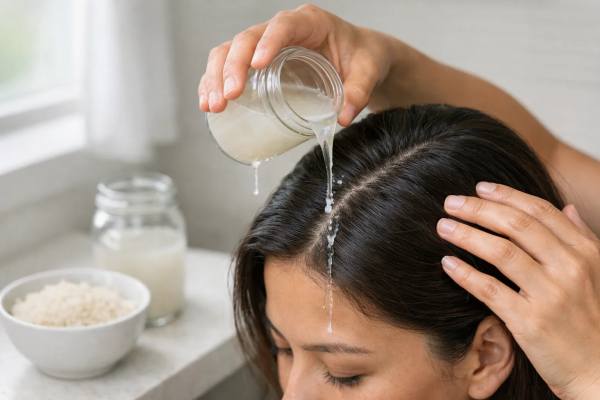
A cloudy jar of rice water on the bathroom shelf can look like a simple beauty secret, but the real story is more nuanced. Rice water has a long cultural history in hair care, and many people still use it hoping for faster growth, less shedding, more shine, and stronger strands. The appeal is easy to understand: it is inexpensive, familiar, and feels gentler than many commercial treatments.
Still, “natural” and “effective” are not the same thing. Rice water may improve how hair feels and behaves, especially when dryness, roughness, or tangling are part of the problem. That does not automatically mean it stimulates follicles or reverses true hair loss. The strongest claims online often stretch well beyond the evidence. Used carefully, rice water can be a reasonable rinse for some hair types. Used too often, too concentrated, or on an irritated scalp, it can leave stiffness, buildup, or more frustration than benefit.
Key Insights
- Rice water may improve softness, slip, and shine more reliably than it improves actual hair growth.
- The best-supported benefit is reduced roughness and easier detangling, not proven regrowth of thinning areas.
- Heavy, concentrated, or poorly rinsed rice water can leave a starchy film that makes some hair feel stiff or dull.
- A cautious starting routine is one rinse weekly for 5 to 10 minutes, followed by a full rinse-out and a pause if the scalp or hair starts feeling tight, coated, or irritated.
Table of Contents
- Why Rice Water Became Popular
- What Rice Water May Help
- Why Growth Claims Stay Weak
- How to Use It Safely
- Who Should Be Cautious
- When Real Hair Loss Needs More
Why Rice Water Became Popular
Rice water became a modern hair trend because it sits at the intersection of tradition, texture care, and internet simplicity. It has deep cultural roots in Asian beauty practices, where rice-washing water and fermented rice preparations have long been associated with long, glossy, manageable hair. Social media then compressed that history into a more dramatic promise: faster growth, stronger strands, and a fuller hairline from something already sitting in the kitchen.
That promise feels believable because rice water is not an obviously harsh treatment. It is made from soaking, boiling, or rinsing rice, so people tend to assume it must be gentle. It also fits the logic many consumers already use with hair care: if a rinse makes hair smoother, then maybe it is also making it healthier. Sometimes those ideas overlap. Often they do not.
Part of the confusion comes from how people use the phrase “hair growth.” They may mean at least four different things:
- faster growth from the follicle
- less breakage, so hair appears to grow longer
- better shine and alignment of the cuticle
- reduced tangling and friction during wash day
Those are not the same outcome. A product can help hair retain length without making follicles produce hair faster. Rice water likely belongs more in that first cosmetic camp than in the category of proven regrowth treatments.
Its popularity also comes from how easy it is to personalize. Some people soak the rice briefly. Others ferment it. Some use it as a final rinse. Others spray it on the scalp, leave it on for hours, or combine it with essential oils and citrus peels. That flexibility keeps the trend alive, but it also makes results inconsistent. Two people can both say they “used rice water,” while one used a diluted rinse once a week and the other used a fermented, concentrated spray every other day.
This is where expectations often drift. Hair that feels smoother after a rinse may break less during detangling, which is valuable. But that does not mean the follicle has shifted into a faster growth phase. For readers trying to separate normal growth from length retention, this guide to the hair growth cycle and its phases helps explain why those are different processes.
The better way to understand rice water is as a traditional hair-care aid with some plausible cosmetic benefits and a much weaker case for true follicle stimulation. That distinction is not a letdown. It is what keeps the trend useful instead of misleading. If you expect a gentle rinse that may improve feel, manageability, and breakage risk, rice water makes more sense. If you expect it to reverse thinning by itself, you are more likely to be disappointed.
What Rice Water May Help
Rice water is most likely to help the part of hair care people can feel with their hands before they can see it in photos: slip, smoothness, tangling, and surface roughness. That matters more than it sounds. Hair does not only “fail” because follicles slow down. It also loses length because the shaft breaks, frays, splits, and snags during ordinary handling. A rinse that leaves the hair more aligned and easier to comb can reduce that everyday damage.
This is why some people come away convinced that rice water made their hair grow faster. In reality, it may have reduced mid-length breakage enough that they finally kept the growth they were already producing. That is not fake progress. It is just a different mechanism than regrowing sparse areas or increasing follicle output.
The most realistic benefits of rice water usually fall into a few buckets:
- improved softness or glide during detangling
- a shinier appearance from a smoother hair surface
- less roughness after washing
- better length retention when breakage is part of the problem
The catch is that these benefits are not universal. Hair responds differently depending on porosity, prior damage, product routine, and how concentrated the rinse is. A person with weathered ends and a gentle routine may enjoy the extra smoothness. Someone whose hair already feels coated, low movement, or rigid may find that rice water pushes it further in the wrong direction.
That is why rice water is often more relevant to people dealing with dry-feeling strands than to people dealing with active scalp-driven shedding. It can be part of shaft care. It is not a good stand-in for diagnosing why density is dropping.
One useful way to test whether rice water is helping is to judge the right outcomes. Ask:
- Does detangling take less force?
- Do my ends feel less rough after wash day?
- Am I seeing fewer short snapped hairs?
- Does my hair still move naturally, or does it feel coated?
Those are better questions than “Did my hairline fill in after two weeks?” If your main problem is breakage, rice water may offer modest support. If your main problem is true thinning, the odds are much lower. A good reality check is this comparison between breakage and true hair loss, because many home remedies seem more successful when the original problem was shaft damage rather than follicle miniaturization.
There is also a practical insight many articles skip: rice water may work best as an occasional rinse, not as the center of a whole routine. It is easy to over-credit one trending step when the real improvement came from gentler detangling, less heat, more conditioning, or fewer tight styles at the same time. Rice water can fit into a careful routine, but it rarely carries the routine on its own.
For the right person, its value is simple. It may help hair feel calmer, comb more easily, and hold onto length a bit better. That is useful. It is just not the same as a proven growth treatment.
Why Growth Claims Stay Weak
The biggest problem with rice water discourse is that the boldest claim is the least secure one. There is not strong clinical evidence that homemade rice water reliably speeds scalp hair growth in humans. The literature around rice-derived ingredients is more promising than the literature around DIY rice water itself, but those are not interchangeable.
This distinction is essential. Some studies and reviews discuss rice bran extracts, isolated compounds, or laboratory models involving rice-derived ingredients. Those findings suggest there may be biologically active components in rice with relevance to follicle signaling, inflammation, or the anagen phase. But that does not prove that a homemade bowl of soaked rice water on your bathroom counter will create the same effect. Ingredient source, concentration, stability, delivery, and contact time all matter.
That is why homemade rice water lives in a gray zone between tradition and evidence. The best human support points more toward cosmetic improvement than regrowth. In other words, smoother hair and less friction are easier to defend than claims about filling in the crown or reversing diffuse thinning.
Three reasons keep the growth claims weak.
First, homemade rice water is not standardized. One person’s rice water may be thin and lightly starchy. Another person’s may be dense, fermented, acidic, and full of suspended residue. That variability makes it hard to predict results or compare experiences.
Second, the endpoint is often blurry. People judge growth by looking at “before” and “after” photos taken under different lighting, with different stretch, curl pattern, or styling. They may also improve other habits at the same time. Once that happens, rice water gets credit for every change.
Third, hair loss itself is often misread. Someone with temporary shedding may improve because the shed was already ending. Someone with brittle, heat-stressed hair may retain more length because detangling got gentler. Someone with androgenetic alopecia may see no real change at all and lose valuable time while experimenting.
A more honest statement is this: rice water may support the appearance of healthier hair in some people, but it has not earned the status of a dependable treatment for medical hair loss. For readers trying to understand why certain hair types seem to respond differently, hair porosity and product behavior can explain why one rinse may leave one person’s hair soft and another person’s hair stiff.
That nuance matters because people often reach for rice water when they are worried, not when they are just curious. Worry changes the stakes. A kitchen rinse is one thing. Delaying the right diagnosis is another. It is fine to be open-minded about rice water. It is smarter to be specific about what it can realistically do. At this point, the strongest case is still for manageability and breakage support, not for robust, proven regrowth.
How to Use It Safely
If you want to try rice water, the safest approach is to treat it like a low-intensity rinse, not a miracle concentrate. Most problems arise when people use it too often, make it too strong, apply it to an irritated scalp, or leave it on so long that the hair feels coated and inflexible afterward.
A simple starting method is enough. You do not need an elaborate fermentation project to test whether your hair likes rice water.
A cautious routine can look like this:
- Rinse about 1/2 cup of uncooked rice once to remove surface debris.
- Add 2 to 3 cups of water and let it soak for about 20 to 30 minutes.
- Swirl, strain, and collect the cloudy water.
- Shampoo first, then apply the rice water to the lengths and, only if your scalp is calm, lightly over the scalp.
- Leave it on for 5 minutes the first time.
- Rinse thoroughly and follow with conditioner if your hair needs softness.
That is enough for a first test. You can increase to 10 minutes later if your hair responds well, but longer is not automatically better. Overnight use is hard to justify. It increases the chance of dryness, stiffness, odor, or scalp irritation without clear evidence of added benefit.
Frequency matters too. Once a week is a reasonable starting point. Very dry, color-treated, or highly textured hair may do better every 1 to 2 weeks, especially if the rinse leaves the hair slightly firm. If your hair feels excellent on day one and coated on day three, that is useful feedback. Pull back rather than pushing through.
Boiled rice water and fermented rice water are trickier. Boiled versions can be thicker and starchier, which may increase film and residue. Fermented versions are more variable and may be less predictable on sensitive skin. Beginners usually do better with a basic soaked rinse first. If that does not agree with your hair, a more aggressive version is unlikely to rescue the result.
Watch for these signs that you should stop or dilute it:
- rough, rigid, or straw-like feel
- less movement or bounce
- itchy scalp
- sticky roots
- dullness that does not improve after rinsing
- new flakes or residue around the scalp line
If buildup is part of the problem, it helps to know how to reset it without overcorrecting. This guide to removing product buildup gently can help if rice water starts leaving hair coated instead of improved.
The safest way to use rice water is to keep the experiment narrow. Change one thing, track the result, and stop quickly if the hair starts feeling worse. Trends tend to reward excess. Healthy routines usually reward restraint.
Who Should Be Cautious
Rice water is not high risk in the way strong chemical treatments are, but that does not mean it is universally suitable. The people most likely to struggle with it are often the ones already trying hardest to fix a problem. That includes anyone with an inflamed scalp, active dermatitis, strong itch, significant buildup, or hair that already feels stiff from strengthening products and hard-water residue.
Be cautious or skip rice water for now if you have:
- scalp eczema, psoriasis, or seborrheic dermatitis flares
- open sores, scratching, or a burning scalp
- known rice allergy
- a scalp that reacts easily to DIY treatments
- hair that already feels coated, rigid, or brittle
- recent bleach damage or high breakage from overlapping treatments
This is especially true for fermented rice water. Fermentation sounds appealing because it feels “traditional” and “boosted,” but homemade fermentation is inconsistent. It can create a product that smells sharp, behaves differently from batch to batch, and is harder to tolerate on reactive skin. A calm scalp is usually more important than a stronger rinse.
Children also deserve extra caution. Adults may notice subtle feedback from the hair and scalp and stop in time. Children are more likely to keep using a trendy rinse because an adult thinks it should help. If a child has hair loss, patchy spots, scale, or tenderness, a home experiment should not become the main plan.
Another group that should pause is people trying to treat obvious medical hair loss with a cosmetic rinse. If you have a widening part, sudden shedding, recession at the temples, patchy bald areas, or a scalp that hurts, rice water is not the right first priority. It may distract from conditions that need diagnosis, not trial and error.
A practical rule is simple: the more inflamed the scalp, the less appropriate the DIY experiment. If you are unsure whether the problem is irritation, allergy, or just a poor product match, this guide to allergy versus product irritation can help you think through the pattern before adding another variable.
The best candidates for rice water are people with a healthy scalp, manageable expectations, and a goal centered on strand feel rather than medical regrowth. Everyone else should use a more guarded approach. Hair care works best when it respects the state of the scalp first. A rinse that seems harmless on healthy skin can become annoying very quickly on a scalp that is already under stress.
When Real Hair Loss Needs More
Rice water is easy to overuse when the underlying issue is fear. Hair coming out in the shower, a widening part, or a thinner ponytail can push people toward home remedies because they feel immediate and low stakes. But when density is actually changing, the most important question is not whether rice water is worth trying. It is whether rice water is delaying something more useful.
True hair loss often needs a different level of response. Sudden shedding can follow fever, surgery, weight loss, medication changes, major stress, or low iron. Pattern thinning can progress slowly for years before it becomes obvious in photos. Patchy loss may point to autoimmune disease. Pain, pustules, crusting, and shiny bare areas raise concern for inflammatory or scarring conditions. None of these are problems a kitchen rinse is likely to solve.
That does not mean rice water has no place. It means its place is smaller than the internet suggests. It may live on the edges of a routine as a cosmetic helper, not at the center of a treatment plan for worsening thinning.
Here are signs that you should stop experimenting and seek a proper evaluation:
- hair loss lasting more than a few months
- rapidly widening part or receding hairline
- bald patches
- scalp tenderness, burning, crusting, or pus
- eyebrow loss
- marked shedding after a new medication or major illness
- no meaningful improvement despite a careful routine
It also helps to ask whether the goal is wrong. If you have androgenetic alopecia, proven options are designed around follicle biology in a way rice water is not. If you have telogen shedding, the work is often to identify the trigger and wait through the cycle while protecting the shaft. If you have breakage, the answer may be gentler handling, fewer high-tension styles, and better conditioning rather than any “growth” product at all.
This is why readers worried about persistent thinning often do better with a clear threshold for escalation. A good one is this: if the problem is visible, progressive, or emotionally distressing, do not let a DIY rinse become the main plan. A dermatologist can tell the difference between shedding, miniaturization, inflammation, and breakage much faster than social media can. If you need that next step, this guide on when hair loss warrants a dermatologist is a useful checkpoint.
Rice water can still have a role. It just works best when it stays in proportion. Think of it as a possible helper for texture and handling, not a substitute for diagnosis or a rescue treatment for active hair loss.
References
- Conventional and Scientific uses of Rice-washed water: A Systematic Review 2024 (Systematic Review)
- A Systematic Review: Application of Rice Products for Hair Growth 2022 (Systematic Review)
- Hairfluencer social media trends every dermatologist should know in 2021 2023 (Review)
- In vivo hair growth-promoting effect of rice bran extract prepared by supercritical carbon dioxide fluid 2014 (Preclinical Study)
- Dermatological uses of rice products: Trend or true? 2022 (Review)
Disclaimer
This article is for educational purposes only and does not replace medical advice, diagnosis, or treatment. Hair thinning, shedding, scalp inflammation, and breakage can have very different causes, including nutritional deficiency, androgenetic alopecia, autoimmune disease, infection, and scarring scalp disorders. Rice water may help some people as a cosmetic rinse, but it is not a proven treatment for medical hair loss and should not delay evaluation when symptoms are persistent, painful, patchy, or worsening.
If this article helped, please share it on Facebook, X, or your preferred platform so more readers can separate useful hair-care habits from overhyped promises.