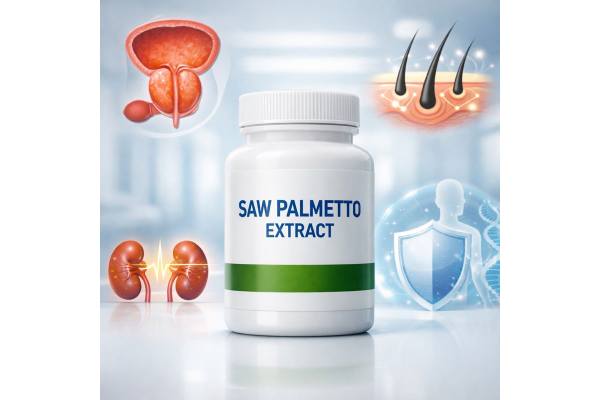
Saw palmetto extract is one of the most widely used herbal supplements for urinary problems in men, especially symptoms linked to an enlarged prostate. It is made from the berries of the low-growing Serenoa repens palm, native to the southeastern United States. Modern products usually contain a standardized oil rich in fatty acids and plant sterols, which are thought to act on hormones such as testosterone and dihydrotestosterone (DHT).
People most often take saw palmetto extract hoping to ease urinary frequency, weak flow, or nighttime urination, or as a “natural” option for benign prostatic hyperplasia (BPH). It also appears in many hair formulas marketed for androgenetic alopecia (pattern hair loss). However, the clinical evidence is mixed. Some studies show modest benefits, while larger trials and recent reviews suggest little or no meaningful effect for prostate symptoms. At the same time, saw palmetto is generally well tolerated, though it is not risk-free. This guide walks you through what is known, what remains uncertain, and how to use it as safely as possible.
Key Insights on Saw Palmetto Extract
- Standardized saw palmetto extract is mainly used for urinary symptoms from benign prostatic hyperplasia and for androgen related hair loss.
- Large, well designed trials suggest little or no meaningful improvement in prostate symptoms versus placebo, while smaller studies report modest benefits.
- Common supplemental doses range from 160–320 mg per day of standardized lipophilic extract, sometimes up to 640 mg under medical supervision.
- Mild digestive upset, headache, or dizziness can occur, and rare liver or pancreas problems have been reported, so monitoring is sensible.
- People who are pregnant, breastfeeding, under 18, or with hormone sensitive conditions or on blood thinners should avoid saw palmetto unless advised by a clinician.
Table of Contents
- What is saw palmetto extract used for?
- How does saw palmetto extract work in the body?
- Evidence based benefits of saw palmetto extract
- How to take saw palmetto extract and typical dosage
- Saw palmetto extract side effects and who should avoid it
- How to choose a quality saw palmetto supplement
What is saw palmetto extract used for?
Saw palmetto extract is an herbal preparation derived from the fat-soluble components of the Serenoa repens berry. Traditional use in North America focused on urinary discomfort, low libido, and general men’s health. Today, the main marketed uses are more specific: lower urinary tract symptoms related to benign prostatic hyperplasia and support for hair health in androgen related hair loss.
In the context of BPH, men may experience frequent urination, urgency, weak stream, difficulty starting, and waking multiple times at night to urinate. Saw palmetto extract is often sold as a gentler alternative to prescription drugs such as alpha-blockers or 5-alpha-reductase inhibitors. Many men are attracted to it because it is perceived as “natural” and might cause fewer sexual side effects than hormone-targeting medications.
Another growing use is in hair loss formulas. Because saw palmetto appears to influence DHT, a hormone that contributes to androgenetic alopecia, it is included in oral supplements and topical products. Some people also take it hoping to support overall hormonal balance, although this is a broad claim and not a well defined medical use.
Beyond prostate and hair, saw palmetto is sometimes promoted for pelvic discomfort, chronic prostatitis, or sexual function. Evidence for these uses is much weaker than for urinary symptoms, and in many cases it comes from small, open label studies rather than rigorous trials. It is important to recognize that regulatory agencies generally do not approve saw palmetto to treat disease; products are sold as dietary supplements, and quality can vary widely.
In short, saw palmetto extract is mainly used for:
- Lower urinary tract symptoms in adult men, especially those attributed to BPH.
- Hair shedding and density concerns in androgenetic alopecia.
- General “prostate support” and, less commonly, sexual health.
However, “used for” does not mean “proven to work,” and the next sections will separate traditional expectations from what the studies actually show.
How does saw palmetto extract work in the body?
Saw palmetto berries contain a mixture of free fatty acids (such as lauric, oleic, myristic, and palmitic acids), phytosterols (including beta-sitosterol), and other lipophilic compounds. Standardized extracts concentrate these components. Laboratory studies suggest several mechanisms that may explain its proposed effects on the prostate and hair.
The most discussed mechanism is inhibition of 5-alpha-reductase, the enzyme that converts testosterone into dihydrotestosterone (DHT). DHT plays a central role in prostate growth and in miniaturizing hair follicles in androgenetic alopecia. By partially blocking this enzyme, saw palmetto might lower local DHT activity in the prostate and scalp, theoretically easing urinary obstruction and slowing hair thinning. Unlike prescription drugs that strongly inhibit specific enzyme subtypes, saw palmetto appears to have weaker, broader effects.
Saw palmetto extracts also show anti-inflammatory activity in cell and animal models. Chronic low-grade inflammation contributes to prostate enlargement and irritative urinary symptoms. By dampening inflammatory signaling and reducing oxidative stress, saw palmetto might modestly improve tissue environment, even if it does not dramatically shrink the prostate.
Another proposed action is on smooth muscle tone. Some data suggest saw palmetto may relax smooth muscle in the bladder neck and prostate, similar in concept to alpha-blockers but likely less potent. This could slightly improve urine flow in some individuals.
Finally, there is evidence that saw palmetto interacts with androgen receptors and estrogen receptors, though these effects appear subtle compared with prescription hormones. For most users, changes in systemic hormone levels are small or undetectable, but sensitive assays may show modest shifts in DHT or related markers in some trials.
It is important to keep expectations realistic. Biochemical activity in a lab does not guarantee strong clinical benefit. The body’s endocrine system is complex, and a mild reduction in local DHT or inflammation may not translate into clear symptom relief for every person. This is exactly what large trials have found: interesting mechanisms but limited real-world impact for many men.
Evidence based benefits of saw palmetto extract
When saw palmetto first gained popularity, small and medium sized studies suggested it might reduce urinary symptoms and improve quality of life in men with BPH. Over time, more rigorous, longer, placebo controlled trials were carried out. These later studies, along with systematic reviews, have painted a more cautious picture.
For benign prostatic hyperplasia and lower urinary tract symptoms, a large randomized trial using a standardized extract at 320 mg per day for one year found that symptom scores and urine flow improved, but not more than in the placebo group. Participants in both groups felt somewhat better, which is common in chronic symptom studies, but there was no meaningful separation between saw palmetto and placebo.
Another trial escalated the dose to double and triple the usual amount over time, reaching 960 mg per day. Even at these high doses, men did not experience better urinary outcomes than those taking placebo. These results strongly suggest that simply increasing the amount of saw palmetto does not overcome its limited clinical effect in BPH.
Recent comprehensive reviews and meta-analyses, including an updated Cochrane review, conclude that saw palmetto monotherapy likely provides little or no improvement in urinary symptoms, maximum urine flow, or prostate size compared with placebo. Some analyses find tiny average benefits, but these are usually below the threshold that patients can clearly notice. Major urology guidelines therefore do not recommend saw palmetto as first-line treatment for BPH.
The picture is somewhat different for hair. Several recent trials have tested saw palmetto-containing supplements or oils in androgenetic alopecia. A 16-week randomized, placebo controlled study using standardized saw palmetto oil found a reduction in daily hair shedding and modest gains in hair density compared with placebo, with good tolerability. Other studies combining saw palmetto with nutrients or other botanicals also report improvements in hair density or patient-rated appearance, though it is hard to isolate the effect of saw palmetto alone in combination formulas.
Overall, evidence based takeaways are:
- For BPH-related urinary symptoms, saw palmetto extract has, at best, small average benefits that often do not differ from placebo in high quality trials.
- It does not appear to significantly shrink prostate volume or prevent disease progression.
- For androgenetic alopecia, early data suggest modest improvements in hair shedding and density in some people, but studies are relatively small and short-term.
- Benefits, when present, are generally milder than those seen with standard medications such as finasteride for hair or alpha-blockers and 5-alpha-reductase inhibitors for BPH.
Saw palmetto may still be reasonable for people who understand these limitations, value a plant based approach, and accept that effects may be subtle and take several months to evaluate.
How to take saw palmetto extract and typical dosage
Most clinical trials and commercial products use a lipophilic (fat soluble) extract of saw palmetto berries standardized to fatty acids, not raw powder. When people talk about “standard saw palmetto dosing,” they usually mean this type of extract, not teas or crude capsules.
For urinary symptoms and prostate support, the most common regimen in studies is 320 mg per day of standardized extract. This is typically taken as:
- 320 mg once daily with food, or
- 160 mg twice daily, morning and evening.
These doses aim to roughly match the preparations studied in BPH trials. Some products contain lower amounts, such as 80–160 mg per capsule, in which case you may need multiple capsules to reach the commonly used 320 mg total. A few clinical studies have used up to 640–960 mg per day, but higher doses have not clearly produced better outcomes, and such regimens should only be considered under medical supervision.
For hair health, dosing is less standardized. Many hair supplements use 160–320 mg of saw palmetto extract daily, often combined with nutrients like zinc, biotin, or other botanicals. The 16-week randomized study of standardized saw palmetto oil for androgenetic alopecia used daily oral supplementation together with a topical application, suggesting that combined systemic and local delivery might be more effective than either route alone. Because product designs vary widely, it is important to follow the manufacturer’s instructions and to discuss long term plans with a dermatologist or other clinician.
Practical tips for taking saw palmetto extract include:
- Take it with food to reduce the chance of digestive discomfort.
- Use products that clearly state the amount of extract per serving and the standardization (for example, 85–95% fatty acids).
- Give it time. For urinary symptoms or hair loss, most studies assess outcomes over at least 3–6 months.
- Do not stop prescribed medications for BPH, blood pressure, or other conditions without talking to your doctor. Saw palmetto is not a substitute for medical treatment.
People with multiple health conditions, those on complex medication regimens, and older adults should be particularly careful. Even though saw palmetto is sold over the counter, it can interact with drugs and might not be appropriate for everyone.
Saw palmetto extract side effects and who should avoid it
Saw palmetto extract is generally well tolerated in clinical trials, with side effect rates often similar to placebo. That does not mean it is entirely risk free. Understanding its safety profile helps you decide whether it is suitable in your situation and how to use it responsibly.
The most frequently reported side effects are mild and include:
- Digestive upset such as nausea, abdominal discomfort, or diarrhea.
- Headache or dizziness.
- Fatigue or a sense of lowered energy in a minority of users.
These effects are usually transient and improve when the supplement is taken with food or the dose is reduced. If symptoms persist or worsen, it is prudent to stop the product and consult a health professional.
Less commonly, there have been case reports of liver or pancreas inflammation in people taking saw palmetto. A direct cause is hard to prove from isolated reports, but they highlight the need for caution, particularly in individuals with existing liver disease, heavy alcohol use, or multiple medications that affect the liver. Unexplained fatigue, dark urine, pale stools, or yellowing of the skin or eyes while using saw palmetto warrants immediate medical evaluation.
Because saw palmetto acts on hormonal pathways, it may also:
- Slightly affect prostate specific antigen (PSA) levels in some men, potentially complicating prostate cancer screening.
- Influence hormone sensitive conditions, although robust data are limited.
For these reasons, several groups should avoid saw palmetto unless specifically advised otherwise by a clinician:
- People who are pregnant or breastfeeding, since hormonal effects may theoretically affect the fetus or infant and safety data are lacking.
- Children and adolescents, because of limited research and ongoing hormonal development.
- Individuals with hormone sensitive cancers or conditions (such as certain prostate, breast, or ovarian cancers) unless their oncologist agrees it is safe.
- People taking anticoagulant or antiplatelet drugs, or with bleeding disorders, since some data suggest possible effects on blood clotting.
Before starting saw palmetto, it is sensible to review all medications and supplements with your health care provider, especially if you take drugs for blood pressure, hormones, or chronic diseases. If you notice new urinary symptoms, blood in the urine, pelvic pain, or unintended weight loss, do not assume saw palmetto will solve the problem; these can be signs of serious conditions that need medical evaluation.
How to choose a quality saw palmetto supplement
Because saw palmetto extract is regulated as a dietary supplement rather than as a drug in many countries, product quality can vary significantly. Two bottles with “saw palmetto” on the label may differ in strength, purity, and even the type of plant material used. Choosing carefully can improve both safety and the chance of seeing any benefit.
First, look for standardized lipophilic extracts, not just “saw palmetto powder.” Most clinical research has been conducted with lipid extracts containing around 80–95% fatty acids and sterols. Labels should clearly state the amount of extract per serving and its standardization. If a product does not provide these details, it is harder to compare with research data.
Second, seek evidence of independent quality testing. This may include seals from third party organizations that test for identity, strength, and contaminants such as heavy metals, pesticides, and microbes. While no seal is a guarantee, third party verification is better than relying solely on a manufacturer’s claims.
Third, check the ingredient list carefully. Many “prostate support” or “hair complex” formulas combine saw palmetto with other herbs, minerals, or hormones. These extras can be useful in some cases but may also increase the risk of interactions or side effects. If you are on prescription medications, simpler formulations with fewer active ingredients are often easier to assess for safety.
A few practical points when comparing products:
- Avoid extreme marketing claims such as “cure,” “shrink your prostate in weeks,” or “stop baldness permanently.” These are not supported by evidence.
- Consider capsule versus softgel formats. Softgels may better preserve oil based extracts, though well made capsules can also be effective.
- Review the dose per serving and total daily amount. Make sure you are comfortable with the implied daily intake compared to commonly studied ranges (around 160–320 mg per day, unless your clinician suggests otherwise).
Finally, remember that supplement choice is only one part of the picture. Lifestyle factors such as fluid timing, caffeine and alcohol intake, weight management, and pelvic floor health can influence urinary symptoms. Likewise, for hair loss, managing stress, addressing nutritional deficiencies, and using evidence based topical treatments can make a significant difference.
Using saw palmetto as part of a broader plan developed with a health professional is more likely to be safe and realistic than relying on any single supplement to solve complex, long standing problems.
References
- Saw Palmetto: Usefulness and Safety | NCCIH 2024 (Guideline/Consumer Summary)
- Serenoa repens for the Treatment of Lower Urinary Tract Symptoms Due to Benign Prostatic Enlargement: An Updated Cochrane Review 2022 (Systematic Review)
- Saw palmetto for benign prostatic hyperplasia 2006 (RCT)
- Effect of increasing doses of saw palmetto extract on lower urinary tract symptoms: a randomized trial 2011 (RCT)
- Oral and Topical Administration of a Standardized Saw Palmetto Oil Reduces Hair Fall and Improves the Hair Growth in Androgenetic Alopecia Subjects – A 16-Week Randomized, Placebo-Controlled Study 2023 (RCT)
Disclaimer
The information in this article is for general educational purposes only and is not a substitute for professional medical advice, diagnosis, or treatment. Saw palmetto extract is not approved to diagnose, treat, cure, or prevent any disease, and research findings may not apply to every individual. Always speak with a qualified health care professional before starting, stopping, or changing any medication or supplement, especially if you have ongoing medical conditions, are pregnant or breastfeeding, or take prescription drugs. Never delay seeking or disregard medical advice because of something you have read here.
If you found this guide helpful, you are welcome to share it with others on Facebook, X (formerly Twitter), or any platform you prefer, and to follow our work on social media. Your support in sharing thoughtful, evidence based content helps our team continue to create reliable, high quality health information.