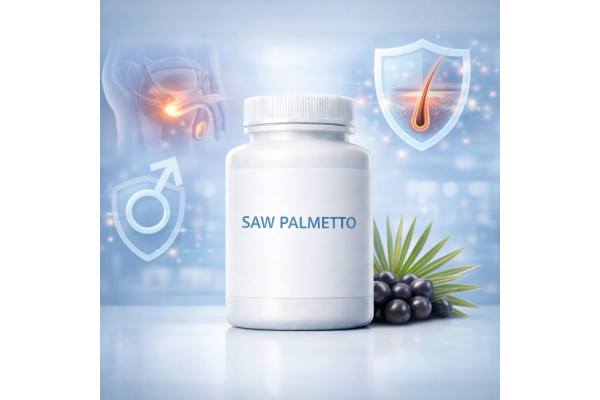
Saw palmetto (Serenoa repens) is a small palm native to the southeastern United States whose dark berries have been used for centuries for urinary and reproductive health. Today, saw palmetto is most often taken for benign prostatic hyperplasia (BPH), lower urinary tract symptoms (LUTS), and androgenetic alopecia (pattern hair loss). Modern extracts concentrate fatty acids and phytosterols that appear to reduce the activity of 5α-reductase, the enzyme that converts testosterone into dihydrotestosterone (DHT), and may also calm inflammation in prostate and scalp tissues.
However, research findings are mixed. Some standardized extracts show modest symptom relief in BPH, while large, high-quality trials and a recent Cochrane review report little to no benefit compared with placebo. Evidence for hair regrowth is promising but still limited, with many studies using multi-ingredient formulas. This guide walks through how saw palmetto works, what it may realistically do, how to take it safely, and who should avoid it.
Key Insights on Saw Palmetto
- Standardized saw palmetto extracts may modestly improve mild urinary symptoms and support hair density, but overall evidence is mixed and not first-line for BPH.
- Typical oral doses range from 160–320 mg per day of a standardized lipidosterolic extract providing about 70–95% fatty acids.
- Common side effects include mild digestive upset, headache, and fatigue; serious events are rare but have been reported.
- People who are pregnant or breastfeeding, have hormone-sensitive cancers, significant liver or pancreatic disease, or are on blood thinners should generally avoid saw palmetto unless a specialist recommends otherwise.
Table of Contents
- What is saw palmetto and where does it come from?
- How does saw palmetto work and does it really help?
- Key benefits of saw palmetto for prostate and hair
- How to take saw palmetto in practice
- How much saw palmetto per day?
- Side effects and safety of saw palmetto
- Who should use or avoid saw palmetto based on research?
What is saw palmetto and where does it come from?
Saw palmetto is a low-growing palm (Serenoa repens) that thrives in the sandy soils of the southeastern United States, especially Florida. The medicinal part is the ripe berry, which contains oils rich in free fatty acids (such as lauric, oleic, myristic, palmitic, and linoleic acids), phytosterols (β-sitosterol, campesterol, stigmasterol), and flavonoids. Modern supplements usually use a lipidosterolic extract of these berries rather than dried whole fruit, because most bioactive components are fat soluble.
Historically, Indigenous peoples in the region used the berries as both food and medicine for urinary issues, reproductive concerns, and general vitality. In the late 19th and early 20th centuries, saw palmetto appeared in American medical texts as a remedy for “prostatic hypertrophy” and various genitourinary complaints.
Today, saw palmetto is sold globally as a dietary supplement for:
- Men with mild lower urinary tract symptoms or early benign prostatic hyperplasia
- People with androgenetic alopecia or other hair-thinning patterns
- Occasionally, pelvic discomfort or overactive bladder symptoms
Not all saw palmetto products are equivalent. High-quality extracts are usually standardized to a specific fatty acid content (often around 70–95%). A 2025 pharmacognosy review highlights that quality control is a real concern: some commercial products contain little true Serenoa repens oil or are adulterated with cheaper plant or even animal fats, which may reduce efficacy and distort safety expectations.
For that reason, most clinical trials and regulatory monographs focus on standardized hexanic or supercritical CO₂ extracts with defined fatty acid and phytosterol profiles rather than raw berry powders or uncharacterized tinctures. When you read about benefits or dosages in research, they almost always refer to these standardized extracts, not generic “saw palmetto” in any form.
How does saw palmetto work and does it really help?
The most widely discussed mechanism of saw palmetto is its effect on androgen metabolism. Its fatty acids and phytosterols can inhibit both type 1 and type 2 isoforms of 5α-reductase, the enzyme that converts testosterone into dihydrotestosterone (DHT). DHT plays a central role in prostate enlargement and hair follicle miniaturization in androgenetic alopecia.
Experimental models suggest several additional actions:
- Anti-androgenic effects: Reduced binding of DHT to androgen receptors and altered local androgen metabolism in prostate tissue.
- Anti-inflammatory activity: Modulation of inflammatory mediators and possible reduction of chronic prostate inflammation, which can accompany LUTS.
- Anti-proliferative effects: Influences on cell-cycle and apoptotic pathways in prostate cells, potentially limiting excessive tissue growth.
A 2025 comprehensive review summarizes these biological mechanisms and notes that they likely act together rather than through a single pathway. It also emphasizes that standardized extracts rich in free fatty acids are the forms most consistently showing these effects in vitro and in animals.
But mechanisms do not guarantee clinical benefit. When researchers look at real-world outcomes, results differ by condition and product:
- For male lower urinary tract symptoms and BPH, a 2023 Cochrane review concluded that Serenoa repens alone provides little to no benefit versus placebo in key patient-important outcomes like symptom scores, quality of life, and urinary flow.
- Some earlier studies and meta-analyses, especially those focusing on hexanic extracts (such as Permixon®), reported modest improvements in symptom scores and peak flow similar to alpha-blockers in men with mild to moderate symptoms, but methodology and product heterogeneity limit firm conclusions.
- For hair loss, a 2020 systematic review in alopecia found that several small randomized trials and cohort studies using oral and topical saw palmetto–containing supplements reported improvements in hair quality, density, and hair count, but sample sizes were small and many products combined saw palmetto with other ingredients, making it hard to isolate its specific effect.
Overall, saw palmetto’s biological plausibility is strong, and some standardized extracts show clinically meaningful benefits in certain studies. Yet the highest-quality, most recent syntheses of evidence indicate that for BPH and LUTS, average benefits over placebo are small at best, and for hair loss, evidence is still preliminary.
Key benefits of saw palmetto for prostate and hair
Even with mixed evidence, there are several situations where saw palmetto may offer practical benefits, especially when expectations are realistic and products are carefully chosen.
Prostate and lower urinary tract symptoms
Potential benefits based on clinical trials and reviews include:
- Mild symptom relief in BPH: Some men experience modest reductions in international prostate symptom scores (IPSS) and slightly improved urinary flow, particularly with hexanic lipidosterolic extracts at 320 mg per day.
- Nocturia and frequency: A subset of trials report fewer night-time urinations and less daytime urgency, although these effects are often small and not universal.
- Female urinary symptoms: A 2022 randomized, double-blind trial in Japanese women found that 12 weeks of saw palmetto fruit extract improved a validated lower urinary tract symptom score, suggesting potential benefit beyond male BPH in certain urinary symptom profiles.
That said, the Cochrane review and related analyses stress that, on average, Serenoa repens monotherapy is unlikely to provide clinically important improvements for most men with moderate to severe LUTS. It may be most appropriate for:
- Mild symptoms where a person prefers a herbal approach
- Individuals not yet ready for prescription drugs or surgery
- Cases where other measures (weight loss, fluid timing, caffeine reduction) are already in place
Hair loss and scalp health
In hair loss, evidence is still evolving but includes:
- Androgenetic alopecia (male and female pattern hair loss): Clinical studies summarized in the 2020 systematic review showed improvements in overall hair quality, hair density, and hair count in some participants using oral doses of 100–320 mg/day and/or topical preparations.
- Telogen effluvium and perceived thinning: Some patients with diffuse shedding or subjective thinning reported improvement in hair quality and shedding rates when taking multi-ingredient formulas that included saw palmetto.
- Adjunct to other therapies: Because its mechanisms overlap partially with finasteride (a prescription 5α-reductase inhibitor), practitioners sometimes use saw palmetto alongside minoxidil, low-level laser therapy, and nutritional support.
Key limitations:
- Many hair studies are small, short-term, and use combinations of ingredients (e.g., cystine, vitamins, plant extracts), so saw palmetto’s individual contribution is uncertain.
- Effects, when present, tend to be modest; it is not a replacement for proven treatments such as minoxidil or oral finasteride.
Other potential benefits
Preclinical and limited clinical data suggest possible roles in:
- Reducing low-grade inflammation in the lower urinary tract
- Supporting comfort in overactive bladder or interstitial cystitis models
- Contributing antioxidant and anti-proliferative effects in prostate tissue
These areas remain exploratory and should not be considered established therapeutic indications.
How to take saw palmetto in practice
Saw palmetto is available in several forms, but only some match what has been studied in clinical trials.
Common supplement forms
- Standardized lipidosterolic extracts (softgels or capsules):
- Typically extracted with hexane or supercritical CO₂.
- Standardized to a specific fatty acid profile (often ≥70% fatty acids).
- Most trials in BPH and LUTS have used this form.
- Powdered whole berries or simple capsules:
- Less consistent fatty acid content.
- Little controlled clinical data; doses are harder to compare.
- Liquid extracts or tinctures:
- Composition depends on the solvent (e.g., alcohol, glycerin) and manufacturing process.
- Labels often do not specify fatty acid percentages.
- Topical products for hair:
- Shampoos, lotions, serums containing saw palmetto extract, sometimes along with caffeine, ketoconazole, peptides, or other botanicals.
For evidence-based use, look for standardized extracts specifying:
- The species (Serenoa repens or Sabal serrulata)
- Extraction type (hexanic, supercritical CO₂, etc.)
- Standardization (for example, “85–95% fatty acids”)
- Daily dose clearly matching clinical ranges (usually 160–320 mg per day)
Timing, food, and combinations
- With or without food:
- Many trials allowed dosing with meals, which can reduce digestive discomfort and may help absorption of fatty components. Taking with food is often reasonable.
- Once versus twice daily:
- Some studies used 160 mg twice daily; others used 320 mg once daily. Either schedule is commonly used; consistency is more important than exact timing.
- Stacking with other supplements:
- For prostate health, saw palmetto is often combined with nutrients such as zinc, lycopene, selenium, pumpkin seed extract, or stinging nettle.
- For hair loss, it frequently appears in blends with biotin, cystine, vitamins, and other botanicals.
- Combinations can be helpful but make it harder to understand which ingredient is doing what, and may raise the risk of interactions or over-supplementation.
Practical expectations and trial periods
- For urinary symptoms, a trial of around 3–6 months is reasonable to judge response with a standardized extract and good lifestyle measures (weight management, limiting fluids and caffeine before bedtime).
- For hair loss, improvements in density and quality typically take at least 6–12 months of continuous use, similar to other hair treatments.
- If there is no noticeable benefit after these time frames, continuing is less likely to help and should be reconsidered with a clinician.
Always keep your doctor informed, especially if you are also using prescription medications for prostate issues, blood pressure, hair loss, or hormone-related conditions.
How much saw palmetto per day?
Most dosing guidance comes from clinical trials and regulatory monographs that focus on standardized extracts rather than raw berries. Typical daily amounts differ slightly by intended use.
For benign prostatic hyperplasia and lower urinary tract symptoms
- Standard oral dose:
- 320 mg per day of a standardized lipidosterolic extract (often given as 160 mg twice daily or 320 mg once daily).
- Extract characteristics:
- Many well-studied products provide approximately 70–95% fatty acids and small amounts of phytosterols.
- Duration:
- Trials often last 3–12 months; some long-term observational data extend to several years without major safety concerns.
Even at this dose, the updated Cochrane review concludes that average benefits are small and may not reach a level that most men would consider clinically significant. As a result, this dose is best viewed as an optional adjunct for mild symptoms rather than a stand-alone treatment for moderate or severe BPH.
For hair loss and scalp support
- Oral doses used in studies:
- Common ranges are 100–320 mg per day of standardized extract, often as part of multi-ingredient supplements.
- Lower doses (around 100–200 mg/day) are more common in cosmetic-oriented products; 320 mg/day mirrors prostate protocols.
- Topical preparations:
- Concentrations vary widely (for example, 0.2–3.3% saw palmetto extract in lotions or shampoos).
- There is no standardized topical dose; studies often apply products once or twice daily.
Because most hair trials involve combination products, a flexible approach is used in practice. Many clinicians start with oral doses of 160–320 mg/day and adjust based on tolerance and concurrent treatments.
Other uses and maximum doses
- Upper intake levels:
- Clinical trials have safely used doses up to 960 mg/day for limited periods, but higher doses have not consistently improved outcomes.
- Regulatory monographs and safety reviews typically treat 320 mg/day as a standard long-term dose in adults.
- Titration:
- It is reasonable to start at the lower end (for example, 160 mg/day) and increase to 320 mg/day if well tolerated and if a stronger effect is desired, under medical supervision.
Children and adolescents generally should not use saw palmetto unless under specialist guidance, since its hormonal effects have not been well studied in younger people.
Side effects and safety of saw palmetto
Overall, saw palmetto has been considered well tolerated in most clinical studies, with side effects usually similar to placebo. However, that does not mean it is risk-free, and serious adverse events, while rare, have been reported.
Common, usually mild side effects
Across controlled trials and a dedicated systematic review of adverse events, the most frequently reported issues include:
- Digestive upset (abdominal discomfort, nausea, diarrhoea, constipation)
- Fatigue and headache
- Mild dizziness
- Decreased libido in some individuals
These events are generally infrequent, mild, and reversible when the supplement is reduced or stopped. Taking saw palmetto with food often lessens digestive symptoms.
Less common and serious events
Case reports and pharmacovigilance data have described:
- Bleeding-related problems: A few reports link saw palmetto use with increased bleeding, including intraoperative haemorrhage and changes in platelet function markers. Causality is not firmly established, but caution is advised in people on anticoagulants or antiplatelet drugs or those preparing for surgery.
- Pancreatitis: Several case reports describe acute pancreatitis in individuals taking saw palmetto, sometimes resolving after discontinuation. The absolute risk appears very low but may be higher in those with other risk factors.
- Liver function changes: Occasional abnormalities in liver tests have been observed in trials, though clear causation is uncertain.
The 2009 systematic safety review concluded that, overall, adverse events from Serenoa repens are mild, infrequent, and similar to placebo, with no strong evidence of systematic drug interactions. At the same time, it emphasizes the importance of better reporting and ongoing monitoring, particularly as use grows and as higher-dose or combination products become more common.
Drug interactions and laboratory tests
- Anticoagulants and antiplatelets:
- Because of bleeding case reports, many clinicians recommend caution or avoidance in people taking warfarin, direct oral anticoagulants, or strong antiplatelet drugs, or in those with bleeding disorders.
- Hormonal therapies:
- Its anti-androgenic action raises theoretical concerns in people on androgen deprivation therapy, hormone replacement therapy, or fertility treatments. In such settings, discuss use with the prescribing specialist.
- PSA testing:
- Unlike finasteride, saw palmetto does not consistently reduce prostate-specific antigen (PSA) values in clinical studies. Still, inform your clinician that you are taking it when interpreting PSA or other urological tests.
Stopping saw palmetto before planned surgery (for example, 1–2 weeks beforehand) is a common precaution, especially if other bleeding-risk medications are involved.
Who should use or avoid saw palmetto based on research?
Saw palmetto is not appropriate for everyone, and its realistic role is narrower than marketing might suggest. Thinking in terms of “good candidates,” “borderline situations,” and “should generally avoid” helps frame decisions.
Who may be reasonable candidates?
With appropriate medical oversight, saw palmetto may be considered for:
- Adults with mild lower urinary tract symptoms who:
- Prefer a herbal approach,
- Understand that evidence shows little to no average benefit over placebo, and
- Are already optimizing lifestyle measures (weight, fluid timing, caffeine and alcohol intake).
- Adults with early or mild androgenetic alopecia who:
- Are using or planning to use established treatments (for example, minoxidil) and wish to add a reasonably well-tolerated oral or topical adjunct.
- Individuals seeking a trial of complementary therapy for urinary comfort or hair quality, provided they accept small effect sizes and use a standardized, reputable product.
In these groups, saw palmetto should be one part of a broader plan that includes lifestyle, monitoring, and evidence-based conventional options where appropriate.
Who should be cautious or generally avoid it?
In the following situations, saw palmetto is usually not recommended unless a specialist explicitly approves and supervises its use:
- Pregnancy and breastfeeding:
- Because of its hormonal activity and lack of safety data, it should be avoided.
- Children and adolescents:
- Hormonal systems are still developing, and there is essentially no high-quality safety data in this age group.
- Hormone-sensitive cancers or conditions:
- People with breast, prostate, ovarian, uterine cancers, or undiagnosed abnormal bleeding should avoid saw palmetto unless advised otherwise by their oncologist or specialist.
- Known bleeding disorders or use of anticoagulants/antiplatelets:
- Given case reports involving bleeding and the availability of alternative options, most clinicians take a conservative approach and avoid saw palmetto in these patients.
- History of pancreatitis or significant liver disease:
- Case reports of pancreatitis and occasional liver test changes warrant caution.
How to integrate saw palmetto safely, if used
If you and your clinician decide to try saw palmetto:
- Confirm the indication and realistic goals (for example, “slight improvement in mild urinary symptoms,” not “avoid surgery entirely”).
- Choose a standardized product with clear labeling and third-party quality testing where possible.
- Document your baseline (symptom scores, urinary diaries, photographs of hair density, relevant lab tests).
- Reassess after 3–6 months and discontinue if there is no clear benefit or if adverse effects appear.
- Keep all health-care providers informed about your supplement use, particularly before surgery or when changing prescription medications.
Used in this structured way, saw palmetto can be evaluated transparently rather than taken indefinitely on the basis of marketing alone.
References
- Natural Hair Supplement: Friend or Foe? Saw Palmetto, a Systematic Review in Alopecia, 2020 (Systematic Review).
- Serenoa repens for the treatment of lower urinary tract symptoms due to benign prostatic enlargement, 2023 (Systematic Review and Cochrane Review).
- Beneficial Effects of Saw Palmetto Fruit Extract on Urinary Symptoms in Japanese Female Subjects by a Multicenter, Randomized, Double-Blind, Placebo-Controlled Study, 2022 (RCT).
- Serenoa repens (Saw Palmetto), 2009 (Systematic Review of Adverse Events).
- From Prostate Health to Hair Loss: A Comprehensive Review of Saw Palmetto’s Bioactive Compounds and Clinical Applications, 2025 (Narrative Review).
Disclaimer
The information in this article is for general educational purposes only and is not a substitute for personal medical advice, diagnosis, or treatment. Saw palmetto can affect hormones, interact with medications, and may not be safe for everyone. Always consult a qualified health-care professional before starting, changing, or stopping any supplement, especially if you have existing medical conditions, are pregnant or breastfeeding, are planning surgery, or take prescription medications. Never disregard professional medical advice or delay seeking it because of something you have read here.
If you found this guide helpful, you are welcome to share it with others on Facebook, X (formerly Twitter), or any platform you prefer, and to follow our work on social media. Your support in sharing our articles helps our team continue creating careful, evidence-based health content.