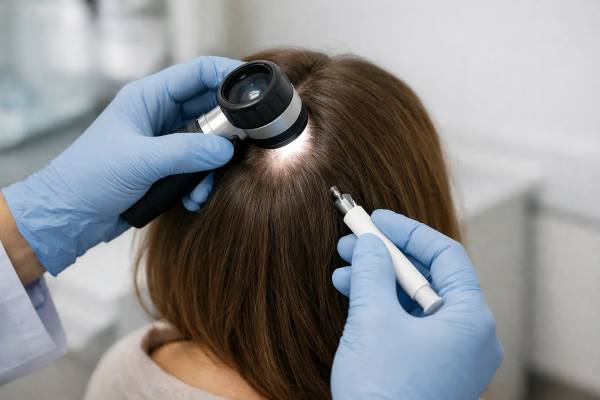
Hair loss is often diagnosed without cutting the skin at all. A careful history, scalp exam, trichoscopy, and targeted blood work can answer many cases. But there are moments when the picture stays blurry, and that is when a scalp biopsy becomes valuable. It is not a routine step for every person shedding hair. It is a focused test used when the diagnosis will change treatment, especially when scarring alopecia is on the table or when two very different causes can look deceptively similar.
For many patients, the idea sounds more alarming than it is. A scalp biopsy is usually a small punch sample taken under local anesthetic in the office. What matters most is not the size of the sample, but what it can reveal: whether follicles are still intact, whether inflammation is attacking them, whether scarring has begun, and which disease pattern best fits the tissue. Those answers can turn a vague hair-loss story into a much clearer plan.
Quick Summary
- A scalp biopsy is most useful when hair loss is atypical, rapidly progressive, inflamed, or suspicious for scarring alopecia.
- The test can help separate conditions that look similar on the surface but need very different treatment.
- Biopsy results often clarify whether follicles are miniaturizing, shedding, inflamed, or being permanently destroyed.
- The biggest limitation is sampling error, which means the biopsy has to be taken from the right spot to be meaningful.
- If your doctor recommends a biopsy, ask what diagnosis they are trying to confirm, where the sample will be taken from, and how the result will change treatment.
Table of Contents
- When a biopsy helps most
- What the procedure is like
- How doctors choose the spot
- Reading non-scarring biopsy results
- Reading scarring biopsy results
- Limits recovery and next steps
When a biopsy helps most
A scalp biopsy is rarely the first step for straightforward hair loss. In classic androgenetic hair loss, acute telogen effluvium after a trigger, or a textbook patch of alopecia areata, clinicians can often make the diagnosis from the story, examination, and trichoscopy alone. The reason to biopsy is not to “be extra sure” in every case. It is to answer a question that matters enough to change treatment.
Situations where biopsy becomes high value
A biopsy becomes much more useful when the scalp shows signs that suggest inflammation, follicle destruction, or diagnostic overlap. That includes:
- Loss of follicular openings.
- Scalp pain, burning, tenderness, or itching out of proportion to visible shedding.
- Perifollicular scale, redness, pustules, or crusting.
- Patchy hair loss with an unusual pattern.
- Progressive hair loss that is not behaving like routine shedding or pattern thinning.
- Treatment failure when the original diagnosis was uncertain.
This is why biopsy is often discussed sooner when there are features of inflammatory or cicatricial disease. In those settings, time matters because delayed diagnosis can mean delayed treatment, and delayed treatment can mean permanent follicle loss. That is especially true when someone has symptoms that fit a broader picture of hair loss that warrants specialist evaluation rather than routine cosmetic thinning.
Common diagnostic dilemmas
Many of the hardest cases live in the gray zone between look-alike conditions. A biopsy may help separate:
- Alopecia areata from trichotillomania.
- Chronic telogen effluvium from early patterned hair loss.
- Lichen planopilaris from discoid lupus erythematosus.
- Folliculitis decalvans from other pustular scalp disorders.
- Long-standing inflammatory hair loss from “just sensitive scalp.”
- Scarring alopecia from non-scarring patchy loss that has become chronic.
A biopsy can also be useful when the scalp looks clinically quiet but the history suggests something more aggressive has been happening underneath. That distinction matters because a quiet-looking scarred patch and a quiet-looking stable non-scarring patch do not carry the same treatment urgency.
When biopsy may not add much
There are also times when biopsy is unlikely to help. A very typical case of diffuse shedding after illness, childbirth, major stress, or rapid weight loss often does not need tissue confirmation. The same is true when the clinical picture strongly matches a known pattern and no inflammatory warning signs are present. In those cases, biopsy can add cost, discomfort, and scar risk without changing the plan.
So the right question is not “Should everyone with hair loss get a biopsy?” It is “Will this biopsy answer the key question in this case?” When that answer is yes, the test can be decisive.
What the procedure is like
For most patients, the procedure is simpler than the word biopsy suggests. A scalp biopsy is usually done in the office using local anesthetic. The clinician numbs a small area, then takes a circular sample of skin, most often with a 4 mm punch instrument. The sample is small, but if it is taken from the right place and processed correctly, it can yield a surprising amount of information about the follicles, the inflammatory pattern, and the chance of regrowth.
What happens on the day
A typical biopsy visit goes in a short sequence:
- The scalp is examined again, often with trichoscopy, to identify the most informative site.
- A small area is cleaned and numbed with local anesthetic.
- One or sometimes two punch samples are taken.
- The site may be closed with a stitch or two, depending on the location and physician preference.
- The sample is sent to the laboratory for sectioning and review.
The actual tissue sampling is brief. The part that requires the most judgment is not the punch itself. It is deciding where to biopsy, how many samples to take, and how the specimen should be processed.
One biopsy or two
In non-scarring alopecia, one punch biopsy may be enough, especially when the main question is hair-cycle shift, miniaturization, or a subtle inflammatory pattern. In suspected scarring alopecia, two biopsies are often preferred because different sectioning methods can reveal different clues. One specimen may be examined in horizontal sections to assess follicle counts, miniaturization, and relationships among follicles at different depths. Another may be examined vertically to evaluate the epidermis, interface change, deeper inflammation, and structures that help distinguish one scarring disorder from another.
In selected cases, direct immunofluorescence may be added, especially when lupus is part of the differential diagnosis.
Does it hurt and will it leave a scar
Most people feel the numbing injection more than the biopsy itself. Afterward, soreness is usually mild and brief, though the scalp can feel tender for a few days. A small scar is possible, because the test removes tissue. In practice, the mark is often hard to notice once surrounding hair grows around it, but scar visibility depends on hair density, healing tendencies, and biopsy location.
That tradeoff is worth understanding. The purpose of biopsy is not cosmetic. It is diagnostic clarity. If a small scar helps distinguish reversible shedding from permanent follicle destruction, the information may be far more valuable than the mark it leaves.
When results come back
Timing varies by laboratory and by whether special stains or immunofluorescence are requested. The most useful way to think about the report is not as a stand-alone answer sheet, but as one part of a bigger diagnostic puzzle that still needs to be matched to the scalp exam and clinical story.
How doctors choose the spot
In scalp biopsy, location is everything. A perfectly processed specimen from the wrong spot can be far less helpful than a modest specimen from the right one. This is one of the main reasons scalp biopsy has a reputation for being either highly informative or frustratingly nonspecific. The difference often begins before the punch ever touches the skin.
The basic rule
For suspected scarring alopecia, the biopsy should usually come from the active edge of disease, not the shiny bald center. The center may show only end-stage scar tissue with missing follicles, which confirms damage but may not reveal what caused it. The edge is more likely to still contain partially affected follicles, active inflammation, and disease-specific clues.
For non-scarring alopecia, the goal is different. The clinician often targets an active area where shedding or miniaturization is occurring, sometimes guided by a positive hair pull test or trichoscopic signs of active change.
Why trichoscopy helps
Modern scalp biopsy is often trichoscopy-guided. That matters because many important clues are too subtle to judge confidently with the naked eye alone. Trichoscopy can help identify:
- Perifollicular scale.
- Erythema around follicles.
- Broken hairs or black dots.
- Follicular tufting.
- Diameter diversity and miniaturization.
- Follicular dropout or loss of openings.
These signs help the physician pick tissue that still contains useful pathology. They also lower the odds of sampling a late, inactive area that only shows generic fibrosis or a normal-looking patch that misses the disease entirely. This is especially important in cases where the scalp has mixed features such as redness, scale, and thinning, or where the pattern raises concern for scalp inflammation linked to hair loss rather than simple pattern shedding.
Why the angle and depth matter
The punch is usually angled parallel to the direction of hair growth rather than pushed in straight down without regard to shaft angle. That helps avoid cutting follicles awkwardly and improves the chance of capturing the full follicle, including its deeper portions. The sample also needs to extend into the subcutaneous tissue so the bulb and lower follicle can be assessed. A shallow biopsy may miss some of the most useful information.
The timing issue
Timing matters too. A biopsy taken after months of uncontrolled inflammation, or after long exposure to treatments that mute the pattern, may be less specific. The same is true if the lesion is sampled long after it has burned out. In active disease, earlier biopsy often yields more informative tissue than waiting until all that remains is scar.
This is why good biopsy technique is really a chain of decisions: the right patient, the right time, the right place, the right angle, and the right processing. When any one of those steps goes wrong, the report becomes harder to interpret.
Reading non-scarring biopsy results
When a biopsy shows non-scarring alopecia, that is already meaningful. It means the follicles are still present, even if they are miniaturized, shifted into resting phase, inflamed, or cycling abnormally. In plain language, the architecture for regrowth still exists. The job then becomes identifying what pattern of non-scarring loss the tissue supports.
What pathologists look for
A pathology report for non-scarring alopecia often comments on features such as:
- Total follicle count.
- Terminal-to-vellus hair ratio.
- Anagen-to-telogen ratio.
- Miniaturization.
- Fibrous streamers or stelae.
- Peribulbar inflammation.
- Pigment casts or shaft damage.
- Sebaceous glands and perifollicular changes.
These details may sound technical, but they map closely to familiar diagnoses.
What different patterns can suggest
A report showing miniaturization with preserved follicle numbers often supports androgenetic hair loss. In that setting, the follicles are not disappearing early on; they are shrinking and producing thinner hairs over time. If the pathologist notes reduced terminal-to-vellus ratio and marked size variation, the tissue is leaning toward patterned thinning rather than simple shedding. That distinction can be especially useful when diffuse loss is hard to sort from early female pattern loss, which is why readers sometimes need a clearer primer on female pattern hair loss stages and treatment before a biopsy report makes sense.
Alopecia areata may show increased catagen and telogen hairs, miniaturization in chronic cases, and inflammation around the bulb in more active disease. Long-standing cases can look subtler than many people expect, which is one reason biopsy can help when patchy loss has an unusual course or does not behave like classic alopecia areata.
Trichotillomania may show distorted follicles, pigment casts, broken shafts, and hemorrhage around follicles, reflecting repeated physical injury rather than immune attack. Telogen effluvium, by contrast, tends to show a shift in hair cycling with increased telogen hairs but preserved follicle structure and no signature miniaturization pattern.
What “follicles preserved” really means
This is one of the most important interpretive points in the whole biopsy process. When the follicles are present, even if they are stressed, that usually means the process is potentially reversible or at least not yet permanently destructive. It does not guarantee full recovery, but it changes the tone of treatment planning. Therapies aimed at reducing inflammation, correcting triggers, or stimulating growth still have a biologic target to work with.
In other words, a non-scarring result is not just a label. It is often a statement about remaining potential.
Reading scarring biopsy results
A scarring biopsy result changes the conversation more than almost any other hair-loss finding. It means follicles are being destroyed and replaced by fibrous tissue, at least in the sampled area. That does not always mean every affected zone is beyond salvage, but it does mean the disease needs to be taken seriously and usually treated with the goal of halting progression rather than promising complete regrowth.
The first major distinction
Pathologists often classify primary scarring alopecias by the dominant inflammatory pattern:
- Lymphocytic.
- Neutrophilic.
- Mixed.
This classification is clinically useful because it narrows the differential diagnosis and points treatment in different directions.
Lymphocytic scarring alopecias include disorders such as lichen planopilaris, frontal fibrosing alopecia, and discoid lupus erythematosus. Neutrophilic scarring alopecias include conditions such as folliculitis decalvans and dissecting cellulitis. Mixed patterns can appear in overlap or later-stage disease.
What disease-specific clues may mean
In lichen planopilaris, the report may describe lichenoid or perifollicular lymphocytic inflammation, loss of sebaceous glands, perifollicular fibrosis, and damage centered around the upper follicle. That combination supports a diagnosis that often aligns with the clinical picture discussed in a guide to lichen planopilaris symptoms and diagnosis.
In discoid lupus erythematosus, the pathologist may note interface change, basement membrane thickening, follicular plugging, deeper periappendageal inflammation, dermal mucin, or supportive direct immunofluorescence findings. In folliculitis decalvans, neutrophils, follicular destruction, and tufted follicles may dominate. In central centrifugal cicatricial alopecia, perifollicular fibrosis and inflammation around vulnerable central scalp follicles are often part of the picture.
Why “active” versus “burned out” matters
Biopsy can sometimes show not only that scarring exists, but whether the process still looks active. Findings such as ongoing inflammatory infiltrate, perifollicular scale clinically, or incomplete follicular destruction can suggest there is still tissue worth protecting. End-stage scarring, by contrast, may show follicular dropout with dense fibrosis and very little inflammation, which can make exact classification harder.
This is why an early biopsy is often more informative than a late one. By the time the disease is fully burned out, the report may confirm permanent loss without clearly revealing the original culprit.
What scarring results do not always tell you
Even a good biopsy is not a promise machine. It can clarify the pattern and the urgency, but it may not perfectly predict how much hair will return. Once follicles are destroyed, regrowth from those specific follicles is not expected. The treatment goal becomes protecting the follicles that remain and reducing symptoms such as pain, burning, scale, or pustules before more permanent loss occurs.
Limits recovery and next steps
A scalp biopsy can be extremely helpful, but it is not infallible. Patients often imagine the result will come back like a lab test with a single bolded answer. Sometimes it does. Often it does not. The report may be highly specific, broadly supportive, or frustratingly nonspecific. That variability is not a sign that biopsy is useless. It reflects the fact that hair disorders change over time, overlap in appearance, and depend heavily on where and when tissue is sampled.
Why biopsies can be nondiagnostic
The most common reasons for a limited result include:
- The biopsy was taken from the wrong area.
- The disease was too inactive or too end-stage.
- Prior treatment altered the inflammatory pattern.
- The lesion was patchy and the sample missed the key pathology.
- The clinical information sent to the pathologist was incomplete.
This is why experienced clinicians and dermatopathologists often emphasize clinicopathologic correlation. The pathology report is strongest when it is read alongside the scalp exam, trichoscopy, symptom history, and evolution over time. A report that says “nonspecific scarring alopecia” may still be helpful if the clinical picture strongly points in one direction. A report that sounds precise may still need caution if the sampled site was suboptimal.
Recovery after the procedure
From the patient side, healing is usually straightforward. The area may feel sore or tight for a few days. Keeping the site clean and following the doctor’s wound instructions is usually enough. If stitches are placed, they are often removed after about one to two weeks, depending on the clinic and the scalp location. Most people can wash their hair again once their physician says it is safe, though they may need to avoid vigorous scrubbing right over the site at first.
Questions worth asking after the result
Once the report is back, these questions are often more useful than asking whether the biopsy was “good” or “bad”:
- Does this show scarring or non-scarring alopecia?
- Are follicles still present in a way that suggests regrowth potential?
- What diagnosis is most likely after combining the biopsy with the exam?
- Was the sample specific enough, or is there still uncertainty?
- How does this result change treatment now?
- Do I need photographs, trichoscopy follow-up, labs, or another biopsy later?
A biopsy is best understood as a decision-making tool. When it works well, it does not just name a disease. It sharpens urgency, refines prognosis, and makes treatment more rational. That is its real value.
References
- A Brief Review of Scalp Biopsy and its Interpretation 2025 (Review)
- Alopecias: Practical Tips for the Management of Biopsies and Main Diagnostic Clues for General Pathologists and Dermatopathologists 2023 (Review)
- Trichopathology of Cicatricial Alopecia 2025
- Scarring Alopecias: Pathology and an Update on Digital Developments 2021 (Review)
- A Three-Step Diagnostic Algorithm for Alopecia: Pattern Analysis in Trichoscopy 2025 (Review)
Disclaimer
This article is for educational purposes only and does not replace medical advice, diagnosis, or treatment. A scalp biopsy should be interpreted by a qualified clinician in the context of your symptoms, scalp examination, trichoscopy findings, medications, and medical history. Hair loss with scalp pain, burning, pustules, crusting, rapid spread, or visible loss of follicular openings deserves timely medical evaluation, especially because some scarring alopecias can cause permanent loss if treatment is delayed.
If this article helped you, please share it on Facebook, X, or another platform that your friends, family, or readers use most.