Rough, sandpapery bumps on the scalp can be surprisingly hard to name. Many people call them “scalp keratosis pilaris” because they resemble the tiny plugged follicles seen on the arms or thighs. Sometimes that description is directionally right. Sometimes it is not. On the scalp, rough follicular bumps can also come from buildup, irritation, seborrheic dermatitis, folliculitis, or less common inflammatory disorders that need very different treatment.
That is why this topic deserves a careful, practical explanation. Classic keratosis pilaris is a benign follicular keratin-plugging condition, but true scalp involvement is less typical than people assume. In hair-bearing skin, texture changes are often shaped by the scalp’s oil production, product residue, sweat, and microbial balance as much as by keratin buildup alone.
The good news is that many rough scalp bumps improve with a gentler routine, better product choices, and a more realistic treatment plan. The key is knowing what you are treating and when roughness is no longer just a cosmetic nuisance.
Core Points
- Rough scalp bumps often improve when you reduce friction, simplify products, and use a scalp-friendly keratolytic or softening treatment consistently.
- True keratin plugging is usually more of a texture problem than a serious scalp disease.
- Red, itchy, tender, or pus-filled bumps suggest a different diagnosis may be more likely than simple keratosis pilaris.
- Over-exfoliating the scalp can make roughness, stinging, and flaking worse instead of better.
- A practical starting plan is one gentle shampoo, one leave-on or rinse-off smoothing product, and at least 4 to 6 weeks of consistent use before judging results.
Table of Contents
- What scalp keratosis pilaris usually means
- How to recognize it and what can look similar
- Why rough bumps happen and what makes them worse
- Product tips that help without overdoing it
- When home care is not enough
- What results usually look like over time
What scalp keratosis pilaris usually means
The phrase “scalp keratosis pilaris” is useful, but it is also a little imprecise. Classic keratosis pilaris is a common follicular keratinization disorder. Tiny plugs of keratin build up at the opening of hair follicles, creating rough, dry, goosebump-like papules. On the body, that pattern is most familiar on the upper arms, thighs, buttocks, and sometimes the cheeks. On the scalp, the story is less straightforward.
In real life, people use this term for several different problems that all feel similar to the touch. Some truly are follicular keratin plugs. Others are rough scalp texture caused by scale, trapped sebum, stubborn product film, or a mild folliculitis. That matters because the scalp is not just “body skin with hair.” It has a denser follicle network, more oil gland activity, more sweat, more styling products, and more friction from washing, brushing, and hats.
Classic keratosis pilaris versus scalp-specific roughness
Classic keratosis pilaris is usually benign, chronic, and more textured than painful. If something similar shows up on the scalp, it often behaves the same way: small follicular bumps, rough feel, limited tenderness, and more cosmetic annoyance than true disease burden. But scalp skin changes live in a busier environment. That means even a mild keratin-plugging tendency can get mixed with:
- Dandruff-like scale.
- Low-grade folliculitis.
- Contact irritation from hair products.
- Sweat and occlusion.
- Over-cleansing or under-cleansing.
This is why many “KP scalp” cases are better understood as follicular roughness with a keratin component rather than a textbook standalone diagnosis.
Why hair loss changes the conversation
A second nuance is that ordinary keratosis pilaris does not usually cause major scalp hair loss. If rough bumps are paired with obvious thinning, scarring, eyebrow loss, or receding follicular openings, clinicians think beyond simple KP. Rare disorders in the broader keratosis pilaris atrophicans spectrum can involve the scalp and may be associated with scarring or atrophy. Those are not the same thing as the common arm-and-thigh version of KP.
That is the practical dividing line. Roughness alone is usually a texture and barrier issue. Roughness plus inflammatory change or hair loss deserves a more formal diagnosis.
A more useful way to think about it
Instead of asking, “Do I have scalp KP, yes or no?” it is often better to ask three questions:
- Are the bumps follicular and rough, or are they inflamed and sore?
- Is the problem mainly texture, or is there itch, scaling, and shedding too?
- Does the scalp still look healthy between the bumps, or are there signs of a more active disease?
That frame leads to better product choices and fewer false assumptions. It also prevents a common mistake: treating every rough scalp bump like harmless KP when the scalp may actually be showing early signs of something else.
How to recognize it and what can look similar
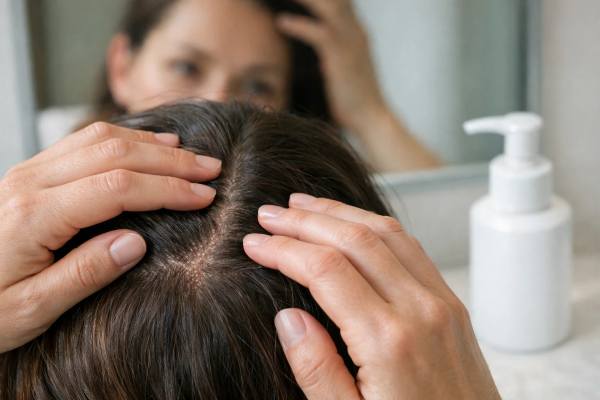
When rough bumps on the scalp are truly KP-like, they tend to be small, follicular, and fairly uniform. The skin may feel sandpapery or grainy when you run your fingers across it. The bumps are often more noticeable by touch than by sight, especially when hair covers them. They may be skin-colored, faintly pink, or slightly darker than the surrounding scalp, depending on skin tone and how much irritation is present.
Features that fit a KP-like pattern
A bump pattern is more likely to behave like scalp keratosis pilaris when it has several of these features:
- Tiny, rough follicular papules rather than large nodules.
- Minimal pain.
- Mild or no itch.
- Texture that worsens in dry weather.
- A history of KP on the arms, thighs, or cheeks.
- Roughness without obvious pus, crusting, or bleeding.
This kind of scalp texture is usually more frustrating than dangerous. It may catch on a comb, make the scalp feel uneven after washing, or become more noticeable when the scalp is dry.
The look-alikes matter more on the scalp
The scalp has many common conditions that imitate follicular roughness. The most important ones to separate from KP are:
- Folliculitis: Often more inflamed, itchy, tender, or pustular.
- Seborrheic dermatitis: More flaky, greasy, and redness-prone.
- Psoriasis: Often thicker, more sharply demarcated, and more scaly.
- Product buildup: Waxy, gritty, or film-like rather than true follicular papules.
- Contact dermatitis: Burning, stinging, patchy redness, or scaling after product exposure.
- Scarring alopecia: Usually accompanied by hair loss, inflammation, and progressive change.
This is why a reader who thinks they have “KP on the scalp” may actually need information on scalp folliculitis and inflamed bumps instead. The texture overlap is real, but the treatment pathway is not the same.
Clues that point away from simple KP
Some features should make you pause before assuming the bumps are harmless keratin plugs:
- Persistent itch strong enough to interrupt sleep.
- Tenderness or burning.
- Pus-filled spots.
- Thick yellow or greasy scale.
- Bleeding or crusting from scratching.
- Noticeable shedding or thinning around the bumps.
- Smooth shiny patches where follicles seem to disappear.
Another helpful comparison is dandruff. Dandruff and dry scalp can both create rough texture, but they usually feel more like loose or adherent scale than fixed follicular papules. If your main issue is flaking rather than bumps, it makes more sense to think through dry scalp versus dandruff differences before treating for KP.
The scalp is a place where mislabeling is easy. The safest rule is simple: if the bumps are quiet, dry, and stable, a KP-style routine is reasonable. If they are red, itchy, painful, or changing fast, widen the diagnosis.
Why rough bumps happen and what makes them worse
At the most basic level, keratosis pilaris is a disorder of follicular plugging. Keratin and dead skin collect at the opening of the hair follicle instead of shedding smoothly. On the scalp, that process does not happen in isolation. The follicle opening also has to deal with oil, sweat, microbes, styling residue, friction, and the mechanical stress of washing.
That combination explains why scalp roughness often seems to flare even when the underlying tendency has probably been there for a long time. The scalp can tip from “slightly grainy” to “clearly bumpy” when the local environment becomes less forgiving.
Common factors that worsen scalp bumpiness
Several patterns make follicular roughness more noticeable:
- Dry winter air or frequent hot showers.
- Harsh shampoos that strip the scalp barrier.
- Heavy pomades, waxes, and rich oils that trap scale around follicles.
- Infrequent washing in people prone to buildup.
- Aggressive scrubbing with brushes or fingernails.
- Repeated scalp exfoliation that creates irritation.
- Helmet, hat, or sweat occlusion.
- Underlying atopic or very dry skin.
This does not mean all scalp bumps come from “poor scalp hygiene.” That is too simplistic and often unfair. Some people wash often and still get a rough scalp because their skin barrier is reactive. Others wash infrequently and do well until product film starts to accumulate. The point is that the scalp is a balance problem, not a purity contest.
The barrier issue is easy to miss
One reason rough bumps linger is that the person tries to scrub them away. That feels logical, but it often backfires. The more the scalp is scrubbed, brushed, or peeled, the more irritated and dehydrated the surrounding skin becomes. Then the follicular roughness feels even sharper, and the urge to exfoliate harder increases.
This loop is especially common when people use acids designed for facial skin all over the scalp without adjusting for hair density, scalp sensitivity, or contact time. A helpful comparison is the broader problem of overdoing scalp exfoliation, where the treatment itself can become part of the irritation cycle.
Why scalp bumps are not always just “dry skin”
Dryness plays a role, but it is not the whole explanation. Some rough scalp bumps are worsened by oil and occlusion rather than lack of moisture. This is why a thick body cream that helps arm KP may feel terrible on the scalp. Product texture matters. A scalp may need keratin-softening plus barrier support, but in a lighter vehicle that does not mat hair or trap residue around follicles.
The most useful mindset is to treat scalp bumpiness as a follicular traffic problem. Keratin is one part of the traffic. Oil, product film, inflammation, and friction are the rest. When several of them improve together, the scalp usually feels smoother even if the tendency toward roughness never disappears completely.
Product tips that help without overdoing it
The best scalp routine for KP-like bumps is usually boring in the best sense of the word. It is steady, gentle, and specific. Most people do not need a seven-product scalp system. They need one cleanser that does not overstrip, one smoothing ingredient used consistently, and enough restraint to avoid turning mild roughness into inflamed irritation.
Start with the right product categories
For scalp bumpiness that seems keratin-driven, the most useful ingredients often fall into three groups:
- Softening humectant-keratolytics: urea and lactic acid.
- Exfoliating keratolytics: salicylic acid and glycolic acid.
- Prescription turnover regulators: retinoids in selected cases.
On the body, these often come as thick creams. On the scalp, vehicle matters just as much as ingredient choice. Better options are usually lightweight tonics, liquids, lotions, gels, foams, or rinse-off treatments that can reach the follicle opening without turning the hair greasy.
A simple starting routine
A reasonable first plan looks like this:
- Use a gentle shampoo on your normal wash schedule.
- Add one scalp-friendly smoothing product two or three times a week.
- Apply it mainly where the bumps are concentrated, not all over the hair if you do not need to.
- Increase slowly only if the scalp stays comfortable.
- Stop or scale back if stinging, flaking, or redness increases.
For people whose scalp feels both rough and dry, lighter urea-based care can be a smart first step, especially around exposed areas such as the part line or hairline. That is why some readers do well with guidance on urea for a dry and scaly scalp before moving to stronger acids.
How to avoid common product mistakes
The main product errors are predictable:
- Using a harsh scrub because the bumps feel “stuck.”
- Layering several acids at once.
- Applying rich body lotions through dense hair and then washing too infrequently.
- Switching products every few days before anything has time to work.
- Treating redness and burning as proof the product is “active.”
A mild tingling effect can happen with keratolytics. Persistent sting, rawness, or worsening flakes is a sign to back off.
When prescription products help
If over-the-counter care only partly smooths the bumps, a dermatologist may suggest a prescription keratolytic, retinoid, or short anti-inflammatory treatment depending on the diagnosis. This is more likely when the bumps are visibly inflamed, extend to the hairline or brows, or overlap with eczema, seborrheic dermatitis, or contact irritation.
One practical point matters more than people expect: consistency beats intensity. A scalp usually responds better to a moderate product used for six weeks than to an aggressive product used three times and then abandoned.
When home care is not enough
Many rough scalp bumps can be managed at home, but not all of them should be. The challenge is that scalp disorders often begin in a quiet, low-grade way and only later reveal what they really are. A person may think they have “KP bumps” for months when the scalp is actually showing folliculitis, psoriasis, allergic contact dermatitis, or a rarer follicular disorder.
Home care is reasonable when
A do-it-yourself routine is usually fair when the bumps are:
- Small and stable.
- Not painful.
- Only mildly itchy or not itchy at all.
- Not associated with shedding or thinning.
- Clearly better with gentler care.
- Limited to texture rather than active inflammation.
In that setting, the goal is symptom control, not a perfect scalp. Mild KP-like scalp texture often improves rather than disappears.
It is time to treat more actively when
A more formal treatment discussion makes sense when the bumps start to behave less like texture and more like disease. Seek evaluation if you notice:
- Pustules, drainage, or crusting.
- Burning or significant tenderness.
- Thick adherent scale.
- Patchy hair loss or widening thin areas around the bumps.
- Eyebrow or frontal hairline changes.
- Rapid spread or worsening despite a careful routine.
- Persistent symptoms after 4 to 8 weeks of sensible home care.
This is also where irritant and allergic reactions deserve attention. Some people are not dealing with KP at all. They are reacting to fragrance, essential oils, hair dye, leave-ins, or scalp serums. A person who develops redness, itch, flaking, or rough patches after new products may need a workup more consistent with scalp contact dermatitis than follicular keratin plugging.
Red flags that deserve a dermatologist
Certain signs justify earlier specialist input:
- Loss of visible follicular openings.
- Scarring, shiny patches, or permanent-looking thinning.
- Bumps that scar or leave pits.
- Symptoms around the hairline, brows, or lashes in a pattern that suggests a rarer keratinization disorder.
- A scalp that hurts more than it looks rough.
These are the moments when it is worth asking not only what the bumps are, but also whether the follicles are being damaged. If hair loss is entering the picture, a dermatologist visit becomes less optional and more strategic. That is especially true when you are unsure when itchy or irritated scalp symptoms cross the line from nuisance to diagnosis-worthy.
The central rule is simple: treat texture at home, but escalate when the scalp becomes inflamed, symptomatic, or linked to hair change.
What results usually look like over time
The most useful expectation for scalp keratosis pilaris is improvement, not cure. That may sound modest, but it is realistic. Follicular roughness tends to ebb and flow. It often gets better with the right routine, worsens in dry or irritating conditions, and returns if maintenance stops completely. The goal is not a permanently flawless scalp. It is a calmer scalp with fewer rough bumps, less temptation to pick or scrub, and better day-to-day comfort.
The timeline most people should expect
If the bumps truly are KP-like and the routine fits the scalp, improvement often looks like this:
- Less roughness after a few weeks.
- Fewer obvious plugs or grainy areas by weeks 4 to 6.
- A smoother feel and easier washing routine after 6 to 8 weeks.
- Ongoing maintenance rather than a one-time fix.
This gradual pace matters because many people stop too early. They expect the scalp to feel transformed after three applications, then abandon a routine that might have worked with steady use.
What counts as success
Success is often subtle at first:
- Your fingertips catch less on the scalp.
- The part line looks cleaner.
- There is less urge to scratch or pick.
- Hair products sit better because the scalp surface is less uneven.
- Redness and reactive flaking decrease.
That is real progress even if a few bumps remain. In chronic follicular conditions, reduced activity is often a more durable goal than total clearance.
Maintenance is part of the plan
Once the scalp is smoother, many people do best with a lighter maintenance schedule. That might mean using the smoothing product once or twice weekly instead of every wash, or reserving stronger treatments for dry seasons and flare-prone periods. The more aggressively a scalp was treated to get better, the more carefully maintenance usually needs to be calibrated.
This is also where overcorrection becomes a problem. People see improvement, become more aggressive, and recreate the irritation that made the scalp feel rough in the first place.
When the result is “not enough”
If the scalp still feels persistently gritty, itchy, or inflamed after a measured six- to eight-week routine, that is useful information. It may mean the diagnosis is incomplete, the product vehicle is wrong, or the problem is less about KP and more about folliculitis, dermatitis, or another inflammatory scalp condition. At that point, the smart next step is not usually more exfoliation. It is better diagnosis.
In the long run, the healthiest expectation is this: scalp KP-like roughness is usually manageable, often seasonal, and very responsive to routine quality. The scalp does best when you treat it like skin with follicles, not like a surface that needs to be scraped smooth.
References
- Keratosis Pilaris Unveiled: Insights into its Origin, Management Strategies and Research Frontiers 2025 (Review)
- Keratosis pilaris treatment paradigms: assessing effectiveness across modalities 2024 (Review)
- The Role of Malassezia in Nonscarring Scalp Folliculitis, The Disease Course, and the Treatment Responses: A Retrospective Case Series 2024 (Case Series)
- Scalp Infection, Inflammation, and Infestation 2023 (Review)
- Treatment of keratosis pilaris and its variants: a systematic review 2022 (Systematic Review)
Disclaimer
This article is for educational purposes only and is not a diagnosis or personal medical advice. Rough scalp bumps can come from several different conditions, including folliculitis, seborrheic dermatitis, contact dermatitis, psoriasis, and less common follicular disorders that may affect hair growth. If your scalp is painful, draining, rapidly worsening, or associated with thinning, eyebrow loss, or scarring, seek evaluation from a qualified clinician.
If you found this article useful, please share it on Facebook, X, or any other platform where it may help someone else make sense of a stubborn bumpy scalp.