Scalp oiling sits at an interesting crossroads between tradition, comfort, and modern hair care. For some people, it is a soothing pre-wash ritual that softens dryness, reduces friction, and makes the hair feel more manageable. For others, it quickly becomes a recipe for itch, buildup, folliculitis, or a stubborn flare of dandruff that seems worse than before. That split experience is not random. It reflects a simple truth: the scalp is not a blank canvas. It has its own oil production, barrier needs, microbes, and inflammatory tendencies, and those factors determine whether extra oil feels helpful or heavy.
That is why scalp oiling works best when it is approached selectively rather than romantically. The question is not whether oils are “good” or “bad.” It is whether a specific scalp actually benefits from added oil, whether the oil is being used on the scalp or only on the hair lengths, and whether the person is trying to moisturize, soften scale, reduce breakage, or solve a medical problem that oil cannot fix.
Key Takeaways
- Scalp oiling can help some dry, tight, or friction-prone scalps feel more comfortable, especially when used as a short pre-wash step.
- Some oils can help protect the hair shaft and reduce grooming-related damage, but that does not mean scalp oiling is a proven hair-growth treatment.
- Oiling can worsen dandruff, seborrheic dermatitis, scalp acne, or folliculitis in people who are already prone to those conditions.
- Essential oils and fragranced scalp oils are common irritants and should not be treated like harmless “natural” products.
- A practical starting point is a small amount of a simple carrier oil once weekly for 15 to 60 minutes before shampooing, then adjusting only if the scalp clearly tolerates it.
Table of Contents
- What scalp oiling can and cannot do
- Who may benefit most
- Who should be cautious or avoid it
- How to choose an oil and use it safely
- How to wash it out without causing buildup
- When to treat the scalp instead of oiling it
What scalp oiling can and cannot do
The most helpful way to think about scalp oiling is to separate scalp benefits from hair-shaft benefits. Those are not the same thing. Oils can reduce friction, improve slip, soften adherent dry scale, and make washing or detangling feel less harsh. Some oils, especially coconut oil, also have better evidence for helping the hair fiber itself by reducing protein loss during grooming. But that evidence mostly speaks to the hair shaft, not to the scalp as a disease site.
That distinction matters because many people oil the scalp hoping for one thing and actually get another. They want faster growth but mainly get softer lengths. They want relief from dandruff but instead trap more scale and sebum. They want to “nourish the roots” but are really just coating the skin surface.
What scalp oiling may do well
Used thoughtfully, scalp oiling may help with:
- Mild dryness or tightness of the scalp.
- Short-term comfort before washing.
- Softening loose dry flakes so they rinse out more easily.
- Reducing mechanical drag from washing and massaging.
- Supporting hair manageability when some oil reaches the roots and nearby hair.
For people with dry hair and a relatively calm scalp, this can be enough to make the routine feel worthwhile. The practice may also have a sensory benefit. A gentle massage with a modest amount of oil can feel relaxing, and that alone has value, as long as it does not create new irritation.
What scalp oiling does not reliably do
Scalp oiling is often over-credited. It does not have strong evidence as a primary treatment for:
- Androgenetic hair loss.
- Alopecia areata.
- Telogen effluvium.
- Seborrheic dermatitis.
- Scalp psoriasis.
- Folliculitis.
- Significant scalp inflammation.
It is also not a direct stand-in for a leave-in conditioner, serum, or scalp medication. Oils can occlude and soften, but they do not automatically hydrate the scalp in the same way a water-based moisturizer or a barrier-support product can. Nor do they correct the inflammatory or microbial drivers behind dandruff and itchy scalp disorders.
The practical bottom line
Scalp oiling is best understood as a supportive grooming tool, not a universal treatment. It can make some scalps feel less stripped and some hair feel less brittle, especially in a pre-wash routine. But once a person starts expecting it to solve inflammation, infection, or patterned hair loss, the practice usually becomes either disappointing or counterproductive.
That is also why it helps to separate scalp goals from hair goals. A person may benefit from oil on the mid-lengths and ends while doing better with very little oil on the actual scalp. In practice, that middle ground is often smarter than all-or-nothing advice.
Who may benefit most
Scalp oiling is not equally useful for everyone. The people who tend to do best are not those with the oiliest scalps or the most active scalp symptoms. They are the ones whose scalp is relatively calm but whose skin barrier or hair texture benefits from a little extra lubrication and a gentler wash process.
The best candidates
Scalp oiling may make the most sense for people with:
- Dry-feeling scalp without much itch or inflammation.
- Thick, curly, coily, or tightly textured hair that loses moisture easily.
- Hair that tangles or breaks during wash day.
- Scalp tightness during winter or in dry indoor climates.
- Chemically processed or heat-exposed hair that benefits from pre-wash protection.
- A routine that already includes frequent cleansing or clarifying.
These groups often have more to gain from reduced friction than from the oil itself. In other words, part of the benefit comes from making the wash less abrasive, not from “feeding” the scalp.
This is especially true for textured hair routines, where the scalp and the hair fiber can have very different needs at the same time. A person may have a scalp that is not particularly oily but hair that loses softness quickly and benefits from pre-shampoo emollients. That is one reason readers with textured hair often find the most useful guidance in a coily hair and scalp dryness guide, where lubrication and wash frequency are balanced more carefully.
When the scalp is dry but not diseased
A person with true scalp dryness often describes tightness, mild flaking, or discomfort after washing, especially with hot water, harsh surfactants, or cold weather. In that setting, a light oiling step before shampooing can act as a buffer. It may reduce how stripped the scalp feels afterward and make the scalp less reactive to cleansing.
That buffering effect is often more useful than long overnight oiling. A short pre-wash application gives some of the comfort without as much buildup risk.
Hair types matter more than trends
This is one place where social-media advice gets flattened too much. A scalp that sits under straight fine hair behaves differently from one under dense coily hair. Fine hair shows oil quickly and can look flat or unwashed faster. Dense textured hair may hide small amounts of oil better and benefit more from reduced wash friction. That does not mean one group “should” oil and the other should not. It means the margin for error differs.
A good fit feels boringly positive
When scalp oiling is a good fit, the signs are usually simple:
- Less post-wash tightness.
- Better comfort while cleansing.
- Less tangling near the roots.
- No increase in itch, bumps, or greasy residue.
- Hair that feels softer without the scalp feeling coated.
That kind of benefit is real, but it is also modest. Scalp oiling works best when it helps a little and quietly, not when it is expected to transform everything.
Who should be cautious or avoid it
Some scalps do not want more oil. That does not make them unhealthy. It simply means the scalp is already producing enough sebum, already struggling with an inflammatory scalp condition, or already reacting to occlusion in ways that extra oil tends to worsen.
The main groups that often do poorly
Scalp oiling deserves extra caution, or outright avoidance, in people with:
- Active dandruff or seborrheic dermatitis.
- Oily scalp that becomes greasy soon after washing.
- Scalp folliculitis or scalp acne.
- Malassezia-prone flaking or itch.
- Known fragrance or essential-oil sensitivity.
- Product buildup that already leaves the scalp coated or itchy.
- A history of contact dermatitis from hair products.
This is the group that often says, “Oiling makes my scalp feel good for an hour, then worse the next day.” That pattern is a clue. Short-term softness can be followed by more scale, more itch, or more follicular irritation if the scalp was not actually lacking oil in the first place.
Seborrheic dermatitis is one of the clearest examples. When dandruff-like flaking, greasy scale, and itch are driven by a mix of barrier dysfunction, inflammation, and Malassezia overgrowth, adding more oil is often the wrong move. That does not mean every oil immediately “feeds” scalp disease in a simple way, but it does mean people with active flaking and itch often respond better to an evidence-based seborrheic dermatitis treatment routine than to repeated oiling.
Folliculitis and scalp bumps
Oil can also be a bad match for a scalp that is already bumpy, pustular, or prone to clogged follicular openings. Occlusion and residue are not the only causes of folliculitis, but they can make a susceptible scalp less comfortable. A person with inflamed bumps around follicles often needs a different plan altogether, more in line with managing scalp folliculitis than with moisturizing the scalp.
Irritation is often the hidden issue
Many popular scalp oils are not just oils. They are blends packed with fragrance, essential oils, botanical extracts, and “stimulating” ingredients. These formulas may smell pleasant and feel tingly, but tingling is not proof that the scalp likes them. It can be the start of irritant dermatitis or contact allergy.
This is especially relevant for people with sensitive scalp, eczema-prone skin, or a history of reacting to hair dyes, leave-ins, or scalp serums. In those individuals, oiling can go wrong not because oil is inherently bad, but because the formula is too busy.
The simple rule
If your scalp is already shiny, itchy, flaky, bumpy, or inflamed, do not assume extra oil is the missing step. In many of those cases, it is more likely to be noise than help.
How to choose an oil and use it safely
If scalp oiling is going to work, the formula and the method matter as much as the decision to oil at all. The safest routine is usually simple: one basic carrier oil, a small amount, a short contact time, and gentle washing afterward. Most problems begin when people choose strong-smelling blends, apply too much, massage too aggressively, or leave the product on far longer than their scalp can comfortably handle.
Start with a plain carrier oil
For a first trial, simpler is better. A plain carrier oil is easier to judge than a blend with ten botanicals. Coconut oil is often discussed because it has some of the best hair-shaft data, especially for reducing protein loss. Jojoba, argan, and mineral oil are also common in hair care, though they behave differently in terms of weight, penetration, and feel.
The best beginner choice is not necessarily the trendiest one. It is the one least likely to confuse the scalp. That usually means no added fragrance, no menthol, no strong essential oils, and no vague “growth complex.”
Essential oils need more caution than most people think
Rosemary, peppermint, tea tree, and similar ingredients are often treated as harmless because they are plant-derived. In reality, essential oils are concentrated aromatic compounds and can irritate or sensitize the scalp, especially when used too often or without proper dilution. A person who already has an itchy or reactive scalp should be especially careful. The same logic applies to people who are trying to sort out whether they are dealing with allergy or simple irritation from hair products. In that setting, a guide to hair product allergy versus irritation is often more useful than adding another “natural” oil blend.
A practical way to use scalp oil
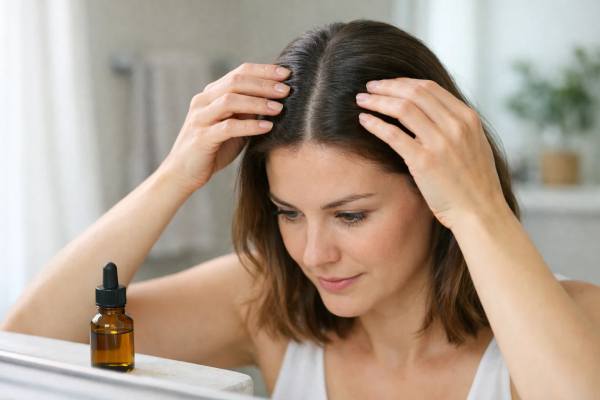
A safe starting method looks like this:
- Apply a small amount to the scalp in sections, not a heavy coating.
- Massage gently with fingertips for one or two minutes at most.
- Leave it on for 15 to 60 minutes before washing.
- Shampoo thoroughly.
- Wait several days before the next session so you can judge the response.
That short-contact approach is often enough. Overnight oiling is more likely to create transfer, buildup, occlusion, and next-day itch in people who are even slightly prone to scalp congestion.
Less is usually more
One of the most common errors is assuming that a dry-feeling scalp needs a saturated scalp. It usually does not. The scalp is small, warm, and already biologically active. It takes less oil than most people think to change how it feels. The goal is a light film, not a visible slick.
Another overlooked issue is the massage itself. Vigorous rubbing can create irritation, especially on sensitive or inflamed scalps. Gentle pressure helps. Aggressive stimulation does not.
How to wash it out without causing buildup
How you remove scalp oil often determines whether the practice feels helpful or turns into a cycle of residue and irritation. People understandably focus on the oil itself, but the wash-out step is where a lot of routines go wrong. Too little cleansing leaves the scalp coated. Too much cleansing leaves it stripped and reactive. The goal is not to erase every trace of oil with the harshest shampoo available. It is to clear the excess without starting a second problem.
The most common wash-out mistakes
These are the patterns that most often create trouble:
- Applying more oil than the shampoo can comfortably remove in one wash.
- Using a very mild cleanser after a very heavy oil treatment and assuming the scalp is “still moisturized” when it is actually coated.
- Scrubbing hard with nails to loosen residue.
- Repeating heavy oiling before the previous film has fully cleared.
- Compensating with overly harsh shampoo every time.
This is how people end up feeling greasy and dry at the same time. The scalp is coated in one sense and irritated in another.
A better wash strategy
For most people, one thorough shampoo is enough after a modest pre-wash oiling session. If the oil amount was heavy or the hair is dense, a second light cleanse may be useful. What matters is technique:
- Wet the scalp completely before shampooing.
- Emulsify the shampoo in the hands first.
- Focus on the scalp, not just the hair lengths.
- Rinse longer than you think you need to.
- Avoid piling on more leave-ins near the roots right afterward.
A person who oils frequently may also need an occasional reset wash to remove the residue that gentle shampoos do not fully clear. That does not mean clarifying every week by default. It means knowing how to use a clarifying shampoo strategically when buildup is starting to feel like part of the problem.
Signs that buildup is forming
A scalp may be getting too much oil or not getting cleansed well enough if you notice:
- Itch that worsens a day or two after oiling.
- Flattened roots with a coated feel.
- Recurrent small bumps near follicles.
- Greasy flakes that stick rather than rinse away.
- Shampoo that no longer seems to lather or cleanse evenly.
Those signs do not always mean “never oil again,” but they do mean the routine needs less oil, less frequency, or a cleaner wash-out.
The wash should match the scalp
A dry scalp with thick textured hair may tolerate richer pre-wash oiling and still do well with a gentle cleanser. A fine-haired oily scalp may need a far smaller amount of oil and much more restraint with frequency. The best routine is the one that leaves the scalp neutral after washing, not squeaky and not coated.
When to treat the scalp instead of oiling it
There is a point where scalp oiling stops being a care choice and starts becoming a distraction from the real issue. That point usually arrives when the scalp is symptomatic in ways that suggest inflammation, infection, or a diagnosed scalp disorder rather than simple dryness.
Signs the scalp needs treatment, not extra oil
You should think beyond oiling if the scalp has:
- Persistent itching.
- Greasy or yellow scale.
- Red patches.
- Burning or tenderness.
- Pustules or crusting.
- Noticeable shedding linked to scalp symptoms.
- Thick plaques or silvery scale.
- Symptoms that worsen after every oiling attempt.
At that stage, oil is not really addressing the cause. A scalp that itches, flakes, and burns may need antifungal shampoo, anti-inflammatory treatment, patch testing, or a dermatologist’s diagnosis. Even scalp dryness is not always what it seems. Some people with “dry scalp” are actually dealing with dandruff, seborrheic dermatitis, eczema, or irritation from product layering. That is why it often helps to step back and compare the picture to common itchy scalp causes and warning signs before adding more emollients.
Hair loss changes the threshold
If scalp symptoms are paired with hair loss, the bar for self-treatment should be lower. Oiling is not a serious diagnostic tool, and it can make some inflammatory hair-loss conditions harder to read by coating scale or delaying more appropriate care. Scalp pain, perifollicular redness, pustules, or loss of follicular openings should not be managed by repeated oiling experiments.
When a pause is smarter than persistence
One of the most useful decisions is to stop oiling when the scalp is clearly objecting. Signs that should prompt a pause include:
- More itch after oiling than before.
- New bumps or clogged-feeling roots.
- Hair that feels dirtier faster.
- Burning after application.
- Flakes that become thicker or stickier.
At that point, the scalp is giving feedback. Respecting it is usually more helpful than trying a different oil every week.
The best long-term mindset
Scalp oiling is optional. That is worth saying plainly. It can be comforting and useful for the right person, but it is not a requirement for scalp health and it is not evidence of a “better” routine. A healthy scalp is one that stays comfortable, clear, and stable with the least friction possible. For some people, oiling supports that goal. For others, avoiding scalp oil is exactly what supports it.
References
- A Comprehensive Review of Plant-Based Cosmetic Oils (Virgin Coconut Oil, Olive Oil, Argan Oil, and Jojoba Oil): Chemical and Biological Properties and Their Cosmeceutical Applications 2024 (Review)
- Hair Product Allergy: A Review of Epidemiology and Management 2024 (Review)
- Seborrheic Dermatitis Revisited: Pathophysiology, Diagnosis, and Emerging Therapies—A Narrative Review 2025 (Narrative Review)
- Scalp Microbiome Dynamics Can Contribute to the Clinical Effect of a Novel Antiseborrheic Dermatitis Shampoo Containing Patented Antifungal Actives: A Randomized Controlled Study 2025 (Randomized Controlled Study)
- Effect of mineral oil, sunflower oil, and coconut oil on prevention of hair damage 2003 (Seminal Experimental Study)
Disclaimer
This article is for educational purposes only and does not replace medical advice, diagnosis, or treatment. Scalp oiling is a grooming practice, not a medical therapy, and it can worsen some scalp conditions even when it helps others. If you have persistent itching, greasy or heavy scale, scalp pain, follicular bumps, drainage, or hair loss linked to scalp symptoms, seek evaluation from a qualified clinician rather than relying on oils alone.
If you found this article useful, please share it on Facebook, X, or another platform where it may help someone else make a more informed decision about scalp care.