The scalp is one of the easiest places to miss with sun protection and one of the easiest places to burn. A neat center part, a wider crown, a lace front, tightly defined braid rows, or thinning at the temples can leave narrow strips of skin exposed for hours without much notice. Hair helps, but it does not create full UV protection, and that protection drops as density, thickness, and pigment decrease. For people with visible scalp, the real challenge is not only remembering SPF. It is finding a format that works with the hairstyle instead of flattening it, whitening it, or making the roots look oily by noon.
That is why scalp sunscreen needs a more practical conversation than ordinary face or body SPF. The best option depends on where the scalp is exposed, how much hair is in the way, how often you can reapply, and whether your scalp is sensitive, flaky, or acne-prone. The right format is the one that protects visible scalp consistently enough to be realistic in real life.
Essential Insights
- Visible scalp at part lines, braid rows, the crown, and thinning areas needs sun protection just like any other exposed skin.
- Sprays and gels are often easier on hairy areas, while precise sticks and fluids work well on narrow exposed strips.
- Powder formats are convenient for touch-ups, but they are usually less reassuring than wetter first-layer formats for long outdoor exposure.
- Aerosol sprays can be hard to apply evenly and should not be inhaled or used near open flame.
- A practical routine is broad-spectrum SPF 30 or higher on exposed scalp, reapplied about every two hours outdoors and after sweating or swimming.
Table of Contents
- Why scalp SPF matters more than most people think
- Best formats for part lines and narrow parts
- Best formats for braids locs and protective styles
- Best formats for thinning hair and exposed crowns
- How to apply and reapply without making hair look worse
- Who should avoid certain formats and lean on hats
Why scalp SPF matters more than most people think
People usually remember sunscreen where they can feel the sun directly: nose, shoulders, chest, ears. The scalp is different. It often burns in thin strips, small islands, or widening zones rather than in one obvious sheet. That makes it easy to ignore until the evening shower stings. The part line, frontal hairline, braid rows, crown, and any area of reduced density are especially vulnerable because they behave like exposed skin, not like protected scalp. Hair does provide measurable UV shielding, but that protection varies with hair density, thickness, length, and color. Darker, denser hair protects better than sparse, light, or gray hair, and scalp exposure rises as hair miniaturizes or parts widen.
This matters for more than comfort. Repeated UV exposure raises the risk of sunburn, photoaging, and skin cancer, and the scalp is a well-known site for actinic damage and skin malignancy. In practice, the risk becomes more obvious as hair thins, especially at the crown and frontal scalp. That is one reason sun protection deserves to be part of routine counseling for visible scalp, not just an afterthought for beach days.
Why ordinary sunscreen advice often fails on the scalp
Most people already know the general rule: use broad-spectrum SPF and reapply. The problem is that scalp application is mechanically awkward. Lotions can separate sections and flatten roots. Thick mineral creams can leave a white trail through dark hair. Aerosols feel convenient but are easy to underapply. Powders are cosmetically elegant but easy to treat like makeup instead of real SPF. That is why scalp sunscreen is less about “the best sunscreen” and more about format matching.
A second issue is that the scalp is a hybrid site. It is skin, but it is also a hair-bearing surface with oil, sweat, styling products, and friction. A formula that feels beautiful on the cheeks can be a disaster at the root. A format that works beautifully on a shaved scalp can be clumsy inside dense braids. General sunscreen guidance helps, but scalp success comes from choosing the format that can actually reach exposed skin and stay tolerable long enough to be repeated. A broader guide to protecting the scalp from sun damage is useful here because hats, shade, and SPF nearly always work better together than any one measure alone.
The key principle
The scalp does not need the prettiest sunscreen. It needs the one you can place accurately on visible skin. That usually means choosing by pattern of exposure:
- Narrow exposed strip: precise format.
- Multiple thin rows: spreadable liquid or mist.
- Large exposed crown: faster, wetter coverage.
- Sensitive scalp: simpler, lower-fragrance formula.
That is the logic behind every good scalp SPF routine. Once the exposed skin pattern is clear, the right format becomes much easier to choose.
Best formats for part lines and narrow parts
A part line is the easiest scalp zone to overlook because it feels small. In reality, a crisp center or side part can receive direct sun for hours, especially around midday and in cars, on walks, or at outdoor events. This is the setting where precision matters more than speed. You are not trying to coat an entire scalp. You are trying to protect a thin ribbon of visible skin without making the surrounding hair look greasy or dusty.
The strongest first-layer options
For part lines, the best first-layer formats are usually lightweight fluids, thin lotions, narrow-nozzle liquids, and sticks. Each has a different advantage.
- Fluids and thin lotions spread evenly and are easier to control with fingertips.
- Narrow applicator liquids or serums can be dotted directly into the line and tapped in.
- Sticks are useful when the part is crisp and straight, especially near the front hairline, because they place product exactly where you want it.
This is one of the few scalp situations where a traditional skin sunscreen can work very well, as long as the formula is lightweight enough not to separate the hair too heavily. A precise mineral or hybrid stick can also be useful on short, exposed parts, though darker hair may show residue if the formula is chalky.
Where powders and sprays fit
Brush-on powders are often attractive for part lines because they reduce shine and do not wet the roots. The problem is reassurance. Real-world sunscreen performance depends heavily on applying enough product, and dry formats make that harder to judge. For that reason, powders tend to work best as touch-up formats rather than as the only layer before a long sunny afternoon.
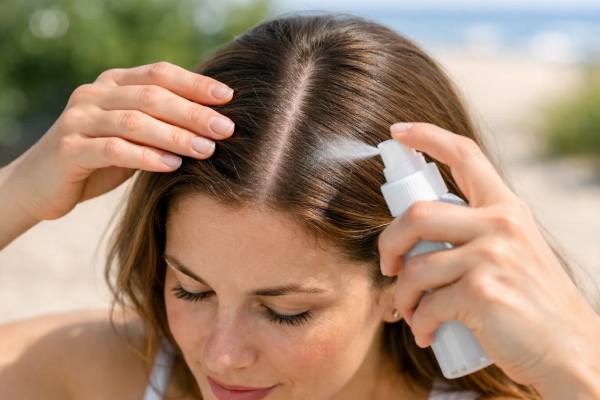
Sprays can work on part lines, but they are less precise. The more targeted approach is to spray onto fingertips first, then press into the line, rather than fogging the entire head and hoping enough landed on the skin. This also lowers the odds of inhalation and wasted product.
The best choice by hair look
A useful shortcut is to pick by finish:
- If you want the least visible product, start with a fluid.
- If your scalp is sensitive, choose fragrance-free and simpler active systems.
- If your roots already get oily fast, avoid thick creams.
- If you need fast touch-ups between meetings or errands, powder can be the second step, not the only step.
This is also where visible irritation matters. A clean part that stings after fragranced SPF is not “just normal sunscreen tingle.” It may point toward product sensitivity, especially in people already prone to fragrance-related scalp irritation. On the scalp, elegance matters, but tolerability matters more.
Best formats for braids locs and protective styles
Braids, locs, twists, cornrows, and other protective styles create a different sunscreen problem. The scalp may be covered overall, but the exposed sections can be long, repeated, and sharply defined. A center part is one line. Cornrows can create ten or twenty. Add a visible hairline and temple exposure, and the surface area becomes more meaningful than it first appears.
What usually works best
In these styles, the strongest practical formats are lightweight sprays, mists, thin liquids, and some scalp serums with sunscreen filters. The reason is reach. These formats can travel down braid lanes or along scalp rows without demanding that you rub a cream between tightly styled sections.
A good rule is:
- Multiple exposed rows: spray or liquid.
- Hairline and edges: stick or fluid.
- Small touch-up at midday: powder if it does not cake at the roots.
This is also one of the few times when the cosmetic elegance of a spray matters a lot. Dense braids can hide a little moisture but do not hide white cast well, especially along dark scalp lines. Lightweight invisible formats are often more realistic here than thicker mineral creams.
The limits of sprays
Convenience should not hide the tradeoff. Sprays are fast, but fast is not the same as thorough. For braid rows, this means you should not simply wave the can over the style from a distance. Hold the rows open if needed, spray close enough to wet the exposed skin, and press the product into the line with fingertips or the pad of a sponge if you need better contact.
Why braid wearers need to think about the hairline too
Protective styles often shift attention to the rows, but the hairline is frequently the real high-risk strip because it stays exposed, catches angled sunlight, and is often already vulnerable from styling tension. Someone with repeated braid styles may therefore need a two-format routine: a spray for the rows and a precise stick or fluid for the front margin. That is especially relevant when the edges are thinning or the hairline is under chronic stress, a pattern that overlaps with braid-related hairline protection rather than sun care alone.
Better expectations for style wearers
Scalp SPF inside braids does not need to look perfect. It needs to reach skin. That often means accepting a slight damp phase after application or a brief touch-up ritual before leaving the house. The best braid sunscreen is the one that can be laid down row by row without forcing a style redo, because a product that technically protects but practically ruins the hairstyle is unlikely to be used again.
Best formats for thinning hair and exposed crowns
Thinning hair changes scalp sunscreen strategy because the exposed area is often larger, less regular, and more visible in bright light. A narrow part line can be handled with precision. A thinning crown or diffuse top scalp usually needs broader coverage with a formula that will not make the hair look flatter and sparser than it already does.
What tends to work best on thinning areas
For visible scalp through fine or thinning hair, the most useful formats are usually gels, lightweight sprays, transparent fluids, and fast-drying hybrids. Gels are especially helpful on hairy areas such as the scalp because they can thread through strands without the same heavy separation that thicker creams create.
For a truly exposed bald spot or closely shaved area, the equation changes. Once the scalp behaves more like ordinary skin than hair-bearing skin, lotions and creams become more reliable again because you can spread enough product evenly and verify the film more easily.
Why thinning hair needs cosmetic realism
People with crown thinning are often reluctant to use scalp SPF because the wrong formula makes the problem look worse. Heavy oils, rich lotions, and some pasty mineral products can reduce lift, darken the scalp with shine, and make gaps between hairs look larger. This is one reason broad advice like “just use your regular facial sunscreen” often fails in practice. It may be medically acceptable and cosmetically impossible.
A better way to choose is to decide what you most want to avoid:
- If you hate shine, avoid oily lotions.
- If you hate white cast, avoid thick untinted mineral products on dark hair.
- If you hate wet roots, use faster-drying fluids or gels.
- If you need reapplication in public, keep a touch-up option that does not announce itself.
This matters at the crown, where people are often already sensitive about visibility. A person dealing with thinning at the crown usually needs a scalp sunscreen that protects without visually magnifying the thinning.
Hair color also changes the experience
Hair itself is a natural UV barrier, but its protection is not constant. Greater density, thickness, and melanin all improve shielding. That helps explain why gray, light, or sparse hair often exposes the scalp more functionally than darker, denser hair, even before full balding occurs.
The working rule
If the scalp is mostly visible, treat it more like skin.
If the scalp is visible through hair, choose a format designed to navigate hair.
That is the simplest way to keep the routine practical. The crown needs coverage you can actually spread, not just a theoretical SPF number printed on a bottle that never gets used.
How to apply and reapply without making hair look worse
Application is where most scalp sunscreen routines quietly fail. The product may be good, the SPF may be adequate, and the person may be fully convinced. But if the scalp is only misted lightly, applied in a rush, or never reapplied, the real protection falls short of the label. Real-world protection depends heavily on amount, spread, and repeat use.
The simplest way to get better coverage
A practical scalp sequence looks like this:
- Identify the exposed skin first.
- Apply to skin, not just to hair.
- Use enough product to visibly wet or coat the exposed strip.
- Press or tap into place if the format allows.
- Reapply about every two hours when outdoors, and sooner after sweating or swimming.
For sprays, the safest mindset is to assume you used too little unless the scalp actually looks coated. On the scalp, “rub in” often means pressing carefully with fingertips along the line rather than disrupting the hairstyle.
Reapplication by hairstyle
Different styles need different reapplication habits:
- Part line: reopen the same line and reapply precisely.
- Braids and rows: retrace the exposed lanes instead of fogging the whole head.
- Thinning crown: apply in a wider zone than seems necessary, because light hits from angles.
- Shaved or very sparse scalp: reapply like any other exposed skin, more generously than you think.
This is also where powders earn their place. They are not the most reassuring first coat for a long pool day, but they can be very helpful as midday maintenance when roots are already styled and a wet product would be socially or cosmetically annoying.
Mistakes that make scalp SPF feel useless
A few errors cause most disappointment:
- Using too little because you fear greasy hair.
- Spraying from too far away.
- Applying only once on a high-sweat day.
- Forgetting the back part, crown swirl, or edge rows.
- Choosing a formula so cosmetically heavy that you stop using it.
This is why physical protection should stay in the conversation. A hat, scarf, or other cover can reduce how much sunscreen performance you need from an awkward surface. On high UV days, or when you know reapplication will be unrealistic, a plan that combines SPF with a hat is usually stronger than either alone.
Who should avoid certain formats and lean on hats
Not every scalp tolerates every sunscreen format. In fact, scalp sensitivity is one of the main reasons people stop trying. A sunscreen that would be perfectly fine on the shoulders can feel terrible on a flaky, acne-prone, irritated, or freshly treated scalp.
People who should be more selective
Extra caution makes sense if you have:
- Active scalp dermatitis or marked itching.
- Scalp acne or folliculitis.
- Recent sunburn, scratching, or barrier damage.
- A history of fragrance allergy or product stinging.
- Freshly colored or chemically irritated scalp.
- Post-procedure scalp, unless your clinician has given specific instructions.
In these settings, the scalp may react more to vehicle and fragrance than to the sunscreen filters themselves. Alcohol-heavy sprays may sting. Strong fragrance can linger and irritate. Thick occlusive products can worsen follicular bumps. When the scalp is already inflamed, the wrong SPF format can turn a sun-protection habit into an irritation cycle.
When hats are the smarter first move
A hat is not a failure of sunscreen. Sometimes it is the better tool. Hats become especially useful when:
- The scalp is too irritated for repeated product application.
- The hairstyle makes even coverage unrealistic.
- Outdoor exposure will be long and sweaty.
- The person is on a boat, beach, hike, or sports field where reapplication is unlikely.
- Large areas of scalp are exposed and lotion-like application would be easier than hair-compatible application.
This is also true for people dealing with scalp conditions that already require medicated care. If the scalp is burning, flaking heavily, or showing signs of actual sunburn, the next step is not experimenting with more SPF textures. It is protecting the area physically and managing the condition directly. A companion guide to scalp sunburn symptoms and prevention is often more useful after the damage has already happened.
The most realistic closing rule
Choose the lowest-friction solution that you will repeat. For some people, that is a gel or fluid on the part every morning. For others, it is a spray along braid rows plus a hat at midday. For very sensitive scalps, it may be mostly hats and limited direct exposure, with sunscreen only on the most exposed strips.
That is the right standard for scalp SPF: not trendiness, not complexity, and not perfect aesthetics. Just reliable protection for the scalp that is actually visible.
References
- Practical Recommendations for Indians on Sunscreen Use—A Modified Delphi Consensus by Indian Sunscreen Forum (PRISM‐ISF) 2025 (Consensus)
- Sunscreens: A narrative review 2024 (Narrative Review)
- Human Hair as a Natural Sun Protection Agent: A Quantitative Study 2015 (Seminal Study)
- Assessment of the photoprotection properties of hair cosmetics using the hemispherical directional reflectance method 2023
- Sunscreen FAQs 2025 (Professional Guidance)
Disclaimer
This article is for educational purposes only and does not replace personal medical advice. Scalp sunscreen helps protect exposed scalp skin from UV damage, but it is not a treatment for scalp disease, hair loss, or inflamed scalp conditions. If you have repeated scalp sunburn, persistent scalp tenderness, new crusted or bleeding spots, severe irritation from sunscreen, or hair loss with scalp symptoms, seek evaluation from a qualified clinician.
If this article helped you, please share it on Facebook, X, or another platform where it might help someone protect an often-forgotten area more consistently.