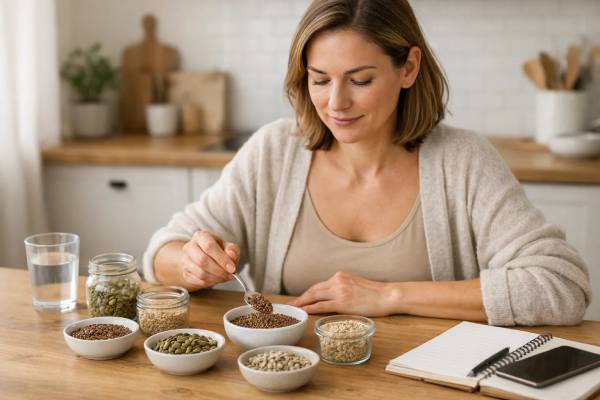
Seed cycling has become one of the most shared food-based ideas in hormone health. The promise is appealing: rotate flax, pumpkin, sesame, and sunflower seeds with the phases of the menstrual cycle, and you may support estrogen balance, improve progesterone function, ease PMS, and encourage more regular periods. It sounds simple, inexpensive, and natural, which helps explain why so many people are curious about it.
The challenge is that popular enthusiasm has moved faster than the science. Seeds are genuinely nutritious foods. They contain fiber, healthy fats, lignans, vitamin E, zinc, selenium, and other compounds linked to metabolic and reproductive health. But that does not automatically prove that eating specific seeds in specific cycle phases changes hormones in a predictable way.
That leaves many readers with a practical question: is seed cycling a helpful ritual, an evidence-based strategy, or mostly a wellness trend with a plausible story behind it? The best answer sits in the middle. It may help some people, but the reasons are probably less dramatic than social media suggests.
Core Points
- Seed cycling may help some people build a steadier, more nutrient-dense eating pattern, which can indirectly support menstrual health.
- The direct evidence for phase-based seed rotation improving hormones, PMS, or cycle regularity is still limited and mixed.
- Flax, sesame, pumpkin, and sunflower seeds can be healthy foods, but they are not a substitute for diagnosis when periods are irregular or symptoms are severe.
- Start with a simple, consistent routine for 2 to 3 cycles rather than changing multiple supplements and habits at once.
- Ground seeds are usually easier to digest and absorb, but portions should stay realistic to avoid stomach upset and excess calories.
Table of Contents
- What Seed Cycling Is
- Why People Think It Works
- What the Evidence Really Shows
- PMS and Cycle Regularity
- How to Try It Safely
- When to Seek More Help
What Seed Cycling Is
Seed cycling is a food routine built around the idea that the menstrual cycle has two different nutritional needs. In the most common version, people eat flax and pumpkin seeds during the follicular phase, then switch to sesame and sunflower seeds during the luteal phase. The follicular phase begins on day 1 of bleeding and lasts until ovulation. The luteal phase begins after ovulation and continues until the next period. If you are still learning that timing, a simple overview of luteal phase timing and cycle phases can make the method easier to follow.
A typical plan looks like this:
- Days 1 to 14: 1 tablespoon ground flaxseed and 1 tablespoon pumpkin seeds daily
- Days 15 to 28: 1 tablespoon sesame seeds and 1 tablespoon sunflower seeds daily
Some people adjust the dates based on their own ovulation pattern instead of using day 14 as a fixed switch point. Others with irregular cycles, amenorrhea, or perimenopausal cycle changes use the first and second halves of the calendar month instead. Some versions follow moon phases. That makes the practice flexible, but it also shows one of its weaknesses: there is no single standardized protocol that has been thoroughly tested in large human trials.
The appeal is easy to understand. Seed cycling feels manageable. It asks for a small daily food change rather than a prescription or a major diet overhaul. It also fits a broader desire to work with the menstrual cycle rather than ignoring it. For people who feel dismissed when they bring up PMS, irregular bleeding, or hormone-related symptoms, the method can feel empowering.
Still, it helps to separate the food pattern from the claims attached to it. Eating more seeds is not the same thing as proving phase-specific hormone regulation. Seeds can support general health because they offer fiber, unsaturated fats, minerals, and plant compounds. That part is not controversial. The more specific claim is that flax and pumpkin meaningfully support the follicular phase, while sesame and sunflower specifically support the luteal phase in a way that changes estrogen and progesterone balance enough to improve symptoms. That is a much stronger claim, and it deserves stronger evidence than lifestyle content usually provides.
In practice, seed cycling is best understood as a structured nutrition habit built around menstrual timing. Whether that structure creates unique hormonal effects beyond simply eating more seeds is the real question, and that is where the science becomes more cautious than the marketing.
Why People Think It Works
The theory behind seed cycling is not random. It comes from real nutritional features of the seeds involved. Flax and sesame seeds contain lignans, a type of phytoestrogen. Pumpkin seeds provide zinc and healthy fats. Sunflower seeds are rich in vitamin E and selenium. All four contribute fiber, minerals, and plant compounds that support metabolic health. The argument is that these nutrients, eaten in the right phase, may help the body handle estrogen and progesterone more smoothly.
The most common explanations sound like this:
- Flax and sesame may influence estrogen metabolism because their lignans can interact with estrogen-related pathways.
- Pumpkin seeds may support ovulation because zinc is important for reproductive hormone signaling.
- Sunflower seeds may support the luteal phase because vitamin E and selenium are linked to antioxidant function and reproductive health.
- Fiber may help with hormone metabolism by supporting gut health and regular elimination.
Each of those ideas has at least some biological plausibility. The body does not run on one hormone at a time, and nutrient status can affect hormone production, signaling, inflammation, insulin sensitivity, and ovulatory function. That makes it reasonable to think food could matter. It also explains why the seed cycling story sounds convincing. It connects recognizable nutrients with specific cycle phases.
But plausible does not mean proven. Hormone regulation is not like pressing four separate buttons. Estrogen levels are not simply “fixed” by flax, and progesterone does not rise on command because sunflower seeds appear in a smoothie. Nutrients work within a much larger system that includes energy intake, body fat, insulin signaling, thyroid status, sleep, stress, exercise, gut health, medications, and whether ovulation is happening at all.
This is where seed cycling often gets oversold. A person may hear that sesame “boosts progesterone” or flax “clears excess estrogen,” when the evidence is actually more indirect and much less predictable. In real life, one person’s PMS may be driven more by sleep disruption and high stress, while another’s irregular cycle is related to weight change, under-fueling, PCOS, or thyroid dysfunction. Seeds may still be a helpful addition, but they are rarely the central missing piece.
There is also a more grounded explanation for why some people feel better on seed cycling: the practice often improves the overall diet. People who adopt it may eat fewer ultra-processed snacks, more fiber, more healthy fats, more minerals, and more consistent meals. That alone can influence energy, bowel regularity, satiety, blood sugar stability, and inflammation. In other words, the benefit may come less from precise phase matching and more from the fact that the person started eating a better-quality diet every day.
That does not make the practice useless. It just means the most credible mechanism may be broader nutritional support rather than a precise hormonal switch flipped by the calendar.
What the Evidence Really Shows
This is the part many articles skip. The direct evidence for seed cycling is still limited. There are small clinical studies, a growing number of reviews, and one recent systematic review focused on seed cycling and related seed-based interventions. Together, they suggest possible benefits for menstrual regularity, PMS symptoms, and some hormone markers in certain groups, especially women with PCOS. But they do not prove that the standard seed cycling protocol works consistently across broad populations.
There are several reasons for that caution.
First, many studies are small. Small studies can be useful for generating ideas, but they are more vulnerable to bias, chance findings, and exaggerated effects. Second, the interventions are not always the same. Some studies use the full seed cycling protocol. Others study flaxseed alone or sesame alone. Some combine seeds with portion control, general diet change, or broader lifestyle advice. That makes it hard to know what caused the result.
Third, the outcomes vary. One study may look at menstrual regularity. Another may focus on weight, insulin, or lipid markers in PCOS. Another may track symptom severity. These are not interchangeable outcomes. Even if one area improves, it does not necessarily mean the protocol “balances hormones” in the sweeping way people often claim.
A more specific issue is that the best evidence for nutrition and PMS does not point uniquely to seed cycling. Broader reviews of dietary interventions suggest that some nutrients and eating patterns may help menstrual symptoms, but the evidence is inconsistent. Calcium, zinc, vitamin B6, and some targeted interventions appear more supported than phase-based seed rotation itself. That matters, because it suggests the research base is stronger for selected nutrients than for the exact seed cycling method.
Flaxseed deserves special mention because it is the most studied of the four seeds. Older human research suggested flax might affect aspects of the menstrual cycle, including luteal phase length in some normally cycling women. Newer meta-analytic work, however, did not find a clear overall effect of flaxseed supplementation on sex hormone profiles in adults. That does not mean flax has no value. It means the hormonal story is more nuanced than simple online claims imply.
The fairest summary is this:
- Seed cycling has a plausible rationale
- Some early and small studies are encouraging
- Direct evidence remains limited and heterogeneous
- The strongest nutrition evidence for PMS does not specifically validate seed cycling as a protocol
- Benefits may come from better overall diet quality as much as from phase-specific timing
That middle ground is important. It is too dismissive to say seed cycling is nonsense, because the foods themselves are nutritious and the early evidence is not empty. It is also too confident to say it has been proven to regulate estrogen, raise progesterone, or normalize cycles in a reliable way. Right now, it is better understood as a low-risk, potentially helpful dietary practice that still needs stronger trials before bigger promises are justified. That is especially relevant when readers are trying to sort out everyday PMS from more disruptive conditions such as PMS compared with PMDD.
PMS and Cycle Regularity
When people ask whether seed cycling helps, they usually mean one of two things. They want fewer PMS symptoms, or they want a more predictable cycle. Those are related goals, but they are not the same problem.
For PMS, seed cycling may help some people indirectly. Seeds add fiber, magnesium-containing foods, healthy fats, and micronutrients that can support steadier energy, fuller meals, and a less processed diet overall. That can matter when PMS symptoms are worsened by blood sugar swings, constipation, inflammation, or a low-quality dietary pattern. Some people also find that a structured daily ritual helps them stay more consistent with meals, hydration, and symptom tracking, which can reduce the sense of unpredictability that often makes PMS feel worse.
What seed cycling is less likely to do is act like a fast hormone treatment. If someone has severe mood changes, disabling cramps, marked breast tenderness, migraines, or symptoms that strongly suggest PMDD, seeds alone are unlikely to be enough. In that situation, the real issue may involve ovulation-related sensitivity, neurotransmitter changes, or a need for targeted treatment rather than a food tweak.
Cycle regularity is even more complex. A predictable cycle depends on ovulation and on coordinated signaling between the brain, ovaries, thyroid, adrenal system, insulin pathways, and overall energy availability. That means irregular periods can happen for many reasons:
- PCOS
- Thyroid disease
- Under-eating or overtraining
- Rapid weight loss
- Higher body weight with insulin resistance
- Stress
- Perimenopause
- Hyperprolactinemia
- Pregnancy
A food routine may support general health, but it cannot reliably correct all of those drivers. This is why seed cycling should never become a substitute for evaluating common causes of irregular periods. If cycles are very long, very short, absent, unusually heavy, or changing sharply, the smartest next step is not just switching seeds on day 15.
That said, there is a realistic best-case use for seed cycling. It may serve as an adjunct for someone with mild PMS, inconsistent food habits, or subtle cycle irregularity who wants a structured, food-first experiment. In that setting, a person may notice less bloating, steadier appetite, slightly less breast tenderness, or a sense that their cycle becomes more predictable over time. Those improvements may be real even if the mechanism is broader than “this seed raises this hormone.”
The key is to judge the practice by real outcomes rather than by promises. If symptoms improve after two or three cycles, that is useful information. If nothing changes, that is useful too. The goal is not to defend the trend. It is to learn whether the routine adds value in your actual body and symptom pattern.
How to Try It Safely
If you want to try seed cycling, the safest and most useful approach is simple, consistent, and realistic. You do not need a perfect wellness routine, a list of expensive powders, or five new supplements layered on top. In fact, changing too many things at once makes it harder to know what helped.
A practical starting plan is:
- Use the traditional two-phase method for two to three cycles
- Keep the dose modest, such as 1 tablespoon of each recommended seed per day
- Choose ground flax and, if easier on digestion, lightly ground or well-chewed other seeds
- Add them to meals you already eat, such as yogurt, oats, soup, salads, or smoothies
- Track symptoms, bleeding pattern, bowel changes, and energy rather than looking for instant hormone shifts
Ground flax is often preferred because whole flaxseed may pass through the gut with limited breakdown. Sesame, pumpkin, and sunflower seeds can be eaten whole, but some people tolerate them better when ground or mixed into softer foods. Store ground seeds in the refrigerator or freezer so their oils stay fresh longer.
It also helps to keep expectations realistic. Give the routine enough time to settle in, but do not assume every change is a hormone miracle. A smoother appetite pattern, easier bowel movements, or fewer snack cravings may be the first noticeable benefit. Those effects still matter.
There are a few safety points to keep in mind:
- Increase fiber gradually if you are not used to seeds
- Drink enough water to avoid bloating or constipation
- Watch for seed allergies
- Be careful with large portions if you have digestive conditions that flare with high fiber
- Consider total calorie intake if you are already eating very energy-dense snacks
Seeds are foods, not benign for everyone in unlimited amounts. Some people feel gassy or overly full when they jump from almost no fiber to several tablespoons a day. Others do better splitting the amount between breakfast and lunch rather than taking it all at once. If you already take multiple products for hormone symptoms, it may also be wise to review supplement safety and interactions so that seed cycling does not become part of an overly complicated regimen.
For people without regular periods, some seed cycling guides suggest using the new moon to full moon and full moon to new moon as a substitute rhythm. That can be a harmless organizing tool, but it is not evidence-based. If you are not cycling regularly, the bigger priority is understanding why.
The most useful mindset is to treat seed cycling as a structured food experiment, not a diagnosis and not a cure. Keep the plan simple, track what changes, and let outcomes matter more than theory.
When to Seek More Help
Seed cycling is reasonable as a low-risk self-care strategy for mild symptoms, but there are clear situations where it should not be the main plan. The biggest red flag is relying on it while a significant medical issue goes unaddressed.
You should look beyond seed cycling if you have:
- Cycles that are consistently longer than 35 days or shorter than 21 days
- No period for 3 months or longer when not pregnant
- Very heavy bleeding, large clots, or bleeding that causes dizziness or fatigue
- Severe PMS or mood symptoms that disrupt work, school, or relationships
- Significant acne, facial hair growth, scalp hair thinning, or rapid weight changes
- Infertility concerns
- Suspected eating disorder, under-fueling, or compulsive exercise
- Symptoms of thyroid dysfunction, high prolactin, or early perimenopause
In these cases, seed cycling may still be part of the nutrition picture, but it should not delay proper evaluation. Food cannot diagnose PCOS, rule out thyroid disease, correct iron deficiency, or explain amenorrhea after a major weight change. It also cannot replace mental health support when premenstrual mood symptoms become severe.
Another sign to step back is when the practice starts increasing food anxiety. Some people become preoccupied with switching seeds on the exact right day, fear “doing it wrong,” or interpret every symptom as evidence of hormonal failure. That mindset can turn a simple habit into unnecessary stress. A helpful nutrition practice should make life easier, not narrower.
There is also a difference between “not harmful” and “enough.” Even if seed cycling is safe for you, it may simply be too small an intervention for the problem you are dealing with. A person with true PMDD, marked insulin resistance, hypothalamic amenorrhea, or significant thyroid dysfunction usually needs a broader plan. The same goes for someone who has already tried nutrition changes with no meaningful improvement.
If your symptoms are persistent, confusing, or progressive, that is the moment to consider specialist evaluation for hormone-related symptoms. An endocrinologist, gynecologist, or qualified clinician can help determine whether the main issue is ovulation, thyroid function, insulin signaling, prolactin, stress physiology, or something else entirely.
The best bottom line is this: seed cycling can be a reasonable add-on, but it should stay in proportion. It is a food practice, not a shortcut around diagnosis. Used thoughtfully, it may support symptom tracking and improve diet quality. Used as a stand-in for medical care, it can keep people stuck in a loop of trial and error when they actually need answers.
References
- Efficacy of Seed Cycling as an Integrative Therapy for Premenstrual Syndrome and Polycystic Ovary Syndrome in Reproductive-Aged Women: A Systematic Review 2025 (Systematic Review). ([PMC][1])
- The effect of flaxseed supplementation on sex hormone profile in adults: a systematic review and meta-analysis 2023 (Systematic Review and Meta-Analysis). ([PMC][2])
- Effect of flax seed ingestion on the menstrual cycle 1993 (Randomized Cross-Over Trial). ([PubMed][3])
- Nutritional practices to manage menstrual cycle related symptoms: a systematic review 2024 (Systematic Review). ([PubMed][4])
- Effect of nutritional interventions on the psychological symptoms of premenstrual syndrome in women of reproductive age: a systematic review of randomized controlled trials 2025 (Systematic Review). ([PubMed][5])
Disclaimer
This article is for educational purposes only and is not medical advice. Seed cycling may be a reasonable food-based practice for some people, but menstrual changes, severe PMS, missed periods, infertility, or signs of hormone imbalance should be assessed in clinical context. Do not use seed cycling as a substitute for evaluation of persistent symptoms, and do not delay care for heavy bleeding, severe mood symptoms, suspected pregnancy, or sudden cycle changes. If you have allergies, digestive disease, a history of disordered eating, or you take medications or supplements that affect hormones, review any major diet change with a qualified clinician.
If this article helped you sort through the claims around seed cycling, consider sharing it on Facebook, X, or another platform where clear, balanced hormone health information can help someone else.