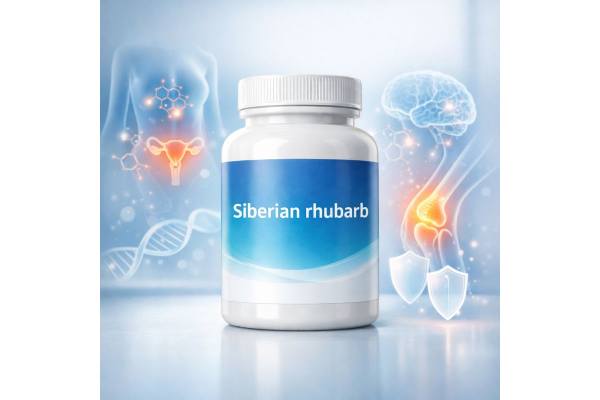
Siberian rhubarb, often labeled as ERr 731, is a standardized extract from the roots of Rheum rhaponticum used mainly to ease perimenopausal and menopausal symptoms. Unlike classic hormone replacement therapy (HRT), this botanical acts in a more targeted way on estrogen receptor beta, which may explain its benefits for hot flashes, mood, and sleep while keeping endometrial effects relatively low.
Over the last two decades, clinical trials and long-term observational studies have followed hundreds of women taking small daily doses (often just 4 mg of extract) for months to years. Many report substantial relief from vasomotor symptoms, improved quality of life, and good tolerability. At the same time, Siberian rhubarb is not a “gentle herbal tea” – it is a pharmacologically active extract that can interact with hormone-sensitive conditions and other treatments.
This guide walks you through what Siberian rhubarb is, how it appears to work, key benefits and uses, practical dosage guidance, safety considerations, and what the evidence actually shows so you can discuss it with your healthcare professional in an informed way.
Key Insights on Siberian rhubarb
- Standardized Siberian rhubarb extract (ERr 731) is a non-hormonal, estrogen receptor beta–selective botanical used mainly for perimenopausal and menopausal symptoms such as hot flashes, mood changes, and sleep disturbance.
- Clinical studies suggest meaningful symptom reduction over 4–12 weeks, but long-term safety and individual responses still vary, so medical supervision is important.
- Typical studied doses are 4 mg per day of standardized ERr 731 extract, sometimes increased to 4–8 mg per day depending on product and response.
- People who are pregnant, breastfeeding, under 18, or with a history of estrogen-dependent cancers or unexplained vaginal bleeding should avoid Siberian rhubarb unless a specialist explicitly recommends it.
Table of Contents
- What is Siberian rhubarb extract?
- How Siberian rhubarb may ease menopause symptoms
- How much Siberian rhubarb to take daily
- How to use Siberian rhubarb safely in daily life
- Side effects, risks, and who should avoid it
- What the research says about Siberian rhubarb
What is Siberian rhubarb extract?
Siberian rhubarb extract, often listed on labels as ERr 731, is a standardized preparation derived from the roots of Rheum rhaponticum (sometimes called rhapontic rhubarb). It is not the same species as the culinary rhubarb used in pies, and it is not the laxative “rhubarb” used in some traditional formulas. Instead, it comes from a medicinal root that has been used in Europe for women’s health for decades.
The extract is standardized to a group of compounds called hydroxystilbenes (including rhaponticin and rhapontigenin). These are structurally related to other plant polyphenols such as resveratrol. Laboratory and animal studies suggest that ERr 731 behaves like a selective estrogen receptor modulator (SERM) that binds preferentially to estrogen receptor beta rather than alpha. This selectivity is important, because activation of estrogen receptor alpha is more closely linked to proliferation of breast and uterine tissue, while receptor beta is often associated with regulatory and protective effects in the brain, vessels, and bones.
Commercial Siberian rhubarb products typically contain a small amount of extract per tablet, often 4 mg of standardized ERr 731. That sounds tiny compared with other herbal supplements measured in hundreds of milligrams, but the extract is highly concentrated and pharmacologically active at low doses. In most clinical trials, women took one tablet once daily.
It is also important to distinguish ERr 731 from non-standardized “rhubarb” supplements. Those may derive from different species, contain different active constituents (including more anthraquinones, which are laxative), and have not necessarily been studied in menopause. When considering Siberian rhubarb for symptom relief, look for products that clearly specify standardized ERr 731 or an equivalent well-defined extract, not just “rhubarb root” generically.
Finally, even though ERr 731 is often marketed as a “natural” option, regulators in several countries treat it closer to a medicinal product than a simple food. That reflects its strong pharmacological actions and the need to respect dosing, contraindications, and potential interactions, just as you would with conventional medications.
How Siberian rhubarb may ease menopause symptoms
The primary reason people consider Siberian rhubarb is relief from perimenopausal and menopausal symptoms, especially hot flashes. Clinical studies with standardized ERr 731 have repeatedly shown reductions in overall menopause symptom scores as well as in specific complaints such as vasomotor symptoms, sleep disturbance, and mood changes. Women often report that hot flashes become milder and less frequent, night sweats interfere less with sleep, and daytime energy and emotional stability improve.
Researchers usually measure these changes through validated tools such as the Menopause Rating Scale, which tracks multiple domains including vasomotor, urogenital, and psychological symptoms. In several trials, once-daily ERr 731 led to a marked drop in total scores over 12 weeks and continued improvement over longer follow-up periods. In some studies, women with the most severe baseline symptoms experienced the greatest absolute benefit, which is encouraging for those whose quality of life feels especially affected.
Mechanistically, ERr 731 appears to work by modulating estrogen signaling without supplying estrogen itself. Preclinical work indicates that its key constituents act as selective agonists of estrogen receptor beta. This receptor is enriched in tissues involved in thermoregulation, mood, and sleep, including the hypothalamus and parts of the limbic system. By gently adjusting signaling in these pathways, Siberian rhubarb may help stabilize the “thermostat” that drives hot flashes and influence neurotransmitters linked to anxiety, irritability, and sleep architecture.
Some investigations also suggest possible effects on body composition, vascular function, and markers of oxidative stress, although these findings are still early and secondary to the main menopausal outcomes. There is no strong evidence that Siberian rhubarb improves bone density directly, so it should not be viewed as a substitute for therapies specifically aimed at osteoporosis prevention.
Overall, the current evidence supports Siberian rhubarb as a non-hormonal botanical option that may substantially reduce menopausal distress for many women, particularly those who cannot or prefer not to use conventional HRT. However, responses vary; some people notice clear benefits within 4–8 weeks, while others experience only modest change or none at all.
How much Siberian rhubarb to take daily
Most clinical trials of Siberian rhubarb have used a simple dosing schedule: one tablet providing 4 mg of standardized ERr 731 extract taken once per day. This low, fixed dose has repeatedly been associated with meaningful improvements in menopausal symptoms in both randomized trials and observational studies. In some open-label research and clinical practice, doses up to 8 mg per day have been used, usually as two 4 mg tablets, but higher doses are not universally necessary or better.
Because ERr 731 is standardized and potent, it is not appropriate to “eyeball” the dose by weighing raw rhubarb powder or using culinary rhubarb. If your product does not clearly state the amount of ERr 731 or an equivalent standardized extract per tablet or capsule, it is safer to choose a different preparation.
A practical approach that aligns with the research looks like this:
- Start with 4 mg of standardized ERr 731 once daily, preferably at the same time each day.
- Swallow the tablet with water, with or without food, unless the product label specifies otherwise.
- Allow at least 4 weeks to assess the initial effect; many women notice progressive improvement between weeks 4 and 12.
- If symptoms remain troublesome after 8–12 weeks and your healthcare professional agrees, some clinicians consider increasing the dose to 8 mg per day, taken as 4 mg twice daily or two tablets once daily, while closely monitoring for side effects.
- Do not exceed the dose recommended on your specific product’s label unless this is done under medical supervision.
The duration of use is another important question. Clinical data include women followed for up to 48–96 weeks on continuous ERr 731 with sustained symptom relief and acceptable safety monitoring. That provides some reassurance for medium- to longer-term use, but it does not guarantee safety for everyone.
For ongoing use, many practitioners reassess every 3–6 months, asking whether the supplement is still needed, whether symptoms are stable, improving, or returning, and whether any new medical conditions or medications have been added that might change the risk–benefit balance. Periodic “drug holidays” may be considered to see if symptoms have naturally eased with time.
Finally, Siberian rhubarb should not be used in children, adolescents, or during pregnancy or breastfeeding, and it should not be self-prescribed at high doses to treat non-menopausal issues. Its evidence base is specific to perimenopausal and menopausal symptom relief in adults.
How to use Siberian rhubarb safely in daily life
Using Siberian rhubarb thoughtfully involves more than just taking a tablet. The supplement fits best as one part of a broader menopause management plan that might include lifestyle strategies, other non-hormonal treatments, or, for some women, carefully selected hormone therapy. A good starting point is a conversation with a healthcare professional who understands both menopause and botanical therapies, especially if you have any chronic conditions.
When you begin Siberian rhubarb, track your symptoms systematically. Many women find it helpful to keep a brief daily log noting hot flash frequency and intensity, night sweats, sleep quality, mood, and overall sense of wellbeing. This does two things: it reduces recall bias (“Was I really worse last month?”) and helps you and your clinician judge whether the supplement is delivering enough benefit to justify continued use.
Try to hold other major changes stable during the first 4–6 weeks so you can attribute improvements more confidently. If you add Siberian rhubarb at the same time as a new antidepressant, major dietary change, or hormone therapy, it becomes much harder to know which intervention is helping or causing side effects.
Siberian rhubarb also pairs well with non-pharmacological strategies that support thermoregulation and sleep, such as:
- Maintaining a cool bedroom temperature and breathable bedding.
- Limiting alcohol and very spicy food in the evening, which can trigger vasomotor symptoms in some people.
- Practising paced breathing or relaxation techniques around bedtime.
- Including regular physical activity, which is associated with better mood, energy, and metabolic health in midlife.
If you already use HRT, certain antidepressants (like SSRIs or SNRIs) for hot flashes, or other phytoestrogen-rich supplements (such as high-dose soy isoflavones or red clover), bring this list to your clinician before adding Siberian rhubarb. There is limited direct data on combined use, and sometimes a simpler regimen is safer and easier to monitor.
Finally, treat Siberian rhubarb as you would any serious medicine: store it out of reach of children, adhere to the expiry date, and use brands that provide clear information about standardization, batch control, and manufacturer identity. If you experience new or worsening symptoms (for example, unexpected vaginal bleeding, chest pain, severe headaches, or significant mood changes), stop the supplement and seek medical advice promptly.
Side effects, risks, and who should avoid it
In clinical studies, standardized Siberian rhubarb (ERr 731) has generally been well tolerated, with a low rate of reported adverse events and very few discontinuations due to side effects. Most women who experience problems report mild issues such as gastrointestinal discomfort, nausea, or occasional headache. These are typically transient and may improve with taking the tablet with food or at a different time of day.
However, the fact that ERr 731 is well tolerated in trials does not mean it is risk-free. Because it modulates estrogen receptors, special caution is warranted in situations where estrogen sensitivity is a concern. Women with a current or past history of estrogen-dependent cancers (such as certain breast, uterine, or ovarian cancers), unexplained vaginal bleeding, known endometrial hyperplasia, or active thromboembolic disease should not start Siberian rhubarb without explicit clearance from their oncologist or specialist. In many cases, alternative non-hormonal options may be preferred.
Liver safety has not been a prominent concern in published ERr 731 studies, but any new supplement can theoretically contribute to liver stress, especially when combined with multiple medications or alcohol. If you have existing liver disease, abnormal liver tests, or are taking other hepatically metabolized drugs, check with your clinician; baseline and follow-up blood tests may be appropriate.
Potential interactions are another area where evidence remains incomplete. Because ERr 731 may affect estrogen signaling, there could be theoretical interactions with:
- Systemic hormone therapies (oral or transdermal estrogen and progesterone).
- Selective estrogen receptor modulators (such as tamoxifen or raloxifene).
- Aromatase inhibitors used in breast cancer treatment.
In these settings, self-prescribing Siberian rhubarb is not advisable. Any use should occur under close specialist supervision, if at all.
Groups that should generally avoid Siberian rhubarb unless there is a compelling, medically supervised reason include:
- Pregnant or breastfeeding women (no safety data and potential hormonal effects).
- Children and adolescents under 18 years of age.
- People with known allergy to rhubarb species or related plants.
- Individuals with severe uncontrolled medical conditions where adding a new active compound could complicate management.
Even in lower-risk adults, it is wise to periodically reassess the ongoing need for ERr 731, particularly once the menopausal transition stabilizes. If symptoms have eased naturally, you and your clinician may decide to taper and discontinue the supplement rather than using it indefinitely.
What the research says about Siberian rhubarb
The evidence base for Siberian rhubarb is more substantial than for many other botanical menopause products, although it is still smaller than the data set for conventional hormone therapy. Research includes randomized, placebo-controlled trials, long-term observational studies, mechanistic experiments in animal models, and comprehensive reviews of phytochemistry and safety.
One open observational study followed over 250 peri- and postmenopausal women taking a standardized ERr 731 tablet daily for six months. Menopause Rating Scale scores fell from the mid-teens to the mid-single digits on average, indicating a substantial reduction in symptom burden, and the preparation was well tolerated with only one adverse event judged unrelated to treatment.
A key randomized, double-blind, placebo-controlled trial in perimenopausal women found that 4 mg of ERr 731 once daily significantly reduced climacteric complaints over 12 weeks compared with placebo. Participants experienced fewer and less intense hot flashes, improvements in mood and sleep, and better overall wellbeing. Subsequent observational extensions of earlier trials followed women for up to 96 weeks and showed sustained symptom relief without clinically significant changes in bleeding patterns, endometrial biopsies, or standard laboratory markers.
More recent research has looked at specific populations and mechanistic questions. An interim analysis in perimenopausal Indian women using 4 mg of ERr 731 daily for 12 weeks reported notable reductions in menopausal symptom scores and confirmed good tolerability in this cohort. Preclinical work in ovariectomized rat models of menopause has demonstrated that ERr 731 can reduce skin temperature surges associated with hot flashes and acts as a strong, selective agonist of estrogen receptor beta with minimal activation of receptor alpha.
On the phytochemical side, detailed reviews have catalogued the stilbene and flavonoid profile of Rheum rhaponticum and explored how these compounds may contribute to estrogenic and antioxidant actions. Collectively, these data support the idea that Siberian rhubarb is not just a mild general tonic, but a precisely targeted botanical with specific receptor-level effects.
There are still open questions. Data on hard endpoints such as fracture risk, cardiovascular events, or long-term breast cancer outcomes are limited, although observational safety follow-up and preclinical toxicity studies have not raised major red flags so far. Comparisons with other non-hormonal options (such as SSRIs, SNRIs, or other phytoestrogens) are also sparse.
In practical terms, the current evidence suggests that standardized ERr 731 is a reasonable non-hormonal option for many perimenopausal and early postmenopausal women seeking relief from vasomotor and related symptoms, provided that decisions are individualized and made in partnership with a knowledgeable clinician.
References
- Efficacy of the special extract ERr 731 from rhapontic rhubarb for menopausal complaints: a 6-month open observational study 2008 (Observational Study)
- Long-term efficacy and safety of the special extract ERr 731 of Rheum rhaponticum in perimenopausal women with menopausal symptoms 2009 (Clinical Trial)
- Evaluation of the Efficacy and Safety of Rheum rhaponticum Root Extract (ERr 731) for Menopausal Symptoms in Perimenopausal Indian Women: An Interim Analysis 2021 (Clinical Trial)
- Rheum rhaponticum Root Extract Improves Vasomotor Menopausal Symptoms and Estrogen-Regulated Targets in Ovariectomized Rat Model 2021 (Preclinical Mechanistic Study)
- Rheum rhaponticum and Rheum rhabarbarum: a review of phytochemistry, biological activities and therapeutic potential 2021 (Phytochemistry and Pharmacology Review)
Disclaimer
The information in this guide is for general educational purposes only and is not a substitute for personalized medical advice, diagnosis, or treatment. Siberian rhubarb (ERr 731) is a pharmacologically active botanical that may not be appropriate for everyone, particularly individuals with hormone-sensitive cancers or complex medical histories. Never start, stop, or change any medication or supplement regimen, including Siberian rhubarb, without consulting a qualified healthcare professional who understands your full medical situation. If you experience new or concerning symptoms while using any supplement, seek medical attention promptly.
If you found this article useful, please consider sharing it with others on Facebook, X (formerly Twitter), or any social platform you prefer, and follow our work on social media. Your support by sharing helps our team continue creating carefully researched, high-quality health content.