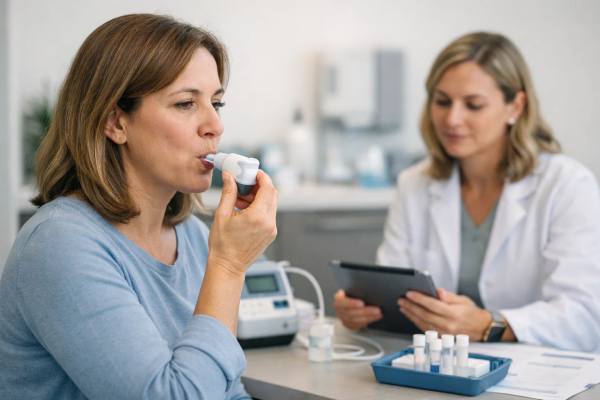
A SIBO breath test is one of the most common noninvasive ways clinicians look for excess microbial fermentation in the small intestine. When bacteria (or methane-producing archaea) meet certain carbohydrates, they generate gases your body does not make on its own—mainly hydrogen and methane. Those gases are absorbed into the bloodstream, carried to the lungs, and exhaled, creating a time-stamped “gas curve” after you drink a test sugar.
Done well, breath testing can help explain stubborn bloating, abdominal discomfort, diarrhea, constipation, or a mixed pattern—especially when symptoms cluster with known risk factors like impaired motility or prior GI surgery. Done poorly, it can mislead. The difference often comes down to preparation details, the right substrate choice, and interpreting the curve in context rather than treating any single number as destiny.
Core points to know before you schedule
- Breath testing can identify patterns consistent with SIBO (hydrogen rise) and intestinal methanogen overgrowth (methane elevation).
- Preparation mistakes can raise baseline gases and create confusing “positive” results that do not match the small intestine.
- Glucose and lactulose tests answer slightly different clinical questions and are not interchangeable for every person.
- A practical starting point is to follow the clinic’s prep exactly and ask what to pause and for how long at least 2 weeks before test day.
Table of Contents
- How breath tests detect overgrowth
- Choosing glucose or lactulose
- Who benefits from testing
- Prep rules that matter most
- Test day step by step
- Interpreting hydrogen and methane curves
- False positives false negatives and follow up
How breath tests detect overgrowth
Breath testing is built on a simple idea: humans do not produce hydrogen or methane gas as part of normal metabolism. When those gases appear in breath after you drink a specific carbohydrate, they are coming from microbes fermenting that substrate somewhere in the digestive tract.
The gas biology in plain terms
- Hydrogen is produced by many bacteria as they ferment carbohydrates.
- Methane is produced mainly by archaea (methanogens). These organisms can use hydrogen produced by other microbes to generate methane. This matters because methane can be high even when hydrogen looks modest.
- Some people also generate hydrogen sulfide; it is not captured by many standard two-gas breath tests, which can make the results look “flat” despite symptoms.
The test tracks gases over time. If fermentation happens early—before the substrate would normally reach the colon—it suggests microbial activity in the small intestine. If fermentation happens later, it may reflect colonic fermentation, which is normal for many carbohydrates.
What the test is and is not
Breath testing does not directly count bacteria. It is an indirect functional test that can be influenced by:
- How fast your stomach empties and how quickly contents move through the small intestine (transit time).
- What you ate the day before (and whether you truly fasted).
- Oral bacteria (saliva contamination can spike early readings).
- Recent antibiotics, bowel preps, laxatives, probiotics, or motility medications.
Because of these variables, a breath test is most useful when it is treated like a tool in a larger clinical picture. The best use is usually: symptoms plus risk factors plus a well-performed test that produces a curve that makes physiologic sense.
Choosing glucose or lactulose
Most SIBO breath tests use glucose or lactulose as the test substrate. You drink the solution, then provide breath samples at set intervals. The choice of substrate shapes what the test can detect and how likely it is to be confounded by normal colonic fermentation.
Glucose breath test strengths and limits
Glucose is absorbed relatively quickly in the proximal small intestine. That feature is helpful because less glucose should reach the colon, which can reduce late “noise” from colonic fermentation.
Glucose testing often works best when the concern is proximal small-intestinal overgrowth, and when you want a test that is somewhat less prone to false positives from fast transit into the colon.
However, glucose has a limitation: because it is absorbed early, it may miss more distal small-intestinal overgrowth. In practical terms, a negative glucose test does not always rule out SIBO—especially if symptoms and risk factors remain convincing.
Lactulose breath test strengths and limits
Lactulose is not absorbed; it continues through the small intestine into the colon. That makes lactulose more likely to produce a second wave of fermentation in the colon, which is expected.
The advantage is that lactulose can, in theory, detect overgrowth patterns farther along the small intestine. The downside is that it is also more vulnerable to false positives when intestinal transit is fast. If lactulose reaches the colon early, the colon can generate an early hydrogen rise that looks like “small intestine” fermentation even when it is not.
Where methane fits in
If methane is elevated, clinicians often think beyond classic “SIBO” and consider intestinal methanogen overgrowth, which is strongly associated with constipation for many people. Methane status can influence treatment choices and expectations—so it is worth confirming your test measures methane, not hydrogen alone.
Bottom line: glucose often offers cleaner signals; lactulose can be informative but requires more careful interpretation. The “best” test is the one that matches your symptom pattern, transit tendencies, and clinician’s interpretation method.
Who benefits from testing
Breath testing is most helpful when it is used for the right person at the right time. Many digestive symptoms overlap—IBS, carbohydrate intolerance, bile acid diarrhea, celiac disease, inflammatory bowel disease, pancreatic insufficiency, and medication effects can all mimic “SIBO-like” symptoms. Testing is not always the first step.
Symptoms that commonly trigger testing
Clinicians often consider a breath test when symptoms are persistent and disruptive, such as:
- Bloating or visible distension that builds through the day
- Excess gas, belching, or discomfort after meals
- Diarrhea, urgency, or loose stools that do not respond to basic dietary changes
- Constipation with hard stools, straining, or incomplete evacuation—especially with prominent bloating
- Mixed bowel habits that cycle between constipation and diarrhea
Because breath testing measures fermentation rather than inflammation, symptoms like fatigue or “brain fog” are not specific. They may improve when gut symptoms improve, but they should not be the primary reason to test.
Risk factors that raise pretest probability
Testing becomes more meaningful when symptoms pair with risk factors that make small-intestinal overgrowth more likely, including:
- Conditions that slow motility (for example, some neurologic or connective-tissue disorders)
- Diabetes with possible autonomic neuropathy
- Prior abdominal surgeries that alter anatomy or create blind loops
- Chronic use of medications that significantly slow the gut (notably opioids)
- Recurrent episodes of food poisoning followed by persistent motility changes in some people
- Structural issues that impair clearance, when documented by a clinician
When testing may not be the best first move
Breath testing may be less useful when red flags suggest another diagnosis needs priority workup, including:
- Unintentional weight loss, persistent fever, anemia, or blood in stool
- Persistent vomiting, difficulty swallowing, or severe nighttime symptoms
- New symptoms after age 50 without prior evaluation
- Strong family history of colorectal cancer or inflammatory bowel disease
In those situations, the safest plan is to coordinate with a clinician before focusing on breath testing.
Prep rules that matter most
Preparation is the make-or-break step. The goal is to minimize fermentation before the test begins so that baseline gas readings are low and the curve reflects the test substrate rather than yesterday’s dinner.
A practical timeline to think about
Clinics vary, but many follow similar ranges:
- Antibiotics: often held for about 2–4 weeks before testing, depending on the antibiotic and why you took it.
- Bowel preparation (colonoscopy or full cleanouts): commonly avoided for at least 2 weeks before testing because it can disrupt the microbiome and skew results.
- Probiotics and fermented products: often paused at least 24 hours before the test (some clinics ask longer).
- Laxatives, stool softeners, and motility agents: frequently paused 24 hours to 1 week beforehand depending on the agent and your safety needs. Always confirm with the ordering clinician—stopping a necessary medication can be risky.
If you have diabetes, hypoglycemia risk, or you take critical medications, your clinic should tailor instructions rather than using a generic handout.
The day-before diet is not “healthy eating” day
The 24-hour prep diet is usually low fermentable. Think “low residue and low fiber,” not high vegetables and legumes.
Commonly tolerated options include:
- Plain white rice, plain potatoes (no skins), or simple gluten-free grains if advised
- Eggs, poultry, fish, or firm tofu (unbreaded, minimally seasoned)
- Clear broth
- Small amounts of oils and salt as needed
Commonly restricted items include:
- Beans, lentils, onions, garlic, most raw vegetables, cruciferous vegetables
- Whole grains, bran, nuts, seeds
- High-sugar snacks, sugar alcohols, and large fruit servings
- Alcohol
Your clinic’s specific list should win. The purpose is temporary control of fermentation, not long-term nutrition.
Fasting and day-of restrictions
Most protocols include:
- Fasting 8–12 hours (water may be allowed)
- No smoking or vaping on test day
- Avoid strenuous exercise before and during the test (hard breathing and changes in ventilation can affect readings)
- Brush teeth and avoid gum or mints; some protocols use an antiseptic mouth rinse immediately before baseline sampling to reduce oral fermentation artifacts
If your baseline readings start high, your clinic may repeat baseline sampling after a mouth rinse or reschedule, depending on protocol.
Test day step by step
Breath tests are simple in concept, but technique matters. Most “mysterious” results trace back to sample collection issues, timing mistakes, or pretest variables that were not controlled.
What you can expect in a standard protocol
While protocols vary, many follow this pattern:
- Check-in and baseline review: Staff confirm fasting, diet compliance, recent medications, recent antibiotics, and recent bowel preps.
- Baseline breath sample: You exhale into a collection device. Some systems measure oxygen or carbon dioxide to confirm an “end-expiratory” sample (deep lung air), which improves accuracy.
- Drink the substrate: Common doses are around 10 g lactulose or 50–75 g glucose in water, depending on the lab.
- Timed samples: You provide breath samples every 15–20 minutes for 2–3 hours (sometimes longer).
- Restrictions during the test: You typically remain seated, avoid eating, and limit activity. Small sips of water may be allowed, depending on protocol.
How to give a good breath sample
The aim is a consistent sample that reflects alveolar air rather than room air or saliva.
- Follow staff instructions for breath-hold and exhalation (often a brief breath-hold helps).
- Keep lips sealed on the mouthpiece to prevent dilution with room air.
- Avoid excessive talking, coughing, or repeated swallowing right before sampling.
- If you feel nauseated after the substrate, tell staff—vomiting can invalidate timing and may require rescheduling.
At-home kits: convenient but easier to get wrong
Home tests can be useful, but the margin for error is larger:
- Samples can be mistimed or contaminated.
- Shipping delays can matter for some collection systems.
- Without supervision, people may unintentionally exercise, nap, or snack, altering the curve.
If you use an at-home test, treat test day like an appointment: set alarms, log exact times, and follow restrictions as strictly as possible.
Interpreting hydrogen and methane curves
Breath test interpretation is less about a single peak and more about the pattern: baseline, timing, and the relationship between hydrogen and methane.
Common cutoffs you may see
Different labs use different thresholds, but many modern interpretations include:
- Hydrogen: a rise of 20 parts per million (ppm) or more above baseline by about 90 minutes is commonly considered consistent with SIBO.
- Methane: 10 ppm or higher at any time is commonly treated as methane-positive, often discussed as intestinal methanogen overgrowth.
These are not perfect rules; they are practical cutoffs meant to balance sensitivity and specificity.
Timing is the story
- An early rise (before the substrate would typically reach the colon) supports small-intestinal fermentation.
- A late rise often reflects colonic fermentation—normal with lactulose and possible with glucose if malabsorption or rapid transit is present.
- A high baseline suggests fermentation is already happening before the substrate, often from inadequate prep, constipation with retained fermentable material, or oral contamination.
Hydrogen and methane can trade places
A common confusion is a person with classic constipation and bloating who shows modest hydrogen but elevated methane. Methanogens can consume hydrogen, so hydrogen may look lower than expected even when fermentation is active. This is one reason two-gas testing can outperform hydrogen-only testing in constipation-predominant patterns.
How symptoms during the test fit in
Some people experience bloating, cramping, or diarrhea during testing. That can happen from:
- The substrate itself (especially lactulose in sensitive guts)
- Osmotic effects that pull water into the intestine
- Fermentation if overgrowth is present
Symptoms during the test can support the overall picture, but they are not diagnostic on their own. A person can have symptoms with a negative test and vice versa.
A good interpretation should read like a physiology narrative: “When and where did fermentation most likely occur, and does that match the person’s symptom pattern and risk factors?”
False positives false negatives and follow up
Breath tests are useful, but they are not definitive. The most important skill is knowing when a result is probably meaningful and when it might be an artifact of transit, prep, or measurement gaps.
Why false positives happen
A “positive” curve can occur even without true small-intestinal overgrowth when:
- Transit is fast: lactulose reaches the colon early and colonic fermentation creates an early hydrogen rise.
- Prep is imperfect: a high baseline sets the stage for exaggerated curves.
- Oral bacteria contribute: saliva contamination can create an early spike that looks like small-intestinal fermentation.
- Carbohydrate malabsorption overlaps: if a substrate is not absorbed as expected, it can amplify fermentation signals.
If your result is positive but your clinical picture does not fit—no risk factors, symptoms are inconsistent, or treatment has repeatedly failed—this is when a careful re-read of the curve and prep details is most valuable.
Why false negatives happen
A “negative” test does not always mean “no problem,” especially when:
- Overgrowth is distal and glucose is absorbed too early to detect it.
- The test did not measure all relevant gases (for example, hydrogen sulfide patterns may not be captured).
- Recent antibiotics, bowel prep, or restrictive dieting temporarily suppressed fermentation.
- Constipation or slow transit altered substrate movement and sampling windows.
What to do after results
A practical next-step framework looks like this:
- Match the result to the story: Does the curve timing and gas pattern fit symptoms and risk factors?
- Confirm the basics: Was prep followed? Were antibiotics, bowel prep, or laxatives involved recently?
- Discuss treatment and root causes: Treatment often focuses on reducing overgrowth and improving motility or anatomy-related drivers, not just “killing bacteria.”
- Know when to broaden the workup: If symptoms persist, clinicians may look for alternative explanations such as celiac disease, bile acid diarrhea, pancreatic insufficiency, pelvic floor dysfunction, or inflammatory conditions.
If you have severe symptoms, red flags, or significant weight loss, do not self-manage based on a breath test alone. The safest path is coordinated care, because the same symptoms can signal very different conditions with very different treatments.
References
- Understanding Our Tests: Hydrogen-Methane Breath Testing to Diagnose Small Intestinal Bacterial Overgrowth 2023 (Review)
- Performance and Interpretation of Hydrogen and Methane Breath Testing Impact of North American Consensus Guidelines 2022 (Clinical Study)
- European guideline on indications, performance, and clinical impact of hydrogen and methane breath tests in adult and pediatric patients: European Association for Gastroenterology, Endoscopy and Nutrition, European Society of Neurogastroenterology and Motility, and European Society for Paediatric Gastroenterology Hepatology and Nutrition consensus 2021 (Guideline)
- Small intestinal bacterial overgrowth. A position paper of ASENEM-SEPD 2023 (Position Paper)
Disclaimer
This article is for educational purposes and does not provide medical advice, diagnosis, or treatment. Breath test protocols and interpretation thresholds vary by lab, and results should be reviewed with a qualified clinician who can consider your symptoms, medical history, medications, and risk factors. Do not stop prescription medications, change diabetes management, or begin antimicrobial treatment based solely on a breath test without professional guidance. Seek urgent medical care for red-flag symptoms such as blood in stool, persistent vomiting, fainting, severe dehydration, unexplained weight loss, fever, or worsening abdominal pain.
If you found this helpful, consider sharing it on Facebook, X (formerly Twitter), or any platform you prefer so others can make more informed decisions about breath testing.