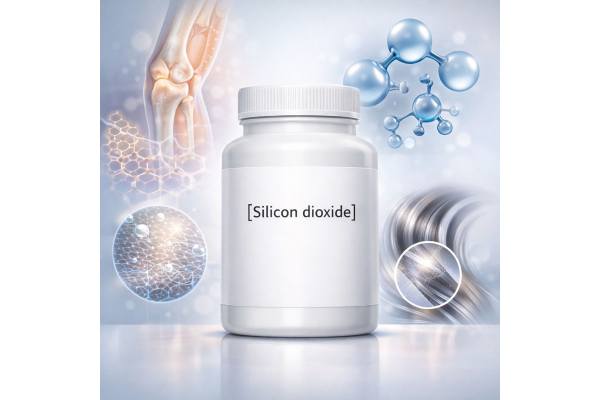
Silicon dioxide, also called silica or E551, is one of the most common substances on Earth and one of the most widely used additives in the food and supplement industry. In capsules and powders, it acts mainly as an anti-caking and flow agent, helping ingredients mix evenly and preventing clumps. Some products also market silicon dioxide as a source of silicon for bones, skin, hair, and nails, which can be confusing when you try to understand what it actually does in your body.
Research on dietary silicon suggests a supportive role in bone mineralization, collagen structure, and connective tissue health, but not all silicon forms are equal in terms of absorption. Typical supplemental silicon dioxide is only weakly soluble, so its main value is technological rather than nutritional. At the same time, oral silicon dioxide (especially amorphous forms used in foods) has repeatedly been evaluated for safety by major regulatory agencies. This guide explains what silicon dioxide is, how it behaves in supplements, realistic benefits, safe intake levels, and who may need to be more cautious.
Quick Facts for Silicon Dioxide
- Silicon dioxide in supplements is mainly an anti-caking and flow agent, with only modest contribution to silicon nutrition.
- Bioavailable silicon is more strongly linked to bone and connective tissue support than silicon dioxide itself.
- Food safety authorities have considered silicon intakes up to about 700 mg per day from silicon dioxide and similar sources to be acceptable for adults, although typical intakes are far lower.
- People with kidney disease, infants outside regulated formulas, and those with complex medication regimens should discuss silicon dioxide and total silicon intake with a health professional before using high-intake products.
Table of Contents
- What is silicon dioxide in supplements?
- Does silicon dioxide really benefit bones and skin?
- How silicon dioxide is used in food and supplements
- Silicon dioxide dosage and how much is safe
- Side effects of silicon dioxide and who should avoid it
- What the research says about silicon dioxide
What is silicon dioxide in supplements?
Silicon dioxide is a compound made of silicon and oxygen (chemical formula SiO₂). It exists in many forms in nature, from quartz and sand to silica in plants and mineral water. In supplements and processed foods, it is typically used as synthetic amorphous silica (SAS), a specially manufactured, high-purity, non-crystalline form.
The key distinction is between:
- Crystalline silica (such as quartz dust) – an occupational inhalation hazard linked to lung disease and cancer in industrial settings.
- Amorphous silica – the form used as E551 in foods and supplements, which has a different structure and has been evaluated separately for oral safety.
In capsules, tablets, and powdered supplements, silicon dioxide plays several roles:
- Prevents powders from clumping together (anti-caking agent).
- Improves flow in manufacturing equipment, so capsules fill evenly.
- Can act as a carrier for flavors or liquid ingredients when used as silica gel.
Although silica is sometimes marketed as a “beauty mineral,” standard silicon dioxide used as an excipient is poorly soluble in water. In the digestive tract, only a small fraction converts into orthosilicic acid, the truly bioavailable form of silicon. Much of it passes through unchanged.
This is different from:
- Stabilized orthosilicic acid liquids
- Organic silicon compounds (such as monomethylsilanetriol)
These specialized forms are formulated specifically for higher solubility and absorption and are usually taken at lower doses because they deliver silicon more efficiently.
So when you see “silicon dioxide” on a supplement label, especially at low milligram amounts near the end of the ingredient list, it is usually there to protect the product’s texture and stability, not to act as the main active nutrient.
Does silicon dioxide really benefit bones and skin?
Research on silicon as a nutrient shows a consistent story: higher intakes of bioavailable silicon are associated with better bone mineral density and may support connective tissue, including skin, hair, and nails. Observational studies report that individuals consuming more silicon through diet (often from whole grains, some vegetables, and certain beverages) tend to have stronger bones, particularly in premenopausal women and some groups of men.
However, there is an important nuance: form matters. The body mainly absorbs silicon as orthosilicic acid, a small, water-soluble molecule. Clinical trials in bone and skin health have mostly used:
- Stabilized orthosilicic acid solutions.
- Orthosilicic acid-releasing compounds that remain soluble in the gut.
Standard silicon dioxide as used in many supplements is only partially converted to orthosilicic acid in the digestive system. As a result:
- It can contribute some silicon to overall intake, but
- It is generally less efficient than dedicated soluble silicon products.
Claims that silicon dioxide alone will dramatically strengthen bones, erase wrinkles, or reverse joint disease are therefore overstated. Any contribution to these outcomes is likely modest and depends on:
- Total dietary silicon intake.
- Presence of other bone-supporting nutrients (calcium, vitamin D, vitamin K, protein).
- Baseline health status and lifestyle factors such as exercise and smoking.
On the positive side, when silicon dioxide is part of a balanced supplement formula that also contains meaningful amounts of bioavailable silicon (for example, as orthosilicic acid) and bone-supporting vitamins and minerals, it can function as a minor silicon source while preserving product quality.
In short:
- Silicon as a nutrient seems beneficial for bone and connective tissue.
- Silicon dioxide in common excipient doses is not harmful for most healthy adults but also not a powerful stand-alone “beauty” or “bone” ingredient.
- If you are aiming specifically to support bone density or skin structure with silicon, forms labeled as orthosilicic acid or similar are usually more appropriate than relying on silicon dioxide alone.
How silicon dioxide is used in food and supplements
Silicon dioxide is one of the most widely used technological additives in food and supplements. In regulatory terminology it appears as E551.
In foods, silicon dioxide is commonly included in:
- Instant soups and drink powders (to prevent clumping).
- Salt, spice mixes, and powdered creamers (to keep them free-flowing).
- Some confectionery and powdered flavors.
In supplements, you will often find it:
- Near the bottom of the ingredient list as “silicon dioxide” or “colloidal silicon dioxide.”
- At low levels in capsules and tablets, often 1–20 mg per serving, mainly as an anti-caking agent.
From a manufacturing perspective, silicon dioxide offers several advantages:
- Flow improvement – It helps powders move smoothly through encapsulation or tableting equipment.
- Moisture protection – It can adsorb small amounts of moisture, reducing the risk of clumping or degradation of sensitive ingredients.
- Consistency – It improves weight uniformity of tablets and capsules, which is important for accurate dosing of the active components.
Regulatory bodies such as the European Food Safety Authority (EFSA) have repeatedly reviewed synthetic amorphous silicon dioxide as a food additive. These reviews cover:
- Toxicological data.
- Particle size distribution, including the presence of nano-sized aggregates.
- Exposure estimates for different age groups, including infants, children, and adults.
EFSA’s conclusions so far are that silicon dioxide does not raise a safety concern at reported uses and levels in foods, including its role as an anti-caking agent, for the general population.
In addition to its use as a functional additive, there are also silicon dioxide–based gels and silicates that may be included in some special-purpose supplements as carriers or as part of silicon-delivery systems. These are evaluated as specific sources of silicon when used with nutritional intent.
For most consumers reading a supplement label, the practical takeaway is:
- Silicon dioxide is there primarily to improve product quality and stability, not to act as the main nutrient.
- Its presence in moderate amounts is a normal feature of many high-quality, professionally manufactured supplements.
Silicon dioxide dosage and how much is safe
There is no official Recommended Dietary Allowance for silicon, and there is no specific “therapeutic dose” of silicon dioxide itself, because it is usually treated as a technological additive rather than the primary active ingredient. Still, several expert assessments provide guidance on safe intake ranges.
Key points from regulatory and scientific evaluations include:
- Typical dietary silicon intake from food and water in adults ranges roughly from 12 to 62 mg silicon per day, depending on dietary patterns and geography.
- When silicon is intentionally added to foods and supplements using sources such as silicon dioxide and silicic acid, safety assessments have considered supplemental silicon intakes up to around 700 mg per day as not raising safety concerns for adults.
- EFSA has repeatedly concluded that, at realistic use levels as a food additive (E551), silicon dioxide does not pose a safety concern for consumers, including when used in foods for infants under defined conditions.
In supplement practice:
- Many multivitamins and specialized formulas use 5–30 mg of silicon dioxide per serving as an anti-caking agent, which corresponds to a smaller amount of elemental silicon (silicon accounts for about half the mass of SiO₂).
- Dedicated “silica” or “silicon” supplements sometimes list elemental silicon content (for example, 10 mg silicon per tablet), often derived from orthosilicic acid, plant extracts, or specially processed silica.
If you are using a product where silicon dioxide is only an excipient:
- You usually do not need to target a specific dose of silicon dioxide, because its role is not to provide nutrition.
- Staying within the manufacturer’s suggested serving size generally keeps intake comfortably within established safety margins.
If you are intentionally using silicon-containing supplements for bone or skin support:
- Many studies of bioavailable silicon use 5–20 mg of elemental silicon per day.
- These doses are typically achieved with soluble silicon forms and are not a reason to seek very high doses of silicon dioxide.
Practical safety guidelines:
- Avoid combining multiple high-dose silicon products unless a clinician has reviewed your overall intake.
- People with reduced kidney function or a history of kidney stones should be cautious about long-term high silicon intake, because silicon is excreted mainly through the kidneys and long-term data in these groups are limited.
- For healthy adults, ordinary use of supplements containing silicon dioxide as an excipient, plus normal dietary exposure, remains well below levels evaluated as acceptable.
Side effects of silicon dioxide and who should avoid it
For most healthy people, silicon dioxide used as a food and supplement additive has a good oral safety profile at typical intakes. Regulatory evaluations have not identified significant toxicity, genotoxicity, or carcinogenicity concerns for synthetic amorphous silica (E551) at usual use levels.
Still, it is important to separate realistic risks from misconceptions and to recognize that some individuals may need extra caution.
Possible side effects and considerations:
- Digestive discomfort
A small number of users report mild bloating, gas, or changes in stool when taking multiple products containing silicon dioxide and other excipients. This is usually related to the overall formulation rather than silicon dioxide alone. Starting with lower doses of complex supplement stacks and taking them with meals can help. - Kidney handling and long-term high intake
Silicon from all sources is largely excreted in urine. While safety reviews up to around 700 mg silicon per day from silicon dioxide and silicic acid sources have not shown clear toxicity, people with impaired kidney function may have altered excretion. Long-term data in this group are limited, so medical supervision is recommended if significant supplemental silicon is used. - Nanoparticle concerns
Modern evaluations pay special attention to the presence of nano-sized aggregates in synthetic amorphous silica. Current evidence indicates that the aggregated materials used as E551 do not raise specific genotoxicity or systemic safety concerns at permitted use levels, but research is ongoing. - Allergy or sensitivity
True allergic reactions to silicon dioxide itself are extremely rare. When reactions occur with a supplement containing silica, they often relate to other excipients, colorants, or active ingredients in the same capsule.
You should use extra caution or seek medical advice before using high-silicon or multiple silicon-containing products if:
- You have chronic kidney disease or a history of recurrent kidney stones.
- You are pregnant or breastfeeding, especially if considering silicon doses above those obtained from a normal diet and a single multivitamin.
- You are giving supplements to infants or very young children, outside of regulated infant formulas where the composition is tightly controlled.
- You take several medications that influence mineral metabolism or kidney function.
Also remember that inhalation risks from industrial crystalline silica dust are a separate issue from oral exposure to amorphous silicon dioxide in food and supplements. The serious lung diseases associated with workplace silica dust do not arise from swallowing regulated amounts of E551.
What the research says about silicon dioxide
The evidence landscape can be divided into two overlapping areas:
- Silicon as a biologically relevant trace element, and
- Silicon dioxide as a specific additive and silicon source.
On silicon generally:
- Experimental and clinical studies suggest that silicon plays a supportive role in bone formation, collagen synthesis, and connective tissue integrity.
- Observational work has linked higher dietary silicon intake with greater bone mineral density in several population groups.
- Reviews of orthosilicic acid and silicon-releasing compounds emphasize improvements in markers of bone formation and some benefits for skin, hair, and nail quality, especially when combined with other supportive nutrients.
On silicon dioxide specifically:
- EFSA and other bodies have repeatedly re-evaluated silicon dioxide (E551) as a food additive, examining toxicology, kinetics, and potential nano-specific issues. The current conclusion is that E551 does not raise a safety concern at reported uses and levels for any age group, including infants, when used as approved.
- Opinions on silicon sources added to supplements, including silicon dioxide and silicic acid, have found no significant safety concerns at supplemental intakes up to about 700 mg silicon per day, providing a wide margin relative to typical consumer use.
- Research on bioavailability indicates that while silicon dioxide can release orthosilicic acid in the gastrointestinal tract, its efficiency is lower compared with stabilized orthosilicic acid solutions or certain organic silicon compounds. This explains why clinical trials often use dedicated soluble forms rather than simple silica powders when targeting bone or skin outcomes.
Putting this together for practical decision-making:
- Silicon appears to be helpful as part of a broader strategy for bone and connective tissue support.
- Silicon dioxide in supplements is primarily a safe, functional excipient, with only modest direct nutritional impact at typical doses.
- If your goal is to increase silicon intake meaningfully for bone or skin health, consider products that use clinically studied, soluble forms of silicon, while treating silicon dioxide in your multivitamin as a neutral helper for manufacturing quality.
When choosing any supplement, look for:
- Clear labeling of elemental silicon content if it is marketed for bone or skin health.
- Third-party testing for purity and contaminants.
- Realistic claims that reflect the evidence (modest support, not miraculous transformation).
References
- Re-evaluation of silicon dioxide (E 551) as a food additive 2018 (Systematic Safety Opinion)
- Re-evaluation of silicon dioxide (E 551) as a food additive in foods for infants below 16 weeks of age and follow-up of its re-evaluation as food additive for uses in foods for all population groups 2024 (Systematic Safety Opinion)
- Silicon Supplementation for Bone Health: An Umbrella Review 2024 (Systematic Review)
- Biological and therapeutic effects of ortho-silicic acid and some ortho-silicic acid-releasing compounds: New perspectives for therapy 2013 (Review)
- Proposed maximum levels for the addition of silicon to foods including food supplements 2021 (Risk Assessment Report)
Disclaimer
The material in this article is intended for general information only and does not replace individual medical advice, diagnosis, or treatment. Silicon dioxide and other silicon-containing ingredients can be part of a balanced diet and supplement plan, but their suitability depends on your overall health, kidney function, medication use, and nutritional status. Always consult a qualified health professional before starting, stopping, or changing any supplement, especially if you have chronic illness, are pregnant or breastfeeding, are considering high-dose products, or are using supplements as part of treatment for bone, skin, or connective tissue disorders. Never ignore or delay seeking professional medical advice because of information you read online.
If you found this overview of silicon dioxide helpful, you are kindly invited to share it on Facebook, X (formerly Twitter), or any platform you prefer, and to follow our work on social media. Your thoughtful support through sharing helps our team continue to produce careful, evidence-informed health articles for readers around the world.