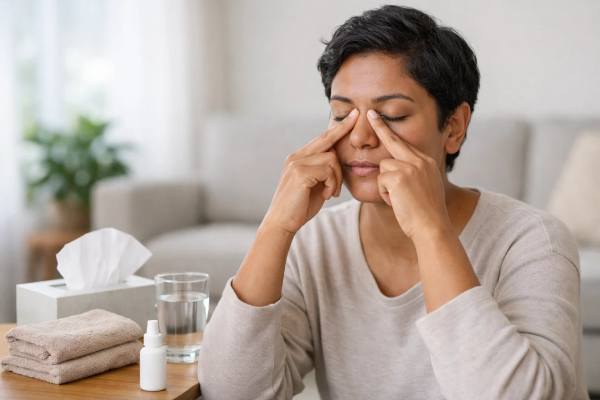
When your nose is blocked and your face feels heavy, “sinus massage” can seem like a simple fix—no pharmacy run, no complicated equipment, just your hands and a few minutes of focused pressure. For many people, gentle facial massage and acupressure-style points do make congestion feel more manageable, especially when the main problem is swelling in the nasal passages and tension in the muscles around the eyes, cheeks, and jaw. The key is understanding what sinus massage can realistically do. It can soothe tenderness, reduce the sensation of pressure, and encourage easier nasal breathing for a while. It cannot “push out” a true sinus infection or replace medical care when symptoms are severe. This article explains the pressure points people commonly use, a safe step-by-step routine, and the situations where massage is best avoided—so you can try it with clear expectations and better results.
Top Highlights
- Gentle facial massage can temporarily reduce the sensation of sinus pressure and help nasal breathing feel easier.
- The most-used points are along the sides of the nose, between the eyebrows, under the cheekbones, and at the base of the skull.
- Avoid strong pressure, especially near the eyes, and stop immediately if pain, dizziness, or worsening symptoms appear.
- Pair a 5 to 10 minute routine with saline rinses, humidity, and hydration for more noticeable relief.
- Seek urgent care for eye swelling, vision changes, severe headache, high fever, or confusion.
Table of Contents
- Why sinus massage can feel helpful
- Pressure points people use for congestion
- A simple step-by-step routine
- Safety tips and who should avoid
- When to stop and seek care
- Pairing massage with proven tools
Why sinus massage can feel helpful
Sinus massage sits in a helpful middle ground: it is low-risk for most people, it can feel soothing quickly, and it gives you a sense of control when congestion is draining your energy. But the benefits are often misunderstood, so it helps to start with a clear picture of what is happening in your head and face during a cold, allergies, or post-viral congestion.
Your sinuses are not “bags of mucus” you can squeeze
The paranasal sinuses are air-filled spaces connected to the nasal cavity through small openings. When you are congested, the lining of the nose and sinus openings swells, and drainage slows. That creates pressure and a “full” sensation—especially in the forehead, around the eyes, and in the cheeks. Massage does not force mucus out of the sinuses like squeezing a tube. Instead, it can influence nearby tissues and nerves that shape how congestion feels.
Why pressure points may change how you perceive airflow
Congestion is partly mechanical (swollen tissue narrowing airflow) and partly sensory (how your brain interprets airflow across the nasal lining). Gentle pressure and slow, rhythmic touch can calm the nervous system and reduce the “alarm” that makes congestion feel intolerable. Some people notice that even if they are still a bit blocked, breathing feels less strained after a short routine.
Muscle tension is a major contributor to “sinus pressure” feelings
During a cold or allergy flare, you may unconsciously tense the forehead, squint, clench the jaw, or tighten the muscles around the eyes. That tension can mimic sinus pain. Massage over the brow line, temples, and cheekbones may ease tenderness that is actually muscular, not sinus-related.
What a realistic result looks like
Most people who benefit describe:
- A temporary sense of “opening” in the nose
- Less facial tenderness when bending forward
- Reduced headache-like pressure
- Easier relaxation and sleep
Think of sinus massage as a symptom-relief tool you can repeat safely, not as a cure. The best outcomes usually come from combining it with measures that actually reduce swelling and thin mucus—like humidity, hydration, and saline care.
Pressure points people use for congestion
People use “sinus pressure points” in two main traditions: straightforward facial self-massage (focused on anatomy and comfort) and acupressure-style points (focused on specific landmarks). You do not need to choose a philosophy to use them safely. What matters is gentle pressure, good placement, and avoiding sensitive structures like the eyeball.
Below are common points people use for congestion and sinus pressure. You can use one or two, or build a short routine from several.
Sides of the nose
- Where: In the grooves beside the nostrils, where the nose meets the cheek.
- How it is used: Press inward and slightly upward with fingertip pads, using small circles.
- What it is used for: Stuffy nose sensation and pressure near the cheeks.
This area is one of the most popular because it is easy to find and often feels immediately “relevant” when you are congested.
Bridge of the nose
- Where: Along the upper sidewalls of the nose, below the inner corners of the eyes (on bone, not on the eyeball).
- How it is used: Gentle pinching pressure with thumb and index finger, or small circles with fingertips.
- What it is used for: Pressure around the eyes and the “tight mask” feeling across the nose.
Avoid pressing too close to the inner eye. Stay on the firm bridge and sidewalls.
Inner eyebrow points
- Where: At the inner ends of the eyebrows, just above the bridge of the nose.
- How it is used: Light, steady pressure or tiny circles.
- What it is used for: Frontal pressure and eye-area heaviness.
This region can be tender. “Gentle enough to be calming” is the right intensity.
Between the eyebrows
- Where: The spot between the eyebrows, above the bridge of the nose.
- How it is used: Soft pressure with slow circles, often paired with slow breathing.
- What it is used for: Stress-related tension that amplifies congestion discomfort.
This point is often helpful when anxiety and congestion are feeding each other.
Under the cheekbones
- Where: On the cheek, under the center of the cheekbone (avoid the eye socket).
- How it is used: Gentle upward circles, then a slow release.
- What it is used for: Maxillary “sinus” pressure and facial tenderness.
If tooth pain or one-sided severe cheek pain is prominent, treat that as a reason to reassess rather than pressing harder.
Base of the skull
- Where: In the hollows at the base of the skull, on either side of the spine.
- How it is used: Moderate pressure with thumbs while the head stays neutral, not cranked forward.
- What it is used for: Headache-like pressure, neck tension, and the “overall sick head” feeling.
If you get dizziness easily, keep pressure light and brief here.
A simple step-by-step routine
A safe sinus massage routine should be short, repeatable, and gentle enough that you could do it even when you feel run down. Aim for 5 to 10 minutes, 1 to 3 times per day, especially before sleep. If your skin is irritated from frequent wiping, you can reduce friction by using clean hands and very light pressure rather than rubbing.
Before you start
- Wash your hands.
- Sit upright with your shoulders relaxed.
- If possible, warm the area first with a warm shower or a warm compress for 1 to 2 minutes.
- Breathe slowly through your nose if you can, or through your mouth if you cannot.
Routine: one round takes about 3 to 4 minutes
- Forehead sweep (30 seconds)
Place fingertips at the center of the forehead and sweep outward toward the temples with light pressure. Repeat slowly. This reduces tension that can mimic sinus pressure. - Between-eyebrows circles (30 seconds)
Use one fingertip to make slow circles between the eyebrows. Keep pressure soft and steady, and exhale slowly. - Inner eyebrow holds (30 to 45 seconds)
Press gently at the inner ends of the eyebrows on both sides. Hold for 5 seconds, release for 2 seconds, and repeat. - Side-of-nose circles (45 to 60 seconds)
Place fingertips in the grooves beside the nostrils. Press inward gently and make small circles. If one side is more blocked, you can spend a little longer there—without increasing pressure. - Cheekbone release (45 to 60 seconds)
Place fingers under the cheekbones (not in the eye socket) and make small upward circles. Keep it comfortable, not painful. - Base-of-skull relax (30 to 45 seconds)
Place thumbs in the hollows at the base of the skull and apply moderate pressure while breathing slowly. If you feel lightheaded, stop and switch back to the face points.
How to repeat without overdoing it
- Do 2 rounds for a typical session (about 6 to 8 minutes).
- If skin becomes sore or red, switch to steady holds instead of circles.
- If your headache worsens with pressure, skip the forehead and base-of-skull steps and focus on gentle side-of-nose work only.
A quick “sleep version”
If you are exhausted, do only:
- Side-of-nose circles for 60 seconds
- Between-eyebrows circles for 30 seconds
- Slow breathing for 60 seconds
This minimalist version can still reduce the “pressure panic” that keeps you awake, even if it does not fully open the nose.
Safety tips and who should avoid
Sinus massage should feel soothing. If it hurts, makes you dizzy, or leaves you feeling worse, that is useful information—massage is not the right tool for that moment. Safety is mostly about pressure, placement, and knowing when congestion is a sign of something more serious than swelling.
Core safety rules
- Use fingertip pads, not nails. Nails can scratch inflamed skin and introduce infection.
- Stay off the eyeballs. Massage on bone and soft tissue around the eye socket only.
- Gentle beats forceful. More pressure does not mean more drainage. It often means more irritation.
- Stop if pain spikes. Sharp, one-sided pain is not a “good release.” It is a reason to reassess.
- Limit sessions. Several short sessions are safer than one long, aggressive session.
When you should avoid sinus massage
Skip massage and seek medical guidance instead if you have:
- Eye swelling, eye pain, or vision changes
- Severe headache that is sudden, rapidly worsening, or different from your usual headaches
- High fever with significant facial pain
- Confusion, stiff neck, fainting, or severe drowsiness
- Facial swelling that is pronounced, one-sided, or worsening
- Recent facial trauma, a suspected fracture, or recent sinus or nasal surgery
- Active skin infection on the face (spreading redness, warmth, pus)
These are not normal congestion features and deserve careful evaluation.
Caution if you bruise easily or take blood thinners
If you are on anticoagulant medication or you bruise easily, sinus massage can still be possible, but keep pressure very light and avoid deep thumb pressure at the base of the skull. The safest approach is short holds, not strong circles.
Children and sinus massage
For children, the main issue is that they may not describe pain well, and their symptoms can worsen faster. If you try massage:
- Keep it brief and extremely gentle
- Avoid pressure near the eyes
- Stop at the first sign of distress
- Do not use massage to delay care if a child has breathing difficulty, dehydration, or unusual sleepiness
What “safe discomfort” feels like
A safe session may feel tender in spots, but it should remain within a comfort zone: pressure that you would describe as “pleasantly relieving,” not “I am pushing through this.” If you have to brace your jaw or hold your breath, the pressure is too strong.
When to stop and seek care
Sinus massage is a symptom tool. It should not become a way to talk yourself out of getting medical help when symptoms suggest a more significant problem. The most important decision cues are severity, worsening, and duration without improvement.
Urgent red flags
Seek urgent evaluation if congestion or sinus pressure comes with:
- Shortness of breath, wheezing, or struggling to breathe
- Eye swelling, drooping eyelid, pain with eye movement, or vision changes
- Severe headache with fever, confusion, stiff neck, or vomiting
- Swelling or redness spreading across the face
- Fainting, extreme weakness, or difficulty staying awake
- Severe one-sided facial pain that escalates quickly
These symptoms are not typical for a routine cold and can signal complications or an entirely different diagnosis.
When timing suggests you need a clinician visit
Consider medical evaluation if:
- Symptoms last more than about 10 days without meaningful improvement
- You start improving, then suddenly worsen again with renewed fever or increased facial pain
- Pain becomes sharply localized to one cheek, one side of the forehead, or one tooth region
- You have recurrent episodes that keep returning or never fully resolve
- You are immunocompromised or have significant chronic illness and symptoms are not trending better
A common trap is assuming that thick or colored mucus automatically means bacterial infection. In reality, mucus color changes often happen during viral illnesses. The more reliable clue is the overall trajectory: improving versus stuck versus getting worse.
Massage should not be your only strategy
If you find yourself repeating massage every hour just to feel “okay,” that is a sign you need additional support, such as saline care, anti-inflammatory nasal treatment (when appropriate), or medical evaluation for sinusitis, allergies, or asthma-related symptoms.
When antibiotics might be discussed
If a clinician suspects bacterial sinusitis, antibiotics may be considered—usually based on symptom pattern rather than a single sign. Massage will not treat bacterial infection, and pressing harder does not change that. Your job at home is to use comfort measures while watching for the patterns that justify medical treatment.
Pairing massage with proven tools
Sinus massage tends to work best as part of a small “congestion stack” that targets swelling, mucus thickness, and sleep disruption. The goal is not to throw everything at the problem, but to combine a few compatible strategies that reinforce each other.
Saline care and why water choice matters
Saline nasal spray is a simple option for dryness and mild congestion. For thicker mucus and postnasal drip, a rinse device can be more effective. If you use rinses, water safety is essential: use distilled, sterile, or previously boiled and cooled water, and keep your device clean. This is one of the highest-impact add-ons to massage because it changes the physical texture and movement of mucus.
Humidity, warmth, and timing
Warmth often makes massage feel more effective. Try:
- A warm shower, then a short massage routine
- A humidifier in the bedroom at night if indoor air is dry
- A warm compress over the cheeks and forehead before bed
Warmth does not cure infection, but it can reduce the “tight” feeling that keeps you from resting.
Medication pairings to consider carefully
Depending on your health profile, these may help:
- Pain relievers for facial tenderness and headache
- Short-term decongestants for severe blockage (with caution for blood pressure, heart rhythm issues, anxiety, and insomnia)
- For allergy-driven congestion, an anti-inflammatory nasal spray may help more than repeated decongestant use
If you are unsure which medicines fit your situation, prioritize non-drug options first and ask a clinician or pharmacist—especially if you have chronic conditions or take multiple medications.
A practical daily plan during a cold
- Morning: Gentle saline spray or rinse, then one massage round
- Midday: Short massage round if pressure returns
- Evening: Warm shower or compress, then two rounds of massage
- Night: Head elevated slightly; hydrate; use a minimalist “sleep version” of massage if you wake congested
What to avoid
- Aggressive pressure around the eyes or on highly tender areas
- Essential oils placed directly inside the nostrils (irritation is common)
- Forceful nose blowing that worsens ear pressure or causes nosebleeds
- Repeated topical decongestant spray use beyond the label window, which can trigger rebound congestion
A calm, consistent routine usually beats intense, sporadic efforts. If the illness is going to resolve on its own, your job is to make the days and nights more tolerable while staying alert to warning signs.
References
- The effects of nasal massage of the “yingxiang” acupuncture point on nasal airway resistance and sensation of nasal airflow in patients with nasal congestion associated with acute upper respiratory tract infection – PubMed 1999 (RCT) ([PubMed][1])
- International consensus statement on allergy and rhinology: rhinosinusitis 2021 – PubMed 2021 (Position Statement) ([PubMed][2])
- Benefits of nasal saline treatment in acute rhinosinusitis: Systematic review and meta-analysis – PubMed 2022 (Systematic Review and Meta-Analysis) ([PubMed][3])
- Sinus Infection Basics | Sinus Infection | CDC 2024 (Guidance) ([CDC][4])
- Is Rinsing Your Sinuses With Neti Pots Safe? | FDA 2025 (Safety Guidance) ([U.S. Food and Drug Administration][5])
Disclaimer
This article is for general educational purposes and does not provide medical advice, diagnosis, or treatment. Congestion and facial pressure are often caused by viral illness or allergies, but similar symptoms can also occur with bacterial sinusitis and, rarely, serious complications. Do not use sinus massage to delay urgent care for warning signs such as breathing difficulty, eye swelling or vision changes, severe or rapidly worsening headache, high fever with significant facial pain, confusion, stiff neck, fainting, or spreading facial swelling. If you are pregnant, immunocompromised, have chronic heart or lung disease, take blood thinners, or recently had facial trauma or sinus surgery, consult a qualified healthcare professional before trying new techniques or combining remedies.
If you found this article helpful, please consider sharing it on Facebook, X (formerly Twitter), or any platform you prefer.