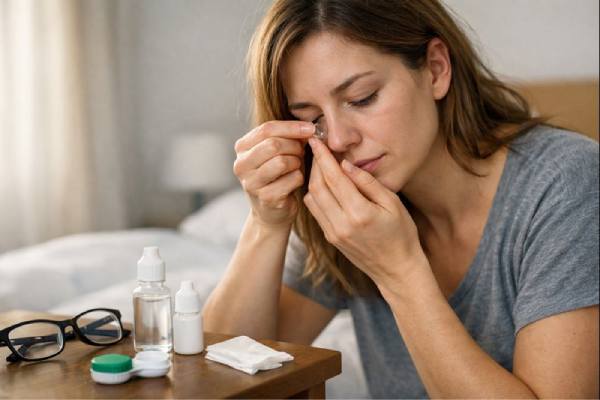
Falling asleep in contact lenses is common—and understandable. Lenses are small, comfortable, and easy to forget after a long day. The problem is that sleep changes the eye’s environment in ways that make contact lenses riskier: oxygen levels drop, tears move less, and germs have more time to cling to the lens and the cornea. For most people, the result is short-lived dryness or redness. For a smaller number, it can trigger a painful corneal injury or a serious infection that threatens vision and may require urgent treatment. This guide explains why sleeping in contacts increases risk, which infections clinicians worry about most, and how to tell “irritated” from “needs same-day care.” You will also find a clear, step-by-step plan for what to do after an accidental nap, plus practical ways to make future wear safer without giving up lenses altogether.
Quick Overview
- Removing lenses before sleep lowers the chance of painful inflammation and corneal injury the next day.
- Overnight wear increases the likelihood of microbial keratitis, including aggressive bacterial infections.
- Severe pain, light sensitivity, discharge, or blurred vision after sleeping in lenses should be treated as urgent.
- If you slept in lenses, take them out as soon as you are awake and switch to glasses for the rest of the day.
Table of Contents
- Why Sleeping in Contacts Is Risky
- What Can Go Wrong: From Dryness to Ulcers
- The Infections Eye Doctors Take Most Seriously
- Warning Signs and When It Is an Emergency
- What to Do If You Slept in Your Lenses
- Prevention and Safer Alternatives
Why Sleeping in Contacts Is Risky
Sleeping with contact lenses changes the balance your eyes rely on to stay clear, comfortable, and resistant to infection. During waking hours, blinking spreads tears across the cornea, washes away debris, and delivers oxygen. When your eyelids close, oxygen delivery drops naturally. A contact lens adds an extra barrier that can push the cornea closer to low-oxygen stress, especially if the lens is older, dry, or not designed for extended wear.
Oxygen and the cornea
The cornea has no blood vessels, so it depends on oxygen from the air and from tears. During sleep, the cornea already receives less oxygen. A lens can reduce oxygen transmission further. Low oxygen does not automatically cause an infection, but it can:
- Increase swelling of the corneal tissue (which can blur vision and increase discomfort).
- Make the surface cells more fragile and easier to injure.
- Slow down normal repair if the lens creates tiny areas of friction.
Tear stagnation and germ buildup
Tears are not just “water.” They contain protective proteins and immune factors. When your eye is closed, tear turnover slows. With a lens in place, the tear layer behind the lens becomes more stagnant. Germs that would normally be flushed out can linger longer, and biofilm (a thin, sticky layer of bacteria) can build on lenses and in lens cases. More time on the eye means more opportunity for microbes to adhere and multiply.
Microtrauma you cannot feel at first
Many contact lens complications begin with microscopic surface damage. A slightly dry lens can rub the cornea. A lens edge can irritate the eyelid margin. Debris trapped under the lens can create a scratch. These small injuries matter because the cornea is your main barrier against infection. If the barrier is compromised, even common bacteria can cause a corneal infection.
“But my lenses are approved for overnight wear”
Some lenses are designed and prescribed for extended wear. Even then, the risk is higher than removing lenses nightly. “Approved” does not mean “risk-free.” The safest interpretation is that extended wear is an option for specific people with careful follow-up, not a universal permission slip. If you have dry eye, allergies, frequent redness, or a history of eye infections, overnight wear tends to be a poor fit.
Sleeping in contacts is risky because it stacks multiple stressors at once—low oxygen, less tear exchange, more microbial exposure, and more friction. That combination explains why a simple nap can sometimes lead to a surprisingly intense next-day reaction.
What Can Go Wrong: From Dryness to Ulcers
Not every episode of sleeping in contacts leads to a crisis. Many people wake up with mild dryness that resolves within hours. The challenge is that early symptoms can look similar across several conditions, while the urgency is very different. Understanding the range helps you respond appropriately.
Common, usually short-term problems
After sleeping in lenses, it is typical to experience:
- Dryness and a “sand in the eye” sensation
- Mild redness that improves after lens removal
- Slight blur that clears as the cornea rehydrates
- Lens tightness (the lens feels stuck)
These symptoms often come from low oxygen and tear stagnation overnight. If they improve steadily after removing the lenses and switching to glasses, that is reassuring.
Inflammation that can mimic infection
A frequent in-between problem is contact-lens-related inflammatory reactions. Examples include:
- Contact lens acute red eye (CLARE): sudden redness and discomfort, often after sleeping in lenses, usually without a corneal ulcer.
- Infiltrates: small inflammatory spots in the cornea that can cause light sensitivity and pain. Some infiltrates are sterile inflammation; others represent early infection.
Because inflammation and infection can overlap, clinicians take a cautious approach when symptoms are significant.
Corneal abrasion
If the lens dries onto the cornea, forcing it off can remove surface cells and create a scratch. An abrasion typically causes:
- Sharp pain, especially with blinking
- Tearing and light sensitivity
- A feeling that something is stuck in the eye
Abrasions usually heal quickly with proper care, but they increase infection risk if you continue to wear lenses too soon.
Corneal ulcer and microbial keratitis
The most serious progression is an infection of the cornea—often called microbial keratitis. This can begin with what feels like “irritation,” but it tends to escalate. A corneal ulcer may cause:
- Increasing pain (often significant)
- Persistent redness in one eye
- Discharge (especially thick or pus-like)
- Worsening light sensitivity
- Blurred vision or a foggy spot
- A visible white spot on the cornea in some cases
Research and surveillance reports consistently show that overnight lens wear increases infection risk substantially. Severe infections can progress quickly, sometimes over 24 to 48 hours, which is why delaying evaluation is the main danger.
The key practical point is this: if symptoms are mild and clearly improving after lens removal, home care and observation may be enough. If symptoms are moderate to severe, worsening, or affecting vision, treat it as urgent—even if you only slept in them “just once.”
The Infections Eye Doctors Take Most Seriously
When clinicians hear “I slept in my contacts,” their concern is not just redness. It is the possibility of microbial keratitis—an infection of the cornea that can scar and permanently reduce vision. Several different organisms can cause it, and the type matters because treatment and speed of progression differ.
Bacterial keratitis
Bacterial infections are the most common serious contact-lens-related corneal infections. They can advance rapidly, especially when the organism is aggressive. Clinicians pay close attention to:
- Pseudomonas aeruginosa: often associated with contact lens wear and known for fast progression.
- Staphylococcus species: can cause ulcers, sometimes in the setting of eyelid inflammation or poor lens hygiene.
Bacterial keratitis often produces marked pain, discharge, and a focal corneal infiltrate (a white or gray area). Vision can drop if the infection is central.
Acanthamoeba keratitis
Acanthamoeba is a microscopic organism found in water and soil. The infection is rarer than bacterial keratitis but can be devastating, difficult to treat, and prolonged. It is strongly associated with contact lens wear—particularly when lenses are exposed to water (showering, swimming, hot tubs, rinsing lenses or cases with tap water). A classic clue is:
- Pain that seems out of proportion to the early appearance of the eye
- Persistent symptoms that do not respond as expected
- Light sensitivity and tearing that linger or worsen
Because early signs can be subtle, acanthamoeba infections are sometimes missed initially.
Fungal keratitis
Fungal infections are less common in typical soft lens wear but may occur, especially with trauma, contaminated solutions, or certain climates and exposures. They can be slow-moving at first, which makes them deceptively dangerous.
Why overnight wear makes infections more likely
Across organisms, sleeping in lenses contributes to infection risk by:
- Lowering oxygen to the cornea, weakening surface defenses
- Creating micro-injuries that allow organisms to enter
- Increasing time for microbes to stick to the lens and cornea
- Reducing tear flushing and the eye’s natural “self-cleaning” function
A useful number to keep in mind is that surveillance reports have estimated that sleeping in lenses can raise the risk of contact-lens-related infections by several-fold compared with not sleeping in them. Population studies also show that the most severe infections are more common among people using lenses for overnight wear, with incidence estimates reported in the range of well under 1 to a few cases per 10,000 wearers per year depending on lens type and wear schedule. The absolute risk is still low for most individuals, but the potential harm is high enough that clinicians treat warning signs aggressively.
The takeaway: infections are uncommon, but when they occur, time matters. Treat persistent pain, light sensitivity, discharge, or blurred vision as a reason to be evaluated promptly rather than as something to “sleep off.”
Warning Signs and When It Is an Emergency
People often ask, “How do I know if this is just irritation?” The most reliable answer is pattern and trajectory. Mild irritation improves after lens removal and rest. Serious problems either start intense or get worse over hours. Use the checklist below to decide how urgently to seek care.
Seek same-day urgent eye care if you have any of these
- Moderate to severe eye pain, especially if it is increasing
- New or significant light sensitivity (photophobia)
- Blurred vision, haziness, or trouble focusing that does not clear within a few hours after lens removal
- Thick discharge, especially yellow or green, or eyelids stuck shut
- A visible white or gray spot on the cornea
- One eye that looks much redder than the other after sleeping in lenses
- Swelling of the eyelids with eye pain
- Symptoms that worsen after you remove the lens
Same-day evaluation matters because corneal infections can progress quickly, and early treatment can prevent scarring.
Go to emergency care immediately if you have red-flag symptoms
- Sudden, significant vision loss
- Severe pain with nausea, vomiting, or a headache that feels unusual for you
- A rapidly worsening eye with inability to keep it open
- Recent eye trauma plus contact lens wear
- A compromised immune system with any significant eye symptoms
Emergency departments vary in eye equipment, but they can coordinate ophthalmology when needed. If you have access to an urgent eye clinic, that is often the most direct option.
Lower-risk symptoms that can be watched briefly
These symptoms are common after an accidental nap and may improve with conservative care:
- Mild dryness, mild scratchiness, mild redness
- Mild blur that improves within one to three hours after lens removal
- Lens tightness that resolves once the lens is removed gently
If these symptoms steadily improve and you can comfortably use glasses, observation is reasonable. If they plateau or worsen, upgrade to urgent evaluation.
Special situations that raise your risk
Be more cautious and seek care earlier if any apply:
- You slept in lenses and also had water exposure (shower, swimming, hot tub)
- You are wearing older lenses beyond the recommended replacement schedule
- You reuse solution, “top off” the case, or rarely replace the lens case
- You have a history of corneal ulcers, eye surgery, or severe dry eye
- You use steroid medications or have immune suppression
In practice, the safest decision rule is simple: pain plus light sensitivity or pain plus blurred vision deserves a same-day check. Those combinations are strongly associated with corneal involvement and should not be managed by guesswork.
What to Do If You Slept in Your Lenses
If you woke up and realized you slept in your contacts, the goal is to reduce friction, remove the lenses safely, and then give the cornea time to recover. The steps below are designed for the common scenario: you slept in daily-wear lenses by mistake and you do not currently have severe symptoms.
Step-by-step: the safest immediate plan
- Do not rub your eyes. Rubbing can worsen microtrauma and increase inflammation.
- Re-wet the lenses before trying to remove them. Use sterile lubricating drops if available. Blink gently and wait a few minutes.
- Wash and dry your hands thoroughly. This reduces introducing additional germs.
- Remove the lenses gently. If a lens feels stuck, do not force it. Add more lubrication, wait, and try again. If it still will not move, seek same-day care.
- Throw away the lenses you slept in. Do not “rinse and reuse.” Overnight wear changes the lens surface and increases contamination risk.
- Switch to glasses for the rest of the day. Even if you feel fine, give the cornea a break.
- Use supportive comfort care. Preservative-free lubricating drops can reduce scratchiness. Cool compresses over closed eyelids may ease redness and swelling.
- Observe your symptoms over the next 6 to 12 hours. Improvement is the reassuring sign.
What not to do
- Do not put the same lenses back in “just for a few hours.”
- Do not use someone else’s drops or old prescriptions, especially steroid drops.
- Do not patch the eye; patches can trap heat and moisture and may worsen infections.
- Do not resume contact lenses the same day if you had notable redness or discomfort.
When to call for help even if you already removed the lenses
Contact an eye clinician urgently if:
- Pain is more than mild, or it increases after removal
- Light sensitivity is present
- Vision is blurred or not returning to baseline
- Discharge develops
- Redness persists into the next day
- You have a history of ulcers or you had water exposure with lenses in
If you slept in lenses repeatedly
If this happens often—because of shift work, travel, or falling asleep on the couch—treat it as a system problem rather than a willpower problem. Small changes reduce repeat episodes:
- Keep a lens case and solution at your bedside and in your bag
- Set a nightly phone reminder labeled “lenses out”
- Use daily disposables if they fit your prescription and budget
- Ask your clinician whether your eyes are suitable for any form of extended wear, rather than deciding based on convenience
Most accidental naps end with dryness and a lesson learned. The purpose of these steps is to keep that outcome predictable and to make sure you do not miss the early signs of something more serious.
Prevention and Safer Alternatives
The safest strategy is simple: do not sleep in contact lenses unless your eye clinician has specifically prescribed an overnight schedule and you are being followed appropriately. Still, people live real lives—late nights, travel, childcare, and exhaustion—and prevention works best when it is practical.
Make “lenses out” easier than “lenses in”
Behavior usually follows convenience. These small adjustments reduce accidental sleep:
- Create a removal station: mirror, clean towel, lens case, and solution in one place.
- Use a trigger habit: remove lenses immediately after brushing teeth or washing your face.
- Build a backup plan: keep glasses where you relax—near the couch, bedside, and desk.
Choose lens types that support safer wear
If you repeatedly struggle with long wear days, discuss options:
- Daily disposable lenses: fewer contamination steps, no case hygiene burden, and often better for people prone to deposits or allergies.
- More breathable materials: higher oxygen transmission can reduce hypoxia stress, though it does not eliminate infection risk.
- Adjusted wearing schedule: fewer hours per day can make dryness and inflammation less likely.
No lens design fully cancels the risk of sleeping in contacts, but thoughtful choices can reduce baseline irritation and make it easier to follow safe habits.
Case hygiene matters more than most people think
Even if you never sleep in lenses, poor case hygiene raises infection risk. Strong habits include:
- Emptying old solution completely rather than topping off
- Rubbing and rinsing the case with fresh disinfecting solution, then air drying it open
- Replacing the case regularly rather than keeping the same one for months
- Keeping lenses away from water (no rinsing with tap water, no showering or swimming in lenses)
Know when extended wear is a bad idea
Overnight wear tends to be especially risky if you have:
- Frequent dry eye symptoms
- Chronic eyelid inflammation or blepharitis
- A history of corneal infiltrates or ulcers
- Poor tolerance of long wear days
- Difficulty attending follow-up visits
If you are considering extended wear for convenience, it should be a shared decision with a clinician who evaluates your cornea, tear film, eyelids, and lifestyle risks.
A realistic safety standard
Aim for these two rules as your baseline:
- No sleeping in lenses you were not specifically prescribed for overnight wear.
- No contact lens use on days when the eye is red, painful, light-sensitive, or producing discharge.
Finally, remember that prevention is not about perfection; it is about reducing the few behaviors that carry the highest risk. Removing lenses before sleep is one of the most protective choices you can make for long-term comfort and vision.
References
- Preventing Eye Infections When Wearing Contacts | Healthy Contact Lens Wear and Care | CDC 2025 (Guidance)
- Corneal Infections Associated with Sleeping in Contact Lenses — Six Cases, United States, 2016–2018 2018 (Case Series and Public Health Report)
- Bacterial Keratitis Preferred Practice Pattern® – PubMed 2024 (Guideline)
- Incidence, risk factors, and patient characteristics in severe contact lens‐related microbial keratitis – PMC 2024 (Observational Study)
- Acanthamoeba keratitis – A review – PMC 2024 (Review)
Disclaimer
This article is for educational purposes and does not replace personalized medical advice from a licensed clinician. Sleeping in contact lenses can cause corneal injury and serious infections that may threaten vision. Seek same-day care for eye pain, significant light sensitivity, discharge, worsening redness, a visible spot on the cornea, or any change in vision—especially if you wore lenses overnight, had water exposure, or have a weakened immune system. If you are unsure whether your symptoms are mild irritation or something more serious, it is safest to be evaluated promptly.
If you found this article helpful, please share it on Facebook, X (formerly Twitter), or any platform you prefer.