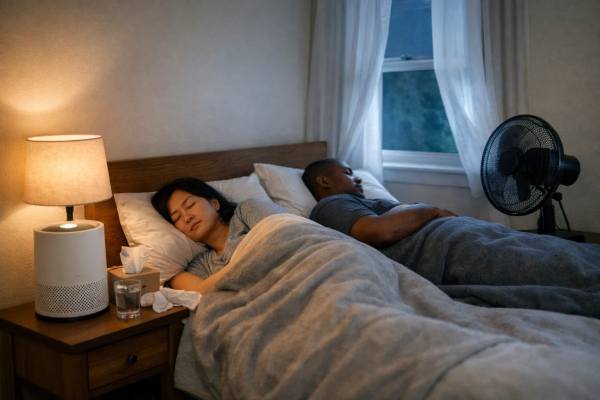
Sharing a bedroom with someone who has a cold, flu, or other respiratory infection can feel like an all-or-nothing situation: either you “catch it” or you don’t. In reality, risk is shaped by small, repeatable choices—especially at night, when you spend hours breathing the same indoor air. The goal is not to sterilize your home or scrub every surface. It is to lower the amount of virus in the air you inhale by improving ventilation, filtration, and room setup in ways that are realistic at 2 a.m.
This guide focuses on airflow strategies that people can actually maintain overnight: creating a clean-air “lane,” placing a HEPA filter where it does the most good, and avoiding common fan mistakes that push air from the sick person toward everyone else. You will also learn when airflow alone is not enough—and what to do next.
Core Airflow Takeaways
- Better airflow and filtration reduce shared-air exposure, especially during long overnight hours.
- The safest “two-person room” setup moves air from the healthier sleeper toward the sick sleeper and then out of the room.
- A properly sized HEPA purifier running continuously is often more effective than frequent surface cleaning.
- Do not aim strong fans directly from the sick person toward the other bed; it can increase short-range exposure.
- If anyone is high-risk or symptoms worsen (wheezing, chest pain, blue lips, confusion), prioritize separation and urgent medical care.
Table of Contents
- Why nighttime sharing raises risk
- A practical airflow plan for two sleepers
- HEPA and DIY filters: what actually helps
- Bed positioning and simple separation moves
- Humidity and comfort without making mold
- Cleaning that matters and what to skip
- When to stop sharing the room and seek care
Why nighttime sharing raises risk
When you sleep near someone who is sick, the main issue is not “germs on pillows.” It is shared air over time. Respiratory viruses spread through a mix of droplets and tiny airborne particles (often called aerosols) that are released when someone breathes, talks, coughs, or clears their throat. Overnight, that exposure becomes more meaningful because you are in the same room for many hours with limited movement and limited fresh-air exchange.
A helpful way to think about risk is the combination of distance, time, and concentration:
- Distance: The air closest to a sick person’s face is usually the most concentrated. If you are within about an arm’s length, short-range exposure dominates even if the room is “well ventilated.”
- Time: Eight hours of low-to-moderate exposure can matter as much as a short period of high exposure.
- Concentration: A smaller, closed bedroom with still air allows exhaled particles to build up. A room with continuous clean-air delivery reduces that build-up.
At night, people also tend to breathe through their mouth more often (especially with congestion), which can increase inhaled volume and dryness. If the sick person coughs during sleep, those bursts can temporarily spike the local concentration in front of them—another reason airflow direction matters.
Two important clarifications keep this practical:
- Ventilation and filtration reduce risk; they do not guarantee zero risk. If you can sleep in separate rooms, that is still the strongest step.
- Air strategies outperform “deep cleaning” for overnight sharing. Wiping every surface repeatedly does not address the fact that the room air is being continuously re-seeded.
The best bedroom plan lowers concentration in two ways at once: it brings in fresh air (ventilation) and removes particles from indoor air (filtration), while also shaping airflow so the healthiest sleeper is not positioned in the sick person’s direct breathing plume.
A practical airflow plan for two sleepers
If two people must sleep in the same room, aim for an airflow pattern that is simple, stable, and quiet enough to keep running all night. Your target is a one-way path: cleaner air near the healthier sleeper, then flow past (or toward) the sick sleeper, then out of the room.
The fastest 10-minute setup
- Pick your “exit.” Ideally, choose a window you can crack open slightly. If there is no usable window, use an exhaust fan in an attached bathroom (if it vents outdoors).
- Create gentle exhaust. Crack the chosen window 2–5 cm (about 1–2 inches) or run the bathroom exhaust fan continuously overnight. This gives stale air a place to go.
- Add controlled incoming air. If possible, crack a second window on the opposite side of the room (or open the bedroom door slightly if the rest of the home is not shared with the sick person). The goal is to avoid a sealed box.
- Use a fan strategically (optional but helpful). Place a small fan near the exit window, blowing outward (or as close as safely possible), to encourage air to leave. Avoid a strong fan that blasts air across both sleepers.
What to avoid
- Do not point a fan from the sick person directly toward the other bed. That can push concentrated air across the room before it dilutes.
- Do not rely on “air stirring.” A fan that only mixes room air without ventilation or filtration can reduce stuffiness but does not reliably reduce exposure.
- Do not create a cold draft on the sick person’s face. It can worsen throat irritation and coughing, and you are more likely to shut the system off at 3 a.m.
If only one window opens
Use it as the exit and keep the rest gentle. Run a HEPA purifier (covered in the next section) and, if you use a fan, keep it low and near the window to support outward flow. If the room gets too cold, shorten the window opening but keep filtration running continuously—steady, lower airflow is often better than short bursts you cannot maintain.
Safety note: If you use gas appliances, a fireplace, or an unvented heater, be cautious about creating strong negative pressure that could draw combustion gases indoors. When in doubt, keep openings modest and rely more heavily on filtration.
HEPA and DIY filters: what actually helps
A portable air cleaner is one of the most reliable “set it and forget it” tools for overnight sharing because it removes particles continuously, even when windows are closed for comfort. The details matter: an underpowered unit running quietly on low may feel reassuring but deliver too little clean air to change exposure meaningfully.
How to size an air purifier for a bedroom
Look for a specification called CADR (clean air delivery rate), usually listed in cubic feet per minute (CFM) or cubic meters per hour (m³/h). As a practical rule:
- A typical bedroom (about 10–14 m² / 110–150 ft²) often benefits from a purifier that can run at a moderate setting overnight while still delivering strong clean-air output.
- If noise is an issue, choose a purifier that is “oversized” for the room so you can run it on a lower, quieter setting while still getting meaningful airflow.
If CADR is not clear, many manufacturers provide a recommended room size. Treat those estimates as best-case. For infection risk reduction, you generally want performance closer to “cleans the room air multiple times per hour,” not “meets minimum for occasional odor control.”
Where to place it when two people share a room
Placement is about protecting breathing zones:
- Best placement: Between the two sleepers but closer to the healthier sleeper, with the clean-air stream oriented so it supports a flow away from the healthy person.
- Alternative: Near the healthier sleeper’s side of the bed, angled so the clean air mixes into that area first, not directly across the sick person’s face.
Avoid placing the purifier behind curtains, under furniture, or tight against a wall. Give it space so it can pull in room air and push out filtered air efficiently.
DIY filtration options
A well-built DIY box-fan filter (often called a “box-fan filter” or “DIY air cleaner”) can deliver surprisingly strong airflow at lower cost. If you use one:
- Use a sturdy setup so it cannot tip at night.
- Keep cords safe and out of walkways.
- Do not run it unattended if the unit feels unstable, overheats, or has damaged wiring.
Whether HEPA or DIY, the key is continuous operation. Overnight consistency beats occasional “high blasts” that disrupt sleep and get turned off.
Bed positioning and simple separation moves
Airflow is powerful, but the simplest “geometry” changes still matter—especially in the first meter (about three feet) from someone’s face. If you cannot separate rooms, aim to separate breathing zones as much as the bedroom allows.
Small moves that reduce face-to-face exposure
- Increase distance. Even moving beds 30–60 cm (1–2 feet) farther apart can reduce direct plume exposure.
- Avoid face-to-face alignment. If you share a bed, consider a head-to-toe arrangement temporarily, or position pillows so faces are not pointed toward each other.
- Use separate bedding. Two blankets reduce nighttime tugging and reduce close face-to-face contact during micro-awakenings.
- Assign “sides.” Keep the sick person on the side closer to the chosen “exit” airflow path when possible.
Should you use a physical barrier?
A barrier can help in certain layouts, but it is not magic. The goal is not to build a wall; it is to interrupt a direct line of exhaled airflow.
- A tall nightstand between beds or a bookcase positioned to block direct face-to-face air movement can help if it does not impede the purifier’s intake and output.
- Avoid hanging fabric “curtains” between sleepers unless you can keep them safely away from heaters, lamps, and purifiers. Fabric can also create dead-air zones that feel stuffy.
Masking and nighttime reality
If the sick person can comfortably wear a well-fitting mask while you are awake in the room (for example, during bedtime routines), that can reduce emitted particles during close contact. Most people cannot tolerate masks for full sleep, and that is okay—focus on what you can maintain: airflow direction, filtration, and distance.
Protect the healthiest sleeper’s breathing zone
If you remember only one positioning rule, make it this: Do not place the healthiest sleeper downwind of the sick person. If you feel a steady draft or fan flow traveling from the sick person toward you, reverse the setup. A quiet, steady clean-air source near the healthier sleeper is often the most practical fix.
Humidity and comfort without making mold
Air quality is not only about particles—it is also about comfort. When people are uncomfortable, they stop using the plan. Two common bedroom problems during illness are over-dry air (worse throat irritation, cough, and nasal dryness) and over-humid air (condensation and mold risk).
A useful humidity target
Many clinicians and indoor-air experts consider moderate humidity (often around the middle range, not extremely dry or very humid) to be the most comfortable for breathing and sleeping. In practice, a common target is roughly 40–60% relative humidity. You do not need to chase a perfect number, but you do want to avoid extremes.
- Too dry: Congestion can feel stickier, nosebleeds are more likely, and cough can worsen from irritation.
- Too humid: Dust mites and mold thrive, and you may see condensation on windows—an early warning sign.
A small digital hygrometer (humidity meter) can help you adjust confidently, especially in winter heating season.
Using a humidifier safely
If you use a humidifier to support comfort:
- Keep it clean and follow the manufacturer’s cleaning schedule; stagnant water can grow microbes.
- Place it so mist does not blow directly onto bedding or walls.
- If windows are cracked open for ventilation, you may need a slightly higher humidifier setting to maintain comfort—but watch for condensation.
Temperature and airflow tradeoffs
A modest window crack may cool the room. Instead of closing everything (and losing airflow), try:
- Adding a layer of blankets (separate blankets work well here).
- Using a lower window opening plus continuous filtration.
- Running the purifier on a steady setting to keep air moving without a cold draft.
Comfort is not a luxury; it is what makes a safer setup sustainable for multiple nights.
Cleaning that matters and what to skip
When someone in the household is sick, many people respond by trying to “out-clean” the virus. The problem is that cleaning can become exhausting and misdirected—especially when the biggest exposure is shared air during long indoor contact.
What is worth doing
Focus on a few high-yield habits:
- Hand hygiene at key moments: After blowing the nose, coughing into hands, handling tissues, or before preparing food.
- High-touch wipe-down once daily: Door handles, light switches, faucet handles, phone screens, bedside tables, remote controls.
- Tissue and trash strategy: Keep tissues and a lined trash bin within reach of the sick person. Tie off and remove trash regularly.
- Laundry with minimal drama: Handle used bedding and towels without shaking them. Wash with regular detergent using the warmest appropriate setting for the fabric, then dry fully.
What to skip (the “over-cleaning” traps)
- Do not disinfect every surface repeatedly. It adds stress, can irritate airways, and often provides diminishing returns.
- Avoid strong-smelling cleaning chemicals in the bedroom. Bleach and harsh sprays can worsen cough and throat irritation—especially in a small room.
- Skip “fogging” or unproven sprays. They can create unnecessary chemical exposure and are rarely needed for routine home illness.
Shared bathroom basics
If the sick person shares a bathroom, prioritize:
- Good ventilation (run the exhaust fan).
- Regular cleaning of high-touch areas.
- Separate towels, toothbrushes, and personal items.
This approach keeps cleaning proportional: enough to reduce obvious contact risks, without turning the home into a constant disinfection project that does not address the primary nighttime exposure pathway.
When to stop sharing the room and seek care
Airflow strategies are a risk reducer, not a cure. Sometimes the correct next step is not “optimize the bedroom,” but “stop sharing the bedroom”—or seek medical attention.
Prioritize separate sleeping spaces when
- Someone is high-risk for severe illness, such as older adults, people with chronic lung disease (asthma with frequent symptoms, COPD), heart disease, diabetes with complications, immune suppression, pregnancy, or serious kidney disease.
- The sick person has frequent coughing fits at night that keep recurring despite hydration and comfort measures.
- The room cannot be ventilated or filtered in a way you can keep running overnight (for example, no workable outlet for exhaust and no purifier).
If you must stay in the same room, consider short-term compromises: one person on a couch, a mattress on the floor in another room, or staggered sleeping arrangements when feasible.
Urgent symptoms that should not be managed at home
Seek urgent care or emergency evaluation if the sick person (or the exposed sleeper) develops:
- Severe or worsening shortness of breath, wheezing, or chest tightness
- Chest pain or pressure
- Blue or gray lips, face, or fingertips
- Confusion, extreme sleepiness, or difficulty staying awake
- Signs of dehydration that do not improve (very dark urine, dizziness, inability to keep fluids down)
For children, rapid breathing, retractions (skin pulling in around ribs), grunting, or poor feeding can be urgent signs.
Timing and contagiousness
Many respiratory viruses are most contagious early, often in the first few days around symptom onset, but contagious periods vary. Plan for your strongest airflow and filtration measures during the period when symptoms are active—especially fever, frequent cough, and heavy congestion—and maintain “good enough” ventilation for a bit afterward if feasible.
The most protective decision is the one you can actually follow: when you cannot sustain the bedroom plan, changing the sleeping arrangement is often safer than forcing a setup that gets abandoned halfway through the night.
References
- Taking Steps for Cleaner Air for Respiratory Virus Prevention | Respiratory Illnesses | CDC 2025 (Guidance)
- Ventilation and Respiratory Viruses | US EPA 2025 (Guidance)
- Roadmap to improve and ensure good indoor ventilation in the context of COVID-19 2021 (Guidance)
- Should homes and workplaces purchase portable air filters to reduce the transmission of SARS-CoV-2 and other respiratory infections? A systematic review – PMC 2021 (Systematic Review)
- Real-World Effectiveness of Portable Air Cleaners in Reducing Home Particulate Matter Concentrations – PMC 2023 (Randomized Crossover Trial)
Disclaimer
This article is for general educational purposes and does not replace individualized medical advice, diagnosis, or treatment. Respiratory symptoms can overlap across many conditions, and the right plan depends on factors such as age, pregnancy, immune status, chronic lung or heart disease, and symptom severity. If you are unsure whether symptoms are “just a cold,” or if breathing difficulty, chest pain, confusion, bluish skin color, or rapid worsening occurs, seek urgent medical care. For product and device decisions (such as air purifiers, humidifiers, or ventilation changes), follow manufacturer safety instructions and local building and fire-safety guidance.
If you found this helpful, consider sharing it on Facebook, X (formerly Twitter), or any platform you prefer so others can set up a calmer, safer bedroom plan when illness hits.