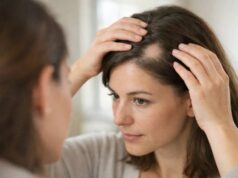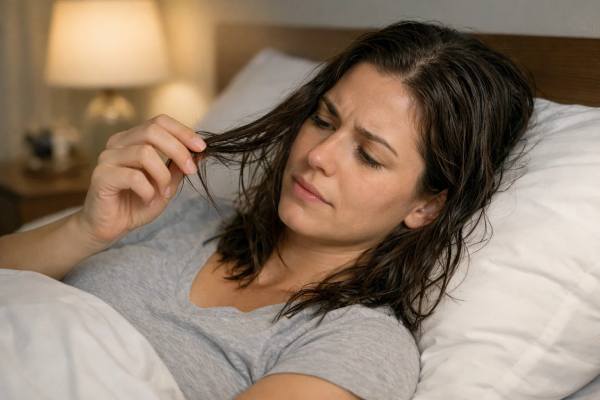
Sleeping with wet hair is one of those habits that feels harmless until the effects start to show up in small, repeatable ways: more tangles at the nape, a rougher surface by morning, a scalp that feels itchy under the roots, or ends that begin to look frayed sooner than expected. The problem is not that water is inherently toxic to hair. It is that wet hair behaves differently from dry hair, and a pillow adds hours of friction, pressure, twisting, and trapped moisture at exactly the moment the fiber is most vulnerable.
That does not mean one late-night shower will ruin your hair. For many people, the real issue is repetition, especially when the hair is bleached, high-porosity, curly, long, fine, or already prone to scalp irritation. This guide explains what actually happens when hair stays wet overnight, how that can contribute to breakage and frizz, which scalp problems are plausible, and the practical steps that reduce damage when bedtime is the only time you have to wash.
Quick Overview
- Wet hair is more vulnerable to stretching, tangling, and surface wear than dry hair.
- Repeated overnight friction can worsen frizz, roughness, and split-end formation over time.
- A damp scalp does not guarantee infection, but it can aggravate itch, flakes, odor, or bumps in susceptible people.
- Sleeping with soaking-wet hair is riskier than sleeping with hair that is only slightly damp.
- Dry the roots first, reduce friction, and keep styles loose if you need to sleep before hair is fully dry.
Table of Contents
- What Really Happens When Hair Stays Wet Overnight
- Why Wet Hair Breaks and Tangles More Easily
- How Overnight Moisture Turns Into Frizz
- When a Damp Scalp Becomes a Scalp Problem
- Who Should Be Most Careful
- Safer Ways to Sleep After a Late Wash
What Really Happens When Hair Stays Wet Overnight
Hair does not simply become “damp” when it is wet. Water enters the fiber, the shaft swells, temporary hydrogen bonds loosen, and the cuticle behaves less like a tightly sealed surface. That matters because hair strength is not just about the cortex deep inside the strand. It is also about how well the cuticle protects the fiber from rubbing, snagging, and repeated deformation.
In daily life, that change is easy to miss. Wet hair can feel softer and more elastic, so people often assume it is safer to manipulate. In reality, that flexibility is part of the problem. A strand that stretches more easily can also be distorted more easily. On a pillow, that means hours of compression, twisting, and fiber-on-fiber friction while you turn your head in sleep.
This is why the question is not simply, “Is water bad for hair?” Water alone is not the villain. The more useful question is, “What happens when wet hair stays under tension and friction for several hours?” That is where the risk rises. Overnight, the hair does not just air-dry in a neutral state. It dries while bent around the scalp, pressed into fabric, and rubbed against itself in repeated small movements.
A few changes are common by morning:
- the root area may still feel damp, even if the ends look dry
- the hair surface may feel rougher or less aligned
- sections at the nape may tangle more than usual
- waves, curls, and cowlicks may dry into flattened or irregular shapes
- the scalp may feel warm, itchy, or stale if moisture stayed trapped
This does not mean every hair type responds the same way. Thick, low-porosity hair may stay damp for longer, especially near the roots, which increases the duration of that stressed state. Fine hair may dry faster, but it can still be more easily stretched or snapped if it is already fragile. Curly and coily hair often holds shape memory strongly, so overnight drying can create dents, flattening, or frizz that is hard to smooth out the next day.
It is also important to separate occasional exposure from repeated habit. One night of sleeping with wet hair will not usually produce dramatic visible damage unless the hair is already compromised. The more noticeable effects tend to build gradually: more roughness, less shine, more snags, more broken shorter hairs around the crown and nape, and styles that stop behaving as predictably as they used to.
If you have heard the phrase “water damage” applied to hair, the more precise idea is repeated swelling plus handling stress, not water acting like bleach or heat. That distinction matters because it points toward practical prevention. You do not need to fear water. You need to reduce the amount of time hair spends wet while rubbing, bending, and drying under pressure. A deeper look at repeated wetting and swelling effects can help explain why this pattern becomes more obvious over time.
Why Wet Hair Breaks and Tangles More Easily
Wet hair is usually more vulnerable to mechanical damage than dry hair, but the way that damage shows up is often misunderstood. Most people do not wake up and find a dramatic pile of snapped strands on the pillow. Instead, the damage appears indirectly: more knots, more resistance while detangling, more mid-length snapping during brushing, and a growing halo of uneven short hairs that looks like frizz but is partly breakage.
The reason starts with the structure of the fiber. When hair is wet, it stretches more readily. That can sound positive, yet it means the strand can be deformed further before you feel obvious resistance. Add friction from a pillowcase, twisting from sleep movement, and tangling between neighboring strands, and the hair is more likely to reach a point where the cuticle lifts, the surface abrades, or a weakened area gives way.
Breakage risk rises even more when one or more of these factors are present:
- bleach or high-lift color
- highlights or frequent toning
- heat styling several times a week
- relaxed, straightened, or keratin-altered hair
- long hair with older, weathered ends
- brushing aggressively while still damp
- sleeping in a tight bun, braid, or clip while wet
This is one reason people confuse breakage with hair loss. Breakage is damage to the shaft. Hair loss is shedding from the follicle. If you see many shorter pieces without the white club bulb at one end, that usually points to breakage rather than true shedding. That distinction matters because the fix is different. A fragile shaft needs less friction, less tension, and better surface protection. A shedding disorder needs a scalp or medical evaluation. A side-by-side explanation of breakage versus hair loss can make that easier to identify.
Hair texture changes the pattern. Straight to wavy hair often shows more obvious tangling, flattening, and mid-length friction when slept on wet. Curly and coily hair can also break, but the risk often comes through knotting, shrinkage, and difficult next-day detangling rather than a visibly flattened surface. In both cases, chemically processed hair is less forgiving because the protective lipid layer and cuticle integrity are already partly compromised.
The most overlooked area is the nape. Hair there is pressed between scalp and pillow for hours, often while staying wetter than the crown. It is also rubbed by collars, sleepwear, and head turning. That makes it a common site for hidden tangling and gradual wear. People sometimes think their ends are splitting “randomly” when the real pattern began higher up with nightly friction and then progressed downward.
What matters most is repeated exposure. Hair can tolerate a lot in isolated episodes. The more often wet fibers are rubbed, bent, and detangled after overnight tangling, the more cumulative damage you see. In that sense, sleeping with wet hair is rarely a single catastrophic event. It is a low-grade mechanical stress that becomes visible once enough nights have added up.
How Overnight Moisture Turns Into Frizz
Frizz is not just “poofy hair.” It is often a visible sign that neighboring strands are no longer lying in a smooth, unified pattern. Some of that comes from natural texture, humidity, and static. But some of it comes from a rougher fiber surface, irregular drying, and misaligned cuticles. Sleeping with wet hair encourages all three.
When hair dries in motionless, controlled conditions, it tends to settle more evenly. When it dries while pinned under a shoulder, folded behind the neck, or twisted under the head, it takes on shape distortions as it loses water. That is why hair can look both flattened and frizzy at the same time the next morning. The roots may be compressed, while the mid-lengths and ends spring out in different directions.
Several mechanisms drive that effect:
- cuticles do not dry back into identical positions after friction
- sections of hair dry at different speeds across the head
- pattern memory changes as hair dries bent or twisted
- tangles create localized roughness and lift
- pillow friction separates grouped strands into a fuzzier surface
This matters even more for textured hair. Waves and curls depend on consistent grouping. When wet curls are crushed against bedding overnight, some clumps break apart, some dry stretched, and others shrink unevenly. The result is often less definition, more surface fuzz, and a shape that feels harder to refresh. People may then use more brushing or heat the next day, which adds another round of damage.
Fine straight hair has a different problem. It may dry into sharp bends, flattened root sections, or a rough top layer that looks dull rather than shiny. The style may also lose direction. A part that normally sits cleanly can split or fall awkwardly because the roots dried under pressure instead of upright.
The role of fabric is easy to underestimate. Cotton absorbs water well, which can help a little with surface moisture, but it also creates more drag than smoother materials. That means the hair may dry while being repeatedly rubbed against a relatively high-friction surface. Satin or silk can reduce some of that drag, though they do not eliminate the basic issue of overnight distortion. The main gain is less rubbing while the strand is vulnerable.
If frizz is already a recurring issue, bedtime habits may be adding more to the picture than your shampoo does. A routine focused only on anti-frizz serums often misses the deeper cause: the hair is drying into friction and disorder before the morning even begins. A practical guide to a frizz-focused moisture routine can help, but the first improvement is often behavioral rather than cosmetic.
This is also why the phrase “let it air-dry overnight” can be misleading. Overnight drying is not the same as calm daytime air-drying. In one case, hair dries with minimal movement. In the other, it dries while compressed and rubbed for six to eight hours. That difference is enough to change both the look and the feel of the fiber by morning.
When a Damp Scalp Becomes a Scalp Problem
The scalp side of this topic deserves a more careful answer than most internet advice gives. Sleeping with wet hair does not automatically cause a scalp infection, and it does not turn a healthy scalp into a diseased one overnight. But prolonged dampness at the roots can still be a problem, especially when it combines with oil, sweat, product buildup, or an already reactive scalp.
The most realistic concern is aggravation rather than sudden disease. A scalp that is already prone to dandruff, seborrheic dermatitis, itching, odor, or follicular irritation may tolerate repeated overnight dampness poorly. The roots stay warm, partially occluded, and slow to dry, especially at the crown and nape. For some people, that environment is enough to intensify itch, scaling, greasiness, or a stale scalp feel by the next day.
Patterns that are more plausible than sensational include:
- itch that is worse the morning after sleeping on wet roots
- increased flaking if dandruff or seborrheic dermatitis is already present
- scalp odor from prolonged moisture and trapped oils
- tender or itchy follicular bumps in areas of friction
- a feeling of heaviness or residue at the roots despite freshly washed hair
Seborrheic dermatitis is especially relevant because it thrives in oil-rich, inflamed environments and often flares when the scalp barrier is stressed. Sleeping with wet roots does not create this condition from nothing, but it can worsen the cycle in people who already have it or sit near that threshold. If flakes tend to be greasy, itchy, or concentrated at the hairline and behind the ears, a guide to seborrheic dermatitis signs and triggers may help you identify the pattern.
Follicular bumps are another possibility, though they are less common than generic itch and flaking. These bumps may come from irritation, occlusion, yeast-related folliculitis, bacterial folliculitis, or reactions to product left too close to the scalp. The clue is not simply “I slept with wet hair once.” It is a repeated link between damp roots and itchy, pimple-like lesions or tender spots.
Scalp type matters here. Oily, dense, or low-porosity hair can hold moisture at the base for a long time. Extensions and thick roots can make that even more pronounced because airflow is reduced. A sensitive scalp may also respond badly to the combination of a damp environment and overnight friction, even without any true infection.
What should make you more cautious is not mild morning flattening. It is persistent itching, new bumps, greasy yellowish flakes, scalp soreness, or a musty smell that keeps returning. Those signs suggest the issue has moved beyond simple inconvenience. In that case, drying the roots more thoroughly and simplifying scalp products is a reasonable first step. If symptoms keep returning, it is worth considering whether the scalp needs a treatment plan rather than just a styling adjustment.
Who Should Be Most Careful
Not everyone pays the same price for sleeping with wet hair. Some people do it occasionally with little obvious effect. Others see damage quickly. The difference usually comes down to the condition of the fiber, the speed of drying, and the scalp’s tolerance for prolonged dampness.
The highest-risk group is chemically processed hair. Bleached, highlighted, relaxed, permed, or repeatedly heat-styled hair already has a more weathered cuticle. When that type of hair is slept on wet, the margin for friction and tangling is smaller. The fiber is less resilient, which means the same pillow movement that leaves one person with minor bedhead can leave another with new breakage and roughness.
High-porosity hair is another group to watch closely. Porous hair takes in water readily and often loses it unevenly. That can create a cycle of swelling, roughness, and frizz that becomes more obvious after nighttime washing. If you are trying to work out whether your hair absorbs moisture too quickly or struggles to hold a smooth finish, a guide to hair porosity patterns can help clarify why overnight wetness hits some hair harder than others.
People with long hair also face more mechanical exposure. There is simply more surface area to tangle, compress, and rub against bedding. The older the ends, the more weathered they usually are. That makes overnight wet sleep especially unhelpful when you are trying to preserve length.
Hair texture changes the specific risk:
- fine hair may flatten, bend, and snap more easily
- straight and wavy hair may show more obvious friction frizz and tangling
- curly hair may lose clump definition and gain surface fuzz
- coily hair may form knots or shrink into harder-to-detangle sections if slept on while very wet
Scalp history matters too. If you are prone to dandruff, seborrheic dermatitis, scalp acne, folliculitis, or itching after workouts, damp roots are less likely to feel neutral. People with extensions, dense roots, or consistently slow-drying hair should also be more careful because the base can stay wet for hours after the surface feels dry.
Children, teens in heavy sports gear, and adults who sleep hot may notice scalp effects sooner because sweat, occlusion, and pillow contact compound the dampness. The same applies to anyone who uses heavy oils, root powders, or leave-in products too close to the scalp before bed.
Who tends to tolerate the habit better? Usually someone with healthy, unprocessed hair, a scalp that is not reactive, shorter length, and roots that are only slightly damp rather than soaked. Even then, “tolerates it” is not the same as “benefits from it.” Many people simply do not notice the cost until they compare a few weeks of drying the roots first with a few weeks of not doing it. The difference often appears in detangling ease, shine, and scalp comfort more than in dramatic breakage.
Safer Ways to Sleep After a Late Wash
Sometimes the perfect routine is not realistic. You wash late, you are tired, and bedtime arrives before your hair is fully dry. In that situation, the goal is not perfection. It is damage control. The biggest win is reducing how wet the roots and mid-lengths still are when your head hits the pillow.
A practical rule is to avoid sleeping on soaking-wet hair. Slightly damp is very different from saturated. The closer the hair is to mostly dry, especially at the scalp, the lower the risk of overnight friction, prolonged root dampness, and next-day frizz.
A useful bedtime sequence looks like this:
- Gently squeeze out excess water with a soft towel or microfiber wrap.
- Let hair air-dry for a short stretch before styling or lying down.
- Dry the roots first if you use a dryer, because scalp moisture tends to linger longest.
- Apply leave-in conditioner or a light serum to the lengths only if your hair tangles easily.
- Use a loose protective style rather than a tight one.
The best protective styles are simple:
- a loose braid for longer straight or wavy hair
- a loose pineapple for curls once they are mostly dry
- a very soft low ponytail if it does not create tension
- a bonnet or low-friction sleep surface if it suits your texture and routine
What to avoid matters just as much:
- tight buns on wet hair
- clips that bend the shaft sharply
- brushing aggressively right before bed
- sleeping with heavy oil sitting on the scalp
- trapping very wet hair inside a dense wrap for hours
If detangling is part of your routine, be strategic. Wet hair is not a good moment for force. Use fingers or a wide-tooth comb, work from the ends upward, and add slip first if needed. A detailed guide to detangling wet and dry hair can help you match technique to texture.
Fabric can help at the margins. A smoother sleep surface may lower friction, and some people notice less morning roughness with a satin bonnet or a lower-drag pillowcase. The effect is supportive, not magical. It does not make sopping-wet hair suddenly safe, but it can reduce one part of the stress.
The most efficient compromise is often simple: dry the scalp and roots, leave the lengths slightly damp, and keep the style loose. That preserves far more hair quality than either extreme of going to bed with dripping hair or blasting the whole head with high heat just to get it done. If you are comparing sleep setups, a guide to low-friction sleep protection can help you choose the option that best fits your hair type and budget.
If you notice persistent scalp itching, repeated bumps, or breakage that does not improve after changing your routine, that is the point to look beyond bedtime habits and consider a scalp or hair-shaft problem that needs more specific care.
References
- Comparing hair tensile testing in the wet and the dry state: Possibilities and limitations for detecting changes of hair properties due to chemical and physical treatments 2022
- On Hair Care Physicochemistry: From Structure and Degradation to Novel Biobased Conditioning Agents 2023 (Review)
- Understanding and controlling the friction of human hair 2025 (Review)
- Scalp Seborrheic Dermatitis: What We Know So Far 2023 (Review)
- A Practical Algorithm for the Management of Superficial Folliculitis of the Scalp: 10 Years of Clinical and Dermoscopy Experience 2023 (Review)
Disclaimer
This article is for educational purposes only and is not a substitute for medical advice, diagnosis, or treatment. Persistent scalp itching, painful bumps, worsening flakes, scalp odor, patchy hair loss, or marked breakage can have causes beyond bedtime hair habits, including inflammatory scalp conditions, infection, and structural hair-shaft damage. Seek care from a qualified clinician if symptoms are ongoing, severe, or unclear.
If this article was useful, please share it on Facebook, X, or another platform you use so more readers can make better decisions about late-night washing, scalp comfort, and preventing avoidable hair damage.