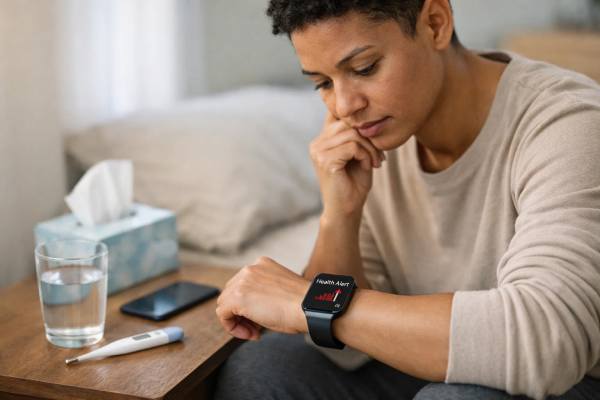
If you wear a smartwatch or fitness ring long enough, you may eventually see a message that feels oddly personal: you might be getting sick. These alerts can be useful—sometimes your body shows signs of strain before your throat hurts or your nose runs. The same sensors that track sleep and workouts can also pick up subtle shifts in resting heart rate, heart rate variability (HRV), skin temperature trends, and breathing patterns. Used well, this information can help you make low-regret decisions: sleep more, ease up on training, test earlier, and avoid spreading a virus to others.
But it helps to know what these signals can and cannot tell you. Wearables do not diagnose flu, COVID-19, or pneumonia. They flag a pattern: your baseline has changed. Understanding that distinction turns a scary notification into something practical.
Essential Insights
- A “getting sick” alert usually means your metrics have shifted from your personal baseline, not that a specific illness is confirmed.
- The most useful pattern is multiple changes at once, such as higher resting heart rate plus lower HRV plus worse sleep.
- Alcohol, poor sleep, travel, hard workouts, and stress can trigger the same pattern and create false alarms.
- Treat an alert as a prompt to check symptoms and exposures and choose lower-risk behavior for 24–48 hours.
- For best signal quality, wear the device consistently overnight and compare trends across at least 2–3 nights.
Table of Contents
- What illness alerts are detecting
- Resting heart rate shifts and early illness
- HRV trends and why they drop
- Temperature and breathing signal changes
- How to respond without overreacting
- Who gets the most and least value
- Common confounders and data quality fixes
What illness alerts are detecting
Most “you might be getting sick” features are not looking for a single number that crosses a universal threshold. They are looking for change over time—your normal pattern compared with what your body is doing now. That is why two people can get the same virus and receive very different alerts. Your wearable is, in effect, asking: “Is today unusually stressful for you?”
Baseline is the hidden engine
Wearables work best when they have enough history to learn your typical range during sleep and rest. That baseline is usually built from nights when you wore the device consistently, slept reasonably well, and were not acutely ill. Many systems weigh recent weeks more heavily than months-old data so the baseline reflects your current fitness, schedule, and season.
Practical takeaway: if you only wear your watch sometimes, the alert becomes less trustworthy because the device is comparing you to an incomplete “normal.”
What the alert really means
In plain terms, an illness alert typically means one or more of these is happening versus your baseline:
- Resting heart rate is higher than usual.
- HRV is lower than usual.
- Skin temperature trend is elevated versus your normal night-to-night pattern.
- Breathing rate is higher than usual during sleep.
- Sleep is more fragmented, shorter, or unusually restless.
- Activity pattern changed, often with fewer steps or less intensity.
This pattern is common with respiratory viruses, but it is also common with heavy training blocks, poor sleep, dehydration, anxiety, and even a single night of higher alcohol intake. The device usually cannot tell which cause is responsible. It flags strain, not a diagnosis.
Think in patterns, not single points
A single odd night is information, but it is rarely decisive. The most useful alerts are those that show a consistent change over 2–3 nights or a cluster of signals that shift together. In other words, your wearable is best at noticing “something is off,” then letting you decide what to do next with symptoms and context.
Resting heart rate shifts and early illness
Resting heart rate (RHR) is often the most intuitive illness signal. When your immune system ramps up, your body’s demand for energy and circulation can increase—especially if fever is starting or sleep quality is falling. Many people notice a higher-than-usual RHR 24–48 hours before they feel obviously sick, particularly with viral infections.
What counts as a meaningful change
RHR naturally varies. A stressful day, a late meal, dehydration, or poor sleep can push it up. Instead of obsessing over a single number, look for a change that is unusual for you.
Many wearable users find these guidelines practical:
- A sustained rise of about 5–10 beats per minute above your usual sleeping RHR across at least two nights is often worth paying attention to.
- A smaller rise can matter if it happens alongside other changes, such as lower HRV and more wake-ups.
If your device reports both daytime RHR and sleeping RHR, the sleeping value is often more stable because it is less influenced by movement, caffeine timing, and daily stressors.
Why colds and flu can push RHR up
Common contributors include:
- Fever or early temperature elevation.
- Increased inflammatory signaling that changes autonomic balance.
- Reduced sleep depth and more awakenings.
- Mild dehydration from faster breathing or reduced intake.
- Congestion and mouth breathing that fragment sleep.
The same reasons explain why you might see a higher RHR with a non-infectious trigger, such as an intense workout, a night of short sleep, or a period of high work stress.
When a high RHR is more concerning
A wearable cannot evaluate you, but it can highlight a trend. Pay closer attention if RHR is high and you also have:
- shortness of breath at rest,
- chest pain,
- fainting, confusion, or severe weakness,
- oxygen saturation readings that are persistently low (if your device tracks it),
- a high fever that is not improving.
For most people, an RHR bump is a cue to reduce load: hydrate, sleep earlier, and treat the next day as a “recovery day.” If RHR stays elevated for several days after other symptoms resolve, it may simply reflect a slower return to baseline—but it can also be a prompt to pace yourself and avoid rushing back into hard training.
HRV trends and why they drop
HRV—heart rate variability—is the small variation in time between heartbeats. Many wearables estimate HRV during sleep because it is the cleanest window for measurement. HRV is often described as a recovery or resilience marker. That framing is useful as long as you remember one rule: HRV is personal. Comparing your HRV to your friend’s is rarely meaningful.
Why HRV often falls before or during illness
Many infections tilt the nervous system toward a higher “alert” state. That shift can reduce vagal tone and lower HRV, especially when paired with poor sleep. A falling HRV trend can also show up when you are overreaching in training, under-fueling, traveling across time zones, or experiencing prolonged stress.
In respiratory illness, HRV is often most informative when it changes with other metrics:
- Lower HRV plus higher RHR is a classic “strain” pattern.
- Lower HRV plus rising breathing rate may suggest your body is working harder during sleep.
- Lower HRV plus fragmented sleep can reflect nasal congestion and repeated arousals.
How big does the drop need to be
Because devices use different HRV methods and smoothing, absolute cutoffs are unreliable. A practical approach is to watch your own range:
- A noticeable drop from your typical nightly pattern that persists for 2–3 nights is more meaningful than a single low value.
- A moderate drop can matter more than a large drop if it is paired with a clear symptom change, such as sore throat, chills, or unusual fatigue.
Common HRV false alarms
HRV is sensitive. These can lower it even when you are not sick:
- Alcohol, especially within a few hours of bedtime.
- Late heavy meals that increase heart rate and disrupt sleep.
- A hard workout late in the day.
- Anxiety, acute stress, or rumination at night.
- Travel, jet lag, or sleeping in a new environment.
If your wearable issues a sickness alert after one of these triggers, it is not “wrong.” It is doing what it was built to do: flag physiology that looks strained. Your job is to interpret why.
A helpful mindset is to treat HRV like a smoke detector. It is designed to be sensitive. Sensitivity is useful, but it means you will occasionally get a “burnt toast” alert. Context keeps you from panicking—and still helps you respond early when the signal is real.
Temperature and breathing signal changes
Temperature and breathing signals often feel the most “medical,” but they are also the easiest to misunderstand. Most consumer wearables measure skin temperature, not core body temperature. That can still be valuable because the device is usually tracking deviation from your own pattern, not trying to label you with a fever.
How temperature trends can help
Skin temperature can rise with infection, but it can also rise with:
- a warm bedroom,
- heavier bedding,
- alcohol,
- late exercise,
- hormonal cycle changes,
- stress-related changes in circulation.
The strength of wearable temperature is not precision; it is trend detection. Many people see a small, sustained upward shift versus their baseline during viral infections, sometimes before daytime symptoms feel obvious.
Practical interpretation:
- A small temperature deviation that lasts one night may be noise.
- A deviation that persists for 2–3 nights and aligns with higher RHR, lower HRV, or new symptoms is more compelling.
Breathing rate and sleep disruption
Some wearables estimate breathing rate during sleep using motion and heart-related signals. A modest rise can happen when your body is working harder or when nasal congestion changes how you breathe.
Breathing-rate changes can be especially useful when:
- your throat feels “off” but you are unsure whether it is allergies or illness,
- you are developing cough and your sleep becomes more fragmented,
- your device also shows a drop in sleep quality or more wake-ups.
Oxygen saturation and its limits
If your device tracks oxygen saturation, remember that consumer measurements can be sensitive to motion, fit, cold hands, and skin factors. A single low reading is rarely enough to interpret. Trends and repeated low values, especially with shortness of breath, deserve more attention than an isolated dip.
Why multi-signal agreement matters
Temperature, breathing rate, RHR, and HRV each have limitations. When two or three shift together in the same direction, the chance that you are seeing a meaningful physiological change increases. This “signal agreement” concept is one of the most practical ways to use wearables during cold and flu season: treat single-sensor changes as hints, and treat clusters as stronger prompts to act.
How to respond without overreacting
The best response to a sickness alert is not panic. It is a short, structured check that reduces your risk and helps you recover faster if you truly are coming down with something. Think of it as a 24–48 hour “decision window.”
Step 1: sanity-check the context
Before assuming infection, ask:
- Did I drink alcohol last night?
- Did I sleep much less than usual?
- Was there a late hard workout or unusually heavy meal?
- Am I traveling, sleeping in a new place, or under unusual stress?
- Is my bedroom warmer than usual?
If one of these clearly explains the change, treat the alert as a recovery reminder rather than a sickness prediction.
Step 2: scan for early symptoms
Early respiratory symptoms can be subtle. Look for:
- scratchy throat, mild cough, or nasal irritation,
- unusual fatigue or “heavy legs,”
- chills, headache, or body aches,
- a new change in appetite,
- a sense that workouts feel harder than they should.
If symptoms match the alert, you have a stronger reason to take precautions.
Step 3: choose low-regret actions for 24–48 hours
These actions make sense even if the alert turns out to be a false alarm:
- Prioritize sleep and hydration.
- Reduce training intensity and avoid maximal efforts.
- Increase ventilation in shared spaces.
- Consider masking in crowded indoor settings if respiratory illness is circulating.
- If you have symptoms or a known exposure, follow your local testing and isolation guidance.
Step 4: watch for improvement or escalation
Most false alarms resolve quickly. If your metrics begin returning toward baseline within 1–2 nights and you feel fine, you can usually resume normal activity gradually.
Escalate your response if:
- metrics worsen over several nights,
- fever develops,
- breathing becomes difficult,
- cough becomes severe or chest pain appears,
- you have a high-risk condition and symptoms are progressing.
A wearable is not a clinician, but it can help you time your caution. Used well, the alert becomes a prompt to protect your sleep, protect others, and seek help sooner if your body is clearly deteriorating.
Who gets the most and least value
Sickness alerts are most useful when your baseline is stable and your body’s responses follow consistent patterns. They can be less reliable when the underlying signals are already noisy, heavily medication-influenced, or affected by rhythm issues.
People who often benefit most
- Those with consistent routines: regular sleep timing and consistent device wear produce cleaner baselines.
- Caregivers and parents: an early prompt can encourage extra caution before visiting older relatives or attending crowded events.
- Frequent travelers: wearables can highlight when your body is strained, even if you try to push through.
- Athletes in training blocks: alerts can support smarter recovery decisions and reduce the temptation to “train through” early illness.
Situations where alerts can be less reliable
- Irregular sleep schedules: shift work, frequent late nights, or insomnia can distort HRV and resting heart rate patterns.
- Certain heart rhythm issues: irregular rhythms can confuse HRV estimation and reduce accuracy.
- Medication effects: drugs that raise or lower heart rate can change the signal without reflecting infection.
- High baseline stress or anxiety: frequent sympathetic activation can produce repeated “strain” patterns.
Higher-risk groups should treat alerts differently
If you are older, immunocompromised, pregnant, or managing chronic lung disease, a wearable alert should not replace symptom-based decisions. It can still help you notice subtle strain earlier, but you should rely more heavily on:
- symptom changes,
- known exposures,
- objective measurements you trust (such as a reliable thermometer),
- earlier contact with a clinician if symptoms worsen.
Children and teens
Most illness-alert ecosystems are not designed with pediatric validation in mind. If a teen uses a wearable, it may still be useful for noticing sleep and recovery changes, but the family should prioritize age-appropriate medical guidance over app interpretations.
The most balanced approach is to treat sickness alerts as a supportive tool: helpful for timing and awareness, but never a substitute for common-sense precautions or medical evaluation when symptoms warrant it.
Common confounders and data quality fixes
If you want your wearable’s illness alerts to be useful, the highest-leverage move is improving signal quality and reducing predictable confounders. Many “false alarms” are not errors; they are the device faithfully reflecting strain from a non-infectious cause.
Top confounders that mimic illness
These can raise resting heart rate and lower HRV in ways that resemble early infection:
- Alcohol, especially close to bedtime.
- Short sleep, late nights, or repeated awakenings.
- Hard training, particularly late-day intensity.
- Dehydration or low carbohydrate intake during heavy activity.
- Psychological stress, acute anxiety, or prolonged work strain.
- Travel, jet lag, and sleeping in unfamiliar environments.
Temperature trends can be confounded by room heat, heavy bedding, and hormonal cycle changes. Breathing rate can be confounded by allergies, nasal congestion from dry air, and sleeping position.
Medication and supplement effects to consider
Some common examples:
- Decongestants and stimulants can raise heart rate and make sleep lighter.
- Thyroid medication changes can shift heart rate trends.
- Beta blockers can lower heart rate and blunt the size of changes you would otherwise see.
- Some sleep aids may improve sleep continuity while altering sleep-stage estimates.
If you start a new medication and suddenly receive repeated sickness alerts, consider timing and side effects as part of your interpretation.
Data-quality fixes that make alerts smarter
You do not need perfection—just consistency.
- Wear the device snugly enough to prevent light leaks, especially overnight.
- Aim for consistent overnight wear, even on rest days.
- Keep the sensor clean and dry.
- Avoid switching wrists or changing device placement frequently.
- Treat “one weird night” as a data point, not a conclusion.
A simple interpretation rule
When in doubt, use a three-part check:
- One signal changed: treat it as a hint.
- Two signals changed: treat it as a prompt to recover and monitor.
- Three or more signals changed, especially with symptoms: treat it as a strong reason to reduce exposure risk and prioritize rest.
This approach keeps you from overreacting to noise while still acting early when your body’s pattern clearly shifts.
References
- The performance of wearable sensors in the detection of SARS-CoV-2 infection: a systematic review – PMC 2022 (Systematic Review)
- Wearable technology for early detection of COVID-19: A systematic scoping review – PMC 2022 (Scoping Review)
- Detection of Common Respiratory Infections, Including COVID-19, Using Consumer Wearable Devices in Health Care Workers: Prospective Model Validation Study – PMC 2024
- Smartwatch-based algorithm for early detection of pulmonary infection: Validation and performance evaluation – PMC 2024
- Validation of nocturnal resting heart rate and heart rate variability in consumer wearables – PMC 2025
Disclaimer
This article is for educational purposes and does not provide medical advice, diagnosis, or treatment. Smartwatch and ring alerts are not diagnostic and can be triggered by non-illness factors such as stress, alcohol, poor sleep, travel, and training load. If you have significant symptoms, worsening breathing, chest pain, confusion, coughing up blood, high fever that persists, or you are at higher risk due to age, pregnancy, or chronic medical conditions, seek timely care from a licensed clinician.
If you found this article useful, please consider sharing it on Facebook, X (formerly Twitter), or any platform you prefer.