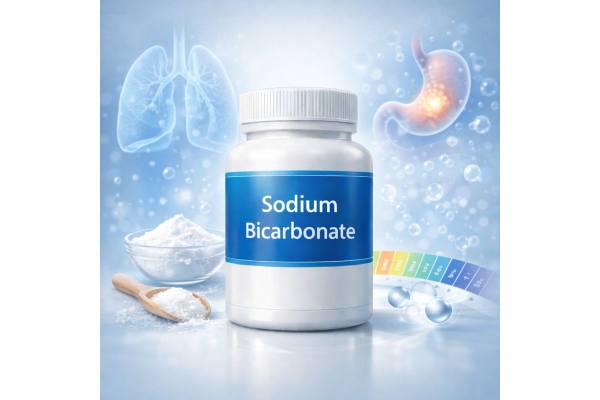
Sodium bicarbonate is best known as common baking soda, but in health and nutrition it is far more than a kitchen ingredient. This simple salt, made of sodium and bicarbonate ions, acts as a powerful buffer that helps neutralise acids in the stomach and blood. It is used medically to correct acid–base imbalances, as an over-the-counter antacid, and by some athletes seeking small improvements in high-intensity performance.
At the same time, it is not a harmless home remedy in higher or repeated doses. Sodium bicarbonate carries a significant sodium load, can disturb blood pH and electrolytes, and may interact with medications or underlying conditions such as kidney, heart, or lung disease.
This guide explains how sodium bicarbonate works, potential benefits, evidence for its use in digestion and sport, practical dosing ranges, and safety limits. The goal is to help you understand where it genuinely fits, when it should remain a prescription-level therapy, and why medical supervision is essential for anything beyond occasional short-term use.
Key Insights for Sodium Bicarbonate
- May relieve occasional heartburn and acid indigestion and can improve some high intensity exercise performance when used correctly.
- Acts as a systemic buffer that can help correct metabolic acidosis in selected medical settings under specialist supervision.
- Typical sports use is around 0.2–0.3 g per kg body weight taken 60–90 minutes before intense exercise.
- High or repeated doses may cause sodium overload, alkalosis, and electrolyte shifts, especially in people with kidney, heart, or lung disease.
- Individuals with uncontrolled hypertension, oedema, advanced kidney disease, or on strict sodium restriction should avoid unsupervised sodium bicarbonate use.
Table of Contents
- What is sodium bicarbonate and how is it used?
- How sodium bicarbonate works in the body
- Health benefits and practical uses
- How to take sodium bicarbonate safely
- Dosage guidelines for different goals
- Side effects, interactions, and who should avoid it
- Summary of evidence and research perspective
What is sodium bicarbonate and how is it used?
Sodium bicarbonate (chemical formula NaHCO₃) is an alkaline salt that dissociates into sodium and bicarbonate ions in water. In everyday life it appears as a white crystalline powder widely used in baking, cleaning, and odour control. In health contexts it is used as an oral antacid, an ingredient in some effervescent tablets, and a prescription medication for specific acid–base disorders.
As an over-the-counter product, sodium bicarbonate is approved to relieve heartburn, acid indigestion, and upset stomach. It works quickly by neutralising gastric acid, often within minutes, which explains its popularity as an inexpensive home remedy.
In hospitals, sodium bicarbonate is given intravenously for acute or chronic metabolic acidosis, such as in severe kidney disease, some drug overdoses, or life-threatening lactic acidosis, where blood pH is dangerously low. In these settings, dosing is individualised using blood tests, and close monitoring is mandatory because both under- and over-correction can be harmful.
A third, more specialised use is sports performance. Athletes in events that generate high levels of acid in the muscles, such as rowing, sprinting, combat sports, or intense interval training, sometimes take sodium bicarbonate before competition. The aim is to increase blood buffering capacity so that muscles can tolerate acid better, delaying fatigue by a small but meaningful margin.
Beyond these evidence-based indications, sodium bicarbonate appears in various “alkalising” or detox regimes and social media trends. Many of these uses lack solid clinical data and may ignore safety limits, especially for people with restricted sodium intake. It is important to separate grounded medical and performance uses from speculative wellness claims.
How sodium bicarbonate works in the body
To understand the benefits and risks of sodium bicarbonate, it helps to look at basic acid–base physiology. Bicarbonate is one of the main buffering systems in the blood. It reacts with hydrogen ions (acids) to form carbonic acid, which then converts to carbon dioxide and water. The lungs excrete carbon dioxide, and the kidneys regulate bicarbonate levels over hours to days.
When you swallow sodium bicarbonate, it dissolves, and bicarbonate can neutralise gastric acid in the stomach by forming carbon dioxide and water with salt. This reduces acidity and relieves heartburn. Some of the bicarbonate is absorbed into the bloodstream, where it can slightly raise blood pH and bicarbonate levels, providing systemic buffering.
In sports performance, this rise in extracellular bicarbonate is the key mechanism. Higher blood bicarbonate allows more hydrogen ions produced by working muscles to move out of the muscle cells into the blood, delaying the drop in intracellular pH that contributes to fatigue. This mechanism appears most relevant for intense efforts lasting from roughly forty-five seconds to ten minutes, where anaerobic metabolism is prominent.
In medical settings, especially chronic kidney disease, the kidneys may not regenerate enough bicarbonate, leading to chronic metabolic acidosis. Supplementing bicarbonate helps restore a more normal blood pH, which can support bone and muscle health and may slow the progression of kidney damage in selected patients. Modern guidance tends to reserve treatment for more clearly defined acidosis rather than for mild changes alone.
The same chemical properties that make sodium bicarbonate useful can also be harmful in excess. Rapid or high-dose administration can push blood pH too high (metabolic alkalosis), cause shifts of potassium and calcium, retain sodium and water, and produce excess carbon dioxide that people with lung disease may not exhale effectively.
Overall, sodium bicarbonate should be viewed as a targeted tool that meaningfully influences acid–base status, rather than a general-purpose wellness supplement.
Health benefits and practical uses
Sodium bicarbonate can offer several well-defined benefits when used correctly and in the right population. The most established areas are digestive relief, management of metabolic acidosis in specific diseases, and enhancement of some forms of exercise performance.
Digestive support and symptom relief
As an antacid, sodium bicarbonate can reduce symptoms of occasional heartburn, acid indigestion, or sour stomach. It acts quickly and may be useful when other options are not available. However, because it produces carbon dioxide gas, it can cause belching and bloating, and repeated use for chronic reflux is not recommended when more controlled therapies, such as acid-suppressing medications and lifestyle measures, are available.
Correction of metabolic acidosis in disease
In chronic kidney disease, chronic acid retention contributes to bone demineralisation, muscle wasting, and faster decline in kidney function. Oral bicarbonate therapy, often in the form of sodium bicarbonate tablets, can correct low bicarbonate levels and improve biochemical markers. At the same time, the extra sodium can worsen blood pressure or fluid retention in some patients, so treatment decisions now place emphasis on the severity of acidosis, cardiovascular risk, and close monitoring.
Exercise performance
For trained athletes, sodium bicarbonate supplementation can produce small to moderate improvements in performance for high-intensity, short-to-medium duration efforts. Research reports average performance gains of a few percent for suitable events, although individual responses vary and gastrointestinal side effects are common without careful dosing strategies. It is most relevant for competitive athletes who have already optimised training, nutrition, and basic recovery.
Potential roles under investigation
Researchers are studying whether bicarbonate may aid recovery between repeated bouts of exercise in the same day and how it influences markers of cellular stress and muscle damage after strenuous exercise. Early findings suggest it might help restore acid–base balance more quickly between bouts and reduce some laboratory markers of stress, but this remains an emerging area.
Claims that sodium bicarbonate “detoxes” the body, prevents serious diseases, or dramatically changes overall body pH are not well supported. The body tightly regulates blood pH, and sustained changes usually reflect underlying illness rather than diet alone.
How to take sodium bicarbonate safely
Safe use of sodium bicarbonate starts with clarifying the purpose: occasional indigestion relief, a carefully planned trial for sports performance, or prescription treatment for a diagnosed acid–base disorder. Each context has different safety requirements.
For occasional heartburn or indigestion, many products supply sodium bicarbonate as 325 mg or 650 mg tablets, or as powder measured by teaspoon. Typical adult labels suggest doses such as 650–2600 mg every four hours as needed, with clear daily maximums and time limits. Older adults often have lower maximum daily doses because of higher risk of sodium overload and alkalosis.
When using sodium bicarbonate for sport, athletes usually aim for a target amount per kilogram of body weight rather than a fixed dose. Common practice is to take around 0.2–0.3 g per kg body mass (for example, 16–24 g for an 80 kg athlete) about sixty to ninety minutes before intense exercise. This should only be attempted after smaller test doses in training, never for the first time on race day, and ideally with support from a qualified sports nutrition professional.
Practical safety tips include:
- Be aware of the sodium load. Each gram of sodium bicarbonate contains a significant amount of sodium. People with hypertension, heart failure, cirrhosis, or fluid retention may be on sodium-restricted plans and should avoid additional sodium unless specifically advised otherwise.
- Avoid long-term self-medication. Persistent reflux, chronic indigestion, or suspected acidosis all warrant medical evaluation. Long-term use of sodium bicarbonate without monitoring can mask symptoms while allowing underlying disease to progress.
- Introduce gradually in sport. Start with lower doses (for example, 0.1–0.15 g per kg) to evaluate tolerance, and consider splitting the dose into smaller portions over sixty to ninety minutes with carbohydrate-containing snacks to reduce gastrointestinal distress.
- Consider timing with meals and medications. Taking sodium bicarbonate immediately after a large meal can produce more gas and discomfort. It may also affect absorption of some oral medications by altering stomach pH, so pharmacists often recommend spacing it at least one to two hours away from certain drugs.
Anyone with kidney disease, lung disease, uncontrolled hypertension, or on medicines that affect electrolytes should speak with a clinician before taking sodium bicarbonate, even at over-the-counter doses.
Dosage guidelines for different goals
Because sodium bicarbonate has varied uses, dosage ranges differ widely. The amounts below are typical examples from clinical and sports practice; they are not personalised prescriptions.
Occasional heartburn and indigestion (adults)
Many reference doses for oral antacid use are in this range:
- Adults younger than 60 years: about 650–2600 mg orally every four hours as needed, up to a maximum of roughly 15.6 g per day.
- Adults aged 60 years and older: about 650–1300 mg every four hours as needed, up to a maximum of around 7.8 g per day.
These doses are usually divided over the day and used for short periods only. People with cardiovascular, kidney, or liver disease, or those on sodium-restricted diets, may need lower limits or may be advised to avoid sodium bicarbonate entirely.
Chronic metabolic acidosis (prescription use)
For chronic kidney disease and other causes of metabolic acidosis, oral sodium bicarbonate tablets are started at modest total daily doses (for example, around 1625–2925 mg per day, divided) and adjusted according to blood bicarbonate and pH. Current guidance tends to reserve therapy for patients with more clearly reduced bicarbonate levels and balances potential benefits against sodium-related harms. This type of treatment always requires clinician oversight and regular blood tests.
High-intensity sports performance
Evidence-based sports protocols can be summarised as:
- Single pre-event dose: about 0.2–0.3 g per kg body mass taken sixty to ninety minutes before exercise. For an 80 kg athlete, that is roughly 16–24 g, often split into multiple capsules or drinks over the hour before competition.
- Repeated small doses over a day of competition: smaller increments, such as 0.1 g per kg taken several times, to support multiple bouts, though research on this pattern is still developing.
Because these doses are high compared with antacid use, strategies such as enteric-coated capsules, co-ingestion with carbohydrate, and individualised timing are often used to reduce gastrointestinal upset while still achieving adequate blood bicarbonate increase.
Upper limits and red flags
Even in healthy individuals, exceeding recommended daily limits or using high doses frequently can cause metabolic alkalosis, fluid retention, and electrolyte imbalances. Intravenous dosages used in emergencies are far higher and are calculated using body weight, current blood pH, and specific formulas; they are not a model for home use and always occur in monitored settings.
The main principle is that more is not better. Benefits plateau while risk rises as doses increase.
Side effects, interactions, and who should avoid it
Sodium bicarbonate is often perceived as harmless because it is a familiar household product, but it has a substantial side-effect profile. Problems can occur even at over-the-counter doses in susceptible individuals, and more serious effects appear with higher or intravenous dosing.
Common, usually mild effects
- Belching and bloating from carbon dioxide gas produced in the stomach
- Nausea or stomach discomfort, especially with large bolus doses
- Temporary water retention and a feeling of puffiness in sensitive individuals
These effects are unpleasant but generally reversible once dosing stops or is reduced.
More serious risks
- Metabolic alkalosis, where blood becomes too alkaline. Symptoms may include confusion, muscle twitching, and tingling sensations in the extremities.
- Electrolyte disturbances, including lower potassium and changes in calcium balance, which may trigger muscle cramps, heart rhythm problems, or neuromuscular symptoms in at-risk patients.
- Sodium overload and fluid retention, which can worsen hypertension, heart failure, or oedema, particularly in people with reduced kidney function.
- Increased carbon dioxide load, which people with chronic lung disease may not be able to exhale effectively, potentially worsening respiratory problems.
Drug and disease interactions
Sodium bicarbonate can alter stomach and urinary pH, which in turn may affect absorption and excretion of certain medications. It may reduce absorption of drugs that require an acidic environment and can change renal handling of weak acids and bases, affecting blood levels of some medicines. This is one reason pharmacists often ask about over-the-counter antacid use when reviewing a medication list.
Individuals at particular risk include those with:
- Moderate to severe chronic kidney disease without specialist guidance
- Congestive heart failure or uncontrolled hypertension
- Cirrhosis with fluid retention
- Chronic lung disease with limited ventilatory reserve
- History of metabolic alkalosis or frequent low potassium levels
- Pregnancy or breastfeeding, where safety data for high-dose use are limited
For these groups, unsupervised sodium bicarbonate supplementation is generally inappropriate. Even occasional antacid use should be discussed with a healthcare professional.
Summary of evidence and research perspective
Research on sodium bicarbonate spans emergency medicine, nephrology, and sports science, and the strength of evidence differs in each area.
In critical care and emergency medicine, sodium bicarbonate has long been used in conditions such as lactic acidosis, cardiac arrest, and some poisonings. Modern reviews emphasise that while it can transiently correct blood pH, clinical outcomes are not always improved, and complications like intracellular acidosis, reduced oxygen delivery, and fluid overload must be weighed. As a result, many guidelines now recommend narrower indications and careful patient selection rather than routine use.
In chronic kidney disease, earlier trials suggested that bicarbonate therapy might slow kidney function decline and improve markers of bone and muscle metabolism. More recent analyses and updated guidance have become more cautious, recommending treatment mainly for more severe metabolic acidosis, with greater attention paid to sodium-related harms and individual cardiovascular risk.
In sports nutrition, the evidence base is comparatively strong. Position statements and meta-analyses show that sodium bicarbonate can improve performance in high-intensity efforts of specific durations, although responses differ between individuals, and gastrointestinal side effects are frequent without tailored protocols. Recent work explores ingestion strategies that limit side effects while maintaining performance benefits and evaluates its role in accelerating recovery across multiple bouts within a single competition day.
Across all fields, a recurring theme is that sodium bicarbonate is powerful but blunt. It can meaningfully shift pH and buffering capacity, yet these shifts are double-edged. Benefits are highly context-dependent and closely tied to dosage, timing, patient selection, and monitoring.
For most health-conscious individuals, the practical implications are straightforward:
- Reserve sodium bicarbonate for clearly defined purposes, such as short-term antacid use or carefully managed sports protocols.
- Avoid long-term or high-dose self-experimentation, especially with underlying heart, kidney, or lung disease.
- Treat it as a pharmacologically active substance rather than a generic “alkalising” supplement.
References
- International Society of Sports Nutrition position stand: sodium bicarbonate and exercise performance 2021 (Guideline)
- Enhancing exercise performance and recovery through sodium bicarbonate supplementation: introducing the ingestion recovery framework 2024 (Systematic Review)
- Sodium Bicarbonate – StatPearls – NCBI Bookshelf 2024 (Clinical Monograph)
- Metabolic Acidosis in Patients with Chronic Kidney Disease: Diagnosis, Pathogenesis, and Treatment—A Narrative Review 2025 (Narrative Review)
- Complexities, Benefits, Risks, and Clinical Implications of Sodium Bicarbonate Administration in Critically Ill Patients: A State-of-the-Art Review 2024 (State-of-the-Art Review)
Disclaimer
The information in this article is for general educational purposes only and is not a substitute for personalised medical advice, diagnosis, or treatment. Sodium bicarbonate is a pharmacologically active substance with significant benefits and risks. Decisions about its use, dose, and duration should always be made in consultation with a licensed healthcare professional who knows your full medical history, current medications, and laboratory results. Never start, stop, or change prescription or high-dose supplementation of sodium bicarbonate based solely on online information.
If you found this guide useful, please consider sharing it with others on Facebook, X (formerly Twitter), or any platform you prefer, and follow our work on social media. Your support through thoughtful sharing helps our team continue to research and publish clear, evidence-based health content.