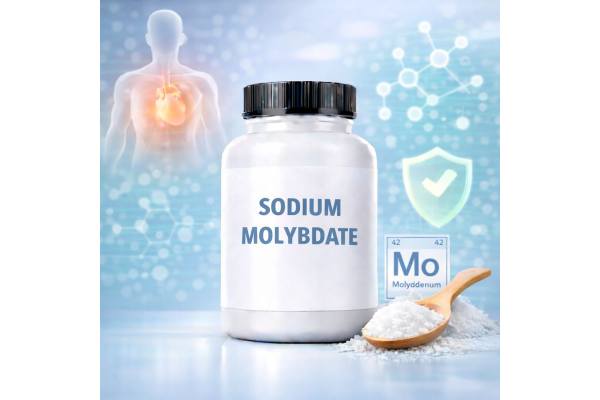
Sodium molybdate is a concentrated source of molybdenum, an essential trace element that your body needs only in tiny amounts but relies on for several key enzyme systems. These enzymes help you process sulfur amino acids, break down purines such as those in DNA, and detoxify certain compounds. In nutrition, sodium molybdate appears most often as the molybdenum source in multivitamins and trace mineral blends. In agriculture and industry, it is widely used as a fertilizer component for legumes and as a corrosion inhibitor.
Because molybdenum requirements are very low and typical diets already provide enough, deficiency in humans is rare. The larger concern is avoiding unnecessary high intakes from multiple supplements or occupational exposure. Understanding what sodium molybdate does, how much molybdenum you actually need, and where toxicity thresholds sit can help you judge whether an extra molybdenum capsule is useful or just one more pill. This guide explains benefits, uses, evidence-based dosage ranges, side effects, and who should be cautious.
Key Insights for Sodium Molybdate
- Sodium molybdate supplies molybdenum, a trace element required for enzymes such as sulfite oxidase and xanthine oxidase that support metabolism and detoxification.
- Most adults meet their molybdenum needs (around 45 mcg/day) through food; supplements typically provide 50–500 mcg/day.
- Tolerable upper intake levels for adults are usually set between 600–2,000 mcg/day of molybdenum, depending on the authority, and long term intake should stay below these limits.
- High intakes from supplements or workplace exposure may affect copper metabolism and, at very high levels, could influence fertility or cause gout-like symptoms.
- People with kidney disease, on total parenteral nutrition, or with multiple mineral supplements should discuss molybdenum intake with a clinician before adding sodium molybdate.
Table of Contents
- What is sodium molybdate?
- Benefits of sodium molybdate for humans
- Common uses of sodium molybdate in supplements and industry
- How much sodium molybdate per day is appropriate?
- Side effects and toxicity of sodium molybdate
- Who should avoid sodium molybdate and when to be careful
- What science says about sodium molybdate safety and effectiveness
What is sodium molybdate?
Sodium molybdate is an inorganic salt in which molybdenum exists in its hexavalent form, typically written as sodium molybdate dihydrate (Na₂MoO₄·2H₂O). In nutrition and toxicology, the key component is the molybdenum ion. When you ingest sodium molybdate, the compound dissolves, and molybdenum is absorbed and incorporated into the body’s molybdenum cofactor.
Molybdenum cofactor is required for a small but important group of enzymes in humans, including sulfite oxidase, xanthine oxidase, aldehyde oxidase, and mitochondrial amidoxime reducing component. These enzymes help:
- Convert sulfite to sulfate during the metabolism of sulfur-containing amino acids.
- Break down purines into uric acid.
- Transform various aldehydes and other compounds into forms that can be excreted or further metabolized.
Without sufficient molybdenum, sulfite can accumulate, and these metabolic pathways do not function properly. Severe deficiency is extremely rare and has mainly been described in individuals with genetic defects affecting molybdenum cofactor formation or in people on long term total parenteral nutrition that lacked molybdenum.
Dietary molybdenum is present in many foods, especially legumes, whole grains, nuts, and some meats. Because it is widely distributed in food and required in microgram quantities, most people consuming a varied diet meet their needs without difficulty.
Sodium molybdate is highly water soluble and is absorbed efficiently in the gut. Once absorbed, molybdenum circulates bound to proteins and is excreted mainly by the kidneys. The body appears to regulate molybdenum fairly well over a range of intakes by increasing or decreasing urinary excretion, which is one reason deficiency is uncommon.
From a supplement perspective, sodium molybdate is simply one of several forms used to provide molybdenum, alongside molybdenum glycinate, molybdenum ascorbate, and others. All of these forms are converted into the same ionic molybdenum pool in the body. The main questions are: do you need extra molybdenum at all, and if so, how much is safe and reasonable, given what you already get from food and any multivitamins.
Benefits of sodium molybdate for humans
The benefits of sodium molybdate are essentially the benefits of adequate molybdenum status. Unlike some supplements that aim to produce a strong pharmacological effect, molybdenum’s role is to quietly support normal metabolism. When intake is adequate, you generally do not feel anything specific; the key is to avoid deficiency and not exceed safe limits.
Normal molybdenum status allows the enzyme sulfite oxidase to convert sulfite to sulfate efficiently. This matters because sulfite can be toxic to cells at high concentrations. People who lack this enzyme due to rare genetic defects develop severe neurological damage early in life. While this extreme scenario is not related to simple dietary variation, it illustrates why molybdenum cofactor is essential.
Other molybdenum-dependent enzymes help:
- Process purines so that they can be excreted as uric acid.
- Break down aldehydes from diverse metabolic reactions.
- Participate in handling some drugs and environmental compounds.
In practice, clear-cut molybdenum deficiency from low dietary intake has not been convincingly demonstrated in healthy free-living adults. A notable human case involved a patient receiving long-term intravenous nutrition that initially lacked molybdenum, leading to neurological symptoms that improved when molybdenum was added. This reinforces the idea that molybdenum is essential but does not imply that most people on regular diets are at risk.
So where does sodium molybdate supplementation help? Potential use cases include:
- Ensuring that long term restrictive diets (for example, very limited food choices or medically prescribed elemental diets) still meet trace mineral needs.
- Acting as the molybdenum source in multivitamins formulated to cover common micronutrient gaps.
- Providing molybdenum to people on specialized medical nutrition support, under the supervision of a clinician.
Some marketing materials claim that extra molybdenum helps “detoxify sulfites” from food additives or supports “sulfur metabolism” in people who feel unwell after high sulfur foods. While sulfite oxidase does rely on molybdenum, there is currently little high quality evidence that pushing molybdenum intake above the recommended dietary allowance meaningfully improves symptoms in these situations, provided basic requirements are already met.
In summary, the realistic benefit of sodium molybdate for most people is to guarantee that molybdenum intake reaches, but does not greatly exceed, recommended levels when diet alone is uncertain. It is a precision tool for filling a small nutritional gap, not a broad performance enhancer or detox cure.
Common uses of sodium molybdate in supplements and industry
Sodium molybdate plays very different roles depending on the context. In human health, it is mainly a trace mineral supplement; in agriculture and industry, its chemistry is put to work in other ways.
In supplements and fortified foods, sodium molybdate is used to:
- Supply molybdenum in multivitamin and multimineral tablets, capsules, and powders.
- Enrich certain medical nutrition formulas or tube feeds that must provide complete micronutrition in a controlled composition.
- Occasionally appear as a stand-alone molybdenum supplement marketed for “sulfite sensitivity” or general trace mineral support.
Typical capsule or tablet products provide molybdenum in amounts ranging from 50 mcg to around 500 mcg per day, expressed as elemental molybdenum. The ingredient list may state “molybdenum (as sodium molybdate)” to clarify the source. In many products, molybdenum content is aligned with recommended dietary allowances and upper safe limits for a typical adult.
Beyond human supplements, sodium molybdate is widely used in:
- Agriculture: As a micronutrient fertilizer, particularly for legumes such as soybeans, peas, and lentils. Molybdenum is essential for the nitrogen-fixing enzyme nitrogenase in root nodule bacteria. Small applications of sodium molybdate to soil or seeds can improve nodulation and nitrogen fixation where soils are deficient.
- Animal nutrition: As a feed additive for some species at controlled levels, with safety evaluations considering both animal health and potential residues in food products.
- Corrosion inhibition: As a component in corrosion inhibitor formulations for industrial cooling water systems and some metalworking fluids.
- Pigments and catalysts: In specialized industrial processes, molybdate compounds contribute to pigments, catalysts, and other materials, though these uses are not directly relevant to dietary intake.
From a human health standpoint, the industrial and agricultural uses matter mainly because they influence environmental levels of molybdenum in soil and water, which can affect background dietary exposure. Risk assessments consider these pathways when setting drinking water guidelines and upper intake limits.
For someone considering a molybdenum supplement, the key practical point is that sodium molybdate is a standard, well studied source of molybdenum. Its presence on a label indicates the form, not an inherently higher or lower quality compared with other bioavailable molybdenum salts. What matters more is whether you need extra molybdenum in the first place, how much a given product provides, and how that fits into your total intake from diet and other supplements.
How much sodium molybdate per day is appropriate?
To answer this, it helps to start with recommended intakes for molybdenum itself, then translate that into typical supplement doses from sodium molybdate.
Major expert bodies have set the recommended dietary allowance for adult men and women around 45 mcg of molybdenum per day, with slightly higher values (around 50 mcg per day) for pregnant and lactating individuals. These values are based on estimates of molybdenum intake in healthy populations and balance studies rather than on clear deficiency thresholds, because deficiency is so rare.
Tolerable upper intake levels, which represent the highest average daily intake unlikely to pose risks for most people, are more variable between authorities:
- Some North American guidelines set the adult upper level at approximately 2,000 mcg (2 mg) of molybdenum per day.
- European bodies have proposed lower upper limits, around 600 mcg per day, using more conservative uncertainty factors due to limited human data.
- A Nordic scoping review suggested a safe supplement dose of about 350 mcg per day, keeping total intake clearly below upper limits.
Most adults consuming a typical mixed diet easily reach or exceed the recommended 45 mcg without supplementation. Surveys often find average intakes in the low hundreds of micrograms per day from food alone, especially in diets containing legumes, grains, and nuts.
Given this background, common supplement dosing practices include:
- Multivitamins providing molybdenum in the range of 45–100 mcg per daily serving, designed to approximate the recommended intake without greatly exceeding it.
- Stand-alone molybdenum supplements with doses from about 100–500 mcg per day, which can be useful when prescribed but may be unnecessary for many people with normal diets.
For a healthy adult with no special medical conditions, a reasonable approach is:
- Aim to meet most or all of your molybdenum requirement through food.
- If you choose a multivitamin, look for molybdenum in the range of 45–100 mcg and avoid stacking multiple molybdenum-containing products.
- Avoid long term use of stand-alone molybdenum supplements above a few hundred micrograms per day unless recommended and monitored by a healthcare professional.
People with reduced kidney function, those on long term parenteral nutrition, or those with unusual occupational exposure need individualized advice, because their ability to excrete molybdenum or their baseline exposure can differ from the general population.
The conversion from sodium molybdate to molybdenum is straightforward: sodium molybdate dihydrate is roughly 39% molybdenum by weight. However, supplement labels typically state the amount as elemental molybdenum, so you do not have to calculate it yourself. Focus on that elemental number, compare it with recommended intakes and upper limits, and consider your total from all sources.
Side effects and toxicity of sodium molybdate
At levels close to the recommended dietary allowance, sodium molybdate is unlikely to cause side effects in healthy adults. Problems arise when intakes significantly exceed physiological needs, either through high-dose supplements, contaminated water, or occupational exposure.
Short term side effects at modest supplemental doses are uncommon but can include:
- Mild digestive upset, such as nausea or loose stools, especially if taken on an empty stomach or along with several other mineral supplements.
- Headache or a general feeling of malaise in some sensitive individuals, though it is often difficult to separate this from other factors.
Toxicological studies in animals provide most of the data on higher exposures. Subchronic and developmental studies in rats given sodium molybdate in the diet at doses up to around 40 mg molybdenum per kg body weight per day for extended periods have generally not found clear systemic toxicity or developmental malformations at these levels. However, other animal work has reported changes such as:
- Diarrhea and reduced weight gain in rats at high dietary molybdenum, along with changes in copper levels in tissues.
- Adverse effects on male reproductive parameters and sperm morphology at high doses in some rodent studies.
These findings support the observation that high molybdenum intakes can interfere with copper metabolism, particularly in ruminants, although direct parallels to human exposure are not straightforward.
Human data on toxicity are more limited. Some occupational reports and case series have described:
- Gout-like symptoms (joint pain, elevated uric acid) in individuals with very high molybdenum exposure, likely related to effects on purine metabolism.
- Non-specific symptoms such as fatigue and irritability at elevated intakes, though evidence is not robust.
The tolerable upper intake levels set by expert bodies are designed to sit well below the doses that produced adverse effects in animals and in human observational reports. Staying below these limits provides a broad margin of safety.
It is also important to consider kidney function. Molybdenum is primarily excreted in urine. People with significantly reduced kidney function may accumulate molybdenum more readily if intake is high, although detailed studies are limited. For this group, high-dose supplements make little sense unless there is a compelling, supervised medical reason.
From a practical standpoint, the main toxicity risk in everyday life is not acute poisoning but long term oversupply from multiple supplements and fortified products combined with a diet already rich in molybdenum. This is why, for most people, the safest course is to use molybdenum-containing products in moderation and avoid high-dose, long term self-experimentation.
Who should avoid sodium molybdate and when to be careful
Although sodium molybdate is safe for many people at low doses, not everyone should treat it as a routine supplement. Certain groups either should avoid supplemental molybdenum altogether or use it only with clear medical guidance.
People who should generally avoid high-dose sodium molybdate supplements include:
- Individuals with known hypersensitivity to molybdenum-containing products or to excipients in a specific supplement.
- People who already take multiple multivitamins or mineral blends, where total molybdenum intake may already be above recommended levels.
- Anyone with confirmed high molybdenum exposure from occupational sources, contaminated water, or other environmental factors.
People who should discuss sodium molybdate with a clinician before use include:
- Those with chronic kidney disease, especially at moderate to advanced stages, because molybdenum is excreted through the kidneys and accumulation is more likely.
- Individuals with chronic gout or markedly elevated uric acid, since molybdenum-dependent enzymes participate in purine metabolism and theoretical interactions exist.
- People with conditions affecting copper metabolism, or those already taking high-dose zinc or other minerals that may influence copper status, given that high molybdenum can antagonize copper in some contexts.
- Pregnant and breastfeeding individuals, because safety margins at high supplemental doses are less well defined, even though basic requirements can be met through diet and standard prenatal formulas.
- Children and adolescents, where trace element needs are lower and the risk of overshooting is greater with adult-targeted supplements.
Total parenteral nutrition is a special case. People on long term intravenous feeding require carefully balanced trace element infusions, and both deficiency and excess are possible if formulations are not optimized. In this setting, molybdenum is adjusted by the nutrition team and sodium molybdate should not be added independently.
Even for healthy adults, it is wise to be cautious if:
- You are using several different “detox,” liver support, or sulfur metabolism formulas that each contain molybdenum, because their combined dose may approach or exceed upper limits.
- You follow a very high intake supplement strategy with little oversight, especially if you also have reduced kidney function or complex medical conditions.
A simple way to stay on the safe side is to:
- Check labels of all supplements you use to identify molybdenum content.
- Add the elemental molybdenum amounts together.
- Keep your daily total near the recommended intake and well below the lowest upper level (for example, staying under 350–600 mcg per day unless specifically advised otherwise).
If there is any doubt, especially if you experience unusual joint pain, extreme fatigue, or other unexplained symptoms after increasing molybdenum intake, discuss this with a healthcare professional and consider simplifying your supplement regimen.
What science says about sodium molybdate safety and effectiveness
Scientific evaluations consider both molybdenum’s role as an essential nutrient and sodium molybdate’s potential toxicity at higher doses. Several strands of evidence are particularly important.
Nutritional science and enzyme function
Reviews of molybdenum nutriture in humans confirm that molybdenum is an essential cofactor for several enzymes involved in key metabolic pathways. These reviews emphasize that deficiency in free-living populations is almost unknown, with the main clear case arising in a patient receiving long term intravenous nutrition without molybdenum. They also note that typical dietary intakes in many countries are comfortably above recommended levels, reinforcing the view that modest needs are easily met through normal food patterns.
Dietary reference values and upper limits
Nutrition authorities have used human intake data, animal toxicology studies, and observed effects on reproduction and growth to derive reference intakes and upper intake levels. One influential framework set the adult recommended intake at 45 mcg per day and the upper level at 2 mg per day, using an uncertainty factor to extrapolate from animal data. European and Nordic evaluations, taking a more cautious view of the same underlying evidence, have suggested lower upper limits around 600 mcg per day and recommended that dietary supplements for adults remain at or below about 350 mcg per day of molybdenum.
Toxicology of sodium molybdate
Subchronic and developmental toxicity studies in rats exposed to sodium molybdate dihydrate in feed or drinking water over 90 days and across generations generally did not find adverse reproductive or developmental outcomes up to the highest doses tested (around 40 mg molybdenum per kg body weight per day). These no observed adverse effect levels underpin modern risk assessments and upper intake calculations, with safety factors applied to translate from animal to human contexts.
At the same time, other rodent studies have reported changes in testicular histology, sperm morphology, and copper status at high molybdenum intakes, suggesting potential reproductive effects and interactions with copper metabolism under conditions of substantial oversupply. These findings are part of the rationale for maintaining a wide margin between typical human intakes and toxicological thresholds.
Environmental and drinking water assessments
International health agencies have reviewed molybdenum in drinking water, noting its essentiality but also summarizing animal data indicating diarrhea, reduced weight gain, and altered copper levels at high doses from sodium molybdate in feed. Based on these data, guideline values for molybdenum in drinking water and safe upper dietary intakes have been proposed to protect human health across life stages.
Overall conclusions
Across these lines of evidence, sodium molybdate emerges as:
- A suitable, well characterized source of molybdenum for dietary supplements, parenteral nutrition, and experimental work.
- Safe at low doses close to recommended intakes, with a comfortable margin between typical human intakes and doses that cause harm in animal studies.
- Potentially harmful at sustained high intakes, especially when multiple exposure pathways are combined or when kidney function is impaired.
For most people, the most evidence-aligned approach is to focus on a balanced diet that naturally provides molybdenum, use a single moderate-dose multivitamin if clearly needed, and avoid treating sodium molybdate as a high-dose “detox” agent in the absence of medical supervision.
References
- Molybdenum – Health Professional Fact Sheet 2021 (Fact Sheet / Guideline)
- Molybdenum – a scoping review for Nordic Nutrition Recommendations 2023 2023 (Scoping Review)
- Molybdenum’s Role as an Essential Element in Enzymes and Human Health 2024 (Review)
- 90-Day subchronic toxicity study of sodium molybdate dihydrate in Sprague Dawley rats 2014 (Toxicology Study)
- Developmental toxicity study of sodium molybdate dihydrate administered in the diet to Sprague Dawley rats 2014 (Developmental Toxicity Study)
Disclaimer
This guide is intended for general educational purposes only and does not provide personalized medical, nutritional, or toxicological advice. Sodium molybdate and other molybdenum sources can be beneficial when they correct genuine dietary gaps, but high-dose or unnecessary supplementation may carry risks, especially in people with kidney disease, complex chronic illnesses, or significant occupational exposure.
Do not start, stop, or change any molybdenum-containing supplement, medical nutrition product, or workplace protective measure based solely on this article. Always consult a qualified healthcare professional or occupational health specialist who understands your medical history, medications, laboratory results, and exposure situation. If you experience unusual symptoms such as persistent joint pain, extreme fatigue, or neurological changes and you are using high-dose mineral supplements or work with molybdenum compounds, seek medical evaluation promptly.
If you found this article helpful, you are warmly invited to share it on Facebook, X (formerly Twitter), or any platform you prefer, and to follow our future updates on social media. Your thoughtful support through sharing helps our team continue to create careful, evidence-based content on micronutrients and health.