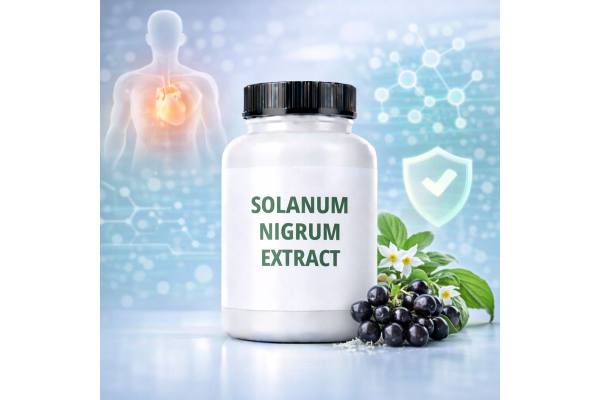
Solanum nigrum, often called black nightshade, is a traditional medicinal plant used across Asia, Africa, and parts of Europe for liver support, skin problems, pain, and fever. Modern extracts concentrate its main bioactive compounds, including steroidal glycoalkaloids (such as solamargine and solasonine), polysaccharides, flavonoids, and phenolic acids. These compounds show antioxidant, anti-inflammatory, and hepatoprotective effects in experimental models, and are being explored for potential anticancer and metabolic benefits.
At the same time, Solanum nigrum belongs to a plant group known for possible toxicity, especially in unripe berries and raw plant material. That means any internal use must balance potential benefits with careful dosing, quality control, and medical guidance. This guide explains what Solanum nigrum extract is, how it may work, how it is typically used in evidence-informed practice, what is known (and unknown) about dosage, and which side effects and risks you should take seriously before considering it.
Key Insights for Solanum nigrum Extract
- Solanum nigrum extract is studied mainly for liver protection, antioxidant effects, and potential supportive roles in cancer and metabolic health.
- Most evidence currently comes from cell and animal studies; high-quality human clinical trials are still limited.
- Commercial oral products often provide about 250–500 mg standardized extract once or twice daily; traditional decoctions may use the equivalent of 3–10 g dried herb per day under professional supervision.
- Because Solanum nigrum contains potentially toxic glycoalkaloids, self-preparing large doses from raw leaves or unripe berries is unsafe.
- Pregnant or breastfeeding individuals, children, and people with serious liver, kidney, or chronic medical conditions should avoid Solanum nigrum extract unless specifically supervised by a qualified clinician.
Table of Contents
- What is Solanum nigrum extract?
- Benefits and how it might work
- How to use Solanum nigrum extract safely
- Dosage guidelines and practical examples
- Side effects, risks, and who should avoid
- Evidence checklist and key safety questions
What is Solanum nigrum extract?
Solanum nigrum is a small herbaceous plant in the nightshade family (Solanaceae). It grows widely as a weed or semi-cultivated plant and is known by many names such as black nightshade or European black nightshade. In some cultures, the young leaves and ripe (usually dark purple-black) berries are eaten as vegetables after proper cooking, while in others the plant is considered poisonous and avoided. These differences largely reflect local botanical knowledge and preparation methods.
“Solanum nigrum extract” usually refers to a concentrated preparation made from the leaves, aerial parts, or berries. Manufacturers may prepare it as:
- A dried powdered extract standardized to certain glycoalkaloids or total saponins
- A hydroalcoholic extract (alcohol–water)
- An aqueous decoction or spray-dried water extract
- Less commonly, oil-based or topical extracts for skin use
Phytochemical studies show that Solanum nigrum contains several important groups of compounds:
- Steroidal glycoalkaloids (for example, solasonine, solamargine, solanine)
- Steroidal saponins
- Polysaccharides and proteoglycans
- Flavonoids (quercetin derivatives and others)
- Phenolic acids and organic acids
Many of these constituents are biologically active. Glycoalkaloids and related saponins are often responsible for both desired pharmacological effects (such as anticancer or immune-modulating actions in experimental models) and potential toxicity at higher doses. Polysaccharides and flavonoids are linked to antioxidant, liver-protective, and anti-inflammatory effects.
Regulatory status varies. In some countries, Solanum nigrum is used in registered herbal products or traditional medicine prescriptions; in others it may be sold only as a dietary supplement or not at all for internal use. Because similar species (and even toxic nightshades) can be confused, correct botanical identification and reputable sourcing are essential.
Overall, Solanum nigrum extract sits at the intersection of food, traditional medicine, and potential pharmaceutical interest. It is not a simple “natural multivitamin,” but a complex botanical that requires respect, careful preparation, and evidence-guided use.
Benefits and how it might work
Most of what we know about Solanum nigrum extract comes from laboratory and animal studies, supported by traditional use patterns. While early results are promising in several areas, human data are still comparatively limited, so claims should be viewed as “potential” rather than proven.
Key areas of interest include:
- Liver protection (hepatoprotective effects)
Extracts of Solanum nigrum have repeatedly reduced liver damage in animal models where toxins such as carbon tetrachloride, alcohol, or certain drugs were used to induce injury. Typical findings include lower liver enzymes, improved antioxidant enzyme activity (such as superoxide dismutase and catalase), and less fat accumulation and fibrosis on histology. Mechanisms appear to involve scavenging of free radicals, modulation of inflammatory pathways, and support of the body’s own detoxification enzymes. - Anticancer and chemo-sensitizing potential
In cell culture studies, Solanum nigrum extracts and isolated glycoalkaloids have shown the ability to trigger programmed cell death (apoptosis) and autophagy in a range of cancer cell lines, including liver, colon, breast, and blood cancers. Some experiments suggest the extract may enhance the effects of common chemotherapy drugs or help overcome drug resistance in certain leukemia models. These findings are intriguing but remain preclinical; they do not mean the extract can replace standard cancer treatment. - Anti-inflammatory and antioxidant actions
Fractions enriched in steroidal glycosides and flavonoids can reduce inflammatory mediators such as nitric oxide, TNF-alpha, and interleukins in stimulated immune cells and animal models. At the same time, Solanum nigrum extracts often show strong antioxidant activity in standard tests and in tissues exposed to oxidative stress, which likely contributes to liver and vascular protection in experimental settings. - Metabolic and other traditional uses
Animal research suggests potential benefits in blood sugar control, lipid profiles, and body weight regulation under certain experimental conditions. Traditional medicine systems use Solanum nigrum for fever, pain, skin disorders, and urinary or respiratory complaints, though modern evidence for these indications is still sparse.
Taken together, the mechanisms that keep appearing are antioxidant effects, modulation of inflammatory signaling, support of cellular detoxification, and direct actions on cell death and cell cycle regulation in cancer models. The challenge for clinicians and researchers is translating these laboratory observations into safe, effective, and well-defined applications in humans.
How to use Solanum nigrum extract safely
Because Solanum nigrum can be both medicinal and potentially toxic, safe use starts with conservative expectations and careful choices rather than aggressive dosing. If you are considering this extract, it should ideally be part of a coordinated plan with a qualified practitioner familiar with herbal medicines and your medical history.
Common forms you may encounter include:
- Standardized capsules or tablets
These usually contain a specific amount of dried extract per capsule (for example, 250–500 mg), sometimes standardized to total saponins or glycoalkaloids. The label may recommend one or two doses daily with food. - Loose powder or non-standardized extracts
Powders made from leaves or aerial parts are more variable. They may be used to make teas or decoctions, but variability in glycoalkaloid content makes it harder to predict effects and safety. - Traditional decoctions
In some traditional systems, the plant is simmered in water and the liquid taken in divided doses. Experienced practitioners adjust the strength and volume based on the individual and the preparation method. - Topical products
Ointments, creams, or poultices containing Solanum nigrum are used in some cultures for minor skin irritation, joint pain, or localized inflammation. Even topically, patch testing is wise in case of sensitivity.
To use Solanum nigrum extract more safely:
- Start low and monitor
If your clinician agrees it may be appropriate, starting at the lower end of the product’s suggested range, once daily with food, helps assess tolerance. Any nausea, abdominal pain, unusual fatigue, or neurological symptoms should prompt stopping the product and seeking medical advice. - Choose reputable brands
Look for manufacturers that provide clear Latin names (Solanum nigrum L.), plant parts used, extraction ratio, and, ideally, glycoalkaloid standardization and testing for contaminants. - Avoid self-prepared high-dose extracts from wild plants
Misidentification or use of unripe berries and raw leaves significantly increases the risk of glycoalkaloid poisoning. Unless you are working with an expert and local pharmacopoeial guidance, do not self-prepare concentrated internal remedies. - Use as an adjunct, not a replacement
For serious conditions such as chronic liver disease or cancer, Solanum nigrum extract, if used at all, should be considered adjunctive to evidence-based treatment and only with your specialist’s awareness.
Quality, dose, and context all matter. A carefully selected and supervised product at modest doses can be a very different risk profile from a strong, homemade decoction of unknown composition.
Dosage guidelines and practical examples
There is currently no universally accepted “therapeutic dose” of Solanum nigrum extract for humans. Most of the more precise dosing information comes from animal experiments or traditional practice, then extrapolated cautiously. The figures below are descriptive, not prescriptive; personal dosing decisions must be made with a qualified professional.
1. Standardized extract in commercial supplements
Many modern products provide Solanum nigrum as:
- 250–500 mg dried extract per capsule, sometimes standardized to a defined percentage of total saponins or glycoalkaloids
A conservative adult pattern sometimes used in integrative practice might look like:
- 250 mg once daily with food for an initial 1–2 weeks to assess tolerance
- If needed and tolerated, potentially 250–500 mg twice daily, always under professional monitoring
Higher amounts are generally avoided due to limited human data and the narrow safety margin associated with steroidal glycoalkaloids in related plants.
2. Traditional decoctions and teas
In traditional herbal medicine, practitioners may use:
- The rough equivalent of 3–10 g per day of dried leaves and/or ripe berries, simmered in water and taken in divided doses
However, this is not a do-it-yourself recommendation. Glycoalkaloid content varies by plant part, maturity, growing conditions, and preparation. Traditional practitioners rely on local species knowledge, preparation techniques, and clinical experience that are not easily replicated at home.
3. Duration of use
For liver support or antioxidant purposes in a monitored setting, a typical trial period might be:
- 4–8 weeks of use, followed by reassessment of liver function tests, symptoms, and overall regimen
Long-term continuous use has not been well studied; many clinicians prefer periodic breaks and regular review.
4. Topical use
Creams or ointments containing Solanum nigrum extract (often blended with other herbs) are applied in:
- A thin layer once or twice daily to localized areas, with use limited by skin tolerance
Even here, avoid open wounds and discontinue if irritation or allergic reactions occur.
5. Children and special populations
Due to the lack of robust safety data and the plant’s potential toxicity:
- Internal use is generally not recommended for children, pregnant or breastfeeding individuals, or people with advanced liver or kidney disease.
- For these groups, any consideration of Solanum nigrum belongs strictly in specialist hands, if at all.
Overall, if you are using any form of Solanum nigrum extract, staying at the lowest effective dose, limiting duration unless regularly reassessed, and coordinating with your healthcare team are central to responsible use.
Side effects, risks, and who should avoid
Solanum nigrum shares some chemistry with other nightshade plants known for glycoalkaloid toxicity. While cooking and careful selection of plant parts can reduce risk, concentrated extracts and poorly prepared products can still cause harm. Understanding these risks is crucial before considering supplementation.
Common or mild effects reported anecdotally
At lower doses of commercial extracts, some individuals report:
- Mild gastrointestinal upset (nausea, stomach discomfort, loose stools)
- Headache or a sense of fatigue
- Occasional skin reactions with topical preparations
These effects usually resolve after dose reduction or discontinuation, but they should never be ignored if they persist or worsen.
Potential signs of glycoalkaloid toxicity
More serious reactions, especially with excessive intake of raw plant material, unripe berries, or high-dose extracts, may include:
- Intense nausea and vomiting
- Abdominal pain and diarrhea
- Dizziness, confusion, or drowsiness
- Rapid heartbeat or changes in blood pressure
- Neurological symptoms such as tremors or, in extreme cases, seizures
Such symptoms require immediate medical attention and disclosure of any plant materials or supplements taken.
Who should avoid Solanum nigrum extract?
Internal use is generally not advised for:
- Pregnant or breastfeeding individuals (insufficient safety data and theoretical risk to the fetus or infant)
- Children and adolescents (greater sensitivity to glycoalkaloids and lack of dosing data)
- People with existing significant liver or kidney disease, unless closely supervised by specialists
- Individuals with recent or recurrent gastrointestinal bleeding, unexplained neurological symptoms, or severe chronic illness
Possible drug interactions
Because Solanum nigrum and its constituents can influence liver detoxification pathways, inflammatory mediators, and possibly blood sugar and lipids, theoretical or observed interactions include:
- Additive stress to the liver when combined with other hepatotoxic drugs or heavy alcohol use
- Unknown interactions with chemotherapy agents, especially if used in an attempt to “enhance” their effects
- Potential modulation of blood glucose or blood pressure when used alongside conventional medications
For anyone taking prescription drugs—especially for liver disease, cancer, seizures, diabetes, or cardiovascular conditions—unmonitored use of Solanum nigrum extract is not advisable.
In short, the same compounds that make this plant pharmacologically interesting can also make it hazardous. Respecting those dual properties is central to safe decision-making.
Evidence checklist and key safety questions
Solanum nigrum extract is sometimes portrayed as a powerful “natural cure,” particularly in online discussions about liver disease and cancer. A closer look at the evidence shows a more nuanced picture.
What the evidence supports so far
- Multiple in vitro and animal studies show hepatoprotective, antioxidant, and anti-inflammatory effects across different models of liver injury.
- Certain glycoalkaloids and polysaccharides from Solanum nigrum display promising anticancer actions in cell lines and animal tumor models, sometimes enhancing the impact of standard chemotherapeutic agents.
- Recent reviews integrate traditional uses with modern data, highlighting a broad pharmacological profile that includes potential metabolic and immune-modulating effects.
Important gaps and limitations
- High-quality human clinical trials are still relatively rare. Many reported benefits are extrapolated from preclinical work, making it difficult to define clear dosing, duration, and risk–benefit ratios for specific conditions.
- Standardization of extracts is inconsistent. Different preparations may focus on polysaccharides, total saponins, or whole-plant extracts with varying glycoalkaloid content. This complicates comparisons and makes safety margins harder to define.
- Long-term safety data, especially for continuous internal use, are limited.
Questions to ask before using Solanum nigrum extract
If you are considering this supplement, these questions can help structure a discussion with your healthcare provider:
- What is my main goal (for example, general antioxidant support versus complementary support in a diagnosed liver condition), and are there better-studied options?
- Is the product standardized, and does the manufacturer provide data on glycoalkaloid content and contaminant testing?
- How will we monitor safety (for example, baseline and follow-up liver and kidney function tests, symptom tracking)?
- How long is a reasonable trial period, and at what point will we stop or reassess if there is no clear benefit?
- Could this extract interact with my current medications or underlying conditions in ways that increase risk?
How to interpret the current research
For most people, the prudent stance is that Solanum nigrum extract is an experimental adjunct rather than a primary therapy. Its strongest role may be within structured research, integrative protocols overseen by experienced clinicians, or traditional frameworks where it is well understood and carefully prepared.
Until more human data clarify optimal doses, long-term safety, and disease-specific benefits, the emphasis should remain on caution, quality, and collaboration rather than self-directed high-dose use.
References
- Solanum nigrum Linn.: An Insight into Current Research on Traditional Uses, Phytochemistry, and Pharmacology 2022 (Systematic Review)
- Progress in Solanum nigrum L. research: Traditional uses, phytochemistry, pharmacological activities, quality control, and clinical applications 2025 (Systematic Review)
- Solanum nigrum L. berries extract ameliorated the alcoholic liver injury by regulating gut microbiota, lipid metabolism, inflammation, and oxidative stress 2024 (Experimental Study)
- Antioxidant Activities of Solanum nigrum L. Leaf Extracts Determined in In Vitro Cellular Models 2019 (Experimental Study)
- Hepatoprotective effects of Solanum nigrum Linn extract against CCl(4)-induced oxidative damage in rats 2008 (Preclinical Study)
Disclaimer
The information in this article is for educational purposes only and is not a substitute for personalized medical advice, diagnosis, or treatment. Solanum nigrum is a biologically active and potentially toxic plant; decisions about its use should always be made with a qualified healthcare professional who understands your full medical history, current medications, and treatment goals. Never start, stop, or change any medication or supplement regimen based solely on online information, and seek urgent care if you experience any concerning symptoms after using herbal products.
If you found this guide helpful, you are warmly invited to share it with others on Facebook, X (formerly Twitter), or any social platform you prefer, and to follow our work on social media. Your supportive sharing helps our team continue to research, write, and update high-quality health content for readers around the world.