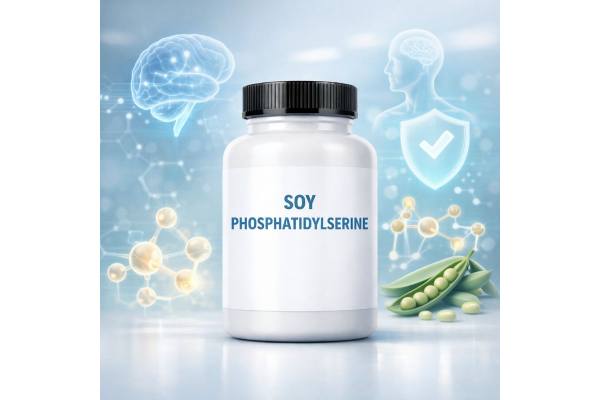
Soy phosphatidylserine (often shortened to soy PS) is a plant-derived phospholipid that has become a popular ingredient in “brain health,” stress, and performance supplements. In your body, phosphatidylserine is concentrated in nerve cell membranes, where it helps keep the structure of brain cells stable and flexible enough for signaling. Soy-based versions replaced older bovine brain extracts after safety concerns about animal tissue, and are now the main commercial source used in capsules, softgels, and functional foods.
Most research on phosphatidylserine looks at memory, attention, and stress responses in older adults or people under heavy mental or physical load. Studies using soy-derived PS have reported modest improvements in memory test scores in people with age-related cognitive complaints, and reductions in stress hormone responses during intense exercise, usually at daily intakes of 100–300 mg over several months. At the same time, regulators typically treat soy PS as a supportive nutrient, not a stand-alone therapy. This guide walks through what soy phosphatidylserine is, how it might help, how to dose it sensibly, and what to know about safety and side effects before you decide whether it fits your routine.
Essential Insights for Soy Phosphatidylserine
- Soy phosphatidylserine supports brain cell membranes and may modestly improve memory in some older adults with cognitive complaints.
- Short-term dosing of 200–800 mg per day can blunt stress hormone responses to intense exercise in some studies.
- Health authorities reviewing the evidence generally consider soy phosphatidylserine safe at supplemental intakes around 100–300 mg per day in adults.
- Many supplements provide 100–300 mg per day; higher intakes up to 600 mg per day should be time-limited and ideally supervised.
- People who are pregnant, breastfeeding, very sensitive to blood pressure changes, or allergic to soy should avoid self-prescribing and seek medical advice first.
Table of Contents
- What is soy phosphatidylserine?
- Does soy phosphatidylserine really help memory?
- How to take soy phosphatidylserine daily
- Soy phosphatidylserine dosage for different goals
- Side effects, risks, and who should avoid
- What the research says about soy phosphatidylserine
What is soy phosphatidylserine?
Phosphatidylserine is a type of phospholipid, a fat-based molecule that forms part of every cell membrane in your body. It is especially concentrated in brain tissue, where it helps organize receptors, ion channels, and enzymes in the outer layer of nerve cells. In a healthy neuron, phosphatidylserine sits mostly on the inner side of the membrane; when a cell is dying, it flips to the outside as a signal for immune cells to clear it away.
Originally, phosphatidylserine supplements were extracted from bovine brain tissue. When concerns about prion transmission emerged, manufacturers shifted toward plant and marine sources. Soy phosphatidylserine is produced by taking soy lecithin (a mixture of phospholipids) and using an enzyme, usually phospholipase D, to swap the head group of another phospholipid for L-serine. The result is a concentrated phosphatidylserine ingredient that keeps the fatty acid profile of soy, rich in linoleic acid with smaller amounts of oleic, palmitic, stearic, and alpha-linolenic acids.
On supplement labels, you will typically see “phosphatidylserine (soy)” or “phosphatidylserine (from soy lecithin).” This indicates the source, not added soy protein. Modern manufacturing yields products with very low residual protein, which reduces but does not entirely rule out the risk of an allergic reaction in people with soy allergy. Regulatory agencies therefore still require “soy” in the ingredient name so that sensitive individuals can avoid it.
In your body, ingested phosphatidylserine is partially broken down in the intestine and then reassembled or converted to other phospholipids after absorption. A small fraction reaches the bloodstream as phosphatidylserine or its metabolites and can be incorporated into cell membranes, including those in the brain. Because natural intakes from food are modest and concentrated mainly in organ meats and certain fish, supplements aim to raise availability without major changes in diet.
Commercial soy phosphatidylserine is sold as stand-alone capsules, combined with omega-3 fatty acids, or as part of multi-ingredient “memory,” “focus,” or “stress support” formulas. The key variable is the actual milligrams of phosphatidylserine per capsule, not the amount of “complex” or “blend,” so reading the fine print on the label matters when you compare products.
Does soy phosphatidylserine really help memory?
The short answer is that soy phosphatidylserine may modestly help memory in some older adults with cognitive complaints, but it is not a guaranteed cognitive enhancer for everyone.
Much of the early positive data on phosphatidylserine came from bovine cortex–derived products in people with age-associated memory impairment and early dementia. Those studies often reported improvements in learning, recall, and daily functioning, but because the source material and fatty acid composition differ from modern soy PS, their results cannot simply be transferred. Later trials tested soy-derived phosphatidylserine directly.
A key randomized, double-blind, placebo-controlled study in Japan gave 100 or 300 mg per day of soy phosphatidylserine to older adults (50–69 years) with memory complaints for six months. The supplement was well tolerated, and in a pre-specified subgroup with lower baseline scores, memory performance—especially delayed verbal recall—improved significantly compared with baseline, whereas the placebo group did not change.
A separate 12-week pilot study using 300 mg per day of soybean-derived phosphatidylserine in older adults with subjective memory problems found improvements in several computerized memory and executive function measures, as well as in auditory verbal learning, compared with baseline. Interestingly, that study also noted small reductions in blood pressure, suggesting that phosphatidylserine may influence vascular or stress-related pathways in some participants.
When researchers pooled available trials in a recent systematic review and meta-analysis of elderly participants, doses of 100–300 mg per day taken for 6 weeks to 6 months showed a positive effect on memory performance, particularly in people with cognitive decline rather than entirely healthy volunteers. The overall effect size was modest, and not all studies reported benefits on every cognitive test.
Taken together, this suggests that:
- Soy phosphatidylserine is most likely to help older adults with existing memory complaints or mild cognitive decline, when used consistently for several months alongside other care.
- Effects in healthy young people with normal cognition are smaller and less consistent; any benefit may be limited to stressful or demanding conditions (for example, exam periods).
- Phosphatidylserine is supportive, not curative: it does not replace medications, physical activity, sleep hygiene, or management of cardiovascular and metabolic risk factors.
If you are considering soy PS for memory, it is reasonable to frame expectations as “possible small improvements in specific memory tasks over time,” not as a dramatic change in everyday functioning.
How to take soy phosphatidylserine daily
Most people encounter soy phosphatidylserine in capsule form, usually providing 50–150 mg per capsule. Some nootropic blends include it in smaller amounts alongside other nutrients. The way you take it can influence both tolerance and your ability to notice any effect.
A practical starting point for many adults is 100–200 mg per day, taken with a meal that contains some fat. Because phosphatidylserine is fat-soluble, co-ingestion with food supports absorption and reduces the chance of mild stomach upset. Many cognitive and safety trials use two or three divided doses, such as 100 mg with breakfast and 100 mg with lunch, or 100 mg with each main meal.
If your goal is cognitive support in the context of age-related memory complaints, a common pattern—used in research—is:
- Start with 100 mg once daily for 1–2 weeks to check tolerance.
- Increase to 100 mg two or three times daily (200–300 mg total) if well tolerated.
- Continue for at least 3 months, and ideally 6 months, before deciding whether it is helping, as most trials observe changes over that time frame rather than in days.
For stress and exercise recovery, some studies have used 200–400 mg taken in the hour before intense training, sometimes combined with a smaller dose earlier in the day. Others have used up to 600–800 mg per day for short periods to blunt cortisol and ACTH responses to heavy exercise. These higher doses should be considered time-limited strategies rather than daily, long-term habits.
Whatever your goal, it helps to:
- Take soy PS at the same times each day, to reduce noise when you evaluate any changes.
- Keep a simple log of sleep, mood, mental clarity, and stress for several weeks, so you can judge whether the supplement adds anything beyond placebo and lifestyle improvements.
- Combine it with fundamentals that support brain health: regular activity, blood pressure and blood sugar control, adequate sleep, and social and cognitive engagement.
Because national authorities differ in their guidance and product categories, it is wise to confirm both dose and duration with a healthcare professional, especially if you take medications, have cardiovascular or neurological conditions, or plan to use soy PS in combination with other nootropics.
Soy phosphatidylserine dosage for different goals
There is no single “one-size-fits-all” dose for soy phosphatidylserine, but several evidence-based ranges have emerged from clinical research and regulatory safety assessments.
For general brain wellness in healthy adults
Many people interested in long-term brain health use soy PS at 100–200 mg per day. This level is below the intake used in most therapeutic studies but above typical background diet intake, and is unlikely to raise safety concerns in otherwise healthy adults.
For age-related memory complaints or mild cognitive decline
Trials in older adults with subjective memory problems or age-associated cognitive decline typically use 100–300 mg per day, divided into two or three doses, for periods of 12–24 weeks. These regimens have been associated with improvements in memory scores, particularly delayed recall and certain learning tasks.
For exercise stress and performance
Sports and exercise studies often target stress hormone responses rather than memory. Protocols have used:
- 200–300 mg per day for several weeks in endurance training programs.
- 400–800 mg per day for short periods around very intense training blocks.
These higher ranges are best reserved for athletes or highly active individuals under professional supervision, because long-term safety data at those levels are more limited.
Regulatory perspectives on safe intake
A clinical safety trial in elderly people found that daily soy phosphatidylserine at 300 or 600 mg for 12 weeks did not produce significant differences in lab tests, vital signs, or reported adverse events compared with placebo.
Building on this and other toxicological data, Health Canada’s Food Directorate reviewed the literature on soy-derived phosphatidylserine and set a recommended maximum daily intake of 300 mg per day when used as a supplemental ingredient in foods, taking into account background dietary exposure. The same assessment notes that 600 mg per day for 12 weeks was well tolerated but chose 300 mg as a conservative ceiling for general food use.
A practical way to interpret these numbers is:
- Up to 300 mg per day: reasonable for many adults as a long-term supplemental intake, assuming no contraindications and medical oversight for high-risk groups.
- 300–600 mg per day: short-term use only, under professional guidance, for specific goals such as clinical trials, supervised cognitive protocols, or athletic stress management.
- Above 600 mg per day: generally unnecessary for most people and should be considered experimental unless part of a monitored study.
Always remember that label claims and proprietary blends can hide the true amount of phosphatidylserine per serving. Count only the actual milligrams of phosphatidylserine—not the total weight of “phospholipid complex”—when comparing doses to study ranges.
Side effects, risks, and who should avoid
In controlled trials, soy phosphatidylserine has shown a favorable safety profile, especially in the 100–300 mg per day range and up to 600 mg per day for several months in older adults. Reported side effects are generally mild and transient when they occur.
The most common complaints include:
- Digestive discomfort such as nausea, soft stools, or a feeling of fullness.
- Headache or a sense of mental “fog” in the first few days for some individuals.
- Occasional insomnia or, conversely, sleepiness—likely reflecting individual differences in how the supplement affects stress hormones and arousal.
The elderly safety trial noted above did not find significant changes in blood tests, blood pressure, or heart rate between placebo and soy PS groups at 300 or 600 mg per day over 12 weeks. A national safety assessment similarly concluded that phosphatidylserine (soy) can be used safely as a supplemental ingredient when kept within the recommended maximum daily intake and appropriate labeling.
However, some cautions are still important:
- Blood pressure and stress response: A pilot study with 300 mg per day of soy PS found small but statistically significant reductions in systolic and diastolic blood pressure. For most people, this is beneficial, but if you already have low blood pressure, are prone to dizziness, or take antihypertensive medications, you should monitor how you feel and discuss supplementation with your clinician.
- Medication interactions: There are no well-documented drug interactions, but in theory any compound that modulates cortisol responses, brain cell membranes, or platelet function could interact with psychiatric medications, anticoagulants, or blood pressure drugs. Caution is prudent if you take multiple prescriptions.
- Soy allergy: Because commercial soy phosphatidylserine contains very little protein, the risk of triggering a soy allergy is low, but not zero. Labels must still indicate “soy,” and people with confirmed soy allergy should avoid soy PS unless a specialist explicitly approves it.
- Pregnancy and breastfeeding: Safety data in pregnant or breastfeeding people are limited. Safety assessments have focused on the general adult population, not on these groups, so self-prescribing is not recommended.
Groups who should avoid self-directed use and instead seek individualized medical advice include:
- Pregnant or breastfeeding individuals.
- Anyone with a history of serious cardiac arrhythmias, uncontrolled blood pressure, or stroke.
- People with neurodegenerative conditions (such as Parkinson’s disease or dementia) who are already on complex treatment plans.
- Individuals with soy allergy or severe food allergies in general.
If you start soy phosphatidylserine and notice persistent gastrointestinal upset, headaches, mood changes, unusual fatigue, or significant changes in blood pressure or heart rate, it is sensible to stop the supplement and consult your healthcare provider.
What the research says about soy phosphatidylserine
When you zoom out from individual trials, a few themes appear in the modern literature on phosphatidylserine, and soy-derived products in particular.
First, mechanistic and review articles describe phosphatidylserine as a key structural and signaling lipid in the brain. It supports synaptic function, influences release of neurotransmitters such as acetylcholine and dopamine, and participates in cell survival signaling. Plant-, animal-, and microbe-derived phosphatidylserine differ in their fatty acid composition, which may subtly alter their biological effects, but they share the same phosphatidylserine backbone. A recent open-access review summarizes these functions, production methods, and supplement applications, highlighting potential roles in cognitive aging, exercise performance, and mood, while also emphasizing the need for more standardized clinical trials.
Second, cognitive outcomes: across multiple clinical studies in older adults, a systematic review and meta-analysis found that phosphatidylserine supplementation (usually 100–300 mg per day for 6 weeks to 6 months) produced a statistically significant improvement in memory performance in people with cognitive decline. The authors noted that study designs, PS sources (bovine, soy, or mixed), and outcome measures varied, but overall the signal favored improved delayed recall and certain learning tasks, with a generally good safety profile. Soy-specific trials support that plant-derived PS can provide similar benefits when appropriately dosed.
Third, regulatory and safety viewpoints:
- A clinical trial dedicated to safety demonstrated that soy phosphatidylserine at 300–600 mg per day in elderly people did not alter standard safety labs or vital signs compared with placebo over 12 weeks, supporting its tolerability at commonly used doses.
- A comprehensive national assessment of phosphatidylserine (soy) integrated toxicology, human trials, and background diet data to justify a recommended maximum daily intake of 300 mg per day for its use as a supplemental food ingredient, noting that higher intakes up to 600 mg per day had been used without observed adverse effects in sensitive older populations.
Finally, stress and exercise data, though more limited, suggest that phosphatidylserine can moderate cortisol and ACTH responses to acute physical stress and may reduce perceived muscle soreness or improve time-to-exhaustion under highly demanding conditions. These effects tend to appear at doses of 400–800 mg per day over short periods in small trials and are less well replicated than the memory findings.
Overall, the evidence paints soy phosphatidylserine as a promising but not miraculous supplement: it has a plausible biological basis, human trials showing modest cognitive benefits and stress-modulating effects, and supportive safety data. It is best used as one component of a broader strategy that includes lifestyle changes and medical care, rather than as a sole intervention.
References
- Phosphatidylserine: An overview on functionality, processing techniques, patents, and prospects 2023 (Review)
- Effect of phosphatidylserine on cognitive function in the elderly: A systematic review and meta-analysis 2022 (Systematic Review)
- Soybean-derived phosphatidylserine improves memory function of the elderly Japanese subjects with memory complaints 2010 (RCT)
- Safety of soy-derived phosphatidylserine in elderly people 2002 (Clinical Trial)
- Summary of Health Canada’s safety assessment of phosphatidylserine for use as a supplemental ingredient 2024 (Regulatory Safety Assessment)
Disclaimer
The information in this article is intended for general educational purposes and should not be interpreted as personalized medical advice, diagnosis, or treatment. Soy phosphatidylserine is not approved as a drug for cognitive disorders, dementia, or any other disease, and its benefits are modest and condition-dependent. Supplement needs and risks vary widely depending on age, medical history, medications, and overall lifestyle. Always consult a qualified healthcare professional before starting, stopping, or changing any supplement, especially if you are pregnant, breastfeeding, over 65, living with chronic illness, or taking prescription medications. If you experience new or worsening symptoms while using soy phosphatidylserine, discontinue it and seek medical assessment promptly.
If this guide was useful, you are kindly invited to share it on Facebook, X (formerly Twitter), or any platform you prefer, and to follow our future updates on social media. Your thoughtful sharing helps support our work so we can continue creating careful, evidence-informed health articles for readers like you.