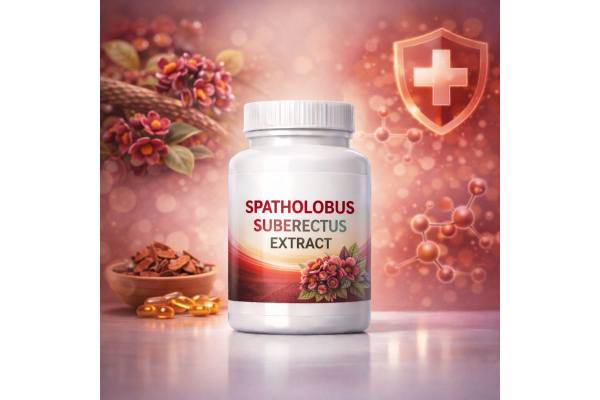
Spatholobus suberectus extract comes from the woody vine stem of a traditional East Asian medicinal plant often known as Caulis Spatholobi or “ji xue teng.” In classical herbal practice it is described as a blood-invigorating herb and used in formulas for menstrual discomfort, tiredness, and joint pain. Modern laboratory research has begun to explore this extract for its rich flavonoid content and potential antioxidant, anti-inflammatory, and immune-modulating effects, as well as experimental anticancer activity.
At the same time, it is not a mainstream supplement and clinical evidence in humans is still limited. Most data come from cell and animal studies, which are useful but cannot replace human trials. This guide explains what Spatholobus suberectus extract is, how it appears to work, where it might reasonably fit in a health plan, practical dosage ranges used in practice, and the key safety concerns and interactions to consider before use, so you can discuss it knowledgeably with a qualified practitioner.
Key Insights for Spatholobus suberectus
- Spatholobus suberectus extract is rich in flavonoids that may support antioxidant and anti-inflammatory pathways.
- Traditional uses focus on blood circulation, menstrual comfort, and relief of “blood stasis” symptoms.
- Common supplemental ranges are about 250–1,000 mg per day of standardized extract, or 3–9 g of dried herb in decoction.
- People who are pregnant, on blood thinners, immunosuppressants, or being treated for hormone-sensitive cancers should avoid unsupervised use.
Table of Contents
- What is Spatholobus suberectus extract?
- Proposed benefits and how it works
- Evidence for key health uses
- How to take Spatholobus suberectus extract
- Safety, side effects, and who should avoid it
- How to choose quality Spatholobus supplements
What is Spatholobus suberectus extract?
Spatholobus suberectus Dunn is a climbing leguminous vine native to China and parts of Southeast Asia. In traditional Chinese medicine it is known as Caulis Spatholobi and classified as a herb that invigorates the blood and relaxes the channels. The medicinal part is the dried vine stem, which is sliced, dried, and typically decocted with other herbs or processed into modern extracts.
Historically, Caulis Spatholobi has been used in formulas for conditions described as “blood deficiency” or “blood stasis.” These include irregular or painful menstruation, fatigue with pale complexion, numbness or weakness in the limbs, and certain joint and rheumatic complaints. It is often combined with other herbs such as Angelica sinensis, Paeonia lactiflora, and Ligusticum chuanxiong in balanced formulas tailored to the individual.
Modern Spatholobus suberectus extracts are usually water or hydroethanolic concentrates of the vine stem, standardized to flavonoid markers. The plant is rich in isoflavones (such as formononetin and genistein), chalcones (such as isoliquiritigenin), and other polyphenolic compounds. These constituents are believed to underpin many of the antioxidant, anti-inflammatory, and potential anticancer properties observed in laboratory research.
On the supplement market, Spatholobus suberectus extract may be offered as:
- Single-herb capsules or tablets containing a defined amount of standardized extract.
- Loose powders to mix into drinks or smoothies.
- A component of multi-herb products aimed at circulation, women’s health, or joint comfort.
Because this herb is still relatively niche outside East Asia, regulatory standards and monographs are less developed than for more common botanicals. As a result, extract strength, composition, and quality can vary significantly between manufacturers.
It is also important to distinguish Spatholobus suberectus from unrelated “blood tonic” blends or other species. Only products that clearly list the Latin name Spatholobus suberectus Dunn and specify vine stem as the plant part truly match the herb described in the research and traditional texts.
Proposed benefits and how it works
The proposed benefits of Spatholobus suberectus extract come from its long history of traditional use and a growing body of experimental research. Most of the modern work focuses on its flavonoid-rich profile and the effects of these compounds on oxidative stress, inflammation, and cellular signaling pathways.
One major proposed benefit is antioxidant support. Flavonoids and related polyphenols can neutralize reactive oxygen species and upregulate endogenous antioxidant defenses. In cell and animal models, Spatholobus extracts have been shown to reduce markers of oxidative stress and protect tissues from various insults, including toxin exposure and inflammatory stress. In theory, this antioxidant activity may help maintain vascular integrity, support immune balance, and protect cellular DNA and lipids from damage.
A second major theme is anti-inflammatory action. Spatholobus suberectus extracts have demonstrated the ability to modulate inflammatory mediators such as cytokines and chemokines in preclinical studies. They appear to influence signaling pathways like NF-κB and MAPK, which sit near the center of many inflammatory cascades. This has led to research on models of allergic skin inflammation, immune stress, and joint-related inflammation.
A third area of interest is potential anticancer-related activity. In various cancer cell lines and animal models, Spatholobus suberectus extracts and isolated compounds have been observed to:
- Inhibit tumor cell proliferation.
- Promote apoptosis, or programmed cell death, in malignant cells.
- Interfere with angiogenesis and metastasis-related processes.
These effects are mechanistic and experimental. They suggest that Spatholobus components interact with multiple signaling pathways relevant to tumor biology, but they do not demonstrate clinical benefit in humans.
Traditional descriptions of the herb as “invigorating blood,” “unblocking channels,” and relieving menstrual pain may reflect a blend of these mechanistic actions: mild influences on circulation and blood rheology, reduction in inflammatory mediators, and relaxation of smooth muscle. While it is tempting to draw direct lines between traditional terms and modern mechanisms, such connections remain partly speculative.
Overall, the strongest mechanistic themes for Spatholobus suberectus extract are:
- Antioxidant support and redox balance.
- Modulation of inflammatory responses.
- Potential influences on vascular and immune function.
These actions make it an interesting candidate for further research, but they do not yet provide a basis for strong treatment claims in human disease.
Evidence for key health uses
The scientific evidence for Spatholobus suberectus extract is promising but still at an early stage. Most published work consists of in vitro experiments and animal studies, with only very limited human data available. Understanding where the evidence is stronger and where it is speculative helps frame realistic expectations.
In immune and infection-related models, total flavonoids of Spatholobus suberectus have been studied in mice infected with porcine circovirus. The extract improved antioxidant markers and modulated immune indices such as spleen and thymus weights, suggesting that it can support immune responses while limiting oxidative damage. Although this model involves animals and a specific virus, it demonstrates in vivo immunomodulatory and antioxidant potential.
In dermatologic research, a standardized water extract has been tested in mice in an atopic dermatitis–like model. Oral administration reduced visible skin lesions, epidermal thickening, and inflammatory infiltrates. Levels of immunoglobulin E, histamine, and key inflammatory chemokines decreased, indicating an effect on allergic and inflammatory pathways at both local and systemic levels. These findings raise the possibility that Spatholobus extracts could be useful as part of strategies for inflammatory skin conditions, though human trials are still needed.
The most comprehensive body of work may exist in oncology research. Reviews of Spatholobus suberectus pharmacology summarize data from multiple tumor models, including breast, liver, and gastrointestinal cancers. In these systems, extracts and isolated constituents:
- Interfere with cell cycle progression.
- Promote apoptosis via mitochondrial and death receptor pathways.
- Influence signaling networks involving STAT3, PI3K/Akt, and other cancer-related pathways.
Some studies have looked specifically at aggressive tumor types such as triple-negative breast cancer and suggest that Spatholobus components can sensitize cells to chemotherapy or reduce metastasis in animal models.
However, it is critical to emphasize what is not yet known. There are no large, high-quality randomized controlled trials showing that Spatholobus suberectus extract improves survival, reduces recurrence, or replaces standard therapies in human cancers. The leap from cell and animal experiments to clinical application is large, and many compounds that perform well in the laboratory do not ultimately prove effective in patients.
For traditional indications such as menstrual irregularity, anemia, and joint pain, formal clinical trials are scarce or absent. Evidence relies mainly on clinical experience in traditional practice and indirect inferences from mechanistic research, which are not substitutes for controlled studies.
In summary:
- Preclinical evidence supports antioxidant, anti-inflammatory, and immunomodulatory effects.
- Experimental anticancer data are intriguing but not yet clinically verified.
- Human trial evidence is minimal, so any current use should be cautious and complementary to standard care rather than substitutive.
How to take Spatholobus suberectus extract
Because formal clinical dosing guidelines are lacking, practical use of Spatholobus suberectus extract relies on traditional herb quantities, extrapolation from preclinical work, and typical supplement label recommendations. Dosing should be individualized and ideally guided by a practitioner familiar with both herbal and conventional medicine.
In traditional decoction form, Caulis Spatholobi is often prescribed in the range of about 6–12 g of dried vine stem per day, usually combined with other herbs. For milder or maintenance-focused formulas, daily amounts of 3–9 g are sometimes used, divided into two or three doses. Decoctions are simmered in water and consumed warm, often over several weeks.
Modern extracts concentrate the active constituents into smaller volumes. A typical supplement might provide:
- 250–500 mg per capsule of standardized extract.
- Suggested daily intakes of 250–1,000 mg, sometimes higher in specialized formulations.
When starting Spatholobus suberectus extract, a cautious, stepwise approach is sensible:
- Begin with a low dose.
Start at the bottom end of the suggested range, such as 250–500 mg per day of extract, taken with food. - Monitor your response.
Over the next one to two weeks, watch for changes in energy, sleep, digestion, menstrual patterns (for women), and any unusual bruising or bleeding. - Adjust slowly if needed.
If tolerated and if a clinician agrees, the dose may be increased toward 750–1,000 mg per day. Many individuals may not need more than this, particularly when the extract is part of a broader herbal formula. - Use in cycles.
Due to limited long-term safety data, some practitioners prefer using Spatholobus in cycles, for example 4–8 weeks on followed by 2–4 weeks off, revisiting the need for continued use at each cycle. - Coordinate with medications.
Because of potential interactions, timing relative to prescription drugs may need adjustment. In some cases, clinicians may recommend spacing the extract at least a few hours away from critical medications.
Taking the extract with meals can help reduce gastrointestinal discomfort and may aid absorption for some constituents. Evening dosing should be monitored in case any individuals experience stimulation or vivid dreams, though this has not been firmly documented.
Above all, Spatholobus suberectus extract should be integrated into a coherent treatment plan rather than added on randomly. This means considering diet, physical activity, stress management, sleep quality, and any conventional therapies as part of a coordinated strategy.
Safety, side effects, and who should avoid it
Although traditional use and preclinical data suggest that Spatholobus suberectus has a relatively wide safety margin when used appropriately, rigorous human safety data are limited. Caution is especially important for individuals with complex medical conditions or those taking multiple medications.
In cell and animal studies, Spatholobus suberectus water extracts and flavonoid fractions have shown low toxicity at typical experimental doses. In many cases, even relatively high concentrations did not cause overt tissue damage or significant adverse effects in the test systems. This supports the idea that the herb is reasonably well tolerated in principle.
However, several areas raise legitimate safety questions:
- Blood and coagulation.
As a traditional blood-invigorating herb, Spatholobus may influence circulation, platelet activity, or clotting dynamics. People with bleeding disorders, low platelet counts, or a history of hemorrhagic events should avoid it without specialized supervision. The same caution applies to those taking anticoagulants (for example, warfarin, direct oral anticoagulants) or antiplatelet drugs. - Immune and inflammatory conditions.
Because the extract modulates immune and inflammatory pathways, there is potential for interactions in autoimmune disease or in people on immunosuppressive therapies and biologic agents. In such cases, only clinicians who understand both conventional immunology and herbal pharmacology should consider its use. - Hormone-sensitive conditions and cancer.
Some constituents of Spatholobus are isoflavones, structurally similar to phytoestrogens. Theoretical concerns exist for hormone-dependent cancers such as certain breast or endometrial cancers. People with current or past hormone-sensitive malignancies should only consider Spatholobus under the guidance of their oncology team, if at all. - Pregnancy and breastfeeding.
Traditional classifications as a blood-moving herb, coupled with the absence of rigorous perinatal safety data, mean that Spatholobus suberectus should generally be avoided during pregnancy and breastfeeding.
Mild side effects reported anecdotally include digestive upset, nausea, or headache. Allergic reactions are possible with any botanical and may present with rash, itching, swelling, or breathing difficulty. Such reactions require immediate discontinuation and urgent medical evaluation.
In summary, the following groups should avoid unsupervised use of Spatholobus suberectus extract:
- Pregnant or breastfeeding individuals.
- People with bleeding disorders or on anticoagulant or antiplatelet medications.
- Individuals with autoimmune disease or receiving immunosuppressive or biologic therapy, unless their specialist agrees.
- Those with hormone-sensitive cancers or a strong family history of such cancers, unless their oncology team explicitly approves.
Everyone else should still discuss potential use with a healthcare professional, especially if they take other supplements or medicines or have underlying health conditions.
How to choose quality Spatholobus supplements
Because Spatholobus suberectus extract is a specialized product, supplement quality and composition can differ widely among brands. Selecting a well-made product reduces the risk of contamination, ensures more consistent dosing, and supports better outcomes.
Key points to consider include:
- Accurate botanical identification.
The label should clearly state the Latin name Spatholobus suberectus Dunn and identify the plant part as vine stem or Caulis Spatholobi. Avoid products that use generic terms like “blood tonic” without specifying the exact herb. - Extraction details and standardization.
High quality products typically list the extraction solvent (such as water or hydroethanolic) and an extract ratio (for example, 10:1) or a standardization marker (such as a defined percentage of total flavonoids or a specific isoflavone). While there is no universal standard, such information indicates manufacturing transparency. - Third-party testing.
Look for brands that conduct independent lab testing for heavy metals, pesticides, microbial contamination, and adulterants. Many reputable companies make certificates of analysis available on their websites or upon request. - Reasonable claims and professional tone.
Supplements that claim to cure cancer, replace chemotherapy, or guarantee dramatic results in short time frames should raise concern. Responsible manufacturers present their products as supportive tools within a broader health plan rather than miracle cures. - Formulation context.
Decide whether you need a single-herb product or a multi-herb formula. Complex formulas may be appropriate within a traditional framework but can complicate the picture if you are trying to understand which ingredient is responsible for effects or side effects. For initial use, some practitioners prefer simpler formulations. - Dosage form and practicality.
Capsules and tablets are easy to dose and travel with. Powders and tinctures may allow finer dose adjustments but can have strong flavors and varying alcohol content. Choose a form you are likely to use consistently and correctly.
Finally, keep all of your healthcare providers informed about any herbal products you take, including Spatholobus suberectus extract. Bringing supplement labels to appointments makes it easier for clinicians to check doses, ingredients, and potential interactions. This collaborative approach helps ensure that herbal and conventional therapies work together as safely and effectively as possible.
References
- A Review of the Pharmacological Potential of Spatholobus suberectus Dunn on Cancer 2022 (Systematic Review)
- Ethnopharmacology, Phytochemistry, and Pharmacological Activities of Spatholobus suberectus Vine Stem 2022 (Review)
- Immunomodulatory and antioxidant effects of total flavonoids of Spatholobus suberectus Dunn on PCV2 infected mice 2017 (Animal Study)
- Spatholobus suberectus Dunn Water Extract Ameliorates Atopic Dermatitis–Like Symptoms by Suppressing Proinflammatory Chemokine Production In Vivo and In Vitro 2022 (Preclinical Study)
Disclaimer
This article is for educational purposes only and does not provide medical, diagnostic, or treatment advice. Spatholobus suberectus extract is an experimental herbal supplement with limited human research. It is not approved to prevent, treat, or cure any disease, including cancer, and must not be used as a substitute for standard medical care.
Always consult a qualified healthcare professional before starting, changing, or stopping any supplement, especially if you have a medical condition, are pregnant or breastfeeding, or take prescription medications. If you experience new or worsening symptoms after starting a supplement, stop taking it and seek medical advice promptly.
If you found this guide helpful, you are welcome to share it on Facebook, X (formerly Twitter), or any platform you prefer, and to follow us on social media. Your thoughtful support by sharing our content helps our team continue to research and produce careful, evidence-informed health information.