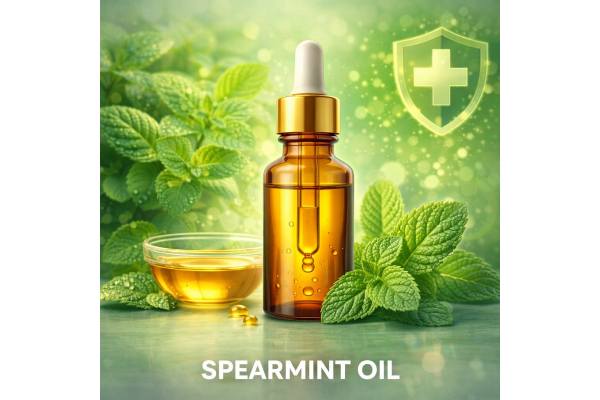
Spearmint oil is an essential oil distilled from the fragrant leaves and flowering tops of Mentha spicata, a mint species best known for its sweet, gentle aroma. Unlike peppermint oil, which is rich in menthol, spearmint oil is dominated by carvone and limonene, compounds that give it a softer scent and a milder cooling feel. This different chemistry also means it behaves differently in the body and on the skin.
Traditionally, spearmint has been used to ease digestive discomfort, calm bloating and gas, freshen breath, and support respiratory comfort. Modern research suggests that spearmint essential oil may have antispasmodic, antimicrobial, antioxidant, and modest pain-relieving actions, particularly in the gut and nervous system. At the same time, it is still a concentrated, bioactive substance. Used correctly, spearmint oil can be a useful part of aromatherapy or topical blends; used carelessly, it can irritate skin or mucous membranes and potentially interact with health conditions. This guide walks you through practical, evidence-informed ways to use spearmint oil, including real-world dosage ranges, safety limits, and when to avoid it.
Key Insights on Spearmint Oil
- Spearmint oil is a carvone-rich essential oil traditionally used for digestive discomfort, mild pain relief, and mental refreshment.
- Typical adult topical dilution is about 0.5–1.5% spearmint oil (roughly 3–9 drops per 30 mL carrier oil) for short-term use on small areas.
- Always dilute spearmint oil before skin use, avoid contact with eyes and mucous membranes, and avoid applying undiluted oil directly to skin.
- People who are pregnant or breastfeeding, children, and those with hormone-sensitive conditions or chronic illnesses should use spearmint oil only with qualified professional guidance or avoid it.
Table of Contents
- What is spearmint oil and what is in it?
- Proven and possible benefits of spearmint oil
- How to use spearmint oil safely at home
- How much spearmint oil can adults use?
- Who should avoid spearmint oil or be cautious?
- Side effects, interactions and how to lower your risk
- What current research says about spearmint oil
What is spearmint oil and what is in it?
Spearmint oil is a volatile essential oil obtained mainly by steam distillation of fresh or partly dried leaves and flowering tops of Mentha spicata (spearmint). The resulting liquid is highly concentrated: a small bottle can represent kilograms of plant material. Unlike cold-pressed plant oils, it contains almost no fatty acids; it is composed of small, aromatic molecules that evaporate easily and penetrate skin readily.
Chemically, spearmint oil is usually classed as a carvone-type mint oil. Modern chemotype studies show that many spearmint essential oils contain carvone in the range of roughly 60–70% of total oil, with limonene often around 10% and smaller amounts of 1,8-cineole and related monoterpenes. These profiles can vary with climate, harvest time, and local chemotype, but carvone is typically the dominant compound in commercial spearmint oil chemotypes.
Carvone is believed to contribute to spearmint oil’s antispasmodic and digestive effects, as well as its sweet, minty aroma that is less sharp than menthol-rich peppermint. Limonene adds a citrus-like note and may support antioxidant and mild anti-inflammatory activity. Other constituents, present in lower amounts, include dihydrocarvone, 3-octanol, 1,8-cineole, and various minor terpenes that can influence both scent and biological activity.
It is important to distinguish spearmint essential oil from spearmint leaf extracts or teas. Teas and aqueous extracts contain water-soluble components (like polyphenols and flavonoids), while the essential oil contains volatile lipophilic compounds. Research on “spearmint” does not always specify whether the intervention was tea, extract, or essential oil, so careful reading of study design is needed before extrapolating benefits or risks.
Because essential oils are lipophilic and highly concentrated, spearmint oil should never be treated as if it were a simple herbal tea. Even though it has a pleasant flavor and smell, the undiluted oil can irritate skin and mucous membranes, and ingestion of large amounts can be dangerous. Understanding what is in spearmint oil helps explain both its potential benefits and its risks.
Proven and possible benefits of spearmint oil
Traditional medicine systems, including Iranian and Unani practice, have long used spearmint preparations for bloating, gas, and abdominal discomfort, often under names that correspond to flatulence disorders. Modern reviews of spearmint essential oil echo these uses, highlighting its historic role in easing digestive complaints and cramping.
Preclinical experiments show that spearmint essential oil and its major constituent carvone can relax smooth muscle and reduce spasms in isolated gut tissues. This antispasmodic effect supports traditional use for flatulence and crampy abdominal pain. Some clinical work has evaluated oral preparations containing spearmint essential oil for conditions such as post-operative gas pain, pain during colonoscopy, menstrual discomfort, and flatulence related to indigestion. These human studies suggest that spearmint oil, in carefully controlled doses and formulations, may modestly reduce pain intensity and bloating scores in these settings.
Spearmint oil also shows notable antimicrobial and antioxidant activity in vitro. Multiple studies demonstrate inhibition of food-borne bacteria and certain fungi, along with free-radical scavenging effects. While in vitro results do not guarantee clinical benefit, they support the traditional use of spearmint in food preservation and oral hygiene products such as toothpastes and mouthwashes, where spearmint oil provides both flavor and antimicrobial action against oral microbes.
In the nervous system, spearmint oil and carvone have been investigated for analgesic and mild sedative properties. Experimental models suggest they can modulate nerve conduction and reduce certain pain responses. This may explain why spearmint-based formulations have been explored for tension headaches, mild musculoskeletal pain, and dysmenorrhea. However, the clinical data here are still limited, and most trials are small or combined with other herbs.
Other areas of interest include:
- Respiratory comfort: aromatherapy blends with spearmint oil are used to create a sense of easier breathing and to freshen the air.
- Mental clarity and mood: inhaled mint aromas have been associated with perceived alertness and reduced fatigue in some small studies.
- Metabolic and neurological conditions: research on spearmint extracts (not always essential oil) is exploring potential roles in obesity, oxidative stress, and neurodegenerative processes, but it is too early to draw firm clinical conclusions.
Overall, the best-supported uses of spearmint essential oil center on digestive comfort, mild pain relief in specific settings, and antimicrobial effects in topical or oral-care formulations. Even in these areas, existing clinical studies are modest in size, and more rigorous trials are needed before spearmint oil can be considered a primary therapy.
How to use spearmint oil safely at home
For most people, the safest ways to use spearmint essential oil are by inhalation (aromatherapy) and properly diluted topical application. Internal use should be reserved for medically supervised situations, using standardized preparations.
Common at-home options include:
- Room diffusion (aromatherapy)
- Add 3–5 drops of spearmint oil to a water-based ultrasonic diffuser that holds about 100 mL of water.
- Run for 20–30 minutes, then switch off for at least the same length of time to limit prolonged exposure.
- Use in a well-ventilated room and avoid continuous diffusion around infants, children, pets, or anyone with asthma or scent sensitivities.
- Personal inhalation
- Place 1–2 drops of spearmint oil on an aroma inhaler stick or a cotton pad kept inside a small, sealable container.
- Inhale gently for a few breaths when you want a feeling of alertness or to help with mild nausea.
- Do not apply the oil directly under the nose or on the upper lip; this can irritate sensitive skin and mucous membranes.
- Topical use in a carrier oil
- For general body use in healthy adults, typical dilution ranges from about 0.5–1.5% spearmint oil in a carrier oil such as jojoba, sweet almond, or fractionated coconut oil.
- As a practical guide, a 1% dilution is about 6 drops of essential oil in 30 mL (2 tablespoons) of carrier oil; a 0.5% dilution is about 3 drops in 30 mL.
- This type of blend can be massaged over the abdomen for occasional digestive discomfort, applied to temples or neck for a gentle aromatic effect (avoiding eyes), or used as a small-area muscle rub.
- Bath or foot soak (with proper dispersal)
- Do not add neat spearmint oil directly to bathwater; oil floats on the surface and can adhere to skin undiluted.
- Instead, mix no more than 3–5 drops of spearmint oil into a tablespoon of carrier oil or an appropriate dispersant, then stir this into a full bath.
- For a foot bath, 1–2 drops premixed in carrier oil is usually sufficient.
- Oral care products
- Commercial toothpastes, mouthwashes, and breath sprays often use low, regulated levels of spearmint oil for flavor and antimicrobial effects.
- Making highly concentrated homemade oral sprays or mouthwashes with essential oil is not recommended, as mucous membranes are particularly sensitive.
In all cases, perform a small patch test with your diluted blend on the inner forearm before broader use. If you experience redness, burning, itching, or rash within 24 hours, wash the area with mild soap and discontinue that blend. Because essential oils can oxidize and become more irritating over time, store spearmint oil in a tightly closed, dark glass bottle away from heat and sunlight, and avoid using very old or degraded oils on skin.
How much spearmint oil can adults use?
There is no single, universally agreed “dose” of spearmint essential oil, because safe amounts depend on route of use, individual sensitivity, and overall health. However, safety experts and clinical aromatherapy references provide practical ranges that can guide day-to-day use.
For topical use in healthy adults, safety authors who review case reports and chemical data have suggested a maximum dermal concentration of about 1.7% for spearmint oil in leave-on products. This corresponds to roughly:
- Up to 1% (about 6 drops per 30 mL carrier oil) for routine use over larger body areas.
- Up to 1–1.5% (about 6–9 drops per 30 mL) for small, localized areas and short periods, provided the skin is intact and not sensitive.
For facial skin, which is more delicate, remaining closer to 0.25–0.5% is a cautious approach, especially in people with a history of dermatitis or sensitive skin. These percentages refer to total final product, not the volume of essential oil alone.
For inhalation and diffusion, amounts are best kept low, with more emphasis on duration and frequency:
- Diffusers: roughly 3–5 drops of spearmint oil per 100 mL of water is usually adequate for a medium-sized room. Running the diffuser for 20–30 minutes at a time, a few times per day, is generally more than enough for most adults.
- Personal inhalers: 5–15 drops on the cotton wick inside a closed inhaler is commonly used in aromatherapy practice, but each inhalation only delivers a small fraction of that amount. If you notice headache, dizziness, cough, or throat irritation, reduce use or discontinue.
Oral intake of spearmint essential oil is more complex and should not be attempted as a home remedy. Clinical studies that have used spearmint oil for flatulence or pain relief generally rely on standardized medicinal products, with carefully measured doses and medical oversight. While these reports note benefit and did not identify serious toxicity at the studied doses, essential oil ingestion can produce acute toxicity if misused, and self-dosing is not recommended.
Practical, safety-oriented summary for adults:
- Day-to-day topical use: stay in the 0.25–1% range; reserve up to about 1.5–1.7% for small areas and short-term use.
- Aromatherapy diffusion: 3–5 drops per 100 mL water, used intermittently in a ventilated room.
- Internal use: only under supervision from a qualified clinician or clinical aromatherapist using a regulated product.
People with chronic conditions, those taking multiple medications, and older adults may need even lower exposures, or may be advised to avoid essential oils altogether in certain contexts. When in doubt, err on the side of lower concentrations and shorter exposure periods.
Who should avoid spearmint oil or be cautious?
Even though spearmint oil is often marketed as “gentle” compared with other mint oils, it is still a potent mixture of bioactive chemicals. Certain groups are more likely to experience adverse effects and are usually advised to avoid spearmint essential oil or use it only with specialist guidance.
Groups that should generally avoid spearmint essential oil:
- Infants and young children
Essential oils are concentrated and children have thinner skin, higher surface-area-to-weight ratios, and developing organ systems. Diffusing strong mint aromas in small, enclosed spaces or applying mint oils to infants’ chests, faces, or feet can irritate airways and skin. Pediatric safety references typically recommend avoiding mint essential oils entirely in very young children and using extreme caution in older children. - People with known allergies or previous reactions to mint oils
Anyone who has experienced contact dermatitis, hives, wheezing, or other reactions to mint-containing products (toothpaste, gums, topical creams) should be considered at higher risk. Cross-reactivity between different Mentha species is possible. - Those attempting self-treatment by ingestion
Individuals who plan to ingest spearmint essential oil without medical supervision should be strongly cautioned against doing so. Case reports on essential oils in general show that accidental overdoses and deliberate ingestion can lead to serious toxicity, including central nervous system depression and organ injury.
Groups that require extra caution and professional advice:
- Pregnant or breastfeeding individuals
Human data on spearmint essential oil exposure in pregnancy and lactation are limited. Some mint oils and their constituents have shown hormonal or reproductive effects in animal studies. Because of the potential for hormonal modulation, high exposures or internal use are best avoided, and even topical or aromatherapy use should be discussed with a qualified health professional. - People with hormone-sensitive conditions
Spearmint extracts have been studied for possible antiandrogenic effects and hormonal modulation. While this research may be of interest for specific disorders, it also raises concern for those with hormone-sensitive cancers or endocrine conditions. Essential oil exposures through skin or inhalation are typically lower than oral extract doses, but caution is still appropriate. - Individuals with asthma, chronic lung disease, or scent sensitivities
Strong aromas of any essential oil can trigger symptoms in susceptible individuals. If someone experiences chest tightness, coughing, wheezing, or headaches when exposed to mint or other fragrances, spearmint oil diffusion and topical use should be avoided. - People with fragile skin barriers
Those with active eczema, psoriasis, or chronic dermatitis have compromised skin barriers and may be more susceptible to irritation or sensitization. Even low-dose essential oils can be poorly tolerated in these contexts.
In short, spearmint essential oil is not automatically “safe for everyone” just because it is natural. Pregnant or breastfeeding people, children, those with chronic illnesses, and anyone with complex medication regimens should talk with a healthcare professional before using spearmint oil beyond occasional, low-level inhalation.
Side effects, interactions and how to lower your risk
Most reported side effects from essential oils, including spearmint, involve the skin or mucous membranes. The largest systematic review of aromatherapy adverse events found that contact dermatitis and other skin reactions were the most frequent problems, with severity ranging from mild rashes to more serious reactions in rare cases. Many incidents involved undiluted oils, high concentrations, or prolonged use.
Possible side effects of spearmint essential oil include:
- Skin irritation, burning, or redness when applied at too high a concentration or on sensitive skin.
- Allergic contact dermatitis, which may present as itchy, inflamed patches that can persist or worsen with repeated exposure.
- Eye and mucous membrane irritation if vapors are intense or if oil is accidentally transferred from fingers to eyes, nose, or mouth.
- Headache, dizziness, or nausea in sensitive individuals, especially in poorly ventilated spaces with heavy diffusion.
Serious systemic toxicity is uncommon at typical aromatherapy or topical doses, but accidental ingestion of larger amounts of essential oil has led to emergency presentations in other essential oils. Because spearmint oil is chemically similar in many respects to other mint oils, it must be handled with the same level of caution.
Potential interactions and special considerations:
- Medications that affect the liver or nervous system: while detailed interaction data for spearmint oil are sparse, essential oils in general are metabolized in the liver and can influence enzyme systems in theory. Until more is known, heavy or chronic use should be discussed with a clinician if you take multiple prescription medications.
- Co-sensitizing products: using spearmint oil along with other fragrance-rich products may increase cumulative exposure to sensitizing compounds such as limonene and linalool oxidation products.
- Underlying skin disease: pre-existing dermatitis can make reactions more likely and more severe.
You can reduce your risk of adverse effects by:
- Always diluting spearmint oil before skin application and staying well within recommended concentration ranges.
- Limiting diffusion sessions in time, and ensuring fresh air circulation.
- Performing a patch test with each new batch or blend on intact skin before regular use.
- Avoiding essential oil use on broken, inflamed, or freshly shaved skin.
- Keeping bottles out of reach of children and pets, and never storing oils in containers that resemble food or drinks.
If you suspect an adverse reaction, wash the affected skin with mild soap and cool water, discontinue use of the product, and seek medical advice, especially if symptoms are severe, involve breathing difficulty, or do not improve within a short period.
What current research says about spearmint oil
Modern research on spearmint essential oil spans laboratory chemistry, animal experiments, and human clinical work, though the human evidence base is still relatively small compared with more established therapies.
Chemical and mechanistic insights
Advanced chromatographic studies across different regions show that spearmint essential oils are dominated by carvone and limonene, but the precise ratios vary by chemotype, growing conditions, and harvest time. Chemotype mapping in Mediterranean populations has identified carvone-rich, carvone/trans-carveol, and other chemotypes, underscoring that “spearmint oil” is not chemically identical worldwide. This variability matters because biological activities can shift with composition.
In vitro, spearmint oils from various regions demonstrate:
- Antioxidant effects in common assays (DPPH, ABTS, β-carotene bleaching).
- Antimicrobial activity against Gram-positive bacteria (such as Staphylococcus aureus) and certain Gram-negative species, as well as fungi, though potency depends on strain and oil composition.
- Cytotoxic activity against selected cancer cell lines at higher concentrations, which is of research interest but does not translate into a cancer treatment at present.
Human data
Human studies of spearmint essential oil are most developed in the area of digestive symptoms and pain:
- A focused review of spearmint oil for flatulence concludes that properly dosed oral preparations may reduce flatulence and abdominal pain in conditions such as postoperative gas pain, dysmenorrhea-associated bloating, and colonoscopy-related discomfort. The same review notes that no major hazardous effects were reported at the studied doses, though it also emphasizes the need for more robust clinical trials.
- Case series and small trials suggest that spearmint-containing formulas can lower pain ratings in some abdominal and gynecological contexts, but most involve combinations with other agents or are not large enough to define clear effect sizes.
More broadly, recent comprehensive reviews of essential oils for clinical aromatherapy and dermatology highlight both the promise and the limitations of essential oils as complementary therapies. They note:
- Evidence for benefits such as anxiety reduction, mild analgesia, and improved comfort in certain settings, balanced by a meaningful rate of mild to moderate adverse skin reactions.
- Gaps in standardized dosing, product quality control, and long-term safety data, especially for chronic daily use and in vulnerable populations.
For spearmint oil specifically, current evidence supports its traditional role as a digestive aid and mild analgesic in carefully controlled preparations, with additional potential in antimicrobial and antioxidant applications. At the same time, the quality of evidence is moderate at best, and there is not yet strong support for high-dose or long-term therapeutic use as a primary treatment for serious disease.
In practical terms, spearmint essential oil is best viewed as a supporting player: a potentially helpful adjunct for short-term symptom relief or sensory support, rather than a replacement for medically evaluated treatments.
References
- Mentha spicata L. essential oil, phytochemistry and its effectiveness in flatulence, 2018 (Review / Clinical focus on flatulence).
- Medicinal Uses, Phytochemistry, Pharmacology, and Toxicology of Mentha spicata, 2022 (Systematic botanical and pharmacological review).
- Chemical Characterization of the Essential Oil Compositions of Mentha spicata and M. longifolia ssp. cyprica from the Mediterranean Basin and Multivariate Statistical Analyses, 2024 (Chemotype and composition study).
- Essential oils for clinical aromatherapy: A comprehensive review, 2024 (Systematic review of clinical uses and safety of essential oils).
- Adverse effects of aromatherapy: a systematic review of case reports and case series, 2012 (Systematic review of aromatherapy adverse events).
Disclaimer
The information in this article is intended for general educational purposes only and does not replace personalized advice from a qualified healthcare professional. Spearmint essential oil is a concentrated, bioactive substance, and individual responses can vary widely depending on health status, medications, age, and other factors. Do not use spearmint oil, especially internally, to diagnose, treat, cure, or prevent any disease without guidance from a licensed clinician or appropriately trained clinical aromatherapist. Always seek prompt medical attention for persistent, severe, or worrisome symptoms, and never delay or disregard professional medical advice because of something you have read online.
If you found this guide helpful, you are warmly invited to share it on Facebook, X (formerly Twitter), or any platform you prefer, and to follow our work on social media. Thoughtful sharing helps our team continue creating careful, evidence-informed content to support safe, informed decisions about natural products.