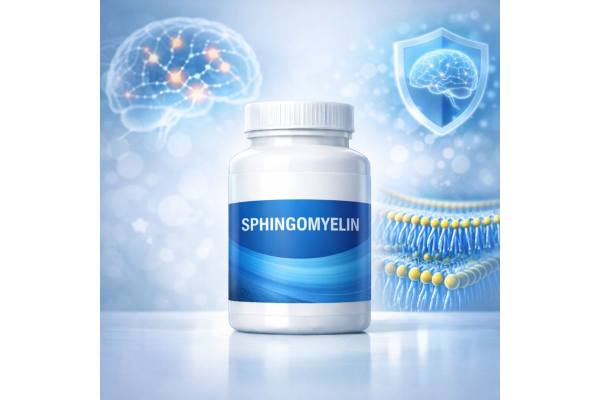
Sphingomyelin is a unique type of phospholipid that sits in the outer layer of many cell membranes, especially in brain and nerve tissue. It is a major building block of the myelin sheath that insulates nerves and plays a structural and signaling role in almost every organ system. In the diet, sphingomyelin comes mainly from animal foods such as milk, dairy fat, eggs, meat, and some fish, and newer supplements now concentrate it from milk fat globule membrane and other phospholipid-rich fractions.
Because sphingomyelin participates in cell signaling, cholesterol handling, and gut barrier function, researchers are exploring it for potential benefits in brain development, cognitive performance, cardiometabolic health, and skin hydration. At the same time, sphingomyelin and its metabolites are biologically active lipids, which means dose, timing, and individual health status matter. This guide walks you through what sphingomyelin is, how it might help, where it comes from, how much has been used in studies, and what to know about safety before considering higher intakes or supplements.
Key Facts about Sphingomyelin
- Sphingomyelin is a structural lipid that supports cell membranes, myelin formation, and several cell signaling pathways.
- Human and animal data suggest potential benefits for brain development, gut barrier integrity, lipid metabolism, and skin hydration.
- Typical Western diets provide about 300–400 mg of sphingomyelin per day, and supplements in studies range from around 5–10 mg/day up to 1,000 mg/day.
- People with milk or egg allergy, rare genetic sphingolipid disorders, or complex cardiometabolic disease should avoid self-supplementing without medical guidance.
- Sphingomyelin is promising but still under active study; it should complement, not replace, established nutrition and medical care.
Table of Contents
- What is sphingomyelin and how does it work?
- What are the main health benefits of sphingomyelin?
- How to get sphingomyelin from diet and supplements
- How much sphingomyelin per day?
- Side effects, safety and who should avoid sphingomyelin
- What does the science say and where are the gaps?
What is sphingomyelin and how does it work?
Sphingomyelin is a member of the sphingolipid family, which are lipids built on a sphingosine backbone instead of glycerol. In chemical terms, it is composed of a ceramide (sphingosine plus a fatty acid) linked to a phosphocholine head group. This structure makes sphingomyelin both hydrophobic and hydrophilic, allowing it to sit neatly in cell membranes alongside cholesterol and other phospholipids.
In the body, sphingomyelin is especially concentrated in:
- The myelin sheath around nerve fibers in the brain and peripheral nerves.
- The outer leaflet of cell membranes in many tissues.
- Lipoproteins in the blood, including LDL and HDL particles.
Functionally, sphingomyelin does more than “fill space” in membranes:
- It helps organize lipid rafts, microdomains that cluster receptors and signaling proteins.
- When enzymes such as sphingomyelinases break it down, they release ceramide and sphingosine-1-phosphate, which act as potent signaling molecules influencing inflammation, apoptosis, and cell growth.
- In the intestine, dietary sphingomyelin is partially hydrolyzed, and its metabolites can interact with the gut lining and microbiota.
From a nutritional perspective, there are two main sources:
- Endogenous production: your body synthesizes sphingomyelin from simpler lipids and amino acids to meet structural needs.
- Exogenous intake: you consume sphingomyelin in foods such as milk, butter, cheese, cream, egg yolks, organ meats, and some fish. Human milk is a particularly rich source in early life.
These dual sources mean that, unlike vitamins, there is no classical “deficiency disease” for sphingomyelin. Instead, interest focuses on how modest changes in intake might modulate membrane composition, signaling pathways, and downstream outcomes such as cognitive development or metabolic health. Importantly, sphingomyelin is part of a complex network: effects usually arise from shifts in the balance between sphingomyelin, ceramides, and other sphingolipids rather than from sphingomyelin alone.
What are the main health benefits of sphingomyelin?
Research on sphingomyelin is still evolving, but several potential benefit areas have emerged from preclinical work and early human studies.
1. Brain and cognitive development
Sphingomyelin is a major structural lipid in myelin, which insulates nerve fibers and supports efficient nerve conduction. During late pregnancy, infancy, and early childhood, myelination accelerates and demand for sphingomyelin and related lipids is high. Human milk naturally contains substantial sphingomyelin, and formulas enriched with milk fat globule membrane or higher sphingomyelin content have been associated with improved neurobehavioral scores and visual processing measures in preterm and formula-fed infants compared with standard formulas.
In adults, observational and experimental work suggests that sphingomyelin-rich milk phospholipid fractions may support white matter integrity and certain cognitive tasks, although the evidence remains preliminary and based on small populations. The biological rationale is strong, but larger and longer trials are still needed.
2. Gut barrier and intestinal health
Dietary sphingomyelin and its metabolites can interact with the intestinal mucosa and microbiota. Animal and cell models indicate that sphingomyelin may:
- Strengthen gut barrier function by influencing tight junction proteins.
- Reduce endotoxin (lipopolysaccharide) translocation from the gut into the bloodstream.
- Modulate the composition of gut bacteria, often shifting toward a higher proportion of beneficial species.
These effects could contribute indirectly to improved metabolic and inflammatory profiles, especially in the context of high-fat diets. Human evidence is still limited, but this area is active.
3. Cholesterol metabolism and cardiometabolic markers
Several animal studies and a small human trial have investigated how adding sphingomyelin to a controlled diet affects cholesterol handling. In healthy adults, 1 g/day of dietary sphingomyelin for two weeks did not significantly change total or LDL cholesterol but did increase HDL cholesterol while leaving cholesterol absorption largely unchanged. In animal models, milk-derived sphingomyelin and polar lipids have sometimes reduced atherogenic lipoproteins and attenuated plaque development.
These findings suggest that sphingomyelin, particularly within its natural milk phospholipid matrix, might modestly improve certain cardiometabolic markers, though effects in free-living humans are still uncertain.
4. Skin hydration and elasticity
In a randomized, placebo-controlled trial, low doses of sphingomyelin-containing milk phospholipids (equivalent to around 5–10 mg/day of sphingomyelin) improved skin hydration at the heel and elasticity around the eye area after several weeks of daily use in young adults with dry skin. The mechanism likely involves systemic changes in ceramide metabolism and skin barrier lipids.
Taken together, the current evidence points to sphingomyelin as a potentially useful functional ingredient for brain development, gut barrier support, select cardiometabolic markers, and skin health, especially when provided as part of milk-derived polar lipid complexes. However, most findings are modest in magnitude and require confirmation in larger, longer, and more diverse studies.
How to get sphingomyelin from diet and supplements
Most people obtain sphingomyelin through ordinary foods without realizing it. For many, dietary intake is already in the few hundred milligrams per day range, even without specialized products.
Major natural food sources
Key contributors include:
- Dairy and milk fat
- Whole milk, cream, butter, and cheese contain sphingomyelin in the milk fat globule membrane.
- Fermented dairy (yogurt, kefir, some cheeses) also contributes, with amounts depending on fat content and processing.
- Egg yolks
- Eggs, especially the yolk, are a concentrated source of phospholipids, including sphingomyelin.
- Meat and organ meats
- Red meat, poultry, and organ meats contain sphingomyelin in cell membranes, often in smaller amounts per serving than dairy fat but still meaningful.
- Fish and shellfish
- Certain fish and marine foods contribute smaller quantities that can add up across the diet.
Average sphingolipid intake in Western diets is often estimated at around 0.3–0.4 g (300–400 mg) per day, with sphingomyelin making up a large share of this intake.
Sphingomyelin-enriched ingredients and supplements
Food and supplement manufacturers now isolate sphingomyelin-rich fractions from dairy or other sources:
- Milk fat globule membrane (MFGM) concentrates
- Used in some infant formulas, adult nutritional drinks, and capsules.
- Provide a mixture of phospholipids (phosphatidylcholine, phosphatidylethanolamine, sphingomyelin) and bioactive proteins.
- Sphingomyelin content varies by brand and manufacturing method.
- Milk phospholipid or “polar lipid” concentrates
- Enriched in phospholipids, including sphingomyelin, and marketed for cardiometabolic or cognitive support.
- Often standardized to a certain percentage of total phospholipids, not sphingomyelin alone.
- Skin- or beauty-focused capsules
- May use small doses of sphingomyelin-containing milk phospholipids, sometimes combined with ceramides, collagen, or vitamins, targeting skin hydration and barrier function.
Because labeling practices differ, sphingomyelin content may be given either:
- Directly (for example, “provides 50 mg sphingomyelin per day”), or
- Indirectly as phospholipid content (for example, “200 mg milk phospholipids, including sphingomyelin”).
Reading product technical sheets or contacting the manufacturer may be necessary if you need precise sphingomyelin amounts.
Diet versus supplements
For most healthy adults, focusing on nutrient-dense foods that naturally contain sphingomyelin—such as moderate portions of dairy fat, eggs, and fish—will provide physiologic intakes within the range that humans traditionally consume. Supplements may be considered in specific situations:
- Clinical research settings.
- Under professional guidance for individuals with defined health goals (for example, participation in a cardiometabolic or cognitive trial).
- As part of a formulated product (such as an MFGM-fortified infant formula) chosen by parents and clinicians.
Since sphingomyelin is only one piece of the broader lipid and dietary pattern, it is best thought of as a complementary factor rather than a standalone solution.
How much sphingomyelin per day?
There is no official recommended daily allowance or upper safe limit for sphingomyelin. Guidance therefore comes from three sources: habitual dietary intake estimates, experimental human trials, and safety considerations from broader phospholipid research.
Typical background intake
- Adults eating a Western-style diet usually consume about 0.3–0.4 g (300–400 mg) of sphingomyelin each day from mixed foods, mainly dairy, meat, eggs, and fish.
- Breastfed infants may obtain up to roughly 150 mg of sphingomyelin per day from human milk, scaled to their lower body weight compared with adults.
These intakes have long human experience and are considered physiologic.
Doses used in human studies
Clinical and experimental trials have tested a range of supplemental amounts, usually in addition to background diet:
- Skin health study
- Adults with low skin hydration took sphingomyelin-containing milk phospholipids at doses equivalent to approximately 5–10 mg/day of sphingomyelin for 12 weeks, with improvements in hydration and elasticity.
- Cholesterol and lipid metabolism study
- Healthy adults consumed a controlled diet with or without 1 g/day of purified sphingomyelin for around two weeks. This higher dose modestly increased HDL cholesterol but did not significantly alter LDL cholesterol or cholesterol absorption in that short time frame.
- Infant neurodevelopment
- Preterm infants received sphingomyelin-fortified milk in which sphingomyelin contributed about 20 percent of total phospholipids compared with 13 percent in the control formula. The fortified group showed better scores on certain neurobehavioral tests, although absolute amounts of sphingomyelin per kilogram were not the same as in adults.
Practical, cautious ranges
For healthy adults without specific medical conditions, and under professional advice, practical supplemental ranges sometimes considered are:
- Around 10–50 mg/day of sphingomyelin from milk phospholipid complexes for skin or general wellness products.
- Up to about 1,000 mg/day in short-term research settings focused on lipid metabolism.
At present, there is insufficient evidence to recommend long-term high-dose sphingomyelin supplementation for the general population. Because sphingomyelin metabolism is closely tied to ceramides and other bioactive lipids, individuals with existing cardiometabolic, liver, or inflammatory conditions should not self-prescribe higher doses.
How to approach dosage personally
If you and your clinician decide to consider a sphingomyelin-containing product:
- Review the exact sphingomyelin content per serving, not just “phospholipids.”
- Consider starting at the lower end of the studied range, especially if combining with a sphingomyelin-rich diet.
- Monitor for gastrointestinal changes, skin responses, and, where clinically appropriate, periodic lipid panels or other relevant labs.
- Reassess the need regularly rather than assuming indefinite use.
Side effects, safety and who should avoid sphingomyelin
Thus far, dietary levels of sphingomyelin from food and modest supplemental amounts have appeared well tolerated in research settings. However, as with many bioactive lipids, context and individual health matter.
Short-term tolerability
In controlled human trials:
- Doses around 5–10 mg/day of sphingomyelin from milk phospholipids for 12 weeks were generally well tolerated, with no major safety signals reported.
- A short-term 1 g/day dose of purified sphingomyelin in healthy adults did not produce major adverse events, though the trial duration was limited and participants were carefully screened.
Mild gastrointestinal symptoms (such as fullness, soft stools, or bloating) are possible with any new lipid-rich supplement but have not been prominent in published trials.
Potential risks and theoretical concerns
- Lipid metabolism and cardiometabolic disease
- While dietary sphingomyelin may modestly improve some markers in certain contexts, ceramide accumulation and altered sphingolipid profiles are associated with insulin resistance, fatty liver, and atherosclerosis.
- In people with existing dyslipidemia, metabolic syndrome, or advanced cardiovascular disease, altering sphingolipid balance through supplementation should be done only under professional supervision, if at all.
- Allergy and intolerance
- Most commercial sphingomyelin ingredients are derived from dairy or eggs. Individuals with cow’s milk protein allergy, lactose intolerance, or egg allergy should avoid or use extreme caution with such products and check sources carefully.
- Cross-contamination with other milk proteins is common, so “dairy-free” claims are essential for those with severe allergy.
- Genetic sphingolipid disorders
- Rare inherited diseases affecting sphingomyelin metabolism (such as Niemann–Pick disease types A and B) involve defective breakdown enzymes. People with these conditions or strong family histories should not experiment with sphingomyelin supplements and require specialist care.
- Pregnancy, breastfeeding, infants, and children
- Human milk naturally provides sphingomyelin, and some infant formulas are fortified under strict regulatory standards.
- However, concentrated adult supplements have not been systematically studied in pregnancy, lactation, or in young children outside clinical protocols. Use in these groups should be restricted to products and doses recommended by a qualified clinician.
Drug interactions
No specific drug–sphingomyelin interactions have been firmly established, but lipid-modifying agents (such as statins, bile acid sequestrants, or certain diabetes medications) could theoretically interact with changes in lipid absorption or metabolism. People taking such medications should discuss any new lipid-rich supplement with their prescribing clinician.
Who should avoid unsupervised supplementation
It is prudent to avoid self-directed sphingomyelin supplementation if you:
- Have a diagnosed milk or egg allergy or severe lactose intolerance.
- Live with rare inherited lysosomal or sphingolipid storage disorders.
- Have advanced cardiovascular disease, recent cardiovascular events, or complex dyslipidemia under active treatment.
- Are pregnant, breastfeeding, or considering supplements for infants or children outside of regulated formula products.
For others, using food-based sources and modest, well-characterized products under professional guidance appears reasonable while research continues to clarify long-term effects.
What does the science say and where are the gaps?
Sphingomyelin has attracted attention because it sits at the crossroads of membrane structure, lipid signaling, and nutrition. Over the last decade, several lines of evidence have converged:
- Mechanistic and animal studies show that dietary sphingomyelin can influence cholesterol handling, gut barrier integrity, inflammatory signaling, and tumor formation in certain models. These studies help map pathways but do not always predict human responses.
- Human observational data link sphingomyelin and other sphingolipids in blood to cardiometabolic risk and neurodegenerative conditions. Higher circulating ceramides, for example, often associate with worse outcomes. However, these patterns largely reflect endogenous metabolism rather than dietary intake alone.
- Intervention trials provide more direct clues:
- Short-term supplementation with 1 g/day of dietary sphingomyelin in healthy adults modestly increased HDL cholesterol without major changes in LDL or triglycerides.
- Fortifying infant formula or preterm feeds with higher sphingomyelin fractions from milk has been associated with improvements in neurobehavioral assessments compared with control formulas.
- Low-dose sphingomyelin-containing milk phospholipids improved skin hydration and elasticity in healthy young adults with dry skin.
- A recent systematic review and meta-analysis of dietary sphingomyelin in healthy adults indicated small but favorable shifts in some lipid and insulin outcomes, but highlighted limited sample sizes, heterogeneous designs, and short durations.
From this body of work, several themes emerge:
- Context matters: Sphingomyelin behaves differently depending on the food matrix (for example, purified versus within milk fat globule membrane), background diet, and metabolic state of the host.
- Moderate intakes appear safe: Intakes similar to or slightly above typical dietary levels have not raised major safety concerns in the available trials.
- Benefits are modest and domain-specific: Effects tend to be small-to-moderate, focused on specific endpoints like HDL cholesterol, certain cognitive tests in infants, or skin hydration, rather than broad “anti-aging” or disease reversal claims.
Key knowledge gaps include:
- Long-term safety and efficacy of higher doses in diverse adult populations.
- Clear dose–response relationships for specific outcomes (for example, cognition, cardiometabolic risk, gut health).
- Interactions between sphingomyelin intake and other dietary lipids, including saturated fat and cholesterol.
- Whether individuals with particular genetic profiles or baseline sphingolipid patterns respond differently.
For now, the most evidence-based approach is to view sphingomyelin as a promising functional component of certain foods—especially dairy-based products and infant formulas—rather than a standalone high-dose supplement. Future large, well-controlled human trials will be needed before firm clinical recommendations can be made.
References
- The nutritional functions of dietary sphingomyelin and its applications in food 2022 (Review)
- Dietary Sphingomyelin Metabolism and Roles in Gut Health and Cognitive Development 2022 (Review)
- The impacts of dietary sphingomyelin supplementation on metabolic parameters of healthy adults: a systematic review and meta-analysis of randomized controlled trials 2024 (Systematic Review)
- Effect of dietary sphingomyelin on absorption and fractional synthetic rate of cholesterol and serum lipid profile in humans 2013 (RCT)
- Improvement of skin condition by oral supplementation with sphingomyelin-containing milk phospholipids in a double-blind, placebo-controlled, randomized trial 2015 (RCT)
Disclaimer
The information in this article is for general educational purposes only and does not replace personalized medical advice, diagnosis, or treatment. Sphingomyelin and related supplements may not be appropriate for everyone, particularly individuals with existing medical conditions, special dietary needs, allergies, or those taking prescription medications. Always discuss any significant dietary changes or new supplements with a qualified healthcare professional who can consider your full medical history, current treatments, and laboratory results. Never delay or disregard professional medical advice because of something you have read here.
If you found this guide useful, you are warmly encouraged to share it with others on Facebook, X (formerly Twitter), or any platform you prefer, and to follow our work on social media. Your thoughtful sharing helps support our team in continuing to produce careful, evidence-informed content for readers worldwide.