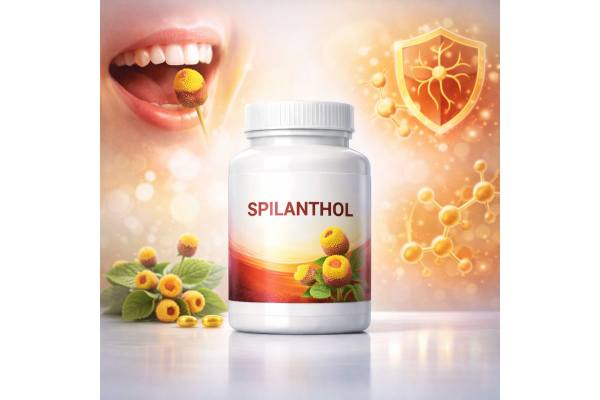
Spilanthol is the main bioactive compound found in the toothache plant Spilanthes acmella and its close relative Acmella oleracea, sometimes called the “electric daisy” or “buzz button.” When you chew the fresh flowers or leaves, spilanthol is responsible for the intense tingling, numbing sensation and increased salivation. Traditional systems of medicine have used this effect for toothache, oral infections, and throat discomfort, but spilanthol is now attracting attention far beyond folk remedies.
Standardized spilanthol extracts appear in modern dietary supplements for male sexual function, muscle support, and joint comfort, and in cosmetic products that aim to soften expression lines and improve the look of skin firmness. Early human studies suggest that spilanthol-rich formulas may influence testosterone levels, circulation, and inflammatory pathways. At the same time, long-term safety data are still limited. This guide explains what spilanthol is, how it may work, how it is used, practical dosage ranges, side effects, and who should avoid it so you can discuss it more confidently with a qualified professional.
Spilanthol Quick Overview
- Spilanthol is a tingling N-alkylamide from Spilanthes and Acmella plants with local numbing, salivation-stimulating, and anti-inflammatory properties.
- It is used internally in standardized capsules for sexual health and performance and externally in cosmetic serums for wrinkle softening and skin-firming effects.
- Common supplement regimens provide extracts delivering roughly 5–20 mg spilanthol per day, usually from about 250–500 mg standardized plant extract.
- People who are pregnant, breastfeeding, have hormone-sensitive conditions, cardiovascular disease, or complex medication regimens should avoid unsupervised spilanthol use.
Table of Contents
- What is spilanthol and how does it work?
- Spilanthol benefits for oral health, skin, and performance
- How to use spilanthol from foods, extracts, and skincare
- Spilanthol dosage, timing, and practical ranges
- Spilanthol side effects, interactions, and who should avoid it
- What current research says about spilanthol
What is spilanthol and how does it work?
Spilanthol is a plant-derived N-alkylamide, often described chemically as an isobutylamide of an unsaturated fatty acid. It occurs mainly in the flower heads and leaves of Spilanthes acmella and Acmella oleracea, although related species and some other plants may contain smaller amounts. In nature, spilanthol likely helps the plant defend itself against insects and microbial threats. For humans, it is most noticeable for the dramatic tingling, numbing sensation it produces on the tongue and gums.
When spilanthol comes into contact with mucous membranes, it interacts with sensory nerve receptors involved in temperature and pain perception. This leads to a combination of local anesthesia, tingling, and a strong increase in salivation. The effect appears within seconds and usually fades over minutes. Traditional healers have used spilanthol-rich plant parts for toothache and oral discomfort because that numbing is fast and localized.
Beyond sensory effects, spilanthol and related alkylamides can cross cell membranes and influence several molecular pathways. Experimental work suggests that spilanthol can modulate inflammatory signaling, reduce some oxidative stress markers, and influence vascular smooth muscle tone. These actions may help explain observed effects on joint comfort, circulation, and muscle performance in preclinical and early clinical studies.
Spilanthol is lipophilic, meaning it dissolves better in fats and oils than in water. This property is important for product design. In supplements, it is often extracted with alcoholic or supercritical solvents from the most concentrated plant parts (usually flower heads) and standardized to a defined percentage. In cosmetic formulas, spilanthol-rich extracts are dispersed in oils, emulsions, or glycolipid systems so that the compound can reach deeper skin layers and interact with nerve endings and collagen structures.
It is also important to distinguish spilanthol itself from the broader plant matrix. Fresh flowers contain many other compounds, including flavonoids, triterpenoids, and essential oils. Some benefits may come from these accompanying molecules rather than from spilanthol alone. When you evaluate a product, check whether it is an isolated spilanthol ingredient, a standardized extract with a known spilanthol percentage, or a crude plant powder with unknown content. This distinction matters for both potency and safety.
Spilanthol benefits for oral health, skin, and performance
The best known benefit of spilanthol is rapid oral numbing. Chewing spilanthol-rich flowers or using tinctures in the mouth can temporarily decrease the perception of toothache and gum pain. The associated surge in saliva may support natural cleansing and comfort in a dry mouth. In some traditions, this effect has been used for minor throat irritation. While this can be helpful as a temporary measure, it does not replace dental treatment or professional care when infection or structural problems are present.
In the cosmetic field, spilanthol has gained attention as a plant-based ingredient for fine-line and wrinkle care. Topical products containing Acmella oleracea or Spilanthes acmella extracts standardized for spilanthol often claim a “botox-like” effect. Laboratory work and human studies have shown that spilanthol can reduce the intensity of subcutaneous muscle contractions and influence the organization of dermal collagen. In practice, this may translate to a subtle softening of expression lines and a slightly firmer appearance of treated skin areas over days to weeks, especially around the eyes and mouth.
Spilanthol is also being studied for male sexual function and performance. Human trials using standardized capsules of Spilanthes acmella extract, delivering a defined daily dose of spilanthol, have reported improvements in questionnaire-based measures of erectile function, sexual satisfaction, and overall quality of life in men with erectile difficulties. These changes appear alongside modest increases in total and free testosterone levels in some participants. The exact mechanism is still being explored but may involve improved endothelial function, hormonal modulation, and changes in nitric oxide pathways.
Another emerging area is musculoskeletal and exercise performance. In some clinical studies, men taking spilanthol-rich supplements have shown increases in mid-arm and thigh circumference, improved strength measures such as bench press and squat performance, and reductions in recovery-related soreness when compared with placebo. It is not yet clear whether these outcomes are driven mainly by hormonal changes, local anti-inflammatory effects, altered perception of effort, or a combination of mechanisms.
Preclinical studies suggest broader anti-inflammatory and antioxidant effects that might support joint comfort and general resilience. Animal models have shown reductions in markers of inflammation and pain when spilanthol-containing extracts are administered, as well as improved bone and tendon parameters in some experiments. Translating these findings to humans requires caution, but they offer a rationale for using spilanthol as part of integrated strategies for joint and tissue health.
Despite these promising signals, spilanthol is not a cure-all. Evidence is strongest for localized oral analgesia, cosmetic skin-smoothing, and targeted male sexual health applications. Many other claims on the market, such as broad immune boosting or comprehensive anti-aging in every system, are extrapolated from early-stage data and traditional use rather than from large, long-term, well-controlled human trials.
How to use spilanthol from foods, extracts, and skincare
Practical use of spilanthol depends on your goal and whether you prefer dietary, supplemental, or topical approaches. For many people, the simplest exposure is through foods and beverages that incorporate fresh or dried “buzz buttons,” often as a novelty in cocktails or gourmet dishes. These uses typically deliver small amounts of spilanthol, resulting in a short-lived tingling sensation but relatively low systemic exposure.
For oral comfort, herbalists and some integrative practitioners use spilanthol-rich tinctures or liquid extracts. A common approach is to place a small amount of tincture directly on the affected gum or tooth area with a cotton swab, hold it there for a short time, and then spit out the excess. This technique concentrates the numbing effect where it is needed while minimizing swallowing. Some mouthwashes and oral sprays also include low concentrations of spilanthol-containing extracts, sometimes combined with other botanicals such as clove or myrrh.
Topical cosmetic products are another major category. You will often see spilanthol present as “Acmella oleracea extract,” “Spilanthes acmella flower extract,” or similar names on ingredient lists. These extracts are formulated into serums, creams, eye treatments, and sometimes sheet masks. A typical routine involves cleansing the face, applying a small amount of the spilanthol-containing product to areas with expression lines (forehead, crow’s feet, nasolabial folds), allowing it to absorb, and then following with moisturizer and daily sun protection. Many users report a mild tightening or smoothing sensation shortly after application, with more noticeable but still modest cosmetic improvements after regular use.
Dietary supplements provide the highest and most standardized exposures. Capsules and tablets may contain pure spilanthol, but more commonly they provide a fixed amount of Spilanthes acmella or Acmella oleracea extract standardized to a specific percentage of spilanthol. These products are often marketed for male vitality, sexual performance, muscle support, or joint comfort. Typical regimens involve taking the supplement once or twice daily with meals, sometimes in combination with resistance training or structured exercise programs.
When choosing a product, consider the following:
- Does the label clearly state the plant species and plant part (flower, leaf, or aerial parts)?
- Is the extract standardized to a known percentage of spilanthol, or is it a non-standardized powder with uncertain potency?
- Are there third-party quality certifications or testing for contaminants such as heavy metals, pesticides, and microbial load?
- Does the product provide realistic claims, or does it promise dramatic, rapid transformations that are unlikely for a botanical ingredient?
Regardless of format, start with the lowest effective amount and pay attention to how you feel. The oral tingling can be intense, so it is wise to test a small amount first. When combining spilanthol-containing products with other supplements or medicines that affect circulation, hormones, or inflammation, discuss the combination with a healthcare professional to avoid unintended interactions.
Spilanthol dosage, timing, and practical ranges
There is no universally accepted “standard dose” of spilanthol for all purposes. Most available guidance comes from traditional use, product-label directions, and a small number of clinical studies that have used specific standardized extracts. Dosage also depends on whether you are dealing with external cosmetic use or internal supplementation.
In clinical trials that examined sexual health and hormonal effects, participants often used capsules containing 500 mg of Spilanthes acmella extract standardized to around 3.5 percent spilanthol. This corresponds to approximately 17.5 mg of spilanthol per day. These regimens were usually administered once daily with food over periods of about three months, with some follow-up observations after discontinuation. Within these boundaries, the supplement was generally well tolerated in study populations of adult men.
For general male vitality or exercise support, many commercially available products provide a similar or slightly lower daily amount of extract, often in the range of 250–500 mg standardized extract per day. Depending on standardization, this may deliver roughly 8–20 mg of spilanthol daily. As a conservative starting point, a daily intake at the lower end of this range, taken with meals, is reasonable for healthy adults under the guidance of a health professional.
Topical products do not specify spilanthol in milligrams per day. Instead, they list percentages of plant extract in the formula. Cosmetic serums commonly use Acmella oleracea extract at around 1–5 percent of the formulation. Because only a small quantity of serum is applied to the skin once or twice daily, systemic absorption of spilanthol appears to be low, and the main goal is local action on nerve endings and dermal structures. For most individuals with intact skin, following the manufacturer’s instructions for frequency and amount is sufficient.
For oral tinctures or liquid extracts, dosing is more variable. Some concentrated tinctures might suggest 0.5–1 ml taken up to three times per day. Because tincture strengths differ significantly among brands, it is important to follow the instructions provided with that specific product. If the intended use is local numbing, holding the liquid in the mouth briefly and then spitting it out may reduce systemic exposure while preserving the desired local effect.
In all cases, it is wise to:
- Treat label directions as an upper limit unless a clinician suggests otherwise.
- Use spilanthol-rich supplements for defined periods (for example, 8–12 weeks), then pause and reassess with your practitioner rather than taking them indefinitely.
- Avoid combining high-dose spilanthol with multiple other stimulatory or vasoactive supplements unless a professional has evaluated the full regimen.
People with lower body weight, older adults, and those with multiple medical conditions may require more conservative dosing or may need to avoid internal spilanthol altogether. Because definitive long-term safety data are not available, staying within studied ranges and using the lowest effective dose for the shortest necessary time is a prudent guiding principle.
Spilanthol side effects, interactions, and who should avoid it
Most reports suggest that spilanthol, when used appropriately by healthy adults, has a relatively favorable short-term safety profile. Nevertheless, side effects do occur, and certain groups are at higher risk of problems. Understanding these issues is essential before adding spilanthol-containing products to your routine.
The most immediate and common effect is intense tingling, numbness, and increased salivation in the mouth. While this is usually desirable for a toothache remedy or novelty food, it can be uncomfortable or alarming if unexpected. Some people also experience altered taste sensations or a transient metallic taste. These sensory effects typically fade within minutes but can persist longer if high concentrations are used.
Gastrointestinal disturbances are another possible side effect. Nausea, stomach discomfort, and loose stools have been reported in some users, particularly when taking concentrated capsules on an empty stomach or at higher than recommended doses. Taking supplements with food and starting at a low dose may reduce these issues, but they can still occur in sensitive individuals.
Because spilanthol can influence vascular tone and circulation, there is theoretical concern about effects on blood pressure and heart rate. People taking antihypertensive drugs or medications that affect blood clotting, as well as those with cardiovascular disease, should exercise caution. Combining spilanthol with other herbs that impact circulation, such as high-dose ginkgo, hawthorn, or large amounts of caffeine, adds complexity and uncertainty.
The potential influence of spilanthol on testosterone and other sex hormones raises special considerations. Although modest testosterone increases may be welcomed by some men, hormone-sensitive conditions such as prostate cancer, breast cancer, or certain reproductive disorders could be adversely affected. Individuals with these conditions, or with unexplained hormone imbalances, should avoid spilanthol supplements unless a specialist explicitly supports their use.
Allergic reactions, while not common, are possible. Spilanthes and Acmella species belong to the Asteraceae family, which also includes ragweed and chamomile. People with known allergies to this plant family may have a higher risk of reactions such as itching, rash, swelling, or difficulty breathing. Any signs of an allergic response require immediate discontinuation and urgent medical attention.
In general, the following groups should avoid spilanthol-rich supplements unless under close medical supervision:
- Pregnant individuals, due to limited data and the possibility of uterine or hormonal effects.
- Those who are breastfeeding, since excretion into breast milk and infant safety are unknown.
- Children and adolescents, for whom safety and appropriate doses have not been established.
- People with serious cardiovascular disease, uncontrolled hypertension, arrhythmias, or recent stroke or heart attack.
- Individuals scheduled for surgery in the near term, because of potential interactions with anesthesia and clotting; discontinuation at least one to two weeks before elective procedures is prudent.
If you notice persistent headaches, dizziness, chest discomfort, unusual mood changes, or any other concerning symptoms after starting a spilanthol-containing product, stop using it and consult a healthcare provider. Even though spilanthol is plant-derived, it can have potent physiological effects, and those effects may interact in unpredictable ways with existing health conditions and medications.
What current research says about spilanthol
Spilanthol has been the subject of growing scientific interest as researchers explore its potential in several fields: ethnomedicine, pharmacology, dermatology, sports and sexual medicine, and even agriculture. Understanding the current evidence helps place marketing claims and personal experiences into context.
Phytochemical and pharmacological reviews have mapped out spilanthol’s occurrence and chemistry, confirming that flower heads of Spilanthes acmella and Acmella oleracea are especially rich sources. These reviews highlight multiple biological activities in laboratory and animal models, including analgesic, anti-inflammatory, antipyretic, vasorelaxant, antimicrobial, insecticidal, and antifungal actions. Mechanistic studies suggest that spilanthol interacts with transient receptor potential channels, modulates inflammatory mediators, and affects oxidative stress pathways.
From a toxicology perspective, studies in rodents and other model organisms indicate that spilanthol has a relatively high median lethal dose and low acute toxicity when administered at doses comparable to or higher than typical human exposures. Regulatory assessments conducted for its use as a flavoring agent have set acceptable daily intake levels based on subchronic toxicity data. However, researchers consistently note that comprehensive human toxicity studies are still lacking, especially for long-term, high-dose supplementation.
In dermatology and cosmetology, spilanthol-rich Acmella oleracea extracts have been evaluated in topical formulations aimed at reducing wrinkles and improving skin firmness. Clinical and instrumental assessments in these studies usually report modest but statistically significant improvements in fine-line depth, skin hydration, and surface microrelief after several weeks of regular use. Safety evaluations have generally found good tolerance, with low rates of irritation and negligible systemic absorption through intact skin.
In the area of male sexual health, randomized controlled trials using standardized Spilanthes acmella extracts with defined spilanthol content have shown improvements in erectile function scores, sexual satisfaction, and serum testosterone levels compared with placebo in men with erectile dysfunction. Some studies have also examined lipid profiles and markers of muscle mass and strength, noting beneficial trends, especially when supplementation is combined with structured exercise. While these findings are encouraging, they are based on specific branded formulations and studied populations, so results may not automatically apply to all products or demographic groups.
Researchers are also exploring spilanthol as an antimicrobial and antifungal agent. Laboratory investigations have demonstrated activity against certain bacteria and fungi, including pathogens involved in oral infections and vulvovaginal candidiasis. Proposed mechanisms include disruption of microbial membranes, interference with biofilm formation, and modulation of virulence factors. These results may support future development of localized treatments, but clinical applications are still at an early stage.
Overall, the scientific picture of spilanthol is that of a multi-target natural compound with meaningful biological activity and several promising applications, but with important gaps in knowledge about long-term human use, optimal dosing, and rare adverse events. Many of the most enthusiastic claims on the internet are based on a combination of small trials, animal work, and extrapolation. As with most botanical compounds, the most responsible use of spilanthol is as a complement to, rather than a replacement for, established medical and lifestyle strategies, ideally under the guidance of a qualified professional.
References
- Spilanthol: occurrence, extraction, chemistry and biological activity 2016 (Review)
- Phytochemistry, Pharmacology and Toxicology of Spilanthes acmella: A Review 2013 (Review)
- Exploring the Therapeutic Potential of Spilanthol from Acmella oleracea 2024 (Systematic Review / Mechanistic)
- Spilanthol from Spilanthes acmella flowers, leaves and stems obtained by selective supercritical carbon dioxide extraction 2012 (Experimental Study)
- Randomized, Triple-Blinded, Placebo-Controlled Trial of SA3X (Spilanthes acmella) for the Management of Erectile Dysfunction 2022 (RCT)
Disclaimer
The information provided in this article is for general educational purposes only and is not intended to replace personalized medical advice, diagnosis, or treatment. Spilanthol and spilanthol-containing products can interact with medications and pre-existing health conditions, and their long-term safety at supplemental doses has not been fully established. Always consult a qualified healthcare professional before starting, changing, or stopping any supplement or herbal product, especially if you are pregnant, breastfeeding, managing chronic illness, preparing for surgery, or taking prescription or over-the-counter medicines. Never ignore or delay seeking professional medical guidance because of something you have read online.
If you found this article helpful, you are welcome to share it on Facebook, X (formerly Twitter), or any platform you prefer, and to follow our work on social media. Your thoughtful support by sharing our content helps us continue to research, write, and update high-quality, evidence-informed guides for readers who value careful and responsible health information.